Archive for July, 2021

Paper of the month: Novel imino- and aryl-sulfonate based photoacid generators for the cationic ring-opening polymerization of ε-caprolactone

Sardon’s group investigate the ring opening polymerization of cyclic esters using novel photo acid generators.
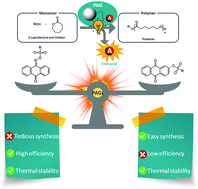


Light has emerged as a powerful stimulus allowing for spatial and temporal control over polymerization kinetics, macromolecular sequence, and composition and has enabled a number of high-end applications including coatings, microelectronics, additive manufacturing and 3D printing. However, the potential of light in polymer chemistry is far from being fully exploited. Photopolymerization is currently dominated by (controlled) radical polymerizations of vinyl monomers. Little attention has been paid to photo-induced cationic ring-opening polymerization (CROP) of cyclic esters. In a recent contribution to Polymer Chemistry, Sardon and co-workers developed six new photocatalysts for light-mediated CROP. Upon exposure to light, the new photocatalysts release strong sulfonic acids that can trigger the CROP of ε-caprolactone. The authors particularly focused on imino-sulfonates and aryl-sulfonates based photocatalysts, and this strategy was hugely successful. Complete monomer conversion was obtained after only 5 minutes of irradiation. This is an impressively high polymerization rate despite the catalyst efficiency being typically strongly related to the chromophore and the sulfonate substituent. In addition, several of these photocatalysts are stable even at 100 °C and were successfully used to produce not only linear biodegradable polymer polymers but also crosslinking poly(ε-caprolactone) exhibiting excellent mechanical properties. Furthermore, the authors employed density functional theory calculation to propose a photodissociation mechanism. The studied photopolymerization has also been successfully applied to surface coating. The potential applications of these new photocatalysts are certainly not limited to photocoating, and therefore, we look forward to seeing further exciting applications of these photocatalysts.

Tips/comments directly from the authors:

  • The efficiency of the PAGs was observed to be highly dependent on the chromophore and the photolabile bond; imino-sulfonates were more capable of producing sulfonic acids than aryl-sulfonates. However, their preparation is tedious and requires a multistep synthesis process. Aryl-sulfonates are not as efficient but their synthesis is performed in a single step in excellent yields up to 90%.


  • Imino-sulfonate based photocatalyst were able to promote the ring opening polymerization of ε-caprolactone at room temperature but 3 h were required for getting full conversion. Nevertheless, as several of these catalyst were stable up to 100 °C we were able to get full conversion in just 5 minutes at 100 °C


  • To further expand the applications of the studied PAGs, we demonstrated the ability of the photoacid to promote the crosslinking at room temperature in the presence of a dilactone. While the crosslinking reaction was successful, long reaction times were required for reaction completion, making impractical the use of these photocatalyst in 3 D printing applications.


Citation to the paper: Novel imino- and aryl-sulfonate based photoacid generators for the cationic ring-opening polymerization of ε-caprolactone, Polym. Chem., 2021,12, 4035-4042, DOI: 10.1039/D1PY00734C

Link to the paper:

https://pubs.rsc.org/en/content/articlelanding/2021/py/d1py00734c#!divAbstract



Professor Athina AnastasakiDr. Athina Anastasaki is an Editorial Board Member and a Web Writer for Polymer Chemistry. Since January 2019, she joined the Materials Department of ETH Zurich as an Assistant Professor to establish her independent research group.


Digg This
Reddit This
Stumble Now!
Share on Facebook
Bookmark this on Delicious
Share on LinkedIn
Bookmark this on Technorati
Post on Twitter
Google Buzz (aka. Google Reader)

Paper of the month: Locally controlling dynamic exchange reactions in 3D printed thiol-acrylate vitrimers using dual-wavelength digital light processing

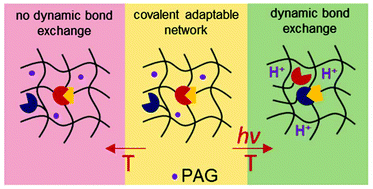
Rossegger et al. employ a photolatent catalyst for the local activation of topological rearrangements in thermo-activated vitrimers.

Vitrimers are covalent adaptable polymers networks which have recently attracted tremendous interest thanks to their unique feature of switching from a classic thermoset behaviour to a malleable plastic upon heating. In particular, at low temperature, vitrimers exhibit properties similar to a thermoset (e.g. rigid, brittle, opaque, high strength, good chemical resistance, etc.). Instead, heating vitrimers to temperatures above their topological freezing temperature, leads to activation and exchange of the covalent bonds within the networks thereby allowing the polymer chains to flow like viscoelastic liquids. However, one of the main limitations of this thermoresponsive feature is the lack of spatial control. In their current contribution, Schlögl and coworkers report a novel photocatalyst that can introduce spatial control to vitrimers. In particular, triphenylsulfonium phosphate was used as a photocatalyst to release strong Brønsted acids in a vitrimer region exposed to UV light (365 nm). The acids subsequently catalyse the bond exchange of vitrimer networks only in this local UV-exposed region, thus fully controlling the vitrimeric property. Furthermore, this new chemistry was not only confirmed by stress relaxation studies but was also applied to develop shape-changing vitrimer materials. Importantly, the triphenylsulfonium phosphate catalyst is stable at high temperatures and transparent in the visible light region. As such, visible light (405 nm) could be used to prepare the vitrimer in 3D structures without introducing any Brønsted acid. Subsequently, UV light was successfully used to change the shape of the vitrimer by locally activating the photocatalyst. The authors anticipate that this new spatial control technology enables the fabrication of sophisticated soft active devices that can change shape in a programmable manner. We look forward to reading more about such fantastic development from the Schlögl group.


Tips/comments directly from the authors:


  • Owing to their strong Brønsted acidity and high thermal stability, photoacid generators are able to catalyze thermo-activated transesterifications in hydroxyl ester networks.
  • Stress relaxation kinetics increase with rising catalyst content and rising irradiation dose.
  • Since activation of the photoacid generator and the curing of the network can be achieved simultaneously by irradiating the desired layers with UV-A light (365 nm), a compromise between sufficient activation and resolution has to be made.
  • Prior to the shape memory experiments it is important to thermally anneal the networks to form additional crosslink sites by hydrogen bonding, which leads to a change in thermal and mechanical properties. After 4 h at 140 °C, the network properties remain constant and the printed test specimen are able to repeatedly undergo shape changes after the programming step.
  • Photoacid generators are highly versatile transesterification catalysts and can be applied for imparting dynamic network properties in numerous photopolymer systems. Network architecture can be conveniently adjusted by the structure and functionality of the monomers and/or crosslinkers.


Citation to the paper: Locally controlling dynamic exchange reactions in 3D printed thiol-acrylate vitrimers using dual-wavelength digital light processing, Polym. Chem., 2021,12, 3077-3083, DOI: 10.1039/d1py00427a

Link to the paper:

https://pubs.rsc.org/en/content/articlepdf/2021/py/d1py00427a 


Athina AnastasakiDr. Athina Anastasaki is an Editorial Board Member and a Web Writer for Polymer Chemistry. Since January 2019, she joined the Materials Department of ETH Zurich as an Assistant Professor to establish her independent research group.

Digg This
Reddit This
Stumble Now!
Share on Facebook
Bookmark this on Delicious
Share on LinkedIn
Bookmark this on Technorati
Post on Twitter
Google Buzz (aka. Google Reader)