

Miquel Solà and Jordi Poater working University of Girona in Spain have put forward an extension of Hirsch’s rule to open-shell spherical species.
The famous Hückel rule allows one to estimate whether or not a planar ring molecule would have aromatic properties. When the molecule has 4N + 2 π-electrons then it follows Hückel’s rule. In 2000 Andreas Hirsch found a rule to predict the aromaticity of fullerenes, known as the 2(N +1)2 rule and now Solà has extended this rule to spherical systems with an open-shell.
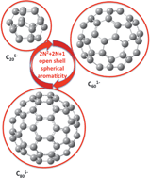
They found that spherical compounds with a half filled last energy level, e.g. those with 2N2 + 2N + 1 electrons, are aromatic. This was backed up with computational evidence and showed that for example C6019+ and C601- both have strong aromatic character.
Solà speculates that this finding could be an important tool for those working in the in stable high spin molecules such as molecular magnets.
Interested in finding out more? Then download the full ChemComm article for free today.


In a previous work (F. Feixas et al. Phys. Chem. Chem. Phys. 12 (2010) 7126-7137), we analyzed the electron delocalization in 4n+2 and 4n species. We found that changes in crossed terms (the so-called ortho (1,2), meta (1,3), para (1,4),…) when adding or removing two electrons represented a kind of electronic footprint that makes it possible to discern between aromatic and antiaromatic systems. In addition, our results confirmed the validity of the 4N+2 Hückel and 4N Baird rules. On the other hand, we have analyzed the reactivity of fullerenes in a number of studies and we were aware of the 2(N+1)2 Hirsch rule for spherical species. With this background, the idea of extending Hirsch’s rule to spherical open-shell systems was relatively obvious. More difficult was to prove it since there are not many aromaticity indicators that can be applied to open-shell species. However, we knew that bond length alternation values and multicenter indices could do this work. Results from NICS are likely to be somewhat less reliable (although still useful) due to the open-shell character of the species.
We think that next step in our investigation will be to look for spherical aromatic systems having the open-shell configuration as their ground state. This may happen, for instance, for certain M+@C60- species.
(Report comment)