For Green Chemistry, the top 10 most accessed articles in January were as follows:
Selective oxidation of alcohols and aldehydes over supported metal nanoparticles
Sara E. Davis, Matthew S. Ide and Robert J. Davis
Green Chem., 2013, 15, 17-45
DOI: 10.1039/C2GC36441G, Critical Review
Food waste biomass: a resource for high-value chemicals
Lucie A. Pfaltzgraff, Mario De bruyn, Emma C. Cooper, Vitaly Budarin and James H. Clark
Green Chem., 2013, 15, 307-314
DOI: 10.1039/C2GC36978H, Perspective
A simple metal-free catalytic sulfoxidation under visible light and air
Xiangyong Gu, Xiang Li, Yahong Chai, Qi Yang, Pixu Li and Yingming Yao
Green Chem., 2013, 15, 357-361
DOI: 10.1039/C2GC36683E, Communication
Deconstruction of lignocellulosic biomass with ionic liquids
Agnieszka Brandt, John Gräsvik, Jason P. Hallett and Tom Welton
Green Chem., 2013, 15, 550-583
DOI: 10.1039/C2GC36364J, Critical Review
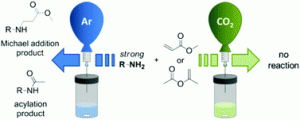
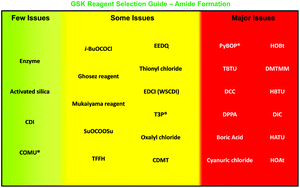
Evaluation of alternative solvents in common amide coupling reactions: replacement of dichloromethane and N,N-dimethylformamide
Donna S. MacMillan, Jane Murray, Helen F. Sneddon, Craig Jamieson and Allan J. B. Watson
Green Chem., 2013, 15, 596-600
DOI: 10.1039/C2GC36900A, Communication
Catalytic conversion of biomass to biofuels
David Martin Alonso, Jesse Q. Bond and James A. Dumesic
Green Chem., 2010, 12, 1493-1513
DOI: 10.1039/C004654J, Critical Review
Designing endocrine disruption out of the next generation of chemicals
T. T. Schug, R. Abagyan, B. Blumberg, T. J. Collins, D. Crews, P. L. DeFur, S. M. Dickerson, T. M. Edwards, A. C. Gore, L. J. Guillette, T. Hayes, J. J. Heindel, A. Moores, H. B. Patisaul, T. L. Tal, K. A. Thayer, L. N. Vandenberg, J. C. Warner, C. S. Watson, F. S. vom Saal, R. T. Zoeller, K. P. O’Brien and J. P. Myers
Green Chem., 2013, 15, 181-198
DOI: 10.1039/C2GC35055F, Paper
Gamma-valerolactone, a sustainable platform molecule derived from lignocellulosic biomass
David Martin Alonso, Stephanie G. Wettstein and James A. Dumesic
Green Chem., 2013, 15, 584-595
DOI: 10.1039/C3GC37065H, Critical Review
Metal-catalyzed amide bond forming reactions in an environmentally friendly aqueous medium: nitrile hydrations and beyond
Rocío García-Álvarez, Pascale Crochet and Victorio Cadierno
Green Chem., 2013, 15, 46-66
DOI: 10.1039/C2GC36534K, Tutorial Review
Cyclometalated iridium complexes for transfer hydrogenation of carbonyl groups in water
Yawen Wei, Dong Xue, Qian Lei, Chao Wang and Jianliang Xiao
Green Chem., 2013, 15, 629-634
DOI: 10.1039/C2GC36619C, Communication
Take a look at the articles, then let us know your thoughts and comments below.
Interested in submitting your own work to Green Chemistry? You can submit online today, or email us with your ideas and suggestions.
Comments Off on Top 10 most accessed articles in January




 The ACS Green Chemistry Institute®’s

 Although some of the waste ash produced from the combustion of biomass is currently used in construction, most of it ends up in landfill. Therefore, extracting alkali silicates, which can be used in cement, detergents, catalysts and catalyst supports, is one way of reusing the potentially huge quantities of ash due to be produced in the future.