

Green Chemistry is proud to present the Green Chemistry Emerging Investigators Series, showcasing work being conducted by Emerging Investigators. This collection aims to highlight the excellent research being carried out by researchers in the early stages of their independent career from across the breadth of green chemistry. For more information about this series, click here
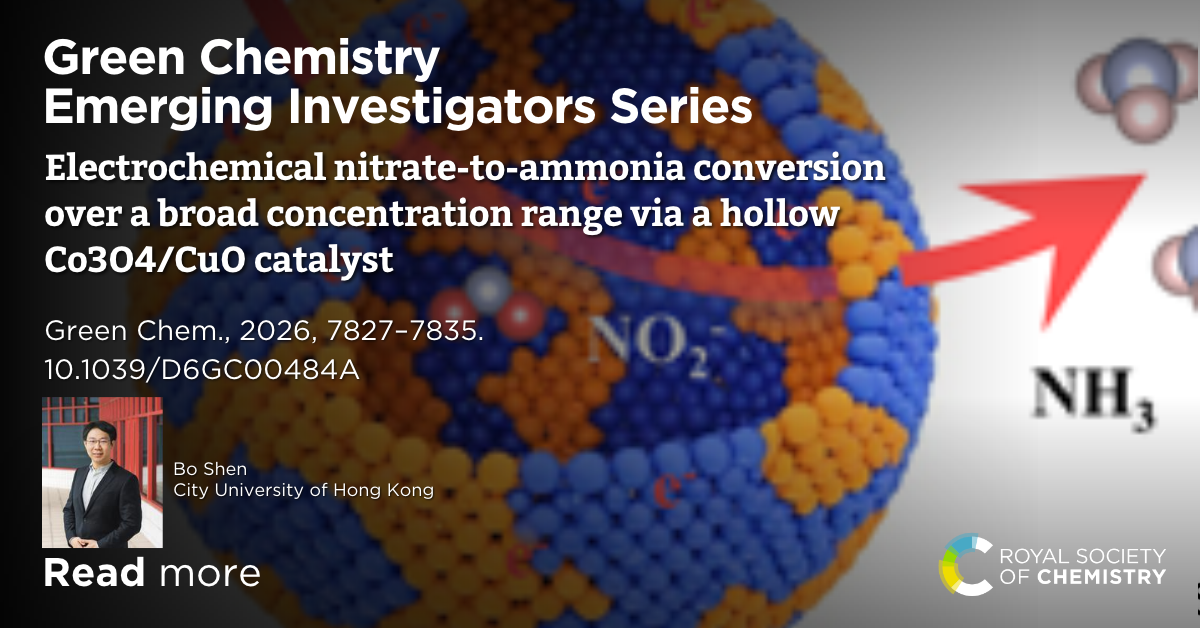
Among the contributions to this series is a Paper entitled Electrochemical nitrate-to-ammonia conversion over a broad concentration range via a hollow Co3O4/CuO catalyst
Read our interview with the corresponding author Bo Shen below.
 |
Could you briefly explain the focus of your article to the non-specialist?
What if a water pollutant could become a useful chemical instead of simply being removed? In this work, we developed a catalyst that uses renewable electricity to efficiently convert nitrate into ammonia under mild conditions. The approach could help both cleaner ammonia production and wastewater treatment.
|
How would you set this article in a wider context?
The future of sustainable chemistry is not only about producing chemicals more cleanly, but also about rethinking what we consider waste. From the perspective of a circular economy, waste streams can become valuable sources of raw materials instead of environmental burdens. By linking pollution control with resource recovery, this work points towards a more circular and sustainable way of managing nitrogen.
What is the motivation behind this work?
I was fascinated by a simple contradiction: we invest tremendous effort in removing nitrate from water, while separately consuming enormous amounts of energy to produce ammonia from atmospheric nitrogen. This led us to ask whether these two challenges could be addressed together. We therefore explored how electrochemistry could bridge these seemingly separate challenges.
What aspects of this work are you most excited about at the moment and what do you find most challenging about it?
The most exciting part is not that we made a better catalyst, but that we are beginning to understand why it works. By uncovering how the local structure of the catalyst influences reaction pathways and product selectivity, we can move beyond trial and error towards more rational catalyst design. The most challenging part is that electrocatalysts are dynamic under operating conditions, so identifying the true active structure and connecting atomic-scale behaviour with device-level performance remain difficult.
What is the next step? What work is planned?
A catalyst is only the beginning. Our next step is to move from catalyst discovery towards technology development. We plan to evaluate the system under conditions that are closer to real operation, including high current densities, continuous-flow reactors, long-term testing, and complex wastewater streams. Ultimately, we hope to develop a scalable process that can treat nitrate-containing wastewater while producing ammonia at the same time.
Please describe your journey to becoming an independent researcher.
Looking back, every major step in my career involved starting over and learning to see science from a new perspective. My interest in chemistry grew from simple experiments in high school to a deeper understanding at university of how closely chemistry is connected to everyday life and industrial progress. I later moved to the United States for my PhD and postdoctoral training, where Professors Shouheng Sun and Chad A. Mirkin helped me develop complementary perspectives on nanomaterial synthesis, catalysis, and materials discovery. These experiences helped me define the scientific questions I wanted to pursue independently and the kind of research environment I hoped to create. I eventually chose Hong Kong because of its vibrant international research community, which brings together diverse academic and cultural perspectives. At City University of Hong Kong, I am building an interdisciplinary research programme at the intersection of materials science, chemistry, data science, and engineering to address challenges in sustainable catalysis.
Can you share one piece of career-related advice or wisdom with other early career scientists?
Think big, stay curious, and be willing to step outside our comfort zones. Some of the most rewarding research comes from crossing disciplinary boundaries and tackling questions that once seemed impossible.
Why did you choose to publish in Green Chemistry?
I wanted this work to reach readers who care not only about better catalysts, but also about how chemistry can contribute to a more sustainable future. Green Chemistry provides an ideal platform for this kind of research because it brings together scientists working across catalysis, materials science, environmental chemistry, and sustainable chemical manufacturing. I also appreciate the journal’s emphasis on connecting fundamental discoveries with real-world sustainability challenges.
Meet the author
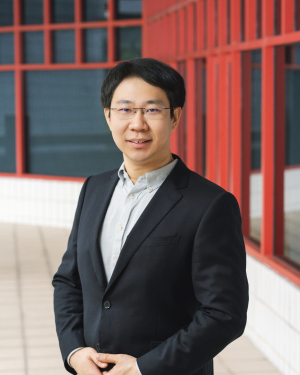 |
Dr Bo Shen
ORCiD: 0000-0001-8011-7134 Dr. Bo Shen is a Presidential Assistant Professor in the Department of Materials Science and Engineering at City University of Hong Kong. He received his Ph.D. in Chemistry from Brown University under the supervision of Professor Shouheng Sun in 2019 and completed his postdoctoral training with Professor Chad A. Mirkin at Northwestern University. His research combines precise nanomaterial synthesis, high-throughput experimentation, and data-driven approaches to accelerate the discovery of catalysts for sustainability. His group is particularly interested in developing materials and technologies that realize resource circularity, clean energy conversion, and environmental remediation. |
Engage with us and stay tuned for more news
- Sign up for journal email alerts here and follow the latest news on the Green Chemistry blog, on Bluesky @greenchemistry.rsc.org and on our LinkedIn Sustainable Chemistry Showcase.
- Sign up to be a reviewer for Green Chemistry.


