Archive for the ‘Uncategorized’ Category

Announcing the winner of the 2026 Soft Matter Lectureship

It is with great pleasure that we announce Amin Doostmohammadi (University of Copenhagen) as the recipient of the 2026 Soft Matter lectureship. 

This award honours an early-career researcher who has made significant contributions to the soft matter research field. The recipient is selected by the Soft Matter Editorial Board from a list of candidates nominated by the community. 


Find out more about Amin and his research in our interview below!

How has your research evolved from your first article to your most recent article? 

My research has changed a lot in the specifics, but one thread runs through all of it: I’ve always been drawn to how the physics of fluids and interacting systems produces collective behaviour that one would not predict from the individual parts. 

My first paper, during my PhD, was about low Reynolds number swimming in density-stratified fluids, how microorganisms move through water whose properties change with depth, and how that changes their swimming and transport. At the time I was thinking like a fluid dynamicist: hydrodynamic interactions, transport, how the fluid shapes the swimmer. 

From there I got interested in systems where the moving components don’t just respond to the fluid around them but actively generate forces and flows themselves. That’s active matter. I became particularly interested in active nematics, polar active matter, and the role topological defects play in organising collective flows. 

The move from active fluids to living systems then felt natural, because a tissue is, in its own way, an extraordinarily complicated active material. Cells generate forces, change shape, move, divide, and constantly read and respond to signals from their neighbours. I wanted to know whether the concepts built for active matter could actually explain these biological behaviours, or whether biology would just break them. 

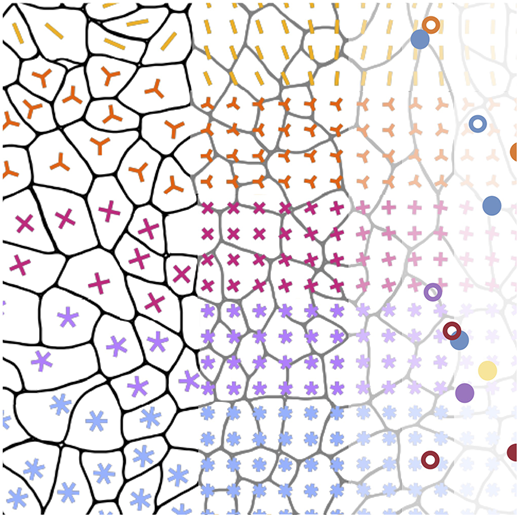
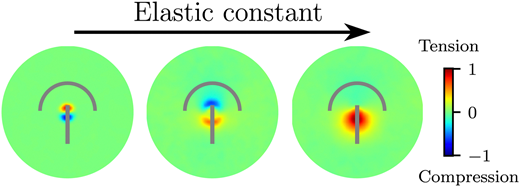
Today my research sits at that interface between active and living matter, combining theory, simulation and experiment to ask how mechanical interaction and cellular activity generate collective states, and how those states depend on the scale at which you look. Essentially, my research has moved further toward asking what new physics emerges when activity, mechanics and biological regulation are coupled. For example, we have studied how topological defects can concentrate mechanical stresses in active materials, and how cellular systems can display universal geometrical and dynamical behaviour despite their very different microscopic compositions. 

I think that is the most exciting evolution for me. The starting point was essentially, “What does activity do to matter?” The question now is closer to, “What can activity allow living matter to do?” 


What excites you most about your area of research, and what has been the most exciting moment of your career so far? 

That physics can get real traction on phenomena that look, at first glance, uniquely biological. 

Biology doesn’t fall from another reality. Living systems are extraordinarily complex, but they’re still physical systems, bound by the same laws as everything else. The genuinely hard part is figuring out which physical principles survive the jump from individual molecules and cells to collective biological behaviour, and which ones simply don’t apply anymore. 

Active matter is a sharp tool for this because it’s built entirely around what happens when matter is driven out of equilibrium. Cells aren’t passive building blocks sitting around waiting to be pushed. They burn energy, generate their own forces, change shape, and constantly negotiate with their neighbours, and that produces collective behaviour that looks nothing like a passive material doing the same thing. 

The moments in my career I remember most clearly are the ones where something that looked hopelessly complicated turned out to have one simple physical principle sitting underneath it, usually to do with topological defects and collective flows in active matter. More recently, the real thrill has been watching that same logic work in actual tissue, taking an idea born in active matter physics, finding it show up in a living system, then using experiment and theory together to explain why. That link between a fairly abstract piece of physics and something a cell is actually doing is, for me, the best part of the job. 


In your opinion, what are the most important questions to be asked and answered in your field of research? 

The biggest one, I think, is how collective function emerges from microscopic activity. 

We’ve gotten quite good at describing how active matter moves, the mechanisms by which individual active components generate force, interact, and produce collective flow are increasingly well understood. Living systems ask something harder: how does a collection of active components use those same physical interactions to organise itself, make decisions, and hold a functional state together? 

A closely related question is how information actually moves through living matter. In a tissue, information is almost never purely chemical or purely mechanical: a cell generates a force, that force changes its neighbours’ behaviour, those cells alter their signalling, and the biochemistry feeds back onto the mechanics. You end up with coupled flows of mechanical and chemical information running across many scales at once, and I think we’re still missing the physics vocabulary to describe that properly. 

We also need better theory for systems that are permanently, structurally out of equilibrium. Equilibrium statistical mechanics gave us extremely powerful concepts for describing states and transitions between them; living systems never sit still long enough for most of that toolkit to apply cleanly. We need to know what replaces those concepts once probability currents, time-directed dynamics and active stress are baked into the system rather than being a perturbation on top of it. 


How do you feel about Soft Matter as a place to publish research? 

I’ve always thought of Soft Matter as a natural home for this kind of work. 

Soft matter isn’t defined by a material or a technique, it’s a way of thinking about systems where mechanics, fluctuations, interactions and collective behaviour matter more than the specific substance involved. That makes it a genuine meeting point for physics, chemistry, engineering and biology, which matters a lot for active matter specifically: the same physical ideas turn up in a bacterial suspension, a cytoskeletal network, a synthetic active material, or a tissue, and having one journal where those communities actually run into each other is valuable in a way that’s easy to underrate. 

I’ve also watched Soft Matter help active matter become a real part of the broader soft matter community over the last decade, creating space for ideas to move between disciplines that otherwise wouldn’t talk to each other. Some of my own work has appeared there across several stages of that arc, from active nematic flows and topological defects to active matter in complex environments and, more recently, collective behaviour in tissue. 


Which of your Soft Matter publications are you most proud of and why? 

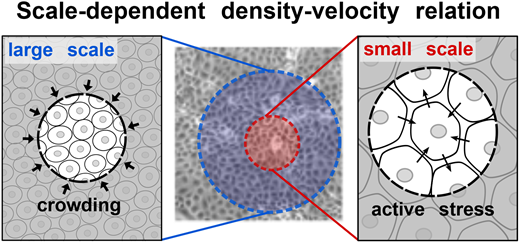
“Density–velocity relation is scale-dependent in epithelial monolayers” 

I’m proud of this one because it’s a good representation of what my lab is trying to do right now: treat experiment and theory as one continuous process rather than two separate activities that occasionally compare notes. 

We started from a deceptively simple question: does higher cell density in an epithelial tissue suppress movement, or can dense regions actually become more active? Different experiments and theories had given apparently contradictory answers, and neither side was obviously wrong. What we found is that both are correct — it just depends on the spatial scale you’re looking at. At small scales, velocity increases with density; at larger scales, density suppresses movement. We combined live-cell imaging with traction force and stress measurements to pin down the mechanical origin of that crossover, then built a minimal theoretical model that reproduces it. 

I like this paper because it captures something I think is genuinely fundamental to soft and active matter: properties that look contradictory can turn out to be entirely consistent once you identify the right scale to look at them. It’s also the direction I want the rest of my research to go in — experiment telling us what the living system is actually doing, theory telling us which parts of that are a general mechanism and which are specific to one system. That combination is where active matter earns its keep as a way of understanding living matter, rather than just describing it. 


In which upcoming conferences or events (online or in person) may our readers meet you? 

One event where readers can meet me in 2026 is the IUTAM (International Union of Theoretical and Applied Mechanics) Symposium on Active Fluids, taking place in Shenzhen in December. I am one of the confirmed invited speakers, and the conference is particularly close to my current interests because it brings together active matter physics, tissue mechanics, non equilibrium statistical mechanics and morphogenesis. 

I am also involved in organising scientific meetings at the Niels Bohr Institute in Copenhagen, including the Copenhagen Days for Active Matter, which brings together researchers working on fundamental and biological aspects of active matter normally around April-May. 

My conference schedule changes quite a bit, so the best way for readers to find me is probably through the soft matter community and the events surrounding active matter, biological physics and non equilibrium soft matter. 


How do you spend your spare time? 

Most of it goes to my wife and our daughter. Having a young child is a remarkably effective way of guaranteeing that work doesn’t quietly eat your entire life. 

I also swim, it’s one of the few things that actually switches my brain off from research. You cannot answer emails or think about a paper while swimming, which is precisely the point. Research is consuming, and the best ideas often show up right when you’ve stopped actively hunting for them. 



To learn more about Amin’s research, have a look at some of his recent publications in Soft Matter, which are FREE to access until 26 December 2026. You can also check out articles from our previous lectureship winners in our lectureship winners collection. 
 

Density–velocity relation is scale-dependent in epithelial monolayers 

Hengdong Lu, Tianxiang Ma and Amin Doostmohammadi

Soft Matter (2026) 22 (6): 1350–1357 


A spectrum of p-atic symmetries and defects in confluent epithelia 

Lea Happel, Griseldis Oberschelp, Anneli Richter, Gwenda Roselene Rode, Valeriia Grudtsyna, Amin Doostmohammadi and Axel Voigt 

Soft Matter (2026) 22 (5): 1109–1129 


Elasticity tunes mechanical stress localization around active topological defects 

Lasse Bonn, Aleksandra Ardaševa and Amin Doostmohammadi 

Soft Matter (2024) 20 (1): 115–123 


We would like to thank everybody who nominated a candidate for the 2026 Soft Matter Lectureship. The Editorial Board had a very difficult task in choosing a winner from the many excellent and worthy candidates. 

Please join us in congratulating Amin on winning this award! 

Digg This
Reddit This
Stumble Now!
Share on Facebook
Bookmark this on Delicious
Share on LinkedIn
Bookmark this on Technorati
Post on Twitter
Google Buzz (aka. Google Reader)

Submit to our new Themed Collection on Micro- and Nanoplastics

Soft Matter Underpinnings of Micro- and Nanoplastics Themed Collection

In this blog post we give more information about our journal Soft Matter, expand on the scope of the themed collection and explain the vision for it through quotes from our Guest Editors Sanat Kumar, Guruswamy Kumaraswamy and Tom McDonald.  We do hope you will consider submitting a manuscript to this timely themed collection!

Soft Matter 

Soft Matter is an interdisciplinary journal publishing soft matter research at the interface between chemistry, physics, materials science and biology.  Experimental, theoretical and computational soft matter approaches are all welcome.  Soft Matter is well-positioned to bridge interdisciplinary research on microplastics—especially looking at the interaction of polymer materials, environmental factors, and novel analytical methods.

“The persistence and impact of microplastics and nanoplastics in our environment represent some of the most pressing areas of uncertainity in materials science today. Understanding the properties and behaviors of these particles requires the unique interdisciplinary approach that the Soft Matter community embodies, bridging chemistry, materials science and biology.”

Scope

Plastic pollution is one of the defining issues of our time and studies have confirmed that micro- and nanoplastics (MNPs) are ubiquitous. However, our understanding of several aspects of MNPs continues to evolve. This themed collection focuses on mechanistic understanding of microplastic formation, transport processes relevant to microplastics in the environment, methods for preparation of realistic model microplastics for study, characterization of microplastics and interaction of microplastics with cells.

  • What are the processes that lead to plastics fragmentation and to the formation of MNPs?
  • How do we identify and characterize MNPs in laboratory samples and in the field?
  • How are MNPs transported in the environment?
  • How do MNPs interact with and impact living cells and organisms?
  • How can we create realistic model MNP systems for detailed analysis?
  • What are promising strategies for the mitigation of these particulate pollutants?

These and related questions form the focus of this themed collection.

“In this themed collection, we are seeking studies that delve deeply into the fundamental mechanisms driving the formation, degradation, and environmental interactions of micro- and nanoplastics. The most pressing issues include advancing methods for the precise detection and characterization of microplastics and nanoplastics, understanding their interactions with biological systems, and developing sustainable, practical solutions for mitigating their impact on both health and the environment.”

Topics to be included in the themed collection

We propose that the themed collection should include (but not be limited to) the topics of:

  • Polymer degradation: Insights from fundamental polymer chemistry and physics
    • Mechanisms of MNP production including studies on model MNPs
    • Mechanisms of degradation including microbial degradation of MNPs
  • Analytical characterization: Advanced analytical tools for pollutant analysis
    • Characterization of MNPs in laboratory samples and in the field
    • Preparation of realistic model MNPs
  • Biological impacts: Effects on human and animal health
    • Interaction of MNPs with living cells
  • Environmental impacts: Impacts on the environment and climate change.
    • Processes controlling the transport of particles over large distances
    • Innovative solutions and technologies

We welcome a range of article types including original articles, communications, perspectives, and reviews.

“We are looking for manuscripts that bring new insights into the science of microplastics and nanoplastics, particularly those that explore innovative methods for analyzing, modeling, and mitigating these pollutants. We encourage submissions that push the boundaries of materials science, from novel analytical techniques to studies revealing fundamental interactions within natural and synthetic environments. Ultimately, we are interested in work that not only advances our scientific understanding but also has the potential to inform practical solutions to this global challenge”

If you are interested in submitting a manuscript but would like more guidance on how to maximise the appeal of your work to the Soft Matter community, please contact the editorial office (softmatter-rsc@rsc.org ).

Guest Editors


Sanat Kumar

Columbia University, USA

ORCID: https://orcid.org/0000-0002-6690-2221

Sanat Kumar is currently the Bykhovsky Professor of Chemical Engineering at Columbia University. His research interests are in the field of polymers (nanocomposites, advanced capacitor materials, scattering methods) and biopolymers (protein-surface interactions).


Guruswamy Kumaraswamy

Indian Institute of Technology Bombay, India

ORCID: https://orcid.org/0000-0001-9442-0775

Guruswamy (Guru) Kumaraswamy is a Professor of Chemical Engineering at the Indian Institute of Technology Bombay. Guru’s research interests are in the area of structure-property relations in polymers and nanocomposites, waste valorization, and sustainable materials. Guru is primarily an experimentalist and his group uses tools such as rheology and small-angle X-ray and neutron scattering to probe materials’ microstructure.


Tom McDonald

University of Manchester, United Kingdom
ORCID: https://orcid.org/0000-0002-9273-9173  

Tom McDonald is a Reader in Sustainable Materials at the University of Manchester. His research focuses on the development of sustainable polymers, colloids, and plastics, with particular attention to their environmental impact. A major area of his work involves using colloids for drug delivery, where he has developed polymer-based systems for controlled and long-acting therapeutic release. His current research also investigates the challenges associated with effective plastic recycling and the behaviour of micro- and nanoplastics in the environment, with an emphasis on understanding their interactions and long-term effects in natural systems.

Digg This
Reddit This
Stumble Now!
Share on Facebook
Bookmark this on Delicious
Share on LinkedIn
Bookmark this on Technorati
Post on Twitter
Google Buzz (aka. Google Reader)

Soft Matter Emerging Investigator – Lihua Jin

Lihua Jin is an Associate Professor in the Department of Mechanical and Aerospace Engineering at the University of California, Los Angeles (UCLA). Before joining UCLA in 2016, she was a postdoctoral scholar at Stanford University. In 2014, she obtained her PhD degree in Engineering Sciences from Harvard University. Prior to that, she earned her Bachelor’s and Master’s degrees from Fudan University. Lihua conducts research on mechanics of soft materials, stimuli-responsive materials, instability and fracture, soft robotics, and biomechanics. She was the winner of the Haythornthwaite Research Initiative Grant, Extreme Mechanics Letters Young Investigator Award, Hellman Fellowship, NSF CAREER Award, ACS PMSE Early Investigator Award, and Sia Nemat-Nasser Early Career Award.

Find more about Lihua’s work via:

https://www.linkedin.com/in/lihua-jin-58959323/

@lihuajin2014

Read Lihua’s Emerging Investigator article http://xlink.rsc.org/?doi=10.1039/D3SM00770G 


How do you feel about Soft Matter as a place to publish research on this topic?
Soft Matter has a broad audience, and is a go-to journal for many of our works. It’s a perfect place for this topic.

What aspect of your work are you most excited about at the moment and what do you find most challenging about your research?

Liquid crystal elastomers (LCEs) are elastomers with liquid crystal mesogens on the polymer networks. They exhibit significant viscoelasticity. Prior works have mainly characterized the macroscopic rate-dependent behavior of LCEs. In our work, we systematically measure the macroscopic rate-dependent stress and microscopic rate-dependent mesogen reorientation as functions of external strain, and further predict the viscoelastic behavior of LCEs by an analytical model, which connects the macroscopic and microscopic parameters, and shows good agreement with the experimental results.

Digg This
Reddit This
Stumble Now!
Share on Facebook
Bookmark this on Delicious
Share on LinkedIn
Bookmark this on Technorati
Post on Twitter
Google Buzz (aka. Google Reader)

New themed collection: Soft Matter Aspects of Cancer

We are very pleased to announce a themed collection in Soft Matter on the Soft matter aspects of cancer.


This special issue presents important developments in cancer cell mechanics, mechanobiology, tissue mechanics and bioengineered models of cancer, in addition to emerging technologies in the field. The Guest Editors for this collection are:

  • Professor Tanmay Lele (Texas A&M University, USA)
  • Professor Anna Taubenberger (Technische Universität Dresden, Germany)

In their Editorial, Guest Editors Tanmay and Anna discuss the importance of understanding the biophysical changes in cancers and how these can be studied through the lens of soft matter research.

The full collection can be found here and we have also highlighted a selection of articles below. We hope you enjoy these, and the rest of the articles included in the collection.


Materials-driven approaches to understand extrinsic drug resistance in cancer
Justin R. Pritchard, Michael J. Lee and Shelly Peyton

Soft Matter, 2022, 18, 3465-3472


Towards an integrative understanding of cancer mechanobiology: calcium, YAP, and microRNA under biophysical forces
Chenyu Liang, Miao Huang, Tianqi Li, Lu Li, Hayley Sussman, Yao Dai, Dietmar W. Siemann, Mingyi Xie and Xin Tang
Soft Matter, 2022, 18, 1112-1148


On the origins of order
Jeffrey J. Fredberg

Soft Matter, 2022, 18, 2346-2353


Cell adhesion strength and tractions are mechano-diagnostic features of cellular invasiveness
Neha Paddillaya, Kalyani Ingale, Chaitanya Gaikwad, Deepak Kumar Saini, Pramod Pullarkat, Paturu Kondaiah, Gautam I. Menon and Namrata Gundiah

Soft Matter, 2022, 18, 4378-4388


Skin epithelial cells change their mechanics and proliferation upon snail-mediated EMT signalling
Kamran Hosseini, Palina Trus, Annika Frenzel, Carsten Werner and Elisabeth Fischer-Friedrich
Soft Matter, 2022, 18, 2585-2596


All the articles in the collection are currently FREE to read until 31 March 2023!

Digg This
Reddit This
Stumble Now!
Share on Facebook
Bookmark this on Delicious
Share on LinkedIn
Bookmark this on Technorati
Post on Twitter
Google Buzz (aka. Google Reader)

Hot article: How a water drop removes a particle from a hydrophobic surface

Have you ever wished for windows that clean themselves? One of the approaches to design such windows is to make them hydrophobic. On a hydrophobic surface, rain droplets will be more likely to roll over – taking the dirt particles with them. However, this process is not fully understood yet. Questions such as what happens when dirt and droplet collide, and what are the forces involved do not have a complete answer yet. Addressing such problems is of high importance both from a fundamental and applied point of view.

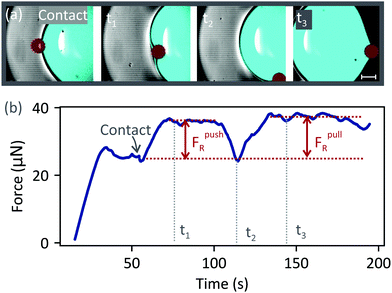
In this publication, the authors used an inverted confocal microscope to study the removal of dirt particles by a water drop deposited on a hydrophobic surface. The drop was held at a fixed position by a blade, while a dirt particle was moved at constant speed towards the drop. This setup allowed them to visualise the drop-particle collision, and measure the force acting on the drop during the collision, enabling the authors to assess the validity of existing models. The insights presented in the article contribute to a better understanding of the mechanisms involved, paving the way towards a future enhancement of self-cleaning surfaces.

Comments from the authors:

  • When a drop collides with a particle on a surface, the drop successfully displaces the particle when the speed of the collision is low. Beyond a certain speed, the particle moves through the drop and leaves at its rear side.
  • The force responsible for displacing the particle is the surface tension (or capillary force), which acts when the particle is at the drop’s interface. Particles experience a negligible viscous force when inside a water drop, because of the low viscosity of water. That is, the force due to the flow inside the drop is insufficient to displace the particle.
  • The particle is displaced by the drop if the maximum capillary force that the drop can exert on the particle exceeds the resistive force that needs to be overcome to displace the particle over the surface.
  • The maximum capillary force depends on the material properties of the liquid and of the particle, as well as how the particle moves (whether it rolls or slides).
  • We developed a model which predicts that a rolling particle experiences a lower maximum capillary force than a sliding one.
  • We observed that the particle rolled when it was pulled by the drop. There are two main contributions to the resistive force experienced by a rolling particle: one from the surface and the other from the drop. The first contribution is due to viscoelastic dissipation in the PDMS surface and due to intermolecular forces between the particle and the surface. The second contribution is due to contact angle hysteresis as the particle rolls at the drop-air interface.
  • To maximise the chance of removing a particle from a surface using water drops, the resistive force experienced by the particle should be minimised. This can be achieved by lubricating the surface, or by coating it with a superhydrophobic material.

Citation to the paper: How a water drop removes a particle from a hydrophobic surface, Abhinav Naga, Anke Kaltbeitzel, William S. Y. Wong, Lukas Hauer, Hans-Jurgen Butt and Doris Vollmer. Soft Matter, 2021, 17, 1746. DOI: 10.1039/d0sm01925a.

To read the full article click here!

About the web writer

Dr Nacho Martin-Fabiani (@FabianiNacho) is a UKRI Future Leaders Fellow and Senior Lecturer in Materials Science at Loughborough University, UK.

Digg This
Reddit This
Stumble Now!
Share on Facebook
Bookmark this on Delicious
Share on LinkedIn
Bookmark this on Technorati
Post on Twitter
Google Buzz (aka. Google Reader)

Hot article: Holographic immunoassays – direct detection of antibodies binding to colloidal spheres

Although probably not for the right reasons, in 2020 we have become fully familiarized with the detection of virus antibodies. One of the most widespread methods is the polymerase chain reaction (PCR), which generates billions of copies of any virus RNA present in the sample to reach enough antibody concentration to be detected. However, tests such as PCR require the use of reagents which are not necessarily cheap and an extra step to increase the concentration of the analyte to be able to detect it.

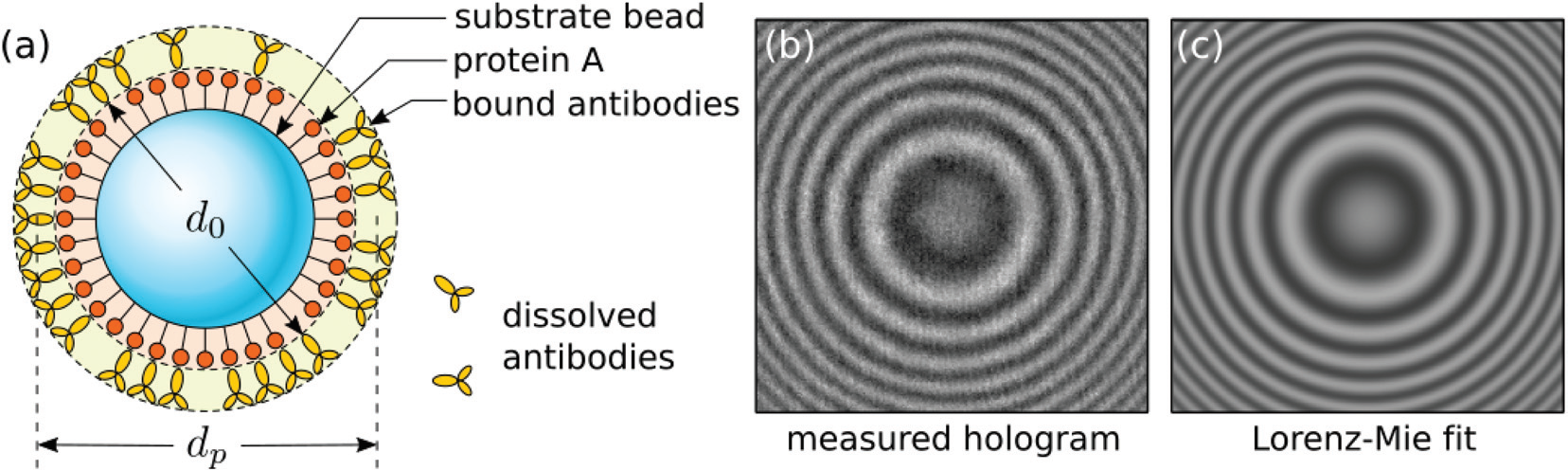
Image describing the work

In this publication, the authors propose an antibody detection method that does not require reagents and reduces the testing time. They calculate the concentration of antibodies by measuring very precisely the size of micrometric particles in the sample through the analysis of their holograms.  The change in size with respect to the original particle is attributed to the binding of antibodies to them. In addition to providing information on the antibody concentration, this technique can also provide insights into their binding mechanism to the surface of the particles – which are treated with proteins beforehand. Therefore, the replacement of these proteins for others could make these holographic assays targeted for specific diseases.

Comments from the authors:

  • Holographic immunoassays detect antibodies by watching them bind to the surfaces of specially functionalized colloidal spheres using holographic video microscopy.
  • A hologram of a micrometer-scale colloidal sphere can be analyzed with the Lorenz-Mie theory of light scattering to measure the sphere’s diameter with nanometer precision.
  • Comparing populations of spheres before and after incubating with a sample reveals a shift in the mean diameter that can be used to measure the concentration of the target analyte.
  • Direct detection through holographic analysis eliminates reagents and processing required for standard bead-based assays, and therefore reduces the cost, complexity and time for each test.
  • 20 minute measurements can detect the antibody IgG at concentrations as low as 10 μg/mL and IgM as low as 1 μg/mL.
  • Specialized tests for antibodies and virus particles can be programmed rapidly and cheaply by suitably functionalizing the colloidal test beads.

Citation to the paper: Holographic immunoassays – direct detection of antibodies binding to colloidal spheres, Kaitlynn Snyder, Rushna Quddus, Andrew D. Hollingsworth, Kent Kirshenbaumb and David G. Grier. Soft Matter, 2020. DOI: 10.1039/d0sm01351j.

To read the full article click here!

About the web writer

Dr Nacho Martin-Fabiani (@FabianiNacho) is a UKRI Future Leaders Fellow and Senior Lecturer in Materials Science at Loughborough University, UK.

Digg This
Reddit This
Stumble Now!
Share on Facebook
Bookmark this on Delicious
Share on LinkedIn
Bookmark this on Technorati
Post on Twitter
Google Buzz (aka. Google Reader)

University of Vienna announces new Full Professorship in Experimental Soft Matter Physics

The University of Vienna are looking for an outstanding researcher with an internationally established record and reputation in the broad area of experimental soft condensed matter physics, non-equilibrium statistical mechanics, or biological physics.

The research topics of interest include, without being limited to these: self-assembly behavior of soft matter in- and out-of equilibrium; phase transformations; novel soft and hybrid and composite materials; active systems; stochastic thermodynamics; rheology; and physics-oriented approach to biological systems. 

Applicants are expected to strengthen the existing research focus of the Faculty of Physics on soft matter, statistical mechanics and soft materials by conducting world-class research, by attracting competitive funding and by actively promoting collaboration with theoretical/computational soft matter groups of the Faculty of Physics.

For more details click here

Digg This
Reddit This
Stumble Now!
Share on Facebook
Bookmark this on Delicious
Share on LinkedIn
Bookmark this on Technorati
Post on Twitter
Google Buzz (aka. Google Reader)

Congratulations to Soft Matter Award Winners at ICBZM2017

Soft Matter was proud to sponsor ICBZM2017, which took place this year in Tokyo, from the 18th to the 20th October. During the conference two Soft Matter Poster prizes were awarded.

Winners of the Soft Matter poster prize were;


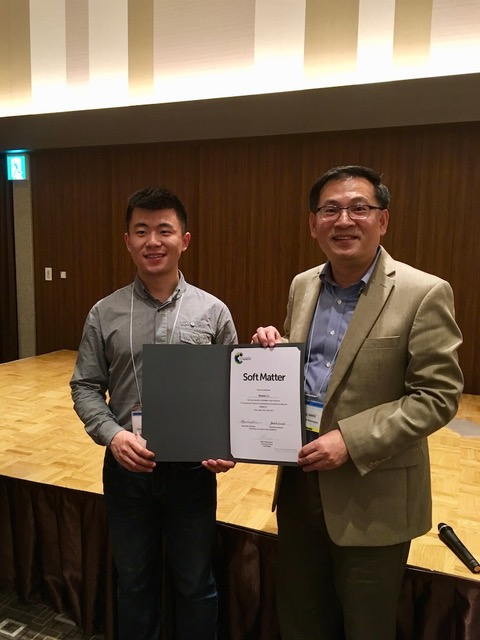
Bowen Li (University of Washington), for his poster presentation on ‘Zwitterionic nanocages improve the safety and efficacy of biologic drugs’.

Bowen Li

Bowen Li with Prof. Shaoyi Jiang


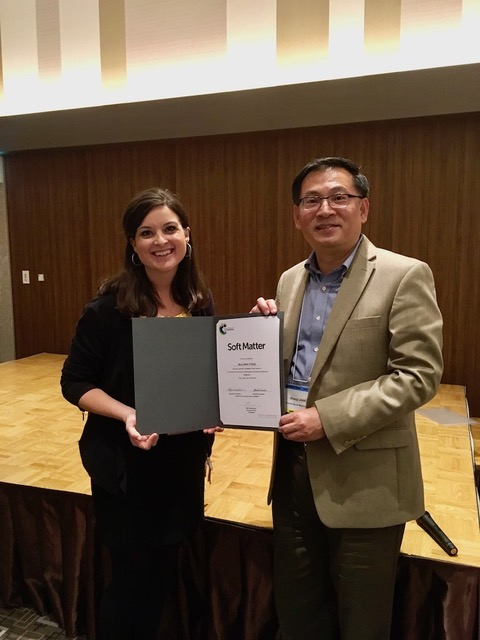
Mary O’Kelly (University of Washington) for her poster presentation on ‘Self-healing ZI micro gels as a versatile platform material for malleable constructs and injectable therapies’.


Mary O'Kelly

Mary O’Kelly with Prof. Shaoyi Jiang


Congratulations to both Bowen and Mary!

Digg This
Reddit This
Stumble Now!
Share on Facebook
Bookmark this on Delicious
Share on LinkedIn
Bookmark this on Technorati
Post on Twitter
Google Buzz (aka. Google Reader)

5th International Conference on Self-Healing Materials 2015 Oral Presentation Prize winner

Soft Matter oral presentation prize icshm2015

A huge congratulations to Arn Mignon who was awarded the Soft Matter Oral Presentation Prize at the 5th International Conference on Self-Healing Materials (ICSHM2015). The conference took place on the 22 – 24 June 2015 in Durham, USA and was sponsored by Soft Matter.

Arn Mignon is from Ghent University and won the Soft Matter Oral Presentation Prize with his talk titled “Smart super absorbent polymers for self-healing of motar.”

ICSHM2015 focussed on the newly emerging field of self-healing biomaterials, encompassing all classes of self-healing materials including polymers, ceramics, metals, and composites, as well as biomedical implants. Further details about the conference can be found by taking a look at their website.

Digg This
Reddit This
Stumble Now!
Share on Facebook
Bookmark this on Delicious
Share on LinkedIn
Bookmark this on Technorati
Post on Twitter
Google Buzz (aka. Google Reader)

Soft Matter’s 2014 Impact Factor is 4.029

Soft Matter is delighted to announce its 2014 Impact Factor is 4.029.

Soft Matter has been dedicated to fundamental soft matter research at the interface of physics, chemistry and biology for the last 10 years. Its impressive Impact Factor of 4.029 is a strong assurance that Soft Matter is a leading journal within the soft matter field.

Our celebratory 10 year Anniversary collection exemplifies the kind of high impact, multidisciplinary soft matter science that Soft Matter aims to publish.

Our fast times to publication ensure that your research is reviewed and announced to the community rapidly.

From receipt, your research papers will be published in 63 days. (Data taken from average manuscript handling times between January – April 2015)

Publishing your research in Soft Matter means that your article will be read and cited by your colleagues.

Our unique combination of high quality articles, outstanding Editorial and Advisory Board, free colour and flexible manuscript format make it clear to see why Soft Matter is the leading journal within the soft matter field.

Our articles encompass a wide range of soft matter research and this is highlighted in these recent Soft Matter articles:

Stretching self-entangled DNA molecules in elongational fields
C. Benjamin Renner and Patrick S. Doyle
Soft Matter, 2015, 11, 3105-3114

A dynamic and self-crosslinked polysaccharide hydrogel with autonomous self-healing ability
Fuyuan Ding, Shuping Wu, Shishuai Wang, Yuan Xiong, Yan Li, Bin Li, Hongbing Deng, Yumin Du, Ling Xiao and Xiaowen Shi
Soft Matter, 2015, 11, 3971-3976

Domain walls and anchoring transitions mimicking nematic biaxiality in the oxadiazole bent-core liquid crystal C7
Young-Ki Kim, Greta Cukrov, Jie Xiang, Sung-Tae Shin and Oleg D. Lavrentovich
Soft Matter, 2015, 11, 3963-3970

Anisotropic colloidal transport and periodic stick-slip motion in cholesteric finger textures
Kui Chen, Linnea P. Metcalf, David P. Rivas, Daniel H. Reich and Robert L. Leheny
Soft Matter, 2015, 11, 4189-4196

Phase separation in ternary fluid mixtures: a molecular dynamics study
Awaneesh Singh and Sanjay Puri
Soft Matter, 2015, 11, 2213-2219

Self-assembly of Janus particles under shear
Emanuela Bianchi, Athanassios Z. Panagiotopoulos and Arash Nikoubashman
Soft Matter, 2015, 11, 3767-3771

So join the many leading scientists that have already chosen to publish in Soft Matter and submit today!

Submit your research
Digg This
Reddit This
Stumble Now!
Share on Facebook
Bookmark this on Delicious
Share on LinkedIn
Bookmark this on Technorati
Post on Twitter
Google Buzz (aka. Google Reader)