Archive for May, 2012

Surface wrinkling in soft materials

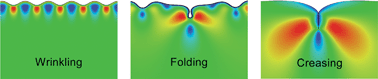
Soft materials are very susceptible to surface instabilities, which can lead to wrinkiling, folding and creasing. These deformations and morphological instabilities are usually in response to environmental stimuli, and this stimulus-responsiveness makes them promising candidates for applications as intelligent materials. This hot review documents recent progress into the investigtation of surface wrinkling of soft materials, such as gels and biological tissues. 

Read for free for a limited time:

Mechanics of morphological instabilities and surface wrinkling in soft materials: a review
Bo Li ,  Yan-Ping Cao,  Xi-Qiao Feng and Huajian Gao
Soft Matter, 2012, 8, 5728-5745, DOI: 10.1039/C2SM00011C

Digg This
Reddit This
Stumble Now!
Share on Facebook
Bookmark this on Delicious
Share on LinkedIn
Bookmark this on Technorati
Post on Twitter
Google Buzz (aka. Google Reader)

Impacting the mechanical properties of elastomers re-inforced with fillers

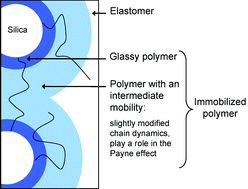
Using solid fillers in an elastomeric matrix is a well-known method for improving the mechanical properties of elastomers. In this hot paper a silica-filled model elastomer was used to study the interparticle connections between the filler particles. It was found that the distance between the particles is a crucial parameter in the mechanics of materials, and was compared to the  range of polymer dynamics modification within the system.

Read for free for a limited time:

Solid particles in an elastomer matrix: impact of colloid dispersion and polymer mobility modification on the mechanical properties
Aurélie Papon,  Hélène Montes,  François Lequeux,  Julian Oberdisse,  Kay Saalwächter and Laurent Guy
Soft Matter, 2012,8, 4090-4096, DOI: 10.1039/C2SM06885K

Digg This
Reddit This
Stumble Now!
Share on Facebook
Bookmark this on Delicious
Share on LinkedIn
Bookmark this on Technorati
Post on Twitter
Google Buzz (aka. Google Reader)

Focus on: Superhydrophobic surfaces

Soft Matter & Journal of Materials ChemistrySuperhydrophobic surfaces can cause water to roll off leaving little or no liquid behind and even pick-up and remove small dirt particles resting on the surface; however, despite the  progress made, there is still an opportunity fabricate these surfaces using simpler and cheaper methods, to maximise roll-off, or to introduction additional functional properties. Here we’ve brought together a selection of articles covering the preparation of superhydrophobic surfaces and coatings, their chemical and physical properties, and the origin of the superhydrophobic effect.

Review
Hydrophilic and superhydrophilic surfaces and materials
Jaroslaw Drelich ,  Emil Chibowski ,  Dennis Desheng Meng and Konrad Terpilowski
Soft Matter, 2011,7, 9804-9828

Highlight
Immersed superhydrophobic surfaces: Gas exchange, slip and drag reduction properties
Glen McHale ,  Michael I. Newton and Neil J. Shirtcliffe
Soft Matter, 2010,6, 714-719

Opinion
Characterization of superhydrophobic behavior: effect of vibrational energy
W. Li ,  Y. P. Diao ,  H. L. Zhang ,  G. C. Wang ,  S. Q. Lu ,  X. J. Dong ,  H. B. Dong and Q. L. Sun
Soft Matter, 2009,5, 2833-2835

Click here to see all the articles

Digg This
Reddit This
Stumble Now!
Share on Facebook
Bookmark this on Delicious
Share on LinkedIn
Bookmark this on Technorati
Post on Twitter
Google Buzz (aka. Google Reader)

Reviews in Soft Matter

Soft MatterSoft Matter publishes five different types of review-style article: Emerging Areas, Highlights, Opinions, Reviews and Tutorial Reviews. We’ve created an easy search to show examples of each of the different article types. Please click on the links below to see the recent reviews published in Soft Matter.

Review-style articles:

  • Highlight
  • Review Article
  • Emerging Area
  • Opinion
  • Tutorial Review
  • Guidelines for writing review articles can be found here: http://www.rsc.org/Publishing/Journals/sm/review_guidelines.asp

    Digg This
    Reddit This
    Stumble Now!
    Share on Facebook
    Bookmark this on Delicious
    Share on LinkedIn
    Bookmark this on Technorati
    Post on Twitter
    Google Buzz (aka. Google Reader)

    Disclinations and the morphology of deformable fluid interfaces

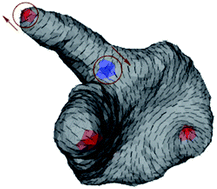
    This Hot Paper describes the use of a Monte Carlo model to explore the spectrum of vesicle shapes engendered by an in-plane nematic field. The study of these complex morphologies can lead to further understanding of cellular organelles, such as the endoplasmic reticulum the Golgi and the mitochondria. In addition, the disclination dynamics on deformable surfaces can also be studied.

    Read for free for a limited time:

    Role of disclinations in determining the morphology of deformable fluid interfaces
    N. Ramakrishnan ,  John H. Ipsen and P. B. Sunil Kumar
    Soft Matter, 2012, 8, 3058-3061, DOI: 10.1039/C2SM07384F

    Digg This
    Reddit This
    Stumble Now!
    Share on Facebook
    Bookmark this on Delicious
    Share on LinkedIn
    Bookmark this on Technorati
    Post on Twitter
    Google Buzz (aka. Google Reader)

    The anatomy of a crease, from folding to ironing

    Ironing is an every-day occurrence, but little is known about the mechanism by which the iron unfolds the wrinkles in fabric. Obviously high temperatures, and pressures are important, but what about humidity, and the use of damp cloth? Researchers in this Hot Paper report experiments on the folding and unfolding of a single crease. Both bulk and weaved materials were studied.

    Read for free for a limited time:

    The anatomy of a crease, from folding to ironing
    Adrien Benusiglio ,  Vincent Mansard ,  Anne-Laure Biance and Lydéric Bocquet
    Soft Matter, 2012, 8, 3342-3347, DOI: 10.1039/C2SM07151G

    Digg This
    Reddit This
    Stumble Now!
    Share on Facebook
    Bookmark this on Delicious
    Share on LinkedIn
    Bookmark this on Technorati
    Post on Twitter
    Google Buzz (aka. Google Reader)

    Top 10 most-read Soft Matter articles in March

    This month sees the following articles in Soft Matter that are in the top ten most accessed for March:

    Extreme wettability and tunable adhesion: biomimicking beyond nature?
    Xinjie Liu, Yongmin Liang, Feng Zhou and Weimin Liu
    Soft Matter, 2012, 8, 2070-2086 
    DOI: 10.1039/C1SM07003G 

    Mechanics of morphological instabilities and surface wrinkling in soft materials: a review 
    Bo Li, Yan-Ping Cao, Xi-Qiao Feng and Huajian Gao
    Soft Matter, 2012, Advance Article
    DOI: 10.1039/C2SM00011C 

    Bridging the gap between hard and soft colloids  
    Dimitris Vlassopoulos and Michel Cloitre
    Soft Matter, 2012, 8, 4010-4013 
    DOI: 10.1039/C2SM90031A 

    Self-assembly of biodegradable polyurethanes for controlled delivery applications 
    Mingming Ding, Jiehua Li, Hong Tan and Qiang Fu 
    Soft Matter, 2012, Advance Article 
    DOI: 10.1039/C2SM07402H 

    Beyond the lipid-bilayer: interaction of polymers and nanoparticles with membranes 
    Matthias Schulz, Adekunle Olubummo and Wolfgang H. Binder  
    Soft Matter, 2012, 8, 4849-4864 
    DOI: 10.1039/C2SM06999G 

    3D-characterization of three-phase systems using X-ray tomography: tracking the microstructural evolution in ice cream 
    B. R. Pinzer, A. Medebach, H. J. Limbach, C. Dubois, M. Stampanoni and M. Schneebeli  
    Soft Matter, 2012, 8, 4584-4594 
    DOI: 10.1039/C2SM00034B 

    pH-responsive colloidosomes and their use for controlling release 
    Olivier J. Cayre, James Hitchcock, Mohamed S. Manga, Sam Fincham, Amandine Simoes, Richard A. Williams and Simon Biggs  
    Soft Matter, 2012, 8, 4717-4724 
    DOI: 10.1039/C2SM00002D 

    Hyaluronic acid-based hydrogels: from a natural polysaccharide to complex networks 
    Xian Xu, Amit K. Jha, Daniel A. Harrington, Mary C. Farach-Carson and Xinqiao Jia 
    Soft Matter, 2012, 8, 3280-3294 
    DOI: 10.1039/C2SM06463D 

    Morphological transformation between three-dimensional gel network and spherical vesicles via sonication 
    Mingming Zhang, Luyan Meng, Xinhua Cao, Meijuan Jiang and Tao Yi  
    Soft Matter, 2012, 8, 4494-4498 
    DOI: 10.1039/C2SM25164G 

    Light-controlled quick switch of adhesion on a micro-arrayed liquid crystal polymer superhydrophobic film 
    Chao Li, Futao Cheng, Jiu-an Lv, Yong Zhao, Mingjie Liu, Lei Jiang and Yanlei Yu  
    Soft Matter, 2012, 8, 3730-3733 
    DOI: 10.1039/C2SM07471K

    Why not take a look at the articles today and blog your thoughts and comments below.

    Fancy submitting an article to Soft Matter? Then why not submit to us today!

    To keep up-to-date with all the latest research, sign up for the Soft Matter e-Alert or RSS feeds or follow Soft Matter on Twitter or Facebook.

    Digg This
    Reddit This
    Stumble Now!
    Share on Facebook
    Bookmark this on Delicious
    Share on LinkedIn
    Bookmark this on Technorati
    Post on Twitter
    Google Buzz (aka. Google Reader)

    Using DNA to detect DNA

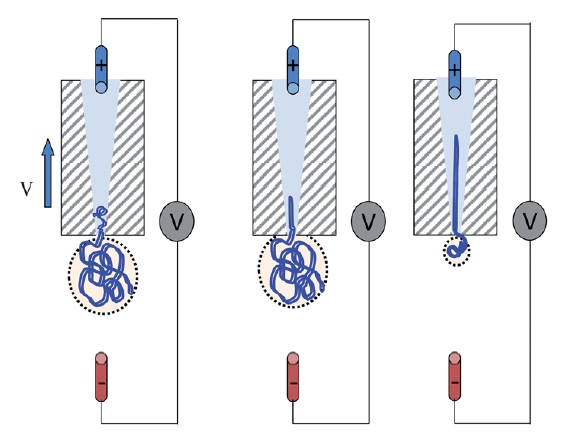
    Schematic of DNA translocation in a glass capillary. Image taken from Soft Matter, 2012, doi:10.1039/C2SM25346A

    Detecting single strands of DNA is a tricky business. One way in which it can be done is by creating a pore and sensing the DNA strand as it passes through the pore. This is what Ullrich Keyser from the University of Cambridge, UK and his group have been doing.

    Keyser forms nanopores with diameters of less than 100nm from glass capillary tubes (the diameters can be as small as 20nm). These nanocapillaries act as single molecule sensors. Using electrophoresis, the negatively charged DNA is pulled towards a positively charged electrode inside the capillary, in a process known as DNA translocation. As the strand enters the capillary the resistance across the capillary pore changes, allowing the DNA to be detected. The change in ionic current is dependent not only on the presence of a DNA strand, but also on its folded state. This method offers a simple and cost-effective method for the detection of single molecules and for DNA sequencing.
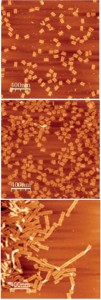
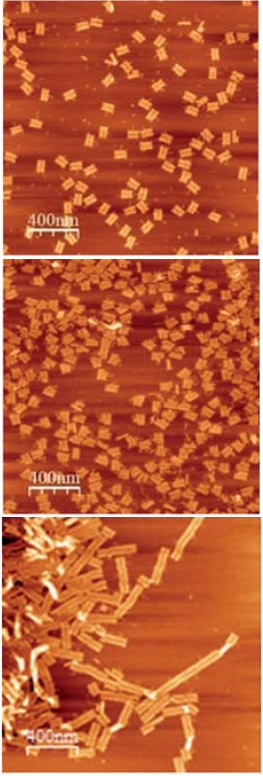
    Examples of DNA origami. Image taken from Soft Matter, 2011, 7, 4636.

    Full control over DNA translocation can be achieved using optical trapping, where the DNA is attached to a colloidal particle, held in place by an optical trap. The DNA can then be moved in and out of the capillary pore at will. Using this method, Keyser and his group have measured the capture force due to the electric field acting on the DNA. Their results show that the DNA capture force is linearly dependent on the number of strands captured in the capillary.

    Whether using glass capillaries, or pores formed in silicon nitride membranes via focussed ion beam milling, control over the exact shape and functionality of the nanocavity can be problematic. Keyser has taken DNA detection yet another step further by using the DNA itself to create the nanopore. The shape into which a DNA strand folds can be controlled in a a process known as DNA origami; the DNA is synthesised such that it will self-assemble into a pre-designed three-dimensional shape. Using this origami, it is possible to design and fabricate virtually any nanosized shape that you want.

    Keyser designed the DNA so that it folded into a funnel like shape with a long tail. This structure was then pulled through a pore in a  silicon nitride membrane to form a hybrid nanopore with a diameter of 7.5nm. The assembly of the hybrid pore is robust and easily reversible. These DNA/silicon nitride pores have been successfully used to detect single strands of DNA. The hybrid nanopores offer a novel way to change the size, shape and functionality of pores.

    Relevant papers in SoftMatter:

    Chen, Q. et al., How does a supercoiled DNA chain pass through a small conical glass pore? Soft Matter, 2012, Advanced Article.

    Geerts, N., Eiser, E., DNA functionalized colloids: Physical properties and applications. Soft Matter, 2010, 6, 4647-4660.

    Kim, K. N., et al., Comparison of methods for orienting and aligning DNA origami. Soft Matter, 2011, 7, 4636-4643.


    Digg This
    Reddit This
    Stumble Now!
    Share on Facebook
    Bookmark this on Delicious
    Share on LinkedIn
    Bookmark this on Technorati
    Post on Twitter
    Google Buzz (aka. Google Reader)