Archive for November, 2014

Take 1…minute for chemistry in health

The chemical sciences will be fundamental in helping us meet the healthcare challenges of the future, and we are committed to ensuring that they contribute to their full potential. As part of our work in this area, we are inviting undergraduate and PhD students, post-docs and those starting out their career in industry to produce an original video that demonstrates the importance of chemistry in health.Take 1... minute for chemistry in health

We are looking for imaginative ways of showcasing how chemistry helps us address healthcare challenges. Your video should be no longer than 1 minute, and you can use any approach you like.

The winner will receive a £500 cash prize, with a £250 prize for second place and £150 prize for third place up for grabs too.

Stuck for inspiration? Last year’s winning video is a good place to start. John Gleeson’s video was selected based on the effective use of language, dynamic style, creativity and its accurate content.

The closing date for entries to be submitted is 30 January 2015. Our judging panel will select the top five videos. We will then publish the shortlisted videos online and open the judging to the public to determine the winner and the runners up.

For more details on how to enter the competition and who is eligible, join us at the Take 1… page.

Good luck!

Digg This
Reddit This
Stumble Now!
Share on Facebook
Bookmark this on Delicious
Share on LinkedIn
Bookmark this on Technorati
Post on Twitter
Google Buzz (aka. Google Reader)

A simple route to responsive, particle-stabilized foams using bare silica nanoparticles

Web writer Rob Woodward highlights a hot article from the journal


Defined as bubbles of gas in liquid-film matrix, foams are important precursors in the food and cosmetic industry and for the production of macroporous materials. In this report a simple, effective route to silica nanoparticle stabilised responsive aqueous foams has been demonstrated by the Binks group. Stimuli-responsive surface active particles have generated growing interest in recent years, utilising triggers including pH, temperature and light irradiation to create ‘switchable’ foams, i.e. the ability to “switch-off” the foaming capability of the particles. However, the production of responsive surface active particles usually involves surface coating of mineral particles or the complicated synthesis of functional polymer particles.

In order to address this problem Binks et al. utilise the interaction of N’-dodecyl-N,N-dimethylacetamidinium bicarbonate, a responsive surfactant, with anionic silica nanoparticles in water. By exposure to either CO2 or N2 the responsive surfactant can be switched between a cationic species and a surface-inactive neural form, respectively. On the formation of the cationic species, complexation of the surfactant to anionic silica nanoparticle surfaces gives an in situ increase in the hydrophobicity of the silica, yielding surface-active nanoparticles. Agitation of the resulting complexed system gives foams, however, on exposure to N2 the responsive surfactant returns to its neutral state and desorbs from the surface of the silica particles, resulting in desorption of the particles from the water-air interface.

This simple route to switchable particle-stabilized aqueous foams removes the need for the complicated synthesis of particles as ‘bare’ silica nanoparticles can be used. The synergistic effect of the responsive surfactant and the nanoparticles also allows for the production of foams using a much lower concentration of surfactant than in a responsive-surfactant system alone.
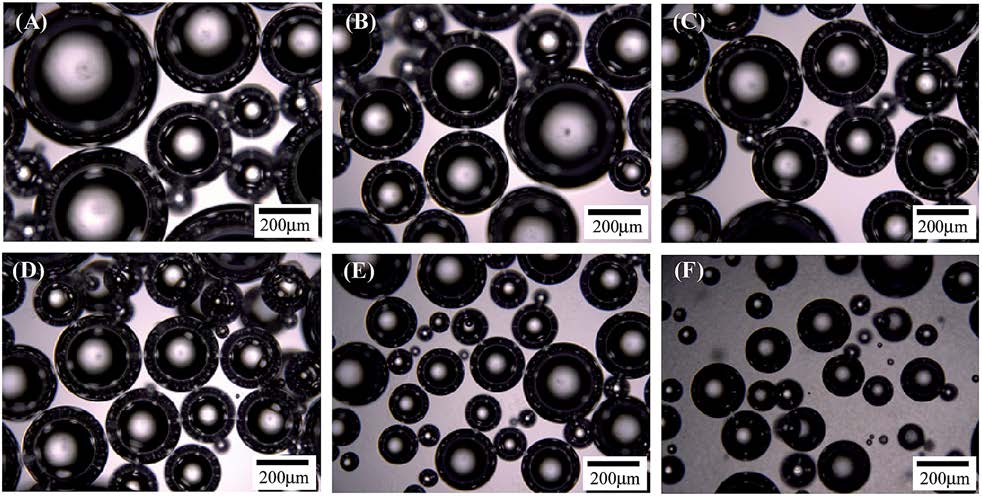
Micrographs of the bubbles in foams produced by shaking 10 cm3 of a dispersion of 0.5 wt% particles in a surfactant solution at different concentrations in bottles (25 cm3) taken immediately after shaking. Surfactant concentrations from A to F are: 0.1, 0.2, 0.3, 0.6, 1.0 and 2.0 mM.

To find out more read the full article:

Responsive aqueous foams stabilised by silica nanoparticles hydrophobised in situ with a switchable surfactant

Yue Zhu, Jianzhong Jiang, Zhenggang Cui and Bernie Binks

Soft Matter, 2014, Accepted Manuscript

DOI: 10.1039/C4SM01970A

This post was written by web writer Rob Woodward. Rob is currently based in Imperial College London working in the Polymer and Composite Engineering (PaCE) group. Rob has a background in both responsive polymeric surfactants and microporous organic polymers for carbon capture and storage.

Digg This
Reddit This
Stumble Now!
Share on Facebook
Bookmark this on Delicious
Share on LinkedIn
Bookmark this on Technorati
Post on Twitter
Google Buzz (aka. Google Reader)

On polydispersity and the hard sphere glass transition – an overview of a hot article

On polydispersity and the hard sphere glass transition, Emanuela Zaccarelli, Siobhan M. Liddle and Wilson C. K. Poon, Soft Matter, 2014

DOI: 10.1039/C4SM02321H

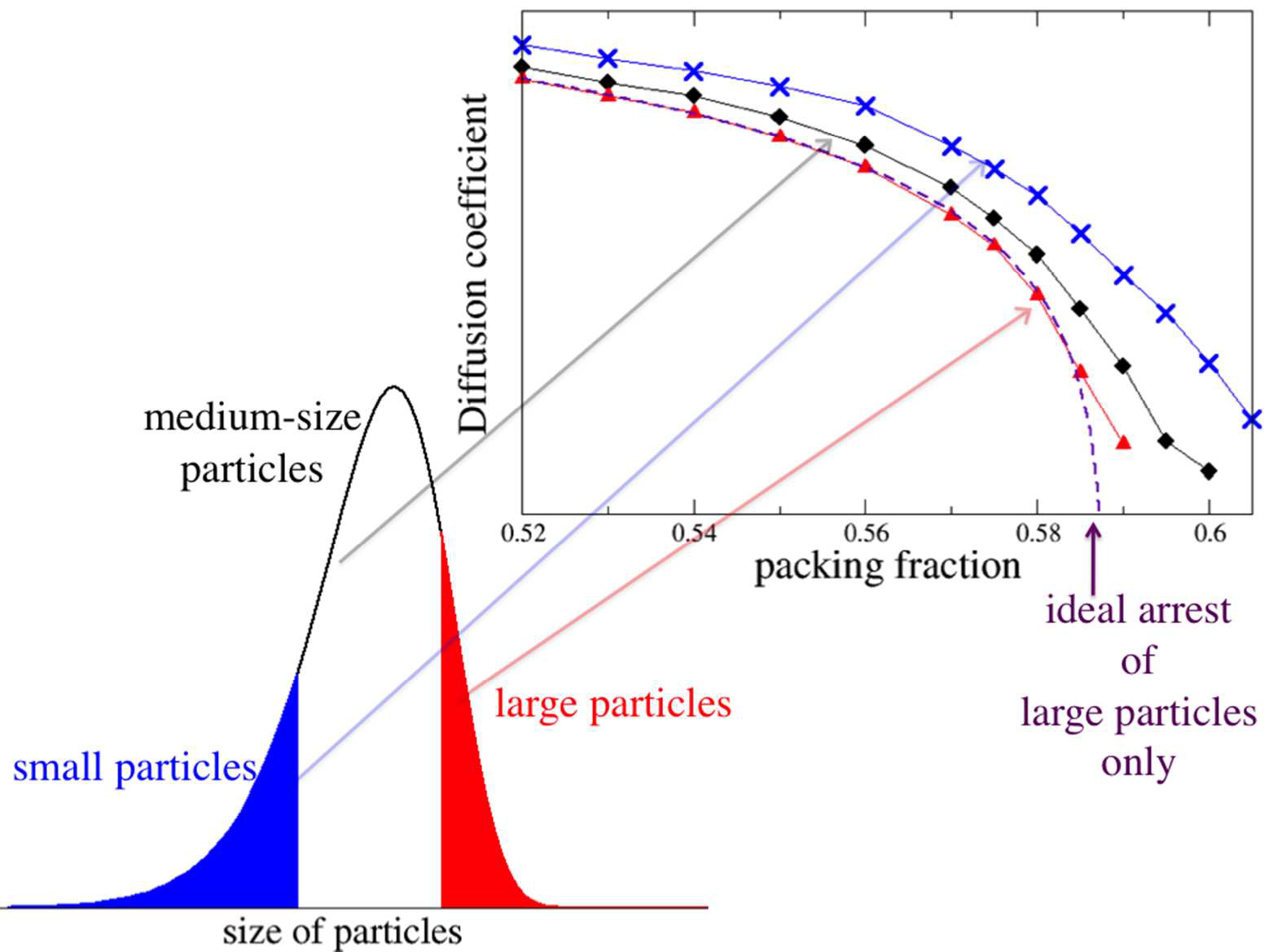
The aim of this work was to investigate the dynamics of polydisperse hard spheres at high packing fractions φ. The effects of polydispersity and the detailed shape of the particle size distribution (PSD) were studied.


The glass transition is not fully understood despite many decades of research. The discovery that hard-spheres, sterically-stabilised polymethylmethacrylate (PMMA) colloids, underwent kinetic arrest at a packing fraction of φ = φg ≈ 0.58 led to hard sphere colloids becoming the preferred method to test mode coupling theory (MCT). This is a significant piece of work by Emanuela Zaccarelli, Siobhan M. Liddle and Wilson C. K. Poon who are the first to present simulations of a polydisperse system of hard spheres with a size distribution essentially identical to the experimental data. The findings of the authors are novel and very important, they also put forward a new interpretation of what is going on in glass transition of MCT experiments. Assumptions with regard to PSD are not made and a model as close to the experimental one as possible is designed.

Event-driven Molecular Dynamics (MD) simulations of hard spheres with different PSD were performed. Experimentally obtained PSD from ≈ 2200 PMMA particles were measured by transmission electron microscopy (TEM). N = 2309 particles were simulated with the experimental PSD, measurement noise was included to produce a realistic system representation. N = 2000 particles taken from Gaussian and top hat distributions were considered for comparison.

It was found that a mixed state of ergodic small particles and glassy large particles in a window of concentrations is present and results in a hybrid dynamical state that is fluid for a long time but shows an unusual type of ageing. The breakdown of the MCT-predictions is due to the existence of partial decoupling, which is not accounted for in the monodisperse-version of MCT. However, the results of MCT are recovered once the polydispersity is reduced. There is a non-monotonic dependence of the quality of the glass former on the polydispersity index, s. When s = 0, the system is prone to crystallization and strong glasses are formed when s = <8%. The glass transition is smeared out due to the emergence of the “ageing liquid” for higher values of s as well as for samples drawn from peaked distributions. The precise form of the size distribution is relevant, a peaked distribution that allows a distinction between small and large particles is essential but this is not the case in the top hat particle distribution.

In conclusion, at a fixed relative standard deviation of the PSD the exact shape of the PSD has little influence on the general behaviour of the dynamics, large differences between the dynamics of “small” and “large” particles are found for realistic PSD shapes.

The glass transition is smeared out in polydisperse hard spheres due to decoupling between small and large particles

Please follow the link for the full article.

Digg This
Reddit This
Stumble Now!
Share on Facebook
Bookmark this on Delicious
Share on LinkedIn
Bookmark this on Technorati
Post on Twitter
Google Buzz (aka. Google Reader)

12th International Conference on Materials Chemistry (MC12) – call for abstracts

We are delighted to announce that 12th International Conference on Materials Chemistry (MC12) will be held at the University of York on 20 – 23 July 2015. Abstracts are now invited for this event so submit today and take advantage of this excellent opportunity to present your work alongside scientists from across the globe.

This cutting edge international research conference is organised around four exciting and diverse areas of the application of materials chemistry. One prominent theme at MC12 is Soft Matter Materials, which aims to cover the wide and varied aspects of soft matter materials showing the power of the interplay between a priori design and physical function. Visit http://rsc.li/mc12 to find out more and submit your abstract today.

Digg This
Reddit This
Stumble Now!
Share on Facebook
Bookmark this on Delicious
Share on LinkedIn
Bookmark this on Technorati
Post on Twitter
Google Buzz (aka. Google Reader)

HOT articles for November!

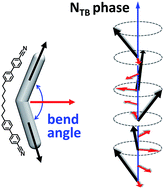
Molecular geometry, twist-bend nematic phase and unconventional elasticity: a generalised
Maier–Saupe theory Cristina Greco, Geoffrey R. Luckhurst and Alberta Ferrarini 

Graphical abstract: Molecular geometry, twist-bend nematic phase and unconventional elasticity: a generalised Maier–Saupe theory

 
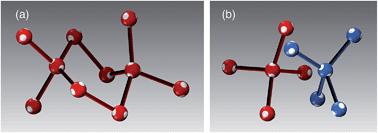
“Crystal-clear” liquid–liquid transition in a tetrahedral fluid
Francis W. Starr and Francesco Sciortino

Graphical abstract: “Crystal-clear” liquid–liquid transition in a tetrahedral fluid

These articles will be free until 1st December 2014


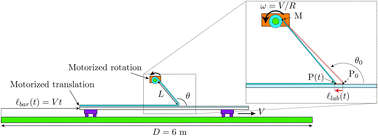
Peeling-angle dependence of the stick-slip instability during adhesive tape peeling
Marie-Julie Dalbe, Stéphane Santucci, Loïc Vanel and Pierre-Philippe Cortet  

Graphical abstract: Peeling-angle dependence of the stick-slip instability during adhesive tape peeling

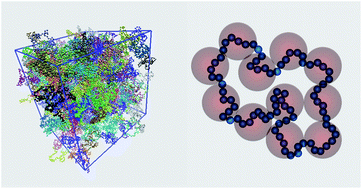
Multi-blob coarse graining for ring polymer solutions
Arturo Narros, Christos N. Likos, Angel J. Moreno and Barbara Capone 

Graphical abstract: Multi-blob coarse graining for ring polymer solutions

These articles will be free until 9th  December 2014


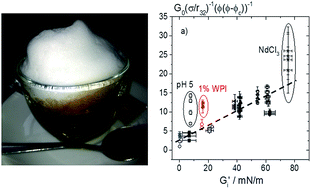
Relating foam and interfacial rheological properties of β-lactoglobulin solutions
M. Lexis and N. Willenbacher

Graphical abstract: Relating foam and interfacial rheological properties of β-lactoglobulin solutions

 
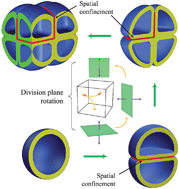
Controlling mechanisms in directional growth of aggregated archaeal cells
Viktor Milkevych and Damien J. Batstone

Graphical abstract: Controlling mechanisms in directional growth of aggregated archaeal cells

These articles will be free until 16th  December 2014


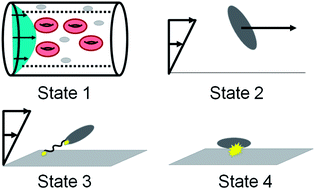
Examining platelet adhesion via Stokes flow simulations and microfluidic experiments
Sean Fitzgibbon, Jonathan Cowman, Antonio J. Ricco, Dermot Kenny and Eric S. G. Shaqfeh

Graphical abstract: Examining platelet adhesion via Stokes flow simulations and microfluidic experiments
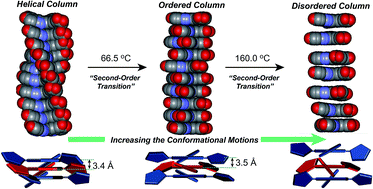
Sequential phase transformation of propeller-like C3-symmetric liquid crystals from a helical to ordered to disordered hexagonal columnar structure
Soyoung Park and Byoung-Ki Cho

Graphical abstract: Sequential phase transformation of propeller-like C3-symmetric liquid crystals from a helical to ordered to disordered hexagonal columnar structure

These articles will be free until 23rd  December 2014


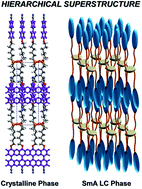
Hierarchical superstructures from a star-shaped molecule consisting of a cyclic oligosiloxane with cyanobiphenyl moieties Dae-Yoon Kim, Minwook Park, Sang-A Lee, Soeun Kim, Chih-Hao Hsu, Namil Kim, Shiao-Wei Kuo, Tae-Ho Yoon and Kwang-Un Jeong

Graphical abstract: Hierarchical superstructures from a star-shaped molecule consisting of a cyclic oligosiloxane with cyanobiphenyl moieties

These articles will be free until 30th  December 2014


Digg This
Reddit This
Stumble Now!
Share on Facebook
Bookmark this on Delicious
Share on LinkedIn
Bookmark this on Technorati
Post on Twitter
Google Buzz (aka. Google Reader)