Archive for August, 2012

Soft Matter Poster Prize

Congratulations to Dr. Michele Griffa for winning a Soft Matter poster prize at the conference ‘Micro-structure, setting and aging of cement: from soft-matter physics to sustainable materials.’

 Michele Griffa, PhD

His winning poster was titled “Nonlinear Mesoscopic Elasticity and microstructural developments in cement-based materials due to micro-damage processes”.

Dr. Michele Griffa works at the Concrete and Construction Chemistry Laboratory Empa Swiss Federal Laboratories for Materials Science and Technology.

Digg This
Reddit This
Stumble Now!
Share on Facebook
Bookmark this on Delicious
Share on LinkedIn
Bookmark this on Technorati
Post on Twitter
Google Buzz (aka. Google Reader)

Hot review: Stimuli-responsive polymers on nano-curved surfaces

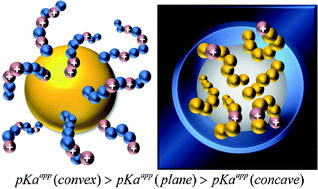
A Hot Review from Tagliazucchi and Szleifer discussing macromolecular layers on nano-curved surfaces. Topics include the fast-growing field of polymer- and polyelectrolyte-modified nanopores and nanochannels, and the practical implications of introducing soft materials into nanofluidic devices.

Read for free for a short time:

Stimuli-responsive polymers grafted to nanopores and other nano-curved surfaces: structure, chemical equilibrium and transport
Mario Tagliazucchi and Igal Szleifer
Soft Matter, 2012, 8, DOI: 10.1039/C2SM25777G

Digg This
Reddit This
Stumble Now!
Share on Facebook
Bookmark this on Delicious
Share on LinkedIn
Bookmark this on Technorati
Post on Twitter
Google Buzz (aka. Google Reader)

Micro-structure, setting and aging of cement: from soft matter physics to sustainable materials

Soft Matter will be publishing a web- theme in collaboration with the the ‘Micro-structure, setting and aging of cement: from soft matter physics to sustainable materials’ conference being held this week.

From 5 to 8 % of the global human CO2 production comes from the production of cement, so research on concrete and cement plays a crucial role for sustainable development. As 60% of CO2 emissions from cement production come from the chemical dissociation of calcium carbonate, the forefront of industrial and academic research is in chemical modifications of cement. It is becoming increasingly clear that no progress is really possible without understanding how the chemical modification of cement can affect its structure, cohesion and mechanics, from the nano-scale components of the material up to the microscale. From the early stages to the onset of setting, cement is very much a soft matter with structural heterogeneity and complexity on multiple length and timescales akin to other soft glassy materials. Bringing together cement researchers with soft matter scientists and glasses physicists, the web theme aims to open a new interdisciplinary perspective on the problem.
For more information, please e-mail us: softmatter-rsc@rsc.org.

More information below

Digg This
Reddit This
Stumble Now!
Share on Facebook
Bookmark this on Delicious
Share on LinkedIn
Bookmark this on Technorati
Post on Twitter
Google Buzz (aka. Google Reader)

Poster Prize winners at Boulder Summer School

Congratulations to the Soft Matter Poster Prize winners at Boulder Summer School: Polymers in Soft and Biological Matter.

The three joint winners were Valeria Cassina (University of Milano – Bicocca), Fernando Vargas-Lara (Wesleyan University) and Andreas Weinberger (Institut Charles Sadron UPR22-CNRS).

Valeria Cassina, Fernando Vargas-Lara and Andreas Weinberger 

From left to right: Valeria Cassina, Fernando Vargas-Lara and Andreas Weinberger

Valeria Cassina
Poster title: Magnetic tweezers measurements of the DNA nanomechanical stability at different environmental conditions of pH and ionic strength
Advisor: Francesco Mantegazza

Fernando Vargas-Lara
Poster tile: The Internal Structure of Nanoparticle Dimers Linked by DNA
Advisor: Francis W. Starr

Andreas Weinberger
Poster title: Interactions of elastin-like polypeptides with lipid membranes
Advisor: Carlos Marques

The Boulder Summer School: Polymers in Soft and Biological Matter was held 9th July – 3rd August in Colorado, USA.

To keep up-to-date with all the latest research, sign up for the Soft Matter e-Alert or RSS feeds or follow Soft Matter on Twitter or Facebook.


Digg This
Reddit This
Stumble Now!
Share on Facebook
Bookmark this on Delicious
Share on LinkedIn
Bookmark this on Technorati
Post on Twitter
Google Buzz (aka. Google Reader)

Soft Matter paper featured on Science Daily

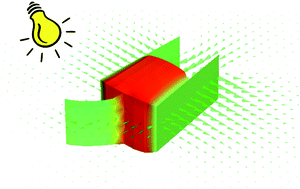
Designing maneuverable micro-swimmers actuated by responsive gelA Soft Matter paper has been highlighted on the science news website Science Daily. In the Soft Matter paper (Designing maneuverable micro-swimmers actuated by responsive gel) Alexander Alexeev and co-workers at Georgia Institute of Technology, USA, design a simple maneuverable micro-swimmer that can self-propel and navigate in microfluidic channels. The micro-swimmer is designed using computational modelling.

You can read the write up in Science Daily here:
Microswimmers: Micron-Scale Swimming Robots Could Deliver Drugs and Carry Cargo Using Simple Motion


To keep up-to-date with all the latest research, sign up for the Soft Matter e-Alert or RSS feeds or follow Soft Matter on Twitter or Facebook.


Digg This
Reddit This
Stumble Now!
Share on Facebook
Bookmark this on Delicious
Share on LinkedIn
Bookmark this on Technorati
Post on Twitter
Google Buzz (aka. Google Reader)

Top 10 most-read Soft Matter articles in June

This month sees the following articles in Soft Matter that are in the top ten most accessed for June:

Magnetic emulsions with responsive surfactants  
Paul Brown, Craig P. Butts, Jing Cheng, Julian Eastoe, Christopher A. Russell and Gregory N. Smith 
Soft Matter, 2012, 8, 7545-7546 
DOI: 10.1039/C2SM26077H 

Chemical approaches to synthetic polymer surface biofunctionalization for targeted cell adhesion using small binding motifs 
Guillaume Delaittre, Alexandra M. Greiner, Thomas Pauloehrl, Martin Bastmeyer and Christopher Barner-Kowollik  
Soft Matter, 2012, 8, 7323-7347 
DOI: 10.1039/C2SM07407A 

Design and properties of supramolecular polymer gels  
Atsushi Noro, Mikihiro Hayashi and Yushu Matsushita  
Soft Matter, 2012, 8, 6416-6429 
DOI: 10.1039/C2SM25144B 

Static wetting on deformable substrates, from liquids to soft solids  
Robert W. Style and Eric R. Dufresne  
Soft Matter, 2012, 8, 7177-7184 
DOI: 10.1039/C2SM25540E 

Mechanics of morphological instabilities and surface wrinkling in soft materials: a review  
Bo Li, Yan-Ping Cao, Xi-Qiao Feng and Huajian Gao  
Soft Matter, 2012, 8, 5728-5745 
DOI: 10.1039/C2SM00011C 

Model, self-assembly structures, and phase diagram of soft Janus particles  
Zhan-Wei Li, Zhong-Yuan Lu, Zhao-Yan Sun and Li-Jia An  
Soft Matter, 2012, 8, 6693-6697 
DOI: 10.1039/C2SM25397F 

The conundrum of gel formation by molecular nanofibers, wormlike micelles, and filamentous proteins: gelation without cross-links?  
Srinivasa R. Raghavan and Jack F. Douglas  
Soft Matter, 2012, 8, 8539-8546 
DOI: 10.1039/C2SM25107H 

Biocompatible and biodegradable polymersomes as delivery vehicles in biomedical applications  
Gong-Yan Liu, Chao-Jian Chen and Jian Ji  
Soft Matter, 2012, Advance Article 
DOI: 10.1039/C2SM25721A 

A novel technique for micro-patterning proteins and cells on polyacrylamide gels 
Xin Tang, M. Yakut Ali and M. Taher A. Saif  
Soft Matter, 2012, 8, 7197-7206 
DOI: 10.1039/C2SM25533B 

Wet granular matter: a truly complex fluid  
Stefanie Strauch and Stephan Herminghaus  
Soft Matter, 2012, 8, 8271-8280 
DOI: 10.1039/C2SM25883H 

Why not take a look at the articles today and blog your thoughts and comments below.

Fancy submitting an article to Soft Matter? Then why not submit to us today!

To keep up-to-date with all the latest research, sign up for the Soft Matter e-Alert or RSS feeds or follow Soft Matter on Twitter or Facebook.

Digg This
Reddit This
Stumble Now!
Share on Facebook
Bookmark this on Delicious
Share on LinkedIn
Bookmark this on Technorati
Post on Twitter
Google Buzz (aka. Google Reader)

Conference: PhysCell2012

Soft Matter is delighted to offer a poster prize at the meeting “Pierre-Gille de Gennes days on Physics of cells: From soft to living matter” taking place 2nd – 9th September 2012, in Hyeres on the Mediterranean coast of France. 

The aim of the meeting is to bring together eminent researchers from interdisciplinary fields working on various aspects of cell and tissue biophysics including adhesion, mechanics, mechano-sensing, morphogenesis, transport, single molecule studies among others.

An advanced school, aimed at graduate students as well as researchers at the interface of biology with physical sciences, will precede the conference. Scientific sessions will include membranes, single molecules, adhesion and mechanics, cytoskeleton, gene expression, tissues and morphogenesis, bacterial motility, intracellular traffic, and emerging tools and techniques. 

More information is available on the meeting website: http://www.physcell2012.com

Digg This
Reddit This
Stumble Now!
Share on Facebook
Bookmark this on Delicious
Share on LinkedIn
Bookmark this on Technorati
Post on Twitter
Google Buzz (aka. Google Reader)

Spider silk and its outstanding mechanical properties

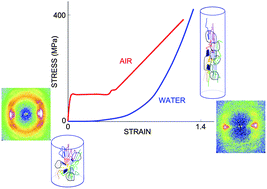
Spider silk has outstanding mechanical properties, and the study of this biomaterial can lead to the development of synthetic high performance fibers. However, there is still limited knowledge of how the structure of silk affects the mechanical properties.

Plaza and co-workers studied the microstructural changes of supercontracted major ampullate silk fibres during deformation, in our first Hot Paper. Two distinct regimes in the microstructural evolution were identified.

Flagelliform (Flag) silk was studied in our second Hot Paper by Lefèvre and Pézolet. Raman spectromicroscopy was used to characterize Flag silk fibers spun by three orb-weaving spiders in their native state. The structural data obtained provides a molecular basis for the tensile properties of these fibers.

 Read both papers for a limited time for free:

Relationship between microstructure and mechanical properties in spider silk fibers: identification of two regimes in the microstructural changes
Gustavo R. Plaza,  José Pérez-Rigueiro,  Christian Riekel,  G. Belén Perea,  Fernando Agulló-Rueda,  Manfred Burghammer,  Gustavo V. Guinea and Manuel Elices
Soft Matter, 2012, 8, 6015-6026, DOI: 10.1039/C2SM25446H

Unexpected β-sheets and molecular orientation in flagelliform spider silk as revealed by Raman spectromicroscopy
Thierry Lefèvre and Michel Pézolet
Soft Matter, 2012, 8, 6350-6357, DOI: 10.1039/C2SM25351H

Digg This
Reddit This
Stumble Now!
Share on Facebook
Bookmark this on Delicious
Share on LinkedIn
Bookmark this on Technorati
Post on Twitter
Google Buzz (aka. Google Reader)

Update regarding issues 24-30 of Soft Matter

Following my previous message on July 24th, I would like to update you as to the status of the articles published in issues 24-30 of volume 8 of Soft Matter which were assigned incorrect page numbers.

These articles have now all been republished online with the correct page numbers. The hard copies of the issues will be distributed to our print subscribers very shortly and we will be liaising with abstracting and indexing services to make sure their databases contain only the correct versions of these articles. We will also be checking that citations to these articles are attributed accurately.

Once again, I would like to apologise for this error and for any inconvenience it has caused our authors, readers and subscribers.

Liz Davies
Editor, Soft Matter

Digg This
Reddit This
Stumble Now!
Share on Facebook
Bookmark this on Delicious
Share on LinkedIn
Bookmark this on Technorati
Post on Twitter
Google Buzz (aka. Google Reader)

Generalizing the Archimedes’ Principle

Roberto Piazza1. You recently published a paper re-examining the Archimedes’ principle. What motivated you to take a second look at this?
We were actually trying to understand some rather weird instability phenomena we had observed in the settling of binary colloid mixtures (see J. Phys.: Cond Matt. 24, 284109, 2012 ). Of course, to perform a numerical simulating of sedimentation, one has to give a value for the buoyant force acting on a particle. Yet, if we consider a particle of type 1 settling in a suspension of particles of type 2, this is less trivial than expected: using the standard Archimedes’ principle, what value  for the density  of the “displaced fluid” should we use, that of the bare solvent or that of the  suspension of the host particles? Looking back at the literature, both attitudes can be found. It turns out that neither of the two is correct. 
(Ref. Soft Matter, 2012, DOI 10.1039/C2SM26120K)

2. Can you explain the main points you discovered in this paper?
The crucial point is precisely the expression “displaced fluid”. When a particle in inserted in a complex fluid, or in general in a liquid displaying strong correlations, it does not “displace” just its own volume. Because of its interactions with the solvent, the particle perturbs the local density of the surrounding too. In the example of binary hard-sphere colloids, for instance, a region “depleted” of the host particles forms around particle 1, followed at larger distances, if particles 2 are sufficiently concentrated, by a region where the latter display an oscillating concentration profile. The interesting point is that a the effect of these perturbations on buoyancy can be quantitatively evaluated using a very general expression obtained by extending a simple mechanical equilibrium argument used in elementary physics courses to derive the Archimedes’ principle. This corrected form of the buoyant form, which we call “Generalize Archimedes’ Principle” (GAP), may lead to curious and counterintuitive effects that we tested experimentally.

Read the full interview

Digg This
Reddit This
Stumble Now!
Share on Facebook
Bookmark this on Delicious
Share on LinkedIn
Bookmark this on Technorati
Post on Twitter
Google Buzz (aka. Google Reader)