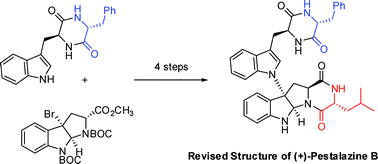
HOT: 4 steps to (+)-pestalazine B

Carlos Perez-Balado and Angel R. de Lera at University of Vigo have designed a convergent and versatile synthetic route to the preparation on this heterodimeric diketopiperazine alkaloid in just 4 steps.

This versatile methodology allows the synthesis of several diastereomers.

The paper is a nice trip through the unexpected paths of organic chemistry that lead you to the right compound.  Discover all of this and much more in this HOT paper. We loved it, the referees loved it and I’m sure you will love it too!

Free to access until the end of October

Concise total synthesis and structural revision of (+)-pestalazine B
Carlos Pérez-Balado and Ángel R. de Lera
Org. Biomol. Chem., 2010, Advance Article
DOI: 10.1039/C0OB00531B , Paper

Digg This
Reddit This
Stumble Now!
Share on Facebook
Bookmark this on Delicious
Share on LinkedIn
Bookmark this on Technorati
Post on Twitter
Google Buzz (aka. Google Reader)

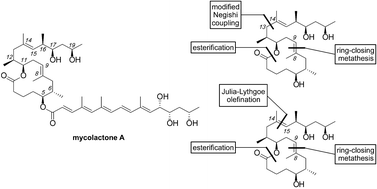
HOT Mycolactone core: Two synthetic approaches

Kwang-Seuk Ko,  Matthew D. Alexander, Michael D. Burkart and colleagues at University of California at San Diego, give us two different synthetic routes to make one product: the macrolide core of the mycolactone polyketides.

As you can see, organic synthesis is a matter of choice!

Read about the story of these new synthetic methods, the authors’ different approaches to their findings and how they succeded with the synthesis of their targeted molecule.

Free to access until the end of October

Synthetic studies on the mycolactone core
Kwang-Seuk Ko, Matthew D. Alexander, Shaun D. Fontaine, James E. Biggs-Houck, James J. La Clair and Michael D. Burkart
Org. Biomol. Chem., 2010, Advance Article
DOI: 10.1039/C0OB00540A, Paper

Read Michael Burkart’s story of this paper on the comments!

Digg This
Reddit This
Stumble Now!
Share on Facebook
Bookmark this on Delicious
Share on LinkedIn
Bookmark this on Technorati
Post on Twitter
Google Buzz (aka. Google Reader)

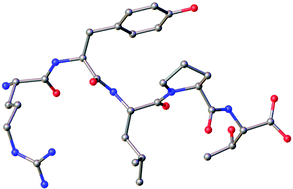
HOT: Proctolin structure revealed

Judith Howard, Olga Chetina and colleagues at University of Durham ellucidate the crystal structure of Proctolin [Arg-Tyr-Leu-Pro-Thr], a much studied insect neuropeptide.

This is a very important step towards the design of the ideal insecticide, highly selective, environmentally friendly, safe and of course effective.  It becomes even more relevant when we think about malaria and mosquitoes resistance to insecticides as one of the main problems to control the spread of the disease.

‘We have revealed the structure of Proctolin [Arg-Tyr-Leu-Pro-Thr]. The molecular association is very unusual for small peptides and it is hoped that the structure elucidation will enable the design of new insecticides towards the effective control of malaria’ say the authors of the paper.

I certainly hope so and I also think research like this one takes us a step closer!

Read the full paper that will be free to access until the end of October.

Crystal structure of the insect neuropeptide proctolin.
Judith A. K. Howard, Dmitry S. Yufit, Olga V. Chetina, Simon J. Teat, Silvia C. Capelli and Philip Pattison
Org. Biomol. Chem., 2010, Advance Article
DOI: 10.1039/C0OB00345J, Paper

Digg This
Reddit This
Stumble Now!
Share on Facebook
Bookmark this on Delicious
Share on LinkedIn
Bookmark this on Technorati
Post on Twitter
Google Buzz (aka. Google Reader)

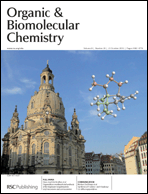
Inside Cover Issue 20: Silicon is the link

Hans-Joachim Knölkner and colleagues reveal the link between this beautiful church in Dresden and β-isocomene: silicon

Find out more about this curious conection in this article and read about the total synthesis of the sesquiterpenes (±)-β-isocomene and (±)-isocomene via a Lewis acid promoted [3 + 2] cycloaddition of allyl-tert-butyldiphenylsilane.

This article will be free to access until 10th November

Organosilicon-mediated total synthesis of the triquinane sesquiterpenes (±)-β-isocomene and (±)-isocomene
Arndt W. Schmidt, Thomas Olpp, Elke Baum, Tina Stiffel and Hans-Joachim Knölker
Org. Biomol. Chem., 2010, 8, 4562-4568
DOI: 10.1039/C0OB00051E

Digg This
Reddit This
Stumble Now!
Share on Facebook
Bookmark this on Delicious
Share on LinkedIn
Bookmark this on Technorati
Post on Twitter
Google Buzz (aka. Google Reader)

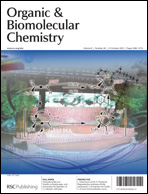
Front Cover Issue 20: Proton as the electrophile

This colourful and arty cover by Chunling Fu, Shengming Ma and colleagues shows the mechanism of a highly regio- and stereo- selective hydration of 1,2-allenylic sulfoxides.

In this reaction, the proton acts as the electrophile and water coming from the solvent attacks the sulfinyl group.
Not convinced yet?  There are even crystal structures to prove it!

Download the article for free until 10th November

Studies on highly regio- and stereoselective hydration of 1,2-allenylic sulfoxides
Zhao Fang, Chao Zhou, Chunling Fu and Shengming Ma
Org. Biomol. Chem., 2010, 8, 4554-4561
DOI: 10.1039/C0OB00007H

Digg This
Reddit This
Stumble Now!
Share on Facebook
Bookmark this on Delicious
Share on LinkedIn
Bookmark this on Technorati
Post on Twitter
Google Buzz (aka. Google Reader)

Top ten most accessed articles in August

This month sees the following articles in Organic & Biomolecular Chemistry that are in the top ten most accessed:-

Recent advances in transition metal-catalyzed N-atom transfer reactions of azides
Tom G. Driver
Org. Biomol. Chem., 2010, 8, 3831 – 3846, DOI: 10.1039/c005219c, Perspective

Sequential combination of Michael and acetalization reactions: direct catalytic asymmetric synthesis of functionalized 4-nitromethyl-chromans as drug intermediates
Dhevalapally B. Ramachary and Rajasekar Sakthidevi
Org. Biomol. Chem., 2010, 8, 4259 – 4265, DOI: 10.1039/c0ob00189a, Communication

Strain-promoted double-click reaction for chemical modification of azido-biomolecules
Isao Kii, Akira Shiraishi, Toshiyuki Hiramatsu, Takeshi Matsushita, Hidehiro Uekusa, Suguru Yoshida, Makoto Yamamoto, Akira Kudo, Masatoshi Hagiwara and Takamitsu Hosoya
Org. Biomol. Chem., 2010, 8, 4051 – 4055, DOI: 10.1039/c0ob00003e, Communication

Recent advances in stereoselective glycosylation through intramolecular aglycon delivery
Akihiro Ishiwata, Yong Joo Lee and Yukishige Ito
Org. Biomol. Chem., 2010, 8, 3596 – 3608, DOI: 10.1039/c004281a, Perspective

A facile method for the synthesis of oxindole based quaternary a-aminonitriles via the Strecker reaction
Yun-Lin Liu, Feng Zhou, Jun-Jie Cao, Cong-Bin Ji, Miao Ding and Jian Zhou
Org. Biomol. Chem., 2010, 8, 3847 – 3850, DOI: 10.1039/c0ob00174k, Communication

High-throughput synthesis of azide libraries suitable for direct “click” chemistry and in situ screening
Rajavel Srinivasan, Lay Pheng Tan, Hao Wu, Peng-Yu Yang, Karunakaran A. Kalesh and Shao Q. Yao
Org. Biomol. Chem., 2009, 7, 1821 – 1828, DOI: 10.1039/b902338k

In water, on water, and by water: mimicking nature’s aldolases with organocatalysis and water
Nobuyuki Mase, Carlos F. Barbas III
Org. Biomol. Chem., 2010, 8, 4043 – 4050, DOI: 10.1039/c004970k, Perspective

Organosilicon-mediated total synthesis of the triquinane sesquiterpenes (±)-beta-isocomene and (±)-isocomene
Arndt W. Schmidt, Thomas Olpp, Elke Baum, Tina Stiffel and Hans-Joachim Knölker
Org. Biomol. Chem., 2010, DOI: 10.1039/c0ob00051e

Intramolecular cycloaddition in 6,6-spiroepoxycyclohexa-2,4-dienone: simple aromatics to (±)-Platencin
Vishwakarma Singh, Bharat Chandra Sahu, Varsha Bansal and Shaikh M. Mobin
Org. Biomol. Chem., 2010, 8, 4472 – 4481, DOI: 10.1039/c004316h

Radical stability and its role in synthesis and catalysis
Johnny Hioe and Hendrik Zipse
Org. Biomol. Chem., 2010, 8, 3609 – 3617, DOI: 10.1039/c004166a, Perspective

Why not take a look at the articles today and blog your thoughts and comments below.

Fancy submitting an article to Organic & Biomolecular Chemistry? Then why not submit to us today or alternatively email us your suggestions.

Digg This
Reddit This
Stumble Now!
Share on Facebook
Bookmark this on Delicious
Share on LinkedIn
Bookmark this on Technorati
Post on Twitter
Google Buzz (aka. Google Reader)

Nominations for the 2011 Prizes and Awards are now open

The RSC currently presents around 60 prestigious Prizes and Awards annually to scientists in all the main chemical science disciplines allowing for the greatest range of scientists to be recognised for their work; individuals, teams and organisations working across the globe.

There are nine categories of awards including specific categories for Industry and Education so whether you work in business, industry, research or education recognition is open to everyone.

Our Prizes and Awards represent the dedication and outstanding achievements in the chemicals sciences and are a platform to showcase inspiring science to gain the recognition deserved.

Do you know someone who has made a significant contribution to advancing the chemical sciences? View our full list of Prizes and Awards and use the online system to nominate yourself or colleagues.

Digg This
Reddit This
Stumble Now!
Share on Facebook
Bookmark this on Delicious
Share on LinkedIn
Bookmark this on Technorati
Post on Twitter
Google Buzz (aka. Google Reader)

Professor Michael Burkart delivers OBC lecture award

Professor Michael Burkart from the University of California, San Diego, delivered the Organic & Biomolecular Chemistry award lecture at the RSC’s Directing Biosynthesis conference in Durham, UK last week. Professor Burkart lecture was entitled Modular Thinking – Explorations in Activity and Function.

Professor Burkart’s recent OBC publications include:

Synthetic studies on the mycolactone core
Kwang-Seuk Ko, Matthew D. Alexander, Shaun D. Fontaine, James E. Biggs-Houck, James J. La Clair and Michael D. Burkart
Org. Biomol. Chem., 2010, DOI: 10.1039/C0OB00540A

Preparation of FRET reporters to support chemical probe development
Timothy L. Foley, Adam Yasgar, Christopher J. Garcia, Ajit Jadhav, Anton Simeonov and Michael D. Burkart
Org. Biomol. Chem., 2010, DOI: 10.1039/C0OB00322K

Mechanism-based crosslinking as a gauge for functional interaction of modular synthases
Andrew S. Worthington, Douglas F. Porter, Michael D. Burkart,
Org. Biomol. Chem., 2010, (8),1769-1772

The OBC lecture award is given to chemists who have made a significant research contribution to organic or bioorganic chemistry, and ideally who have had an independent research career of between 8 and 15 years. Nominations for the 2011 OBC Lecture Award will be open next month.

Digg This
Reddit This
Stumble Now!
Share on Facebook
Bookmark this on Delicious
Share on LinkedIn
Bookmark this on Technorati
Post on Twitter
Google Buzz (aka. Google Reader)

Mark Wood’s article promoted in Highlights of Chemical Biology

Bound to succeed for gene therapy

by David Barden

An all-in-one solution to improve gene therapy in vivo has been devised by US scientists.

Correcting the genetic code of malfunctioning cells, known as gene therapy, has enormous potential to cure diseases. However, two key challenges are getting the new DNA into the cell and tracking it once inside. Now a group led by Mark Woods at Oregon Health and Sciences University in Portland has shown that these two problems can be solved in one stroke, with clear benefits for the development of new gene therapy treatments.

DNA has a high negative charge, meaning that it is repelled by biological membranes such as cell walls. One way of getting it into a cell is to mask the charge by bundling it with a positively charged polymer. Tracking this process in real-time is highly desirable, says Woods and is currently done by attaching a contrast agent to the polymer – but this can fundamentally modify its properties, he says. Instead Woods and colleagues optimised the polymer so that it already contains a contrast agent, which they say will provide ‘a valuable addition to the gene therapy tool kit.’

Woods realised that a polymeric europium complex that they had previously developed as a contrast enhancer in magnetic resonance imaging (MRI) might also be suitable as a transfer agent as it had a high positive charge. Testing their complex out on a stretch of DNA encoding the well-known green fluorescent protein showed that it aided migration into cells. In addition, the binding of the complex to the DNA changed the contrast signal produced, ‘potentially providing a means of imaging the delivery and release of a gene,’ says Woods.

However, he adds, improvements to the transfer efficiency and contrast enhancement are needed before such complexes can be considered as gene therapy agents. Altering the lipophilicity of the polymer, adding copolymers to the chain, or adjusting the charge on the complex should afford routes to more effective agents, he suggests.

Peter van Zijl, an expert in MRI methodologies at Johns Hopkins University in Baltimore, US, says ‘This work constitutes another important step forward in the design of compounds that can function both as MRI contrast agents and gene delivery agents,’ adding that ‘this proof of principle will greatly stimulate future efforts to develop transfection agents that can report on their efficacy through MRI.’

Read the article and comment on the blog

Polymeric PARACEST MRI contrast agents as potential reporters for gene therapy
Yunkou Wu, Christiane E. Carney, Michael Denton, Elaine Hart, Piyu Zhao, Daniel N. Streblow, A. Dean Sherry and Mark Woods, Org. Biomol. Chem., 2010
DOI: 10.1039/c0ob00087f

Original story in Highlights of Chemical Biology

Digg This
Reddit This
Stumble Now!
Share on Facebook
Bookmark this on Delicious
Share on LinkedIn
Bookmark this on Technorati
Post on Twitter
Google Buzz (aka. Google Reader)

HOT: Can carbohydrates and liposomes deliver hepatocytes?

Seeberger and colleagues design carbohydrate-functionalized β-cyclodextrins (βCDs) and liposomes for hepatocyte-specific delivery.

Find out about the detection of hepatocyte binding and uptake in this free to access until October 8th OBC HOT article.

Design, synthesis and biological evaluation of carbohydrate-functionalized cyclodextrins and liposomes for hepatocyte-specific targeting
Gonçalo J. L. Bernardes, Raghavendra Kikkeri, Maha Maglinao, Paola Laurino, Mayeul Collot, Sung You Hong, Bernd Lepenies and Peter H. Seeberger
Org. Biomol. Chem., 2010, Advance Article
DOI: 10.1039/C0OB00372G , Paper

Digg This
Reddit This
Stumble Now!
Share on Facebook
Bookmark this on Delicious
Share on LinkedIn
Bookmark this on Technorati
Post on Twitter
Google Buzz (aka. Google Reader)