Archive for December, 2016

Most read articles in July – September 2016

The articles below are 10 of the most read Review articles and 10 of the most read Papers & Communications from Organic & Biomolecular Chemistry in July, August and September 2016.
Review Articles

Transition-metal catalyzed valorization of lignin: the key to a sustainable carbon-neutral future
Markus D. Kärkäs, Bryan S. Matsuura, Timothy M. Monos, Gabriel Magallanes and Corey R. J. Stephenson
DOI: 10.1039/C5OB02212F, Review Article

Selective chemical labeling of proteins
Xi Chen and Yao-Wen Wu
DOI: 10.1039/C6OB00126B, Review Article

Synthesis of substituted pyrenes by indirect methods
Juan M. Casas-Solvas, Joshua D. Howgego and Anthony P. Davis
DOI: 10.1039/C3OB41993B, Review Article

Modern advances in heterocyclic chemistry in drug discovery
Alexandria P. Taylor, Ralph P. Robinson, Yvette M. Fobian, David C. Blakemore, Lyn H. Jones and Olugbeminiyi Fadeyi
DOI: 10.1039/C6OB00936K, Review Article

Recent applications in natural product synthesis of dihydrofuran and -pyran formation by ring-closing alkene metathesis
Reece Jacques, Ritashree Pal, Nicholas A. Parker, Claire E. Sear, Peter W. Smith, Aubert Ribaucourt and David M. Hodgson
DOI: 10.1039/C6OB00593D, Review Article

Organic synthetic transformations using organic dyes as photoredox catalysts
Shunichi Fukuzumi and Kei Ohkubo
DOI: 10.1039/C4OB00843J, Review Article

Palladium catalysed meta-C–H functionalization reactions
Aniruddha Dey, Soumitra Agasti and Debabrata Maiti
DOI: 10.1039/C6OB00395H, Review Article

Design and synthesis of analogues of natural products
Martin E. Maier
DOI: 10.1039/C5OB00169B, Review Article

Biomineralization-inspired synthesis of functional organic/inorganic hybrid materials: organic molecular control of self-organization of hybrids
Atsushi Arakaki, Katsuhiko Shimizu, Mayumi Oda, Takeshi Sakamoto, Tatsuya Nishimura and Takashi Kato
DOI: 10.1039/C4OB01796J , Review Article

Synthesis of highly functionalized C60 fullerene derivatives and their applications in material and life sciences
Weibo Yan, Stefan M. Seifermann, Philippe Pierrat and Stefan Bräse
DOI: 10.1039/C4OB01663G, Review Article


Papers & Communications

A protocol for amide bond formation with electron deficient amines and sterically hindered substrates
Maria E. Due-Hansen, Sunil K. Pandey, Elisabeth Christiansen, Rikke Andersen, Steffen V. F. Hansen and Trond Ulven
DOI: 10.1039/C5OB02129D, Communication

5-Position-selective C–H trifluoromethylation of 8-aminoquinoline derivatives
Ben S. Pilgrim, Alice E. Gatland, Carlos H. A. Esteves, Charlie T. McTernan, Geraint R. Jones, Matthew R. Tatton, Panayiotis A. Procopiou and Timothy J. Donohoe
DOI: 10.1039/C6OB01325B, Paper

Enantioselective synthesis of 2,3-disubstituted trans-2,3-dihydrobenzofurans using a Brønsted base/thiourea bifunctional catalyst
Pan Gao, Li Liu, Zhuangzhi Shi and Yu Yuan
DOI: 10.1039/C6OB01326K, Paper

Iridium(III)-catalyzed regioselective direct arylation of sp2 C–H bonds with diaryliodonium salts
Estela Haldón, M. Carmen Nicasio and Pedro J. Pérez
DOI: 10.1039/C6OB01145D, Paper

Palladium-catalyzed enolate arylation as a key C–C bond-forming reaction for the synthesis of isoquinolines
Ben S. Pilgrim, Alice E. Gatland, Carlos H. A. Esteves, Charlie T. McTernan, Geraint R. Jones, Matthew R. Tatton, Panayiotis A. Procopiou and Timothy J. Donohoe
DOI: 10.1039/C5OB02320C, Paper

Facile one-pot synthesis of unsymmetrical ureas, carbamates, and thiocarbamates from Cbz-protected amines
Hee-Kwon Kim and Anna Lee
DOI: 10.1039/C6OB01290F, Paper

Insights into the catalytic mechanism of N-acetylglucosaminidase glycoside hydrolase from Bacillus subtilis: a QM/MM study
Hao Su, Xiang Sheng and Yongjun Liu
DOI: 10.1039/C6OB00320F, Paper

Scalable anti-Markovnikov hydrobromination of aliphatic and aromatic olefins
Marzia Galli, Catherine J. Fletcher, Marc del Pozo and Stephen M. Goldup
DOI: 10.1039/C6OB00692B, Communication

A rapid and efficient one-pot method for the reduction of N-protected α-amino acids to chiral α-amino aldehydes using CDI/DIBAL-H
Jakov Ivkovic, Christian Lembacher-Fadum and Rolf Breinbauer
DOI: 10.1039/C5OB01838B, Communication

Pd-catalyzed cascade allylic alkylation and dearomatization reactions of indoles with vinyloxirane
Run-Duo Gao, Qing-Long Xu, Li-Xin Dai and Shu-Li You
DOI: 10.1039/C6OB01523A, Communication

Keep up-to-date with the latest issues of Organic & Biomolecular Chemistry with our E-alerts

Digg This
Reddit This
Stumble Now!
Share on Facebook
Bookmark this on Delicious
Share on LinkedIn
Bookmark this on Technorati
Post on Twitter
Google Buzz (aka. Google Reader)

Editor’s Choice – Meet our Associate Editors

Professor Jin-Quan Yu’s (Scripps Research Institute, La Jolla, California, USA) research centres around the discovery of novel reactions based on C-H activation.

Jin’s recommended articles:

C–H activation enables a rapid structure–activity relationship study of arylcyclopropyl amines for potent and selective LSD1 inhibitors
Shin Miyamura, Misaho Araki, Yosuke Ota, Yukihiro Itoh, Shusuke Yasuda, Mitsuharu Masuda, Tomoyuki Taniguchi, Yoshihiro Sowa, Toshiyuki Sakai, Takayoshi Suzuki, Kenichiro Itami, Junichiro Yamaguchi

Asymmetric synthesis of (−)-renieramycin T
Junhao Jia, Ruijiao Chen, Hao Liu, Xiong Li, Yuanliang Jia, Xiaochuan Chen


Professor Margaret Brimble (University of Auckland, New Zealand) is the Director of Medicinal Chemistry and a distinguished Professor at the University of Auckland. Her research program focuses on the synthesis of bioactive natural products, antimicrobial peptides and peptidomimetics.

Margaret’s recommended articles:

Concise diastereoselective synthesis of calcaripeptide C via asymmetric transfer hydrogenation/Pd-induced chiral allenylzinc as a key reaction
Gullapalli Kumaraswamy, Vykunthapu Narayanarao, Ragam Raju

Concise synthesis of calystegines B and B< intramolecular Nozaki–Hiyama–Kishi reaction
Hong-Yao Wang, Atsushi Kato, Kyoko Kinami, Yi-Xian Li, George W. J. Fleet, Chu-Yi Yu


Professor Christian Hackenberger’s (Leibniz-Institut für Molekulare Pharmakologie and Humboldt Universität zu Berlin, Germany) research focuses on the development of new bioorthogonal reactions to study protein function and in particular posttranslational modifications, addressing issues such as the study of the Alzheimer-relevant tau protein, antibody-drug conjugates and new methods for the delivery of functional proteins into cells.

Christian’s recommended articles:

Site-selective incorporation and ligation of protein aldehydes
Richard J. Spears, Martin A. Fascione

Protein ubiquitination via dehydroalanine: development and insights into the diastereoselective 1,4-addition step
Roman Meledin, Sachitanand M. Mali, Sumeet K. Singh, Ashraf Brik


Professor Lei Liu’s (Tsinghua University, China) research group is interested in all aspects of chemical protein synthesis.

Lei’s recommended articles:

Hybrid phase ligation for efficient synthesis of histone proteins
Ruixuan R. Yu, Santosh K. Mahto, Kurt Justus, Mallory M. Alexander, Cecil J. Howard, Jennifer J. Ottesen

Enediyne-based protein capture agents: demonstration of an enediyne moiety acting as a photoaffinity label
Joyee Das, Sayantani Roy, Swapnil Halnor, Amit Kumar Das and Amit Basak


We invite you to submit your urgent research to their editorial offices. With a reputation for quality and fast times to publication, OBC is the home of highly significant original research and reviews in all areas of organic chemistry, including organic synthesis, physical organic chemistry, supramolecular chemistry and bioorganic chemistry.

————————————–

*Access is free until 31/12/2016 through a registered RSC account.

Digg This
Reddit This
Stumble Now!
Share on Facebook
Bookmark this on Delicious
Share on LinkedIn
Bookmark this on Technorati
Post on Twitter
Google Buzz (aka. Google Reader)

OBC Call for Papers – Peptide Materials

Organic & Biomolecular Chemistry is delighted to announce a call for papers for its latest themed issue on:

Peptide Materials

Guest Editors: John D. Tovar (Johns Hopkins University, USA), Dave Adams (University of Glasgow, UK) and Honggang Cui (Johns Hopkins University, USA)

Deadline for Submission: 15 April 2017

OBC offers fast decisions and publication (average time from receipt to first decision for peer reviewed articles is 12 days for communications and 19 days for papers). Colour publication is free and all articles are indexed in MEDLINE. You can choose for your article to be handled by the Cambridge office or one of our Associate Editors: Christian Hackenberger, Lei Liu, Margaret Brimble or Jin-Quan Yu.

Scope

Proteins are privileged macromolecules that play critical roles in catalysis, extracellular matrix structure, cargo transport, and cell signalling. Over the past two decades, the role of peptides as functional components of materials systems has been elucidated. These systems have found use in a variety of emerging technologies spanning optoelectronics, energy conversion, regenerative medicine and drug delivery.

In this special issue, we will focus on peptides and peptide mimics not as isolated molecules of therapeutic value but as components of larger collective systems. Among these collections will be examples of polymers with a variety of natural and unnatural amino acid monomer feed compositions, smaller oligopeptides designed to self-associate into complex hierarchical structures, and complex macromolecules with unusual properties. We will showcase examples whereby specific functions are built into molecular units that can be augmented or even amplified within higher-order structures.


Research in OBC is published as communications (for urgent work – up to 5 pages in length) or full papers. There is also the opportunity to write a Perspective or Review article for the issue, and if you would be interested in this please let us know beforehand. All submissions will be subject to rigorous peer review to meet the usual high standards of OBC. Guidelines are available at rsc.li/1K0EgYx and rsc.li/1OoQWQh.

If you are interested in taking part in this issue, please email OBC: obc-rsc@rsc.org

Manuscripts can be submitted using the Royal Society of Chemistry’s online article submission service. Please clearly state that the manuscript is submitted for the themed issue on Peptide Materials.

To view recent articles or find out more about OBC, please visit the journal’s homepage:

Organic & Biomolecular ChemistryRapid publication of high quality organic chemistry research


Please note that articles will be published online as soon as ready to ensure no delay in dissemination of your work. Articles for the web theme will be published in regular issues of the journal. The themed issue will then be published online once all articles have been published. Click here for an example of a previous web theme issue in OBC.

Digg This
Reddit This
Stumble Now!
Share on Facebook
Bookmark this on Delicious
Share on LinkedIn
Bookmark this on Technorati
Post on Twitter
Google Buzz (aka. Google Reader)

Improving liposomal boron carriers for effective boron neutron capture therapy

For years, radiotherapy has been an essential mode of noninvasive cancer therapy and advancements have led to life saving treatments for patients. In contrast to other conventional radiotherapies, boron neutron capture therapy (BNCT) is unique in its selective destruction of cancerous cells. BNCT is based on nuclear capture and fission reactions when nonradioactive 10B is irradiated with neutrons to yield excited 11B* which decays into high energy alpha particles and 7Li nuclei. Boron is preferentially accumulated into tumour cells though non-toxic carriers and the short length of the generated neutron beams (5-9 µm) destroys nearby cells leaving the surrounding healthy tissue intact.

The development of carrier systems that deliver sufficient amounts of boron to carry out effective destruction of all vicinal tumour cells has been a significant area of BNCT research for many years. A recent breakthrough made by Professors Atsushi Ikeda of Hiroshima University, Takeshi Nagasaki of Osaka City University and Kazuya Koumoto of Konan University has led to the development of a novel method for incorporating boron-containing moieties within hydrophobic lipid membranes.

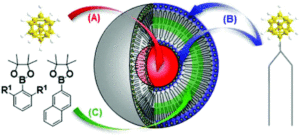
Liposomes have been studied extensively as boron carriers and are promising candidates for BNCT as lipids display low toxicity. In the past, boron-containing liposomes have been prepared by dissolution of boron compounds in an internal water phase (Figure, A) or by using amphiphilic boron compounds embedded in the liposomal bilayer such that boron coats the outer surface of the lipid membrane (Figure, B). Unfortunately, even when these two methods are used in conjunction, the concentration of boron within the liposome is insufficient for effective BNCT and increasing liposomal dosing is problematic as high concentrations of lipids interfere with uptake mechanisms in the liver.

A novel method for boron transport is therefore of high value and in their recent OBC publication, the first example of boron incoporation into liposomal lipid membranes was successfully demonstrated. Key was the preparation of aryl pinacolato boronate esters bearing methyl groups at both ortho positions (Figure, R1 positions) of the phenyl rings which helped in stabilizing the boronate esters against hydrolysis.

While the concentration of boron within the lipid membrane was not particularly high, this study has unlocked yet another avenue through which non-toxic liposomal boron carrier concentrations can be improved and when used with previous boron loading methods, produces liposomes with sufficient boron concentrations to carry out BCNT. This result will no doubt enhance BNCT and lead to critical, life saving therapies for cancer patients.

To find out more see:

Lipid-membrane-incorporated arylboronate esters as agents for boron neutron capture therapy
Masafumi Ueda, Kengo Ashizawa, Kouta Sugikawa, Kazuya Koumoto, Takeshi Nagasaki and Atsushi Ikeda
DOI:10.1039/C6OB02142E


Victoria Corless is currently completing her Ph.D. in organic chemistry with Prof. Andrei Yudin at The University of Toronto. Her research is centred on the synthesis of kinetically amphoteric molecules, which offer a versatile platform for the development of chemoselective transformations with particular emphasis on creating novel biologically active molecules.

Digg This
Reddit This
Stumble Now!
Share on Facebook
Bookmark this on Delicious
Share on LinkedIn
Bookmark this on Technorati
Post on Twitter
Google Buzz (aka. Google Reader)

OrgSyn 50 Conference 27th – 28th February 2017

OrgSyn 50 – Developments in Organic Chemistry

Fluorochem invite you to join them from 27-28 February 2017 in Manchester, UK to celebrate their 50-year milestone in helping support research and supplying intermediates for R&D worldwide.

During the two days there will be 13 outstanding lectures covering a broad range of subjects. Fluorochem are delighted to have attracted a high calibre of speakers to this event and want to ensure people don’t miss out on a unique opportunity to appreciate the remarkable standard of current research being undertaken in the UK. Join them for tales of the unexpected; from fluorination to feedstock, cascades to catalysis and nanoscale to nature. Learn about the latest in cancer research and engage in topics such as rotaxanes, urea function and digitising chemistry.

Introducing an outstanding line up of speakers which includes:

For more information and to register please visit the website.

Digg This
Reddit This
Stumble Now!
Share on Facebook
Bookmark this on Delicious
Share on LinkedIn
Bookmark this on Technorati
Post on Twitter
Google Buzz (aka. Google Reader)