HOT: Understanding the mechanism of non polar Diels Alder reactions

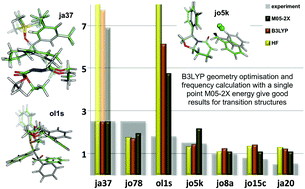
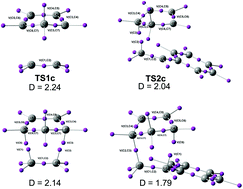
Luis Domingo and colleagues at Universidad de Valencia study the electronic reorganization associated with the non-polar Diels-Alder reaction between cyclopentadiene and ethylene.

To know more about their findings read this HOT (as recommended by the referees) article which is free to access until the 25th November.

Understanding the mechanism of non-polar Diels–Alder reactions. A comparative ELF analysis of concerted and stepwise diradical mechanisms
Luis R. Domingo, Eduardo Chamorro and Patricia Pérez
Org. Biomol. Chem., 2010, Advance Article
DOI: 10.1039/C0OB00563K, Paper

Digg This
Reddit This
Stumble Now!
Share on Facebook
Bookmark this on Delicious
Share on LinkedIn
Bookmark this on Technorati
Post on Twitter
Google Buzz (aka. Google Reader)

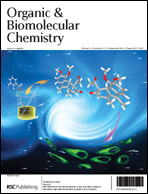
An ‘unexpected’ synthesis – cover of OBC Issue 22

Xianzhang Bu and colleagues at Sun Yat-Sen University in China have ‘unexpectedly’ discovered new fluorescent trans-dihydrofluoren-3-ones from one pot reactions of benzaldehydes and acetylacetone.
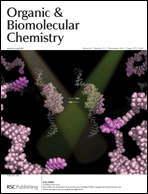
Find out more on the article which is free to access until the 7th December
Have you ever experienced an ‘unexpected’ synthesis in your lab? You can now tell us by commenting on this blog.

New fluorescent trans-dihydrofluoren-3-ones from aldol–Robinson annulation–regioselective addition involved one-pot reaction
Yingpeng Huo, Xu Qiu, Weiyan Shao, Jianing Huang, Yanjun Yu, Yinglin Zuo, Linkun An, Jun Du and Xianzhang Bu
Org. Biomol. Chem., 2010, 8, 5048-5052
DOI: 10.1039/C0OB00401D

Digg This
Reddit This
Stumble Now!
Share on Facebook
Bookmark this on Delicious
Share on LinkedIn
Bookmark this on Technorati
Post on Twitter
Google Buzz (aka. Google Reader)

OBC Lecture Award 2011 – nominations now open!

Nominations are now invited for the 2011 Organic & Biomolecular Chemistry Lecture Award, to be given at the 16th IUPAC International Symposium on Organometallic Chemistry Directed Towards Organic Synthesis (OMCOS 16), held from 24-28 July 2011 in Shanghai, China.

Anyone can make a nomination for the award. All you need to do is send the name of your nominee and a brief justification to the Editor, Dr Richard Kelly. All nominations should take account of the award criteria (below) and the topic of the conference and should be received by Monday 6th December 2010.

This annual award is open to scientists who have made a significant contribution within the scope of OBC and ideally will have an independent academic career of between 8 and 15 years.

The winner, who must be available to give the sponsored lecture, will also be invited to submit a related article for publication in OBC (which will be subject to the usual peer review process). The award, open to anyone fitting these criteria, will cover various expenses incurred at the meeting.

The winner will be selected from the nominees by a panel of judges, who will announce the result in early 2011.

We look forward to receiving your nominations.

Previous winners of the award include Professor Wilfred van der Donk, from University of Illinois, USA and Dr Akimitsu Okamoto, from RIKEN, Japan.

Digg This
Reddit This
Stumble Now!
Share on Facebook
Bookmark this on Delicious
Share on LinkedIn
Bookmark this on Technorati
Post on Twitter
Google Buzz (aka. Google Reader)

Chemistry Nobel Prize 2010 Web Collection

Chemistry Nobel Prize 2010

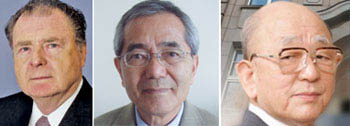
Richard Heck, Ei-ichi Negishi and Akira Suzuki

To commemorate the 2010 Nobel Prize, Organic & Biomolecular Chemistry has collated some of the OBC articles published on cross-coupling reactions in organic chemistry in the last years.

You can take a look at them on this special 2010 Chemistry Nobel Prize web collection.

We hope you enjoy reading them and once again, congratulations to the recipients of this prestigious award.

Digg This
Reddit This
Stumble Now!
Share on Facebook
Bookmark this on Delicious
Share on LinkedIn
Bookmark this on Technorati
Post on Twitter
Google Buzz (aka. Google Reader)

HOT: New methodology to screen thousands of drug-like molecules

David Spring and colleagues at University of Cambridge have developed a new methodology to rapidly screen large arrays of drug-like small molecules.

By using this new 3D microarray platform, they discover small molecules (novel pharmacores) that bind to quorum sensing receptors.
The platform has the potential to display and examine 10000 different small molecules in a miniaturised, low-cost format.

The authors say that ‘this new methodology is likely to find important application within the fields of medicinal chemistry, chemical biology, molecular recognition and chemical genetics, where the aim is to discover small molecules that bind to macromolecular complexes’

As a HOT article, it will be free to access until the 10th November.

Read more and tell us about it.

Discovery of a quorum sensing modulator pharmacophore by 3D small-molecule microarray screening
David M. Marsden, Rebecca L. Nicholson, Mette E. Skindersoe, Warren R. J. D. Galloway, Hannah F. Sore, Michael Givskov, George P. C. Salmond, Mark Ladlow, Martin Welch and David R. Spring
Org. Biomol. Chem., 2010, Advance Article
DOI: 10.1039/C0OB00300J, Paper

Digg This
Reddit This
Stumble Now!
Share on Facebook
Bookmark this on Delicious
Share on LinkedIn
Bookmark this on Technorati
Post on Twitter
Google Buzz (aka. Google Reader)

OBC Inside Cover Issue 21

Toshihiro Ihara and colleagues at Kumamoto University demonstrate a quick reversible photocircularization of an anthracene-modified oligodeoxyribonucleotide conjugate and provide an example of its analytical application.

‘ The oligonucleotide conjugate was reversibly circularized through photodimerization of the antracenes attached on both ends. This process would be potentially useful as a probe reaction with high specificity and sensitivity’ say the authors on the description of their cover.

Read the article free to access until the end of November

Reversible circularization of an anthracene-modified DNA conjugate through bimolecular triplex formation and its analytical application
Pelin Arslan, Akinori Jyo and Toshihiro Ihara
Org. Biomol. Chem., 2010, 8, 4843-4848
DOI: 10.1039/C0OB00282H

Digg This
Reddit This
Stumble Now!
Share on Facebook
Bookmark this on Delicious
Share on LinkedIn
Bookmark this on Technorati
Post on Twitter
Google Buzz (aka. Google Reader)

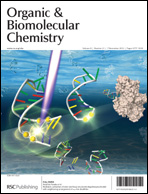
OBC Issue 21 Outside Cover

Tanabe, Nishimoto and co-workers at Kyoto University, propose a mechanism for the intramolecular cyclization of modified oligodeoxynucleotides bearing a pair of disulfides.

This colourful cover represents how X-Ray irradiation of an aqueous solution of modified oligodeoxynucleotides with a pair of disulfides at both ends causes efficient cyclization via an
intramolecular exchange reaction.

The article is free to access until the end of November.

Radiolytic cyclization of stem-and-loop structured oligodeoxynucleotide with neighboring arrangement of α,ω-bis-disulfides
Kazuhito Tanabe, Eiji Matsumoto, Takeo Ito and Sei-ichi Nishimoto
Org. Biomol. Chem., 2010, 8, 4837-4842
DOI: 10.1039/C0OB00275E

Digg This
Reddit This
Stumble Now!
Share on Facebook
Bookmark this on Delicious
Share on LinkedIn
Bookmark this on Technorati
Post on Twitter
Google Buzz (aka. Google Reader)

Efficient Biodiesel Conversion

Aaron Socha and Jason Sello at Brown University, USA, describe an efficient method to convert both virgin and waste vegetable oils into biodiesel in a single reaction vessel by using scandium and bismuth triflates as catalysts.

Some of the advantages of this new environmentally friendly method are:

  • The lack of corrosive chemicals
  • The high efficiency: conversion in 6 times faster
  • The simplicity: one step reaction in one vessel
  • The use of environmentally friendly and recoverable catalysts

Not surprisingly, this paper has been highlighted in many different outlets. These are just some of them:

You can now read this article for free until the 4th November:

Efficient conversion of triacylglycerols and fatty acids to biodiesel in a microwave reactor using metal triflate catalysts
Aaron M. Socha and Jason K. Sello
Org. Biomol. Chem., 2010, 8, 4753-4756
DOI: 10.1039/C0OB00014K, Paper

From the Organic & Biomolecular Chemistry editorial office we wanted to congratulate the authors of this paper and encourage them to carry on developing their meaningful research.

Digg This
Reddit This
Stumble Now!
Share on Facebook
Bookmark this on Delicious
Share on LinkedIn
Bookmark this on Technorati
Post on Twitter
Google Buzz (aka. Google Reader)

Nobel Prize to Organic Chemistry

Congratulations to  Richard Heck (University of Delaware, USA), Ei-ichi Negishi (Purdue University, USA) and Akira Suzuki (Hokkaido University, Japan), the recipients of the 2010 Nobel Prize in Chemistry.

These three chemists have been working independently on palladium-catalysed cross coupling reactions to make C-C bonds to design new organic molecules. Their chemical methods are widely used by the chemical communities  to develop new compounds and molecules with applications in pharmaceuticals, agriculture and the electronic industry.

I was listening to Professor Negishi this morning on his first interview live from Stockholm and he was absolutely delighted with the news. He was awoken by a phone call that told him he was one of the Chemistry Nobel Prize winners – what a great way of waking up in the morning!

Negishi said that he was ‘extremely happy – this means a lot’.   ‘I have been dreaming about this prize for half a century, since I came to America and encountered several Nobel laureates, when I realised it was not a story – it was a reality which in principle could happen to anyone, including myself.’ 
Professor Negishi, 2010 was your turn! Congratulations.

Neghisi, Suzuki and Heck will go to Stockohlm next December to receive this very well deserved prestigious prize. From Organic & Biomolecular Chemistry we wanted to send our most sincere appreciation and admiration to these three pioneers of organic chemistry.

Read more from Chemistry World here.

Digg This
Reddit This
Stumble Now!
Share on Facebook
Bookmark this on Delicious
Share on LinkedIn
Bookmark this on Technorati
Post on Twitter
Google Buzz (aka. Google Reader)

OBC Accepted Manuscripts: publishing your research even faster

In a fast moving subject field, you need your research to be available to the community as soon as possible.

At Organic & Biomolecular Chemistry (OBC) we are working with our authors to make this happen. That’s why you can now choose to have the unedited and unformatted version of your article published shortly after acceptance as an Accepted Manuscript.

This new, free service from RSC Publishing allows you to make your results available, in citable form, before publication of the edited article. Published on the website as a downloadable pdf file, your Accepted Manuscript is readily accessible to the people you want to read it.

Of course, all OBC articles will continue to receive the current high quality editing and formatting service from RSC Publishing’s professional team of technical editors. Once the fully edited and formatted Advance Article is published the Accepted Manuscript version of your article will become unavailable.

Check out these examples of recent Accepted Manuscripts free:

Microwave and flow syntheses of Pseudomonas quinolone signal (PQS) and analogues
James Hodgkinson, Warren Galloway, Shreya Saraf, Ian R Baxendale, Steven V Ley, Mark Ladlow, Martin Welch      
and David Spring
Org. Biomol. Chem., 2010, DOI: 10.1039/C0OB00652A

A ferrocene functionalized rotaxane host system capable of the electrochemical recognition of chloride
Nicholas Henley Evans and P D Beer
Org. Biomol. Chem., 2010, DOI: 10.1039/C0OB00458H

More information about OBC Accepted Manuscripts can be found on our blog.

Wouldn’t it be great to have your research read by your peers almost as soon as you know your manuscript has been accepted? Go online to submit your next article  to OBC now: we look forward to receiving your work.

Digg This
Reddit This
Stumble Now!
Share on Facebook
Bookmark this on Delicious
Share on LinkedIn
Bookmark this on Technorati
Post on Twitter
Google Buzz (aka. Google Reader)