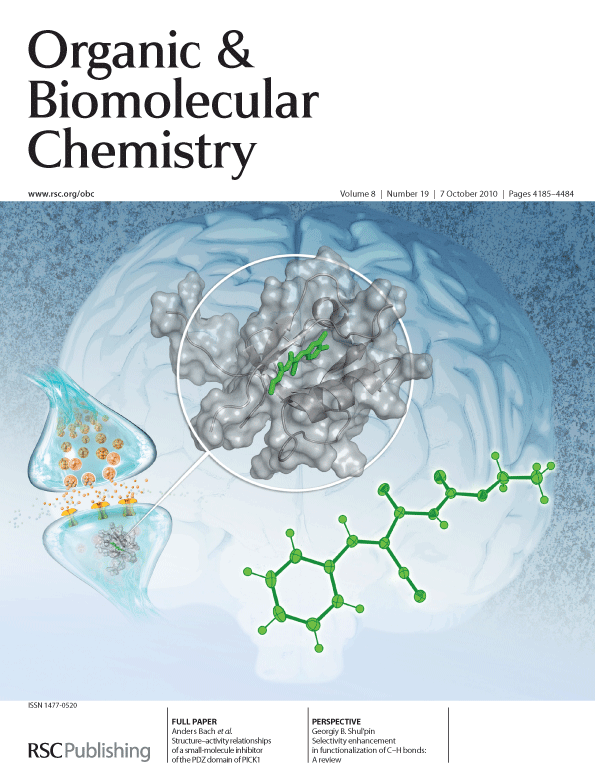
OBC Issue 19 Inside Cover: Gether and Stromgaard

Ulrik Gether, Kristian Stromgaard and colleagues at University of Copenhagen explore the structure-activity relationships of the first small molecule inhibitor of PICK 1, a potential drug target against brain ischemia, pain and cocain addiction.

It is the inside cover of OBC Issue 19 and it will be free to access until October 19th.

Read it and try to PICK 1 comment!

Structure–activity relationships of a small-molecule inhibitor of the PDZ domain of PICK1
Anders Bach, Nicolai Stuhr-Hansen, Thor S. Thorsen, Nicolai Bork, Irina S. Moreira, Karla Frydenvang, Shahrokh Padrah, S. Brøgger Christensen, Kenneth L. Madsen, Harel Weinstein, Ulrik Gether and Kristian Strømgaard
Org. Biomol. Chem., 2010, 8, 4281-4288
DOI: 10.1039/C0OB00025F

Digg This
Reddit This
Stumble Now!
Share on Facebook
Bookmark this on Delicious
Share on LinkedIn
Bookmark this on Technorati
Post on Twitter
Google Buzz (aka. Google Reader)

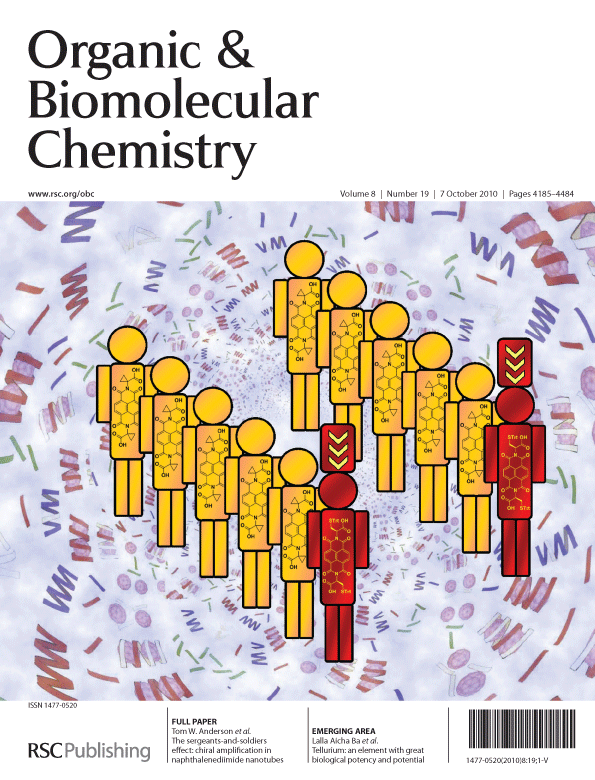
OBC Cover Issue 19: Sergeants and soldiers

Dan Pantos and co-workers at Cambridge University explore the ‘sergeants and soldiers’ behaviour where a chiral derivative, amino acid derivatives of naphtalene-diimides (NDIs), imposes its chirality on a structure formed out of achiral derivatives.

Supramolecular systems, nanotubes, C60… everything included in this very interesting paper, front cover of OBC Issue 19.

Reading it is a must (although not an order!) and commenting on it an option
Free to access until 19th October

The sergeants-and-soldiers effect: chiral amplification in naphthalenediimide nanotubes
Tom W. Anderson, Jeremy K. M. Sanders and G. Dan Pantoş
Org. Biomol. Chem., 2010, 8, 4274-4280
DOI: 10.1039/C0OB00027B

Digg This
Reddit This
Stumble Now!
Share on Facebook
Bookmark this on Delicious
Share on LinkedIn
Bookmark this on Technorati
Post on Twitter
Google Buzz (aka. Google Reader)

Top ten most accessed articles in July

This month sees the following articles in Organic & Biomolecular Chemistry that are in the top ten most accessed:-

Heterocycles in organic synthesis: thiazoles and triazoles as exemplar cases of synthetic auxiliaries
Alessandro Dondoni
Org. Biomol. Chem., 2010, 8, 3366-3385, DOI: 10.1039/C002586K

In water, on water, and by water: mimicking nature’s aldolases with organocatalysis and water
Nobuyuki Mase and Carlos F. Barbas, III
Org. Biomol. Chem., 2010, 8, 4043-4050, DOI: 10.1039/C004970K

Folding and self-assembly of aromatic and aliphatic urea oligomers: Towards connecting structure and function
Lucile Fischer and Gilles Guichard
Org. Biomol. Chem., 2010, 8, 3101-3117, DOI: 10.1039/C001090A

Nitrone protecting groups for enantiopure N-hydroxyamino acids: synthesis of N-terminal peptide hydroxylamines for chemoselective ligations
S. Irene Medina, Jian Wu and Jeffrey W. Bode
Org. Biomol. Chem., 2010, 8, 3405-3417, DOI: 10.1039/C004490C

Intramolecular Michael addition reaction for the synthesis of benzylbutyrolactones
Hu He, Li-Xin Dai and Shu-Li You
Org. Biomol. Chem., 2010, 8, 3207-3210, DOI: 10.1039/B924770J

Expedient, one-pot preparation of fused indoles via CAN-catalyzed three-component domino sequences and their transformation into polyheterocyclic compounds containing pyrrolo[1,2-a]azepine fragments
Padmakar A. Suryavanshi, Vellaisamy Sridharan and J. Carlos Menéndez
Org. Biomol. Chem., 2010, 8, 3426-3436, DOI: 10.1039/C004703A

Ultrafast Grignard addition reactions in the presence of water
Gyorgyi Osztrovszky, Torkil Holm and Robert Madsen
Org. Biomol. Chem., 2010, 8, 3402-3404, DOI: 10.1039/C0OB00170H

A three-step tandem process for the synthesis of bicyclic γ-lactams
Fiona I. McGonagle, Lindsay Brown, Andrew Cooke and Andrew Sutherland
Org. Biomol. Chem., 2010, 8, 3418-3425, DOI: 10.1039/C004695G

Total synthesis of decarestrictine I and botryolide B via RCM protocol
Palakodety Radha Krishna and T. Jagannadha Rao
Org. Biomol. Chem., 2010, 8, 3130-3132, DOI: 10.1039/C004556J

Picolylamine as an organocatalyst template for highly diastereo- and enantioselective aqueous aldol reactions
Thomas C. Nugent, M. Naveed Umar and Ahtaram Bibi
Org. Biomol. Chem., 2010, 8, 4085-4089, DOI: 10.1039/C0OB00049C

Why not take a look at the articles today and blog your thoughts and comments below.

Fancy submitting an article to Organic & Biomolecular Chemistry? Then why not submit to us today or alternatively email us your suggestions.

Digg This
Reddit This
Stumble Now!
Share on Facebook
Bookmark this on Delicious
Share on LinkedIn
Bookmark this on Technorati
Post on Twitter
Google Buzz (aka. Google Reader)

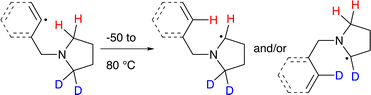
HOT: Deuterium as a protecting group

Can Deuterium act as a protecting group to prevent unwanted hydrogen atom transfers?

Mark Wood and colleagues have the answer here.

Reviewers were very impressed with it and we made it a HOT article.

Curious? Find out more! Free to access until the end of September.

Synthetic use of the primary kinetic isotope effect in hydrogen atom transfer: generation of α-aminoalkyl radicals
Mark E. Wood, Sabine Bissiriou, Christopher Lowe, Andrew M. Norrish, Katell Sénéchal, Kim M. Windeatt, Simon J. Coles and Michael B. Hursthouse
Org. Biomol. Chem., 2010, Advance Article
DOI: 10.1039/C0OB00205D , Paper

Digg This
Reddit This
Stumble Now!
Share on Facebook
Bookmark this on Delicious
Share on LinkedIn
Bookmark this on Technorati
Post on Twitter
Google Buzz (aka. Google Reader)

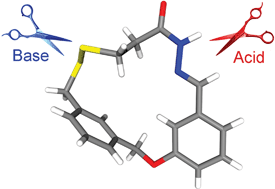
HOT: Chemistry of a hydrazone-disulfide macrocycle

David Leigh and co-workers talk about a macrocycle that contains both a hydrazone and a disulfide linkage.
Find out more about the synthesis, the structure and the different chemistry they perform on it in this very interesting paper.

Excellent reviews from the referees and thumbs up from the editorial office make it a HOT paper.

Free to access until the end of September.

Synthesis and solid state structure of a hydrazone-disulfide macrocycle and its dynamic covalent ring-opening under acidic and basic conditions
Max von Delius, Edzard M. Geertsema, David A. Leigh and Alexandra M. Z. Slawin
Org. Biomol. Chem., 2010, Advance Article
DOI: 10.1039/C0OB00214C, Paper

Digg This
Reddit This
Stumble Now!
Share on Facebook
Bookmark this on Delicious
Share on LinkedIn
Bookmark this on Technorati
Post on Twitter
Google Buzz (aka. Google Reader)

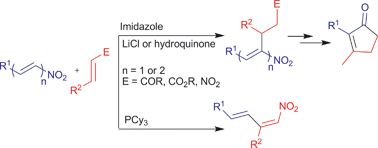
HOT: Nitroalkenes and nitrodienes reactions

Namboothiri and colleagues describe Rauhut-Curier (RC) reactions of aliphatic nitroalkenes and nitrodienes with enones and acrylates.

It has received very positive comments from the referees and the Editorial Office. What do you think?

As a HOT article, it will be free to access until September 26th.

Rauhut–Currier type homo- and heterocouplings involving nitroalkenes and nitrodienes
Pramod Shanbhag, Pradeep R. Nareddy, Mamta Dadwal, Shaikh M. Mobin and Irishi N. N. Namboothiri
Org. Biomol. Chem., 2010, Advance Article
DOI: 10.1039/C0OB00062K , Paper

Digg This
Reddit This
Stumble Now!
Share on Facebook
Bookmark this on Delicious
Share on LinkedIn
Bookmark this on Technorati
Post on Twitter
Google Buzz (aka. Google Reader)

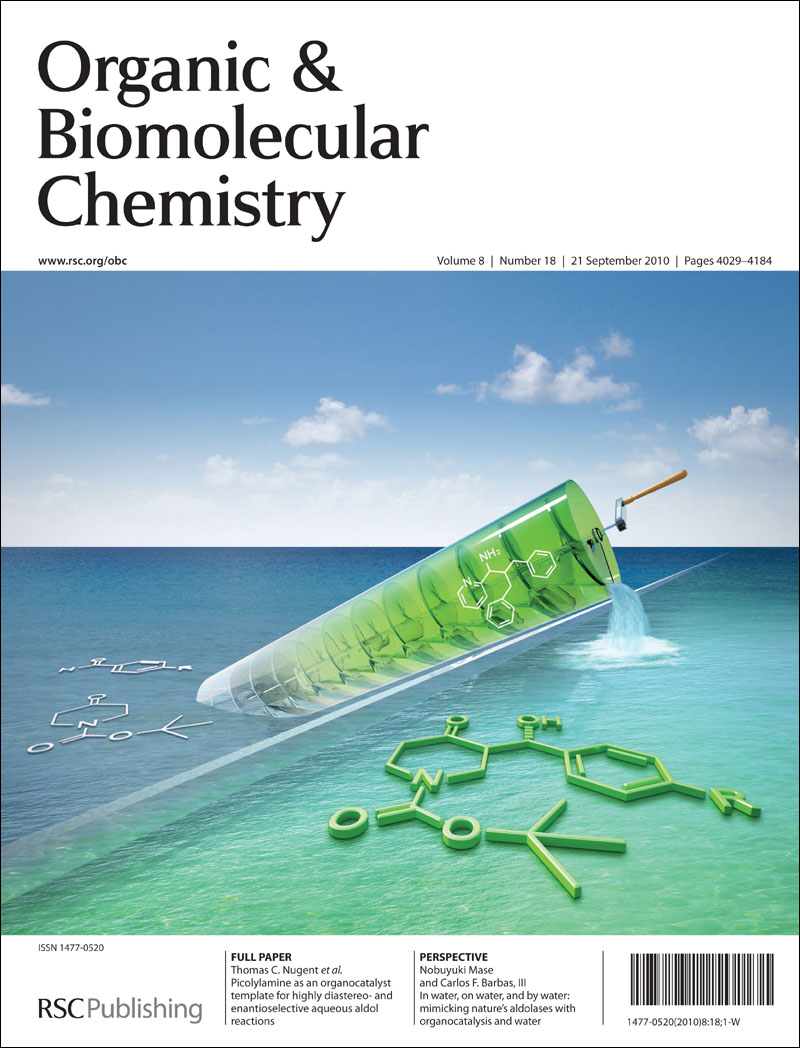
OBC Issue 18 Cover: Organocatalysis and aqueous aldol reactions

Thomas Nugent and co-workers talk about the top organocatalysts for cyclic ketones and discover a 2-picolylamine template which is a promising new organocatalyst for aqueous aldol reactions.

Do you want to read more? You can do it for free until early October here!

Picolylamine as an organocatalyst template for highly diastereo- and enantioselective aqueous aldol reactions
Thomas C. Nugent, M. Naveed Umar and Ahtaram Bibi
Org. Biomol. Chem., 2010, 8, 4085-4089
DOI: 10.1039/C0OB00049C

Digg This
Reddit This
Stumble Now!
Share on Facebook
Bookmark this on Delicious
Share on LinkedIn
Bookmark this on Technorati
Post on Twitter
Google Buzz (aka. Google Reader)

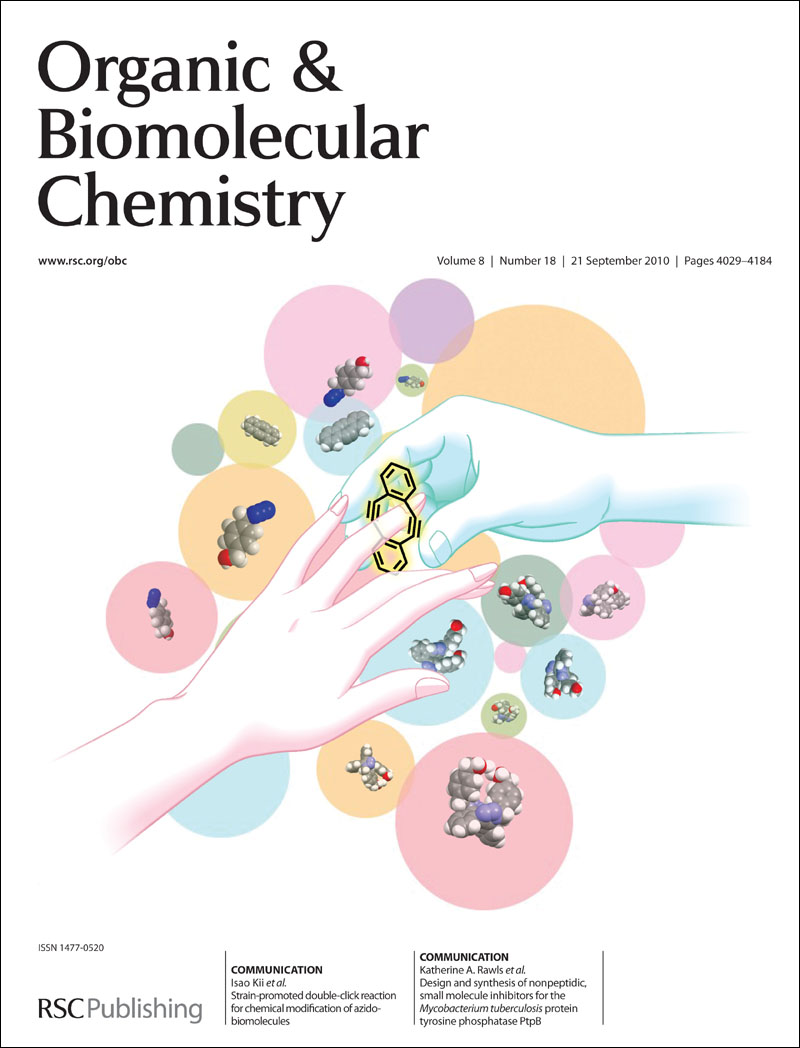
OBC Inside Cover Issue 18: “Double-click” chemistry

Isao Kii, Takamitsu Hosoya and colleagues modify an azido-biomolecule by a new method that conjugates three molecules spontaneously in a catalyst-free strain-promoted “double-click” (SPDC) reaction.

If you find “click chemistry” interesting, this will double your enjoyment!

Discover this facile method to prepare various functional biomolecules by “clicking” here.

Strain-promoted double-click reaction for chemical modification of azido-biomolecules
Isao Kii, Akira Shiraishi, Toshiyuki Hiramatsu, Takeshi Matsushita, Hidehiro Uekusa, Suguru Yoshida, Makoto Yamamoto, Akira Kudo, Masatoshi Hagiwara and Takamitsu Hosoya
Org. Biomol. Chem., 2010, 8, 4051-4055
DOI: 10.1039/C0OB00003E , Communication

Free to access until early October!

What do you think?

Digg This
Reddit This
Stumble Now!
Share on Facebook
Bookmark this on Delicious
Share on LinkedIn
Bookmark this on Technorati
Post on Twitter
Google Buzz (aka. Google Reader)

Tom Driver-OBC cover Issue 17-Free to access now

Tom Driver, from University of Illinois at Chicago, tells us about efficient ways to  construct new C-N and S-N bonds from azides using Transition metal-catalyzed N-atom transfer reactions.

This is the inside cover article of OBC Issue 17 and therefore is free to access for 6 weeks!

A simple, colourful and direct cover for a comprehensible, didactic and clear perspective.

Read it here and feel free to comment on it.

Recent advances in transition metal-catalyzed N-atom transfer reactions of azides
Tom G. Driver
Org. Biomol. Chem., 2010, 8, 3831-3846

Digg This
Reddit This
Stumble Now!
Share on Facebook
Bookmark this on Delicious
Share on LinkedIn
Bookmark this on Technorati
Post on Twitter
Google Buzz (aka. Google Reader)

Synthesis of oxindole-OBC Issue 17 cover

Jian Zhou and colleagues at East China Normal University in Shanghai find a very straightforward method for the synthesis of oxindole, a very important subunit in many bioactive natural products and drugs.

OBC cover of Issue 17 shows the direct road that leads to the synthesis of this very useful product. It is free to access for 6 weeks from publication of the issue.

Do you want to know more? Read it here and let us know what you think!

A facile method for the synthesis of oxindole based quaternary α-aminonitriles via the Strecker reaction
Yun-Lin Liu, Feng Zhou, Jun-Jie Cao, Cong-Bin Ji, Miao Ding and Jian Zhou
Org. Biomol. Chem., 2010, 8, 3847-3850

Digg This
Reddit This
Stumble Now!
Share on Facebook
Bookmark this on Delicious
Share on LinkedIn
Bookmark this on Technorati
Post on Twitter
Google Buzz (aka. Google Reader)