Top ten most accessed articles in June

This month sees the following articles in Organic & Biomolecular Chemistry that are in the top ten most accessed:

Gold catalyzed oxycyclizations of alkynols and alkyndiols
Benito Alcaide, Pedro Almendros and José Miguel Alonso
Org. Biomol. Chem., 2011, 9, 4405-4416
DOI: 10.1039/C1OB05249G

Acylation of Grignard reagents mediated by N-methylpyrrolidone: A remarkable selectivity for the synthesis of ketones
Maravanhalli Sidde Gowda, Sushanth Sudhir Pande, Ramesha Andagar Ramakrishna and Kandikere Ramaiah Prabhu
Org. Biomol. Chem., 2011, 9, 5365-5368
DOI: 10.1039/C1OB05780D

Nitrogen cation–p interactions in asymmetric organocatalytic synthesis
Shinji Yamada and John S. Fossey
Org. Biomol. Chem., 2011, Advance Article
DOI: 10.1039/C1OB05228D

Protein assisted fluorescence enhancement of a dansyl containing fluorescent reagent: Detection of Hg+ ion in aqueous medium
Priyanka Srivastava, Mohammad Shahid and Arvind Misra
Org. Biomol. Chem., 2011, 9, 5051-5055
DOI: 10.1039/C1OB05540B

Synthetic studies on the solanacol ABC ring system by cation-initiated cascade cyclization: implications for strigolactone biosynthesis
Kinga Chojnacka, Stefano Santoro, Radi Awartani, Nigel G. J. Richards, Fahmi Himo and Aaron Aponick
Org. Biomol. Chem., 2011, 9, 5350-5353
DOI: 10.1039/C1OB05751K

Kopsihainanines A and B, two unusual alkaloids from Kopsia hainanensis
Jia Chen, Jian-Jun Chen, Xiaojun Yao and Kun Gao
Org. Biomol. Chem., 2011, 9, 5334-5336
DOI: 10.1039/C1OB05724C

A rapid and convergent synthesis of the integrastatin core
Pamela M. Tadross, Pradeep Bugga and Brian M. Stoltz
Org. Biomol. Chem., 2011, 9, 5354-5357
DOI: 10.1039/C1OB05725A

Carbohydrate chemistry in drug discovery
M. Carmen Galan, David Benito-Alifonso and Gregory M. Watt
Org. Biomol. Chem., 2011, 9, 3598-3610
DOI: 10.1039/C0OB01017K

Cascade polycyclisations in natural product synthesis
Edward A. Anderson
Org. Biomol. Chem., 2011, 9, 3997-4006
DOI: 10.1039/C1OB05212H

An organocatalytic ionic liquid
Zsolt Kelemen, Oldamur Hollóczki, József Nagy and László Nyulászi
Org. Biomol. Chem., 2011, 9, 5362-5364
DOI: 10.1039/C1OB05639E

Why not take a look at the articles today and blog your thoughts and comments below.

Fancy submitting an article to Organic & Biomolecular Chemistry? Then why not submit to us today or alternatively email us your suggestions.

Digg This
Reddit This
Stumble Now!
Share on Facebook
Bookmark this on Delicious
Share on LinkedIn
Bookmark this on Technorati
Post on Twitter
Google Buzz (aka. Google Reader)

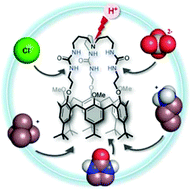
HOT: Versatile Calix[6]crypturea receptor with variable functionalities

Ivan Jabin and collaborators in Belgium and France have designed a novel Calix[6]crypturea receptor with unique binding properties that are acid-base controllable.

This external stimulus is used to modulate the flexibility of the calixarene, allowing it to bind either neutral molecules, anions, primary/secondary ammonium ions, quaternary ammonium ions, with remarkable selectivity.

Interested? Why not read the article now and let us know what you think by leaving a comment below!

Acid–base modulation of a versatile heteroditopic calix[6]arene based receptor Damien Cornut, Jérôme Marrot, Johan Wouters and Ivan Jabin
Org. Biomol. Chem., 2011, Advance Article
DOI: 10.1039/C1OB05759F, Paper

This OBC paper has been selected as a Hot Article and will be FREE to access to all for a period of 4 weeks.

Digg This
Reddit This
Stumble Now!
Share on Facebook
Bookmark this on Delicious
Share on LinkedIn
Bookmark this on Technorati
Post on Twitter
Google Buzz (aka. Google Reader)

Laser Flash Photolysis – an insight into retinol’s phototoxicity

While retinoids are essential in many biological processes such as vision or cell differentiation and can be found in many of our favorite cosmetic products, both phototoxicity and photocarcinogenicity have been reported for retinol. Professor Fukuzumi and Dr. El-Agamey at Ozaka University (Japan) are shedding light on the roles of retinol in phototoxicity and free radical initiated oxidative stress: using Laser Flash Photolysis, the scientists have successfully generated the retinol radical cation , which was found to be reactive towards bases and other carotinoids inducing pro-oxidant effects.

Wish to find out more? Why not read this OBC paper today!

Laser flash photolysis study on the retinol radical cation in polar solvents
Ali El-Agamey and Shunichi Fukuzumi
Org. Biomol. Chem.., 2011, Advance Article
DOI: 10.1039/C1OB05814B, Paper

This Hot Article will be FREE to access to all for a period of 4 weeks.

Digg This
Reddit This
Stumble Now!
Share on Facebook
Bookmark this on Delicious
Share on LinkedIn
Bookmark this on Technorati
Post on Twitter
Google Buzz (aka. Google Reader)

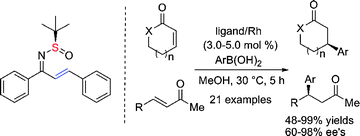
HOT: Chiral olefin/sulfinimide hybrid ligands for efficient asymmetric 1,4-additions

Haifeng Du and colleagues from the Chinese Academy of Sciences and the Beijing University of Chemical Technology (Beijing, PR China) have used a simple one-step condensation of a α,β-unsaturated ketones and readily available (R)-tert-butanesulfinamide to synthesise a variety of chiral olefin/sulfinimide hybrid ligands. Highly efficient in rhodium-catalyzed asymmetric 1,4-additions, these novel ligands lead to high yields with excellent ee’s (up to 98%) , and could find wide application as a useful asymmetric synthetic methodology.

Interested in asymmetric 1,4-additions? Why not read this OBC communication now!

Chiral N-tert-butanesulfinyl α,β-unsaturated ketimine: a simple and highly effective olefin/sulfinimide hybrid ligand for asymmetric 1,4-additions
Xiangqing Feng, Beibei Wei, Jing Yang and Haifeng Du
Org. Biomol. Chem., 2011, 9, 5927-5929
DOI: 10.1039/C1OB05971H

This OBC communication will be FREE to access to all for a period of 4 weeks

Digg This
Reddit This
Stumble Now!
Share on Facebook
Bookmark this on Delicious
Share on LinkedIn
Bookmark this on Technorati
Post on Twitter
Google Buzz (aka. Google Reader)

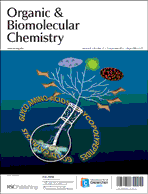
Gold-catalysed glycosylation on the cover of Issue 17

Work from Srinivas Hotha at the Indian Institute of Science Education & Research, and colleagues at the National Chemical Laboratory (Pune, India) features on the front cover of Issue 17. Their paper describes the efficient preparation of glycosylated amino acids using propargyl orthoesters as glycosyl donors, via gold-catalysis.

Are your interests in carbohydrate chemistry, or peptide and glycopeptide chemistry? Then this article is for you!

Facile synthesis of unusual glycosyl carbamates and amino acid glycosides from propargyl 1,2-orthoesters as glycosyl donors
Ashif Y. Shaikh, Gopalsamy Sureshkumar, Debasish Pati, Sayam Sen Gupta and Srinivas Hotha
Org. Biomol. Chem., 2011, 9, 5951-5959
DOI: 10.1039/C1OB05056G


As with all our cover articles, this paper is free to access for 6 weeks – why not download it today.

View the issue here

Digg This
Reddit This
Stumble Now!
Share on Facebook
Bookmark this on Delicious
Share on LinkedIn
Bookmark this on Technorati
Post on Twitter
Google Buzz (aka. Google Reader)

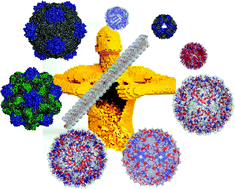
HOT: Bionanoparticles as building blocks

Nature has designed many biogenic systems with exquisite symmetries and complexities on the nanometer scale, such as viruses, ferritins and enzyme complexes. These structures have acted as building blocks on which researchers have been able to develop bionanoparticles with a wide variety of applications including biosensors, electronic nanodevices,  drug delivery agents and vaccine carriers, amongst others. 

In this OBC Perspective Qian Wang and colleagues highlight some of the recent progress in the chemical modification and molecular engineering of these bionanoparticles with the aim of sparking new discussions and inspiring the development of many new materials in the future.

Graphical abstract: Altering the landscape of viruses and bionanoparticles

Interested? Then why not read this comprehensive review now. It is free to download for the next four weeks!

Altering the landscape of viruses and bionanoparticles
L. Andrew Lee, Huong Giang Nguyen and Qian Wang
Org. Biomol. Chem., 2011, DOI: 10.1039/C1OB05700F

Digg This
Reddit This
Stumble Now!
Share on Facebook
Bookmark this on Delicious
Share on LinkedIn
Bookmark this on Technorati
Post on Twitter
Google Buzz (aka. Google Reader)

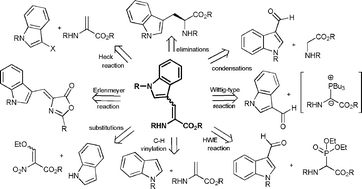
Review: Dehydrotryptophan – a building block for peptide synthesis

Produced by microorganisms, marine organisms and plants, dehydrotriptophan and its derivatives are amino acids commonly found in peptide-based natural products, thereby prompting their use as a building block for peptide synthesis.

Although literature is available on the synthesis of dehydroamino acids, the focus on dehydrotriptophan has now been addressed by Margaret Brimble and coworkers (the University of Auckland, New Zealand) in this OBC Perspective, which highlights the different methods to synthesise the dehydrotryptophan-containing segment of naturally occurring peptides, amino acids and their derivatives.

Interested? Then why not read this comprehensive review now:
The synthesis of dehydrotryptophan and dehydrotryptophan-containing peptides Harveen Kaur, Amanda M. Heapy and Margaret A. Brimble
Org. Biomol. Chem., 2011, Advance Article
DOI: 10.1039/C1OB05777D, Perspective

Digg This
Reddit This
Stumble Now!
Share on Facebook
Bookmark this on Delicious
Share on LinkedIn
Bookmark this on Technorati
Post on Twitter
Google Buzz (aka. Google Reader)

HOT: Using precursor-directed biosynthesis to open new fronts in the battle against cancer

Supplying an organism with modified precursor materials for biosynthesis is a great way of hijacking the synthetic machinery of an organism to make the compounds you want. In this paper Cormac Murphy and colleagues from University College Dublin and Ecole Normale Superieure demonstrate that precursor-directed biosynthesis is a convenient way to create analogs of rumbrin with tunable potency and selectivity, also showing that the 3-chloropyrrole moiety is not absolutely essential for biological activity in this class of polyenes. One of the compounds prepared showed dramatically improved activity against lung cancer cells.

Interested? Read this article in OBC, it is free to access for the next four weeks!

Production of anticancer polyenes through precursor-directed biosynthesis
Benjamin R. Clark, Stephen O’Connor, Deirdre Fox, Jacques Leroy and Cormac D. Murphy
Org. Biomol. Chem., 2011, Advance Article

DOI: 10.1039/C1OB05667K

Digg This
Reddit This
Stumble Now!
Share on Facebook
Bookmark this on Delicious
Share on LinkedIn
Bookmark this on Technorati
Post on Twitter
Google Buzz (aka. Google Reader)

Review: Glycoconjugates degradation – the enzymes involved and their probes

Glycoconjugates play a major role in a number of biological processes, for example modulating cellular interactions, and chemical tools have been instrumental in understanding these aspects of the glycosciences.

In this OBC Perspective Herman Overkleeft and co-authors provide an overview of the enzymes involved in the degradation of glycoconjugates, and the activity-based probes that have been used to study these enzymes, along with the advantages and disadvantages of these probes. Addressing all facets of carbohydrate enzymology, the authors identify a number of key areas for future development in the field.

Are you a glycoscientist or a bioorganic chemist? Then this OBC Perspective is for you! Download the article to read the full details:
Irreversible inhibitors and activity-based probes as research tools in chemical glycobiology
Martin D. Witte, Gijsbert A. van der Marel, Johannes M. F. G. Aerts and Herman S. Overkleeft
Org. Biomol. Chem., 2011, Advance Article
DOI: 10.1039/C1OB05531C, Perspective

Digg This
Reddit This
Stumble Now!
Share on Facebook
Bookmark this on Delicious
Share on LinkedIn
Bookmark this on Technorati
Post on Twitter
Google Buzz (aka. Google Reader)

HOT: Novel drugs fight back against MRSA

The enormous success of antibiotics is seriously threatened by the development of resistance to many drugs available on the market. So the search for new antibiotics that are less prone to resistance is on.

Antimicrobial peptides (AMPs) are a possible solution that has attracted considerable attention but they have some drawbacks including high cost of manufacturing. Now Steven Firestine and colleagues at Wayne State University in the US have examined the potential of a new class of benzophenone-based membrane targeted antibiotics (BPMTAs).

Firestine shows that these agents release potassium ions from treated bacteria which  results in disruption of the bacterial membrane potential. This membrane-targeted disruption means that BPMTAs have excellent activity against antibiotic-resistant strains like MRSA and VRSA.

Structures of novel membrane-targeted antibiotics.

The team have demonstrated the promising potential of these agents by using them to cure mice of a lethal MRSA infection. They were also unable to develop a mutant resistant to the agents.

Interested? Read the article in OBC that is free to access for the next four weeks!

Examination of a synthetic benzophenone membrane-targeted antibiotic
Sunil K. Vooturi, Mahender B. Dewal and Steven M. Firestine
Org. Biomol. Chem., 2011, DOI: 10.1039/C1OB05643C

Digg This
Reddit This
Stumble Now!
Share on Facebook
Bookmark this on Delicious
Share on LinkedIn
Bookmark this on Technorati
Post on Twitter
Google Buzz (aka. Google Reader)