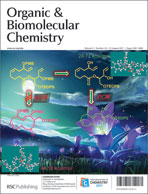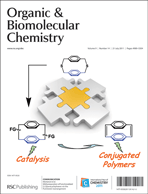
RCM synthesis of amphidinolactone A core on the cover of Issue 16

On the front cover of this issue is work from Debendra Mohapatra at the Indian Institute of Chemical Technology, together with colleagues at Hyderabad University and King Saud University on the ring-closing metathesis based synthesis of the macrolactone core of amphidinolactone A.

The convergent synthesis achieved the macrolactone core in 32% yield and demonstrated the steric hinderance resulting from protecting groups in the RCM reaction.  PMB (p-methoxybenzyl ether) protecting groups on the macrolactonization precursor prevented the RCM reaction from proceeding, but  simple de-protection to the subsequent diol achieved the 13-membered lactone ring system present in amphidinolactone A in 76% yield.  Further work to incorporate the the RCM reaction into the total synthesis of amphidinolactone A is ongoing.

Ring-closing metathesis (RCM) based synthesis of the macrolactone core of amphidinolactone A
Debendra K. Mohapatra, Manas R. Pattanayak, Pragna P. Das, Tapas R. Pradhan and J. S. Yadav
Org. Biomol. Chem., 2011,
DOI: 10.1039/C1OB05335C

View the rest of the articles in Issue 16

Digg This
Reddit This
Stumble Now!
Share on Facebook
Bookmark this on Delicious
Share on LinkedIn
Bookmark this on Technorati
Post on Twitter
Google Buzz (aka. Google Reader)

HOT: vinylogous Mukaiyama-Michael reaction for synthesis of γ-subsituted butenolides

The butenolide skeleton is one of the more common to natural products and bioative compounds, thus its synthesis has afforded much attention from synthetic chemists in recent years.  Here, Xiamong Feng and colleagues from the Key Laboratory of Green Chemistry and Technology at Sichuan University have devised a simple route that affords the desired γ-butenolide compounds in high yields with high levels of selectivity.

By using a chiral N,N‘-dioxide-scandium catalyst in an asymmetric vinylogous Mukaiyama–Michael reaction they were able to form highly functionalized chiral γ-substituted butenolides with broad substrate scope, with up to 92% ee.  The pathway is air stable and produces product on a gram scale.

For the full details download the article – it’s free to access for the next four weeks:

Highly enantioselective synthesis of γ-substituted butenolides via the vinylogous Mukaiyama–Michael reaction catalyzed by a chiral scandium(III)–N,N′-dioxide complex
Qi Zhang, Xiao Xiao, Lili Lin, Xiaohua Liu and Xiaoming Feng
Org. Biomol. Chem., 2011, Advance Article
DOI: 10.1039/C1OB05558E

Digg This
Reddit This
Stumble Now!
Share on Facebook
Bookmark this on Delicious
Share on LinkedIn
Bookmark this on Technorati
Post on Twitter
Google Buzz (aka. Google Reader)

Hot: New tools to fight HIV

New potentially useful therapeutic tools for the sexually transmitted HIV infection have been identified by Anna Bernardi at the University of Milan, Franck Fieschi and colleagues in France, Spain and Italy.

DC-SIGN and Langerin are two C-type lectins involved in the initial steps of HIV infection: the former acts as a viral attachment factor and facilitates viral invasion of the immune system, while the latter has a protective effect. Bernardi and Fieschi have successful synthesised potential antiviral compounds targeted against DC-SIGN using a common fucosylamide anchor.

Their DC-SIGN affinity was found to be similar to that of the natural ligand Lewis-X (LeX). The compounds were also found to be selective for DC-SIGN and to interact only weakly with Langerin. All these results point to the potential for these molecules to be used as therapeutic tools to fight the disease.

This hot piece of synthesis is currently free to access for four weeks:

Second generation of fucose-based DC-SIGN ligands : affinity improvement and specificity versus Langerin
Manuel Andreini, Daniela Doknic, Ieva Sutkeviciute, José J. Reina, Janxin Duan, Eric Chabrol, Michel Thepaut, Elisabetta Moroni, Fabio Doro, Laura Belvisi, Joerg Weiser, Javier Rojo, Franck Fieschi and Anna Bernardi
Org. Biomol. Chem., 2011, DOI: 10.1039/C1OB05573A,

Digg This
Reddit This
Stumble Now!
Share on Facebook
Bookmark this on Delicious
Share on LinkedIn
Bookmark this on Technorati
Post on Twitter
Google Buzz (aka. Google Reader)

Multicomponent reactions and click chemistry on the cover of Issue 15

Work from Asish K. Bhattacharya (National Chemical Laboratory, India) and co-workers features on the front cover of Issue 15.  Their paper describes the FeCl3 catalysed four-component condensation of diamines, acetone and phosphites in the presence of molecular sieves to yield benzodiazepinyl phosphonates which demonstrate protease inhibition activity against clostripain.

An efficient synthesis of benzodiazepinyl phosphonates as clostripain inhibitors via FeCl3 catalyzed four-component reaction
Asish K. Bhattacharya, Kalpeshkumar C. Rana, Dnyaneshwar S. Raut, Vaibhav P. Mhaindarkar and Mohamad I. Khan
Org. Biomol. Chem.
, 2011, 9, 5407-5413
DOI: 10.1039/C0OB01102A

On the inside front cover we have work from Boris Vauzeilles (CNRS) et al. on the synthesis of neoglycoconjugates as glycosidase inhibitors through click connection of the iminosugar deoxynojirimycin and functionalised adamantanes.

Selection of the biological activity of DNJ neoglycoconjugates through click length variation of the side chain
Nicolas Ardes-Guisot, Dominic S. Alonzi, Gabriele Reinkensmeier, Terry D. Butters, Caroline Norez, Frédéric Becq, Yousuke Shimada, Shinpei Nakagawa, Atsushi Kato, Yves Blériot, Matthieu Sollogoub and Boris Vauzeilles
Org. Biomol. Chem., 2011, 9, 5373-5388
DOI: 10.1039/C1OB05119A

Both articles are free to access for 6 weeks, so why not take a look? You can also view the rest of the issue online here

Digg This
Reddit This
Stumble Now!
Share on Facebook
Bookmark this on Delicious
Share on LinkedIn
Bookmark this on Technorati
Post on Twitter
Google Buzz (aka. Google Reader)

HOT: carbene catalysis to make courmarin derivatives

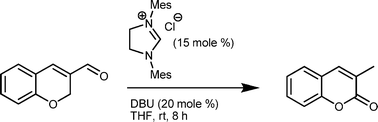
A new nucleophilic heterocyclic carbene mediated transformation of 2H-chromene-3-carboxaldehydes has been reported by Vijay Nair, CSIR, et al.

The team were attempting to make endocyclic homoenolates from 2H-chromene-3-carboxaldehyde, but instead discovered a novel transformation which resulted in 3-methyl coumarin.  Coumarins have demonstrated important bioactives and therefore the group envisage that this reaction may be a useful future route to coumarin derivatives.

This hot piece of synthesis is currently free to access for four weeks:

A novel NHC-catalyzed transformation of 2H-chromene-3-carboxaldehydes to 3-methyl-2H-chromen-2-ones
Vijay Nair, C. R. Sinu, R. Rejithamol, K. C. Seetha Lakshmi and Eringathodi Suresh
Org. Biomol. Chem., 2011, Advance Article
DOI: 10.1039/C1OB05325F

Digg This
Reddit This
Stumble Now!
Share on Facebook
Bookmark this on Delicious
Share on LinkedIn
Bookmark this on Technorati
Post on Twitter
Google Buzz (aka. Google Reader)

Organocatalysis – announcing a joint ChemComm–OBC web theme

We are delighted to announce a forthcoming ChemCommOrganic & Biomolecular Chemistry (OBC) web themed issue:

Organocatalysis

Guest editors: Keiji Maruoka (Kyoto University), Hisashi Yamamoto (University of Chicago), Liu-Zhu Gong (University of Science and Technology of China) and Benjamin List (Max-Planck-Institut für Kohlenforschung)

Submission deadline: 29th February 2012


We are now inviting submissions for this web theme, which will be a celebration of current achievements and future perspectives in this exciting field of research.

ChemComm and OBC are both welcoming urgent communications; OBC also welcomes full papers. Please feel free to submit to either or both journals.

All manuscripts will undergo strict peer review and should be very important and conceptually significant in accord with the ChemComm and OBC mandates.

Publication of the peer-reviewed articles will occur without delay to ensure the timely dissemination of the work. The articles will then be assembled on the RSC Publishing Platform as a web-based thematic issue, to permit readers to consult and download individual contributions from the entire series.

Communications for this web theme can be submitted anytime from now until 29th February using ChemComm’s and OBC’s web submission system. Please add the phrase ‘organocatalysis web theme‘ in the comments to the editor field.

Digg This
Reddit This
Stumble Now!
Share on Facebook
Bookmark this on Delicious
Share on LinkedIn
Bookmark this on Technorati
Post on Twitter
Google Buzz (aka. Google Reader)

On the cover: a mild route to [2.2]paracyclophanes

On the cover of Issue 14 is work from Dario Pasini and colleagues at the University of Pavia.  They have designed a new route to the synthetically challenging cyclophane, [2.2]cyclophanediene.   By using a Pummerer rearrangement of the [3.3]dithiacyclophane starting material, followed by sulfur extrusion the group were able to demonstrate the applicability of this mild and high yielding route.

For the full details download the article – it’s free to access for 6 weeks:

Mild preparation of functionalized [2.2]paracyclophanes via the Pummerer rearrangement
Matteo Montanari, Alberto Bugana, Arvind K. Sharma and Dario Pasini
Org. Biomol. Chem., 2011, 9, 5018-5020
DOI: 10.1039/C1OB05319A

View the issue here

Digg This
Reddit This
Stumble Now!
Share on Facebook
Bookmark this on Delicious
Share on LinkedIn
Bookmark this on Technorati
Post on Twitter
Google Buzz (aka. Google Reader)

Work on bacterial lipoteichoic acids in the press!

The hot Perspective article from Richard Schmidt, Christian Pedersen, Yan Qiao and Ulrich Zähringer has been picked up by several media outlets interested in their work on bacterial lipoteichoic acids.

The team reported the synthesise of several LTAs – which are important important constituents of the cell wall of Gram-positive bacteria – and carried out studies on their biological activity.  More work is needed to understand the recognition of LTAs by the innate immune system, but this work suggests that it is indeed the lectin pathway that LTAs interact with and paves the way for an improved understanding of infection by Gram-positive bacteria.

Here are some of the places the research has been highlighted:

Download the original Perspective article here for all the details:

Chemical synthesis of bacterial lipoteichoic acids: An insight on its biological significance
Richard R. Schmidt, Christian M. Pedersen, Yan Qiao and Ulrich Zähringer
Org. Biomol. Chem., 2011, 9, 2040-2052
DOI: 10.1039/C0OB00794C

Digg This
Reddit This
Stumble Now!
Share on Facebook
Bookmark this on Delicious
Share on LinkedIn
Bookmark this on Technorati
Post on Twitter
Google Buzz (aka. Google Reader)

Top cited OBC articles free to access!

The OBC Editorial Office has collected together the top 5 most cited papers in the last 5 years, and they are now free to access.

Our congratulations and thanks to the authors!

Organocatalysis with proline derivatives: improved catalysts for the asymmetric Mannich, nitro-Michael and aldol reactions
Alexander J. A. Cobb, David M. Shaw, Deborah A. Longbottom, Johan B. Gold and Steven V. Ley
Org. Biomol. Chem., 2005, 3, 84-96
DOI: 10.1039/B414742A, Paper

Synthesis and photophysical evaluation of charge neutral thiourea or urea based fluorescent PET sensors for bis-carboxylates and pyrophosphate
Thorfinnur Gunnlaugsson, Anthony P. Davis, John E. O’Brien and Mark Glynn
Org. Biomol. Chem., 2005, 3, 48-56
DOI: 10.1039/B409018G

Urea vs. thiourea in anion recognition
David Esteban Gómez, Luigi Fabbrizzi, Maurizio Licchelli and Enrico Monzani
Org. Biomol. Chem., 2005, 3, 1495-1500
DOI: 10.1039/B500123D, Paper

Organocatalytic enantioselective indole alkylations of α,β-unsaturated ketones
Wei Chen, Wei Du, Lei Yue, Rui Li, Yong Wu, Li-Sheng Ding and Ying-Chun Chen
Org. Biomol. Chem., 2007, 5, 816-821
DOI: 10.1039/B616504D, Paper

Enantioselective Friedel–Crafts type addition of indoles to nitro-olefins using a chiral hydrogen-bonding catalyst – synthesis of optically active tetrahydro-β-carbolines
Wei Zhuang, Rita G. Hazell and Karl Anker Jørgensen
Org. Biomol. Chem., 2005, 3, 2566-2571
DOI: 10.1039/B505220C, Paper

Want to be in the next top 5? Then why not submit to us today!

Digg This
Reddit This
Stumble Now!
Share on Facebook
Bookmark this on Delicious
Share on LinkedIn
Bookmark this on Technorati
Post on Twitter
Google Buzz (aka. Google Reader)

Hot: solid to soluble biolabelling

Fluorescent bio-probes, polypeptide tags and reporter proteins have become invaluable tools in life science research. So labelling of natural biological molecules with fluorescent organic dyes has become a popular area of research. But while many fluorphores perform well in organic solvents, it’s not so easy to make ones that work well the aqueous media required for biological applications.

Now, Anthony Romieu and colleagues at the University of Rouen, France, have devised an easy and efficient solid-phase synthesis to obtain rapidly water soluble choromophores and fluorophores in a highly pure form. They report the first successful use of N-Fmoc-a-sulfo-b-alanine as a solid-phase peptide synthesis building block, which could open the way to the future development of promising direct protein labelling.

Graphical abstract: N-Fmoc-α-sulfo-β-alanine: a versatile building block for the water solubilisation of chromophores and fluorophores by solid-phase strategy

To read more, download the article – it’s free to access for the next four weeks:

N-Fmoc-α-sulfo-β-alanine: a versatile building block for the water solubilisation of chromophores and fluorophores by solid-phase strategy
Anthony Romieu, Thomas Bruckdorfer, Guillaume Clavé, Virgile Grandclaude, Cédrik Massif and Pierre-Yves Renard
Org. Biomol. Chem., 2011, DOI: 10.1039/C1OB05730

Digg This
Reddit This
Stumble Now!
Share on Facebook
Bookmark this on Delicious
Share on LinkedIn
Bookmark this on Technorati
Post on Twitter
Google Buzz (aka. Google Reader)