HOT: colloidal gold functionalised with carbohydrate mimics for selectin binding

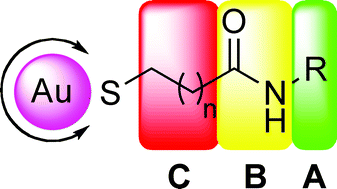
Sabine Schlecht and colleagues from the Free University of Berlin have designed a series of sulfated cyclic and acyclic amino alcohols bound to colloidal gold nanoparticles for use as multivalent selectin binding agents.  The carbohydrate mimics were chosen to act as simplified analogs of the sLex unit found in biological selectin ligands, and demonstrated extremely high binding affinities towards L- and P-selectin and no cytotoxicity.

To read the details of this well conducted study download the article – it’s free to access for 4 weeks:

Multivalent interaction and selectivities in selectin binding of functionalized gold colloids decorated with carbohydrate mimetics
Meike Roskamp, Sven Enders, Fabian Pfrengle, Shahla Yekta, Vjekoslav Dekaris, Jens Dernedde, Hans-Ulrich Reissig and Sabine Schlecht
Org. Biomol. Chem., 2011, Advance Article
DOI: 10.1039/C1OB05583F

Digg This
Reddit This
Stumble Now!
Share on Facebook
Bookmark this on Delicious
Share on LinkedIn
Bookmark this on Technorati
Post on Twitter
Google Buzz (aka. Google Reader)

HOT: β-thiolactones with higher cytotoxic activity than corresponding β-lactones

β-lactones are potentially useful as drugs for several diseases, due to their ability to inhibit key biological functions.  However, their high reactivity in physiologically relevant conditions also renders their half-life very short and limits the potential drug applications.

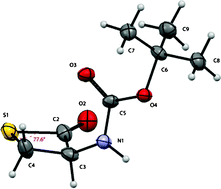
To combat this David Crich and colleagues at the Institut de Chimie des Substances Naturelles, CNRS, have synthesised a series of β-thiolactone analogs of β-lactones, on the basis that they would have greater persistence in aqueous media without too much loss of reactivity with the intended targets, as compared to β-lactam analogues.  The synthesised β-thiolactones were assayed for cytotoxicity against several human cancer cell lines, where they showed greater activity than the corresponding lactones and lactams.

Interested? The article is free to access for 4 weeks:

Exploring the potential of the β-thiolactones in bioorganic chemistry
Sylvain Aubry, Kaname Sasaki, Laure Eloy, Geneviève Aubert, Pascal Retailleau, Thierry Cresteil and David Crich
Org. Biomol. Chem., 2011, Advance Article
DOI: 10.1039/C1OB05967J

Digg This
Reddit This
Stumble Now!
Share on Facebook
Bookmark this on Delicious
Share on LinkedIn
Bookmark this on Technorati
Post on Twitter
Google Buzz (aka. Google Reader)

Self-assembled multivesicular structures for peptide-based drug delivery

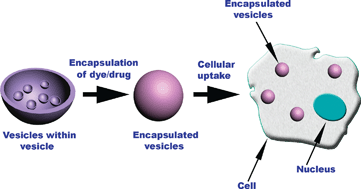
Arindam Banerjee and collaborators at the Indian Institute of Chemical Biology and Indian Association for the Cultivation of Science in Jadavpur (India) demonstrate the spontaneous formation of hierarchical vesicle-in-vesicle systems from remarkably simple peptides.

These multivesicular structures are stable over a wide pH range (2 to 12) and can encapsulate anticancer drugs and fluorescent dyes, while the release is triggered by biocompatible Ca2+ ions. Combined with a negligible cytotoxicity, these peptide based functional vesicles hold future promise as biocompatible delivery vehicles.

This article has been selected as HOT and will be free to access for the next 4 weeks. Why not read it now!


Self-assembling dipeptide-based nontoxic vesicles as carriers for drugs and other biologically important molecules Jishu Naskar, Subhasish Roy, Anindita Joardar, Sumantra Das and Arindam Banerjee
Org. Biomol. Chem., 2011, 9, 6610-6615
DOI: 10.1039/C1OB05757J, Paper

Digg This
Reddit This
Stumble Now!
Share on Facebook
Bookmark this on Delicious
Share on LinkedIn
Bookmark this on Technorati
Post on Twitter
Google Buzz (aka. Google Reader)

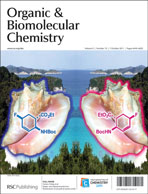
Fluorinated cyclic amino acids on the cover of Issue 19

On the cover of Issue 19 is an article from Ference Fülöp and colleagues from the University of Szeged and the University of Valencia.

They have developed a synthetic route to fluorinated β-aminocyclohexene or cyclohexane esters from a bicyclic β-lactam via selective hydroxylation and hydroxy–fluorine exchange.  Despite the potential of fluorinated cyclic amino acids for medicinal chemistry applications, only a handle of other fluorinated derivatives have been reported so far.

This article is part of a forthcoming Organic & Biomolecular Chemistry web theme issue on Foldamer Chemistry – check back soon for related articles.

Regio- and diastereoselective fluorination of alicyclic β-amino acids
Loránd Kiss, Enikő Forró, Santos Fustero and Ferenc Fülöp
Org. Biomol. Chem., 2011, 9, 6528-6534, Advance Article
DOI: 10.1039/C1OB05648D

Digg This
Reddit This
Stumble Now!
Share on Facebook
Bookmark this on Delicious
Share on LinkedIn
Bookmark this on Technorati
Post on Twitter
Google Buzz (aka. Google Reader)

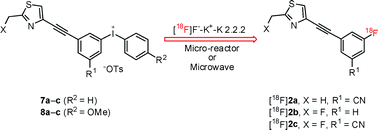
HOT: Iodonium salts as precursors for 18F-labeled mGluR5 PET radioligands

Victor Pike and colleagues from the National Institute of Mental Health in Bethesda (Maryland, USA) have devised novel and efficient methods to readily access 18F-labelled mGluR5 PET radioligands that are useful for molecular imaging with positron emission tomography (PET).

While iodonium based compounds are considered promising for the preparation of PET radiotracers, very few examples of applications have been realised so far. Now, Pike and colleagues have designed appropriate diaryliodonium tosylates as precursors for introducing fluorine-18 into simple arenes to radiosynthesise standard PET radiotracers. These would otherwise be poorly accessible via traditional aromatic nucleophilic substitution reactions with the [18F]fluoride ion, due to the weak activation of the aryl ring.

The referees and the OBC Editorial office very much enjoyed this excellent paper, and we hope you will too! Read it for FREE for the next 4 weeks.

Syntheses of mGluR5 PET radioligands through the radiofluorination of diaryliodonium tosylates
Sanjay Telu, Joong-Hyun Chun, Fabrice G. Siméon, Shuiyu Lu and Victor W. Pike
Org. Biomol. Chem., 2011, Advance Article
DOI: 10.1039/C1OB05555K, Paper

Digg This
Reddit This
Stumble Now!
Share on Facebook
Bookmark this on Delicious
Share on LinkedIn
Bookmark this on Technorati
Post on Twitter
Google Buzz (aka. Google Reader)

RSC e-membership launched

This week, the RSC launched a new product, RSC e-membership, allowing anyone to access an electronic version of Chemistry World through a MyRSC account and to enjoy the benefits of electronic networking via this professional online community for £20/year.

Subscribers to this do not benefit from the professional recognition or any of the other many services and discounts available to RSC Members, but it allows chemists from around the world, many already members of another chemical society in their own country, to benefit from the highly-esteemed content in Chemistry World and the networking opportunities offered from MyRSC, which now stands at over 11,000 members. The RSC e-membership also allows subscribers to join a virtual specialist interest group on MyRSC. If you are interested in joining, please visit www.rsc.org/emembership.

Digg This
Reddit This
Stumble Now!
Share on Facebook
Bookmark this on Delicious
Share on LinkedIn
Bookmark this on Technorati
Post on Twitter
Google Buzz (aka. Google Reader)

HOT: reactivity of p-nitrostyrene oxide as an alkylating agent

This hot article from Julio Casado and colleagues at the University of Salamanca provides the first study of the alkylating ability of p-nitrostyrene oxide (pNSO), which is widely used in the pharmaceutical industry as a chiral building block for a variety of drugs.  pNSO is also used as a substrate to study the activity of epoxide hydrolases and in polymer production.

4-(p-nitrobenzyl)pyridine (NBP), a model nucleophile for DNA bases, was used to study the alkylating effects of pNSO.  They found that although pNSO is a strong alkylating agent, it has low efficacy – probably due to the instability of the  NBP-pNSO adduct formed.  A previously unreported pNSO-guanosine adduct was also detected.

For the full details of this interesting study download the article – it’s currently free to access for 4 weeks:

Reactivity of p-nitrostyrene oxide as an alkylating agent. A kinetic approach to biomimetic conditions
Marina González-Pérez, Rafael Gómez-Bombarelli, M. Teresa Pérez-Prior, José A. Manso, Isaac F. Céspedes-Camacho, Emilio Calle and Julio Casado
Org. Biomol. Chem., 2011, Advance Article
DOI: 10.1039/C1OB05909B

Digg This
Reddit This
Stumble Now!
Share on Facebook
Bookmark this on Delicious
Share on LinkedIn
Bookmark this on Technorati
Post on Twitter
Google Buzz (aka. Google Reader)

Top ten most accessed articles in July

This month sees the following articles in Organic & Biomolecular Chemistry that are in the top ten most accessed:

Recent advances in indole syntheses: New routes for a classic target
Rubén Vicente
Org. Biomol. Chem., 2011, Advance Article
DOI: 10.1039/c1ob05750b

Bent bonds, the antiperiplanar hypothesis and the theory of resonance. A simple model to understand reactivity in organic chemistry
Ghislain Deslongchamps and Pierre Deslongchamps
Org. Biomol. Chem., 2011, 9, 5321-5333
DOI: 10.1039/c1ob05393k

The nucleophilicity N index in organic chemistry
Luis R. Domingo and Patricia Pérez
Org. Biomol. Chem., 2011, Advance Article
DOI: 10.1039/c1ob05856h

First asymmetric cascade reaction catalysed by chiral primary aminoalcohols
Carlos Arróniz, Carmen Escolano, F. Javier Luque, Joan Bosch and Mercedes Amat
Org. Biomol. Chem., 2011, 9, 5079-5085
DOI: 10.1039/c1ob05400g

A synergistic approach to polycyclics via a strategic utilization of Claisen rearrangement and olefin metathesis
Sambasivarao Kotha, Nimita G. Krishna, Somnath Halder and Shilpi Misra
Org. Biomol. Chem., 2011, 9, 5597-5624
DOI: 10.1039/c1ob05413a

Kopsihainanines A and B, two unusual alkaloids from Kopsia hainanensis
Jia Chen, Jian-Jun Chen, Xiaojun Yao and Kun Gao
Org. Biomol. Chem., 2011, 9, 5334-5336
DOI: 10.1039/C1OB05724C

Aromatic C-nitrosation of a bioactive molecule. Nitrosation of minoxidil
Mario González-Jiménez, Jorge Arenas-Valgañón, Emilio Calle and Julio Casado
Org. Biomol. Chem., 2011, Advance Article
DOI: 10.1039/c1ob05686g

Selection of the biological activity of DNJ neoglycoconjugates through click length variation of the side chain
Nicolas Ardes-Guisot, Dominic S. Alonzi, Gabriele Reinkensmeier, Terry D. Butters, Caroline Norez, Frédéric Becq, Yousuke Shimada, Shinpei Nakagawa, Atsushi Kato, Yves Blériot, Matthieu Sollogoub and Boris Vauzeilles
Org. Biomol. Chem., 2011, 9, 5373-5388
DOI: 10.1039/c1ob05119a

An organocatalytic ionic liquid
Zsolt Kelemen, Oldamur Hollóczki, József Nagy and László Nyulászi
Org. Biomol. Chem., 2011, 9, 5362-5364
DOI: 10.1039/C1OB05639E

Mild preparation of functionalized [2.2]paracyclophanes via the Pummerer rearrangement
Matteo Montanari, Alberto Bugana, Arvind K. Sharma and Dario Pasini
Org. Biomol. Chem., 2011, 9, 5015-5020
DOI: 10.1039/c1ob05319a

Why not take a look at the articles today and blog your thoughts and comments below.

Fancy submitting an article to Organic & Biomolecular Chemistry? Then why not submit to us today or alternatively email us your suggestions.

Digg This
Reddit This
Stumble Now!
Share on Facebook
Bookmark this on Delicious
Share on LinkedIn
Bookmark this on Technorati
Post on Twitter
Google Buzz (aka. Google Reader)

Viruses and nanoparticles on the cover of Issue 18

Welcome to Issue 18 of OBC!

On the cover is illustrated a Perspective article by Qian Wang and colleagues at the University of South Carolina, USA, which highlights some of the recent progress in the chemical modifications of bionanoparticles, finding uses as biosensors, electronic nanodevices, drug delivery agents and vaccine carriers, amongst others.

This cover article is FREE to access for a period of 6 weeks. Why not take a look now?

Altering the landscape of viruses and bionanoparticles
L. Andrew Lee, Huong Giang Nguyen and Qian Wang
Org. Biomol. Chem., 2011, DOI: 10.1039/C1OB05700F

Digg This
Reddit This
Stumble Now!
Share on Facebook
Bookmark this on Delicious
Share on LinkedIn
Bookmark this on Technorati
Post on Twitter
Google Buzz (aka. Google Reader)

Recent advances in indole syntheses: New routes for a classic target

This Perspective article from Rubén Vicente at the University of Oviedo, Spain, reviews the most relevant and inventive approaches towards the preparation of the ubiquitous indole motif in the last five years.

Areas covered in this review:

  • Indole syntheses from o-alkynylanilines and derivatives
  • Indole syntheses from o-haloanilines
  • Indole syntheses from o-alkynylhaloarenes or o-dihaloarenes
  • Indole syntheses from b-(pseudo)halostyrene derivatives
  • Indole syntheses from o-propargylanilines
  • Indole syntheses from acetophenone derivatives
  • Indole syntheses from arylhydrazines and related compounds
  • Indole syntheses via nitrene or carbene insertions
  • Indole syntheses via processes involving a C–C- or N–N-cleavage
  • Indole syntheses through C–H-bond functionalizations

Despite the impressive list of clever synthetic routes presented, Dr Vicente highlights that more sustainable and efficient routes are still needed for future developments – so why not take a look and get synthesising? The article is free to access for four weeks:

Recent advances in indole syntheses: New routes for a classic target
Rubén Vicente
Org. Biomol. Chem., 2011, Advance Article
DOI: 10.1039/C1OB05750B, Perspective

Digg This
Reddit This
Stumble Now!
Share on Facebook
Bookmark this on Delicious
Share on LinkedIn
Bookmark this on Technorati
Post on Twitter
Google Buzz (aka. Google Reader)