Butanol aids the cyclisation of snake venom

This paper is HOT as recommended by the referees, and is free to access for 4 weeks
Published on behalf of Steve Moore, Organic & Biomolecular Chemistry web science writer.

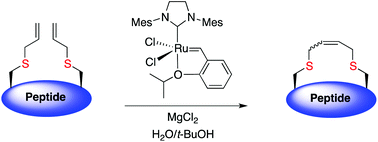
In this HOT article, John C. Vederas and co-workers at University of Alberta report the ring-closing metathesis of unprotected, synthetic analogues of oxytocin (a mammalian hormone) and crotalphine (an analgesic isolated from rattlesnake venom). The replacement of cysteine with S-allylcysteine enables ring-closing metathesis to proceed in water, in the presence of magnesium chloride and tert-butanol co-solvent.

Disulfide bridges are critical for peptide folding, stability and biological activity. This technique enables the replacement of a disulfide bridge with a dicarba linkage, improving stability yet retaining biological activity.

The trick to performing these cyclisations in the aqueous phase is to use tert-butanol or detergent micelles to solubilise the ruthenium catalyst. The addition of magnesium chloride is required to disrupt non-productive chelation between the ruthenium-carbene and unprotected hydroxyl, carboxyl and primary amide functionalities. Low yields with non-sulphur containing peptide analogues indicate that the sulphur atom is a prerequisite for successful ring-closing metathesis in these peptides.

This technique opens up the possibility of performing cyclisations that cannot be achieved on-resin, such as the ring-closing metathesis of crotalphine analogues (due to either complex formation between catalyst and amide backbone and/or hydrophobic peptide protecting groups). Additionally, this method avoids extensive synthetic effort to modify the ruthenium catalyst to optimise aqueous solubility.

Investigation of the ring-closing metathesis of peptides in water
Stephen A. Cochrane, Zedu Huang and John C. Vederas
DOI: 10.1039/C2OB26938D

Published on behalf of Steve Moore, Organic & Biomolecular Chemistry web science writer.

Digg This
Reddit This
Stumble Now!
Share on Facebook
Bookmark this on Delicious
Share on LinkedIn
Bookmark this on Technorati
Post on Twitter
Google Buzz (aka. Google Reader)

Challenges in Chemical Biology (ISACS11) – Call for Abstracts

We are proud to announce that the significant International Symposia on Advancing the Chemical Sciences (ISACS) series will return in 2013 to include Challenges in Chemical Biology (ISACS11) on 23-26 July 2013 in Boston, UK.

Abstracts are now invited for this event so submit today and take advantage of this exceptional opportunity to present your work alongside scientists from across the globe.

For details of speakers and conferences themes, please visit the dedicated website.

Digg This
Reddit This
Stumble Now!
Share on Facebook
Bookmark this on Delicious
Share on LinkedIn
Bookmark this on Technorati
Post on Twitter
Google Buzz (aka. Google Reader)

OBC issue 3 online now, featuring: cylindrical peptides, tubulin inhibitors, aliphatic C–H functionalization & much more

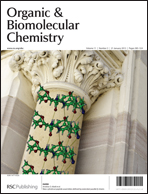
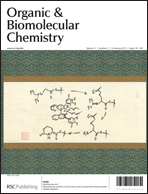
On the front cover (right) of this week’s issue is a paper on cylindrical peptide assemblies from Andrew D. Abell and colleagues from The University of Adelaide. Abell et al. present a new template-based approach to peptide based nanotubes using a ‘smart’ scaffold designed to be constrained into a β-strand geometry.

New cylindrical peptide assemblies defined by extended parallel β-sheets
Ashok D. Pehere, ChRistopher J. Sumby and Andrew D. Abell
DOI: 10.1039/C2OB26637G

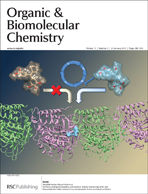
Featuring on the inside cover (left) is a paper from Mouad Alami, Abdallah Hamze and co-workers reporting the synthesis and antiproliferative activity of tri- and tetrasubstituted 1,1-diarylolefins related to isocombretastatin A-4.

Synthesis, biological evaluation, and structure–activity relationships of tri- and tetrasubstituted olefins related to isocombretastatin A-4 as new tubulin inhibitors
Abdallah Hamze and Mouad Alami et al.
DOI: 10.1039/C2OB26253C

Both cover articles are free to access for 6 weeks.

Also in this issue and free to access:

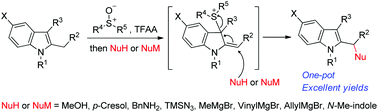
HOT – Sulfoxide-TFAA and nucleophile combination as new reagent for aliphatic C–H functionalization at indole 2α-position

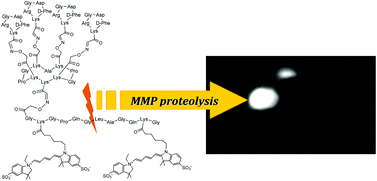
HOT – Integrin and matrix metalloprotease dual-targeting with an MMP substrate–RGD conjugate

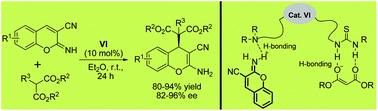
HOT – Organocatalytic conjugate addition promoted by multi-hydrogen-bond cooperation: access to chiral 2-amino-3-nitrile-chromenes

Digg This
Reddit This
Stumble Now!
Share on Facebook
Bookmark this on Delicious
Share on LinkedIn
Bookmark this on Technorati
Post on Twitter
Google Buzz (aka. Google Reader)

HOT: Aliphatic C–H functionalization at indole 2α-position

This paper is HOT as recommended by the referees, and is free to access for 4 weeks

Scientists from Japan report on the use of thionium activation for nucleophilic functionalization of indole derivatives at the 2-alpha position.

In this hot paper Kazuhiro Higuchi and Tomomi Kawasaki and coworkers at Meiji Pharmaceutical University expand on their communication from Chem. Comm. on the aliphatic C–H functionalization at the indole 2α-position mediated by acyloxythionium species generated from sulfoxides, including DMSO, and TFAA.

By using this method the indole ring is transformed into an allyl thionium species, and so is highly activated for nucleophilic attack from a wide variety of nucleophiles. Kawasaki make use of simple and readily available reagents, making the reaction a convenient route to functionalize alpha to the indole ring in a very straightforward fashion, enabling the introduction of O-, N- and C- substituents in a one-pot procedure.

For all the details read this paper for free today.

Sulfoxide-TFAA and nucleophile combination as new reagent for aliphatic C–H functionalization at indole 2α-position
Masanori Tayu, Kazuhiro Higuchi, Masato Inaba and Tomomi Kawasaki
DOI: 10.1039/C2OB26944A

Digg This
Reddit This
Stumble Now!
Share on Facebook
Bookmark this on Delicious
Share on LinkedIn
Bookmark this on Technorati
Post on Twitter
Google Buzz (aka. Google Reader)

Dual-targeting of Integrin and matrix metalloprotease

In this HOT paper Didier Boturyn, Jean-Luc Coll and colleagues have designed a probe containing arginine-glycine-aspartic acid (RGD) that can be used for the dual-targeting of αVβ3 integrin and matrix metallopeptidase -9 extracellular proteases in tumours.

Boturyn et al. synthesise the probe via iterative oxime ligations of peptide fragments and use in vitro and in vivo experiments to evaluate it.

To find out more about this dual-targeting probe download the paper for free today!

Integrin and matrix metalloprotease dual-targeting with an MMP substrate–RGD conjugate
Christiane H. F. Wenk, Véronique Josserand, Pascal Dumy, Jean-Luc Coll and Didier Boturyn
DOI: 10.1039/C2OB26926K

Digg This
Reddit This
Stumble Now!
Share on Facebook
Bookmark this on Delicious
Share on LinkedIn
Bookmark this on Technorati
Post on Twitter
Google Buzz (aka. Google Reader)

Multi-hydrogen-bond cooperation to access chiral 2-amino-3-nitrile-chromenes

This paper is HOT as recommended by the referees, and is free to access for 4 week

In this HOT communication Jian Wang and colleagues at National University of Singapore report an efficient method to construct enantiomeric 2-amino-3-nitrile-chromenes through 2-iminochromenes and malonates. Using a thiourea catalyst Wang et al. rapidly construct the 2-amino-3-nitrile-chromene complexes via a multi-hydrogen-bond cooperative activation model.

For the details of their study download the communication today; it’s free to access for 4 weeks.

Organocatalytic conjugate addition promoted by multi-hydrogen-bond cooperation: access to chiral 2-amino-3-nitrile-chromenes
Wenjun Li, Jiayao Huang and Jian Wang
DOI: 10.1039/C2OB27102H

Digg This
Reddit This
Stumble Now!
Share on Facebook
Bookmark this on Delicious
Share on LinkedIn
Bookmark this on Technorati
Post on Twitter
Google Buzz (aka. Google Reader)

Organic & Biomolecular Chemistry issue 2, 2013 featuring: asymmetric phase-transfer catalysis & ion channel inhibitors

Welcome to the second issue of Organic & Biomolecular Chemistry of 2013. In this issue we have: 3 perspectives, 4 communications and 15 articles.

Featuring on the front cover this week is the paper of Keiji Maruoka et al. who report the catalytic asymmetric synthesis of a wide variety of cyclic amino acid derivatives using chiral phase transfer catalysts.

Stereoselective synthesis of cyclic amino acids via asymmetric phase-transfer catalytic alkylation
Taichi Kano, Takeshi Kumano, Ryu Sakamoto and Keiji Maruoka
DOI: 10.1039/C2OB26778K

Taking us under the sea on the inside cover is the work of Tushar Kanti Chakraborty et al. who have developed a convergent method, involving Julia–Kocienski olefination, Urpi acetal aldol and Shiina macrolactonization as the key steps, for the total synthesis of the potent ion channel inhibitor (29S,37S)-isomer of malevamide E.

Total synthesis of (29S,37S)-isomer of malevamide E, a potent ion-channel inhibitor
Praveen Kumar Gajula, Shrikant Sharma, Ravi Sankar Ampapathi and Tushar Kanti Chakraborty
DOI: 10.1039/C2OB26533H

Both of these articles will be free to access for 6 weeks. Read all this in issue 2 of OBC today.

Digg This
Reddit This
Stumble Now!
Share on Facebook
Bookmark this on Delicious
Share on LinkedIn
Bookmark this on Technorati
Post on Twitter
Google Buzz (aka. Google Reader)

Nanoscience: Using DNA origami as a scaffold to assemble uniform length carbon nanotubes

Scientists in the US have developed a convenient, versatile method to organise discrete length single-walled carbon nanotubes (SWNT) into complex geometries using 2D DNA origami tiles. Constructing intricate geometric arrangements of components is one of the central challenges of nanotechnology. The origami scaffolds considered here, both rectangular and triangular, were used to organise the nanotubes: several arrangements of nanotubes were constructed, with defined tube lengths and inter-tube angles. This method allows for uniform tube lengths and positional precision, leading to the reliable assembly of SWNTs into well-structured arrays.

Graphical Abstract

DNA origami templated self-assembly of discrete length single wall carbon nanotubes
Zhao Zhao, Yan Liu and Hao Yan
Org. Biomol. Chem., 2013, Advance Article
DOI: 10.1039/C2OB26942B

Digg This
Reddit This
Stumble Now!
Share on Facebook
Bookmark this on Delicious
Share on LinkedIn
Bookmark this on Technorati
Post on Twitter
Google Buzz (aka. Google Reader)

Cyclodextrin-surfactant complexes: a chain length balancing act

This paper is HOT as recommended by the referees, and is free to access for 4 weeks

Cyclodextrins are macrocyclic oligomers of α-D-glucose. Their interaction with guest molecules is largely driven by the hydrophobic effect (the expulsion of water from the lipophilic cavity, into bulk, is entropically favourable).

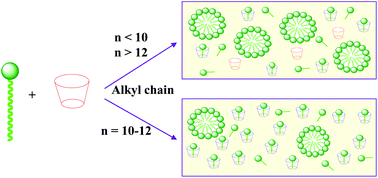
In this HOT paper Cepeda and co-workers explore the solution phase behaviour of β-cyclodextrin/alkyltrimethylammonium bromide mixtures, varying the surfactant alkyl chain length from hexyl (C6) to octadecyl (C18).

Cepeda et al. employ the solvolysis of methoxybenzenesulfonyl chloride (MBSC) as a UV ‘handle’ to monitor the interaction between β-cyclodextrin and surfactant guests. In the presence of aggregated cationic surfactants, MBSC hydrolysis is hindered, owing to the reduced polarity of the micelle interior. MBSC solvolysis can be used to monitor the integrity of surfactant micelles and to calculate the concentration of unbound cyclodextrin.

In the presence of aggregated surfactants Cepeda et al. detect a significant concentration of ‘free’ β-cyclodextrin; the highest of which with decyl (C10) and dodecyl (C12) surfactants. This reflects the balance between the hydrophobic effect (smaller surfactant chains displace less water from the cyclodextrin cavity) and surfactant self-assembly (longer surfactant chains favour micelle formation).  The new model created to describe these interactions will aid the further development of commercial applications for these systems.

Competition between surfactant micellization and complexation by cyclodextrin
M. Cepeda, R. Daviña, L. García-Río, M. Parajó, P. Rodríguez-Dafonte and M. Pessêgo
DOI: 10.1039/C2OB26318A

Published on behalf of Steve Moore, Organic & Biomolecular Chemistry web science writer.

Digg This
Reddit This
Stumble Now!
Share on Facebook
Bookmark this on Delicious
Share on LinkedIn
Bookmark this on Technorati
Post on Twitter
Google Buzz (aka. Google Reader)

OBC Issue 1, 2013 – featuring DNA–peptide energetic studies & prodigiosenes to treat leukemia

An overview of this week’s issue of Organic & Biomolecular Chemistry

Welcome to issue 1, 2013, of Organic & Biomolecular Chemistry. The entire issue is free for you to access so get busy downloading!

Front cover: This very elegant cover highlights the work of Leung Sheh and co-workers. The study of Sheh et al. further explores the allosteric features of DNA–peptide molecular recognition with regard to interaction networks, choosing designed peptides that exhibit significant cooperativity in binding to DNA.

Energetic studies on DNA–peptide interaction in relation to the enthalpy–entropy compensation paradox
Robin C. K. Yang, Jonathan T. B. Huang, Shih-Chuan Chien, Roy Huang, Kee-Ching G. Jeng, Yen-Chung Chen, Mokai Liao, Jia-Rong Wu, Wei-Kang Hung, Chia-Chun Hung, Yu-Ling Chen, Michael J. Waring and Leung Sheh

Inside cover: Featuring on this cover is the work of Alison Thompson and co-workers who have structurally modified the C-ring of a series of prodigiosenes to produce a series of analogues that show promising activity against leukemia cell lines.

Investigations regarding the utility of prodigiosenes to treat leukemia
Deborah A. Smithen, A. Michael Forrester, Dale P. Corkery, Graham Dellaire, Julie Colpitts, Sherri A. McFarland, Jason N. Berman and Alison Thompson


Both of these papers have been highlighted by the reviewers as being HOT.

Also in this issue:

HOTPd-catalyzed Suzuki coupling reaction of chloroalkylidene-β-lactones with LB-Phos as the ligand
Pengbin Li, Bo Lü, Chunling Fu and Shengming Ma

HOT An efficient organocatalytic enantioselective synthesis of spironitrocyclopropanes
Utpal Das, Yi-Ling Tsai and Wenwei Lin

HOT Synthesis of a four-component [3]catenane using three distinct noncovalent interactions
Miguel Á. Alemán García and Nick Bampos

Find all this great FREE content and more in issue 1

Digg This
Reddit This
Stumble Now!
Share on Facebook
Bookmark this on Delicious
Share on LinkedIn
Bookmark this on Technorati
Post on Twitter
Google Buzz (aka. Google Reader)