

Archive for August, 2025

Green Chemistry 25th Anniversary Collection: Liquid-phase hydrogenation of carbon monoxide to methanol using a recyclable manganese-based catalytic system

Over the past 25 years, Green Chemistry has provided a unique forum for the publication of innovative research on the development of alternative sustainable technologies, efficient utilisation of resources and the concomitant minimisation of waste. We are delighted to bring together a very special issue containing articles by members of the green chemistry community as well as past and present Green Chemistry Board members, to mark and celebrate our first 25 years.

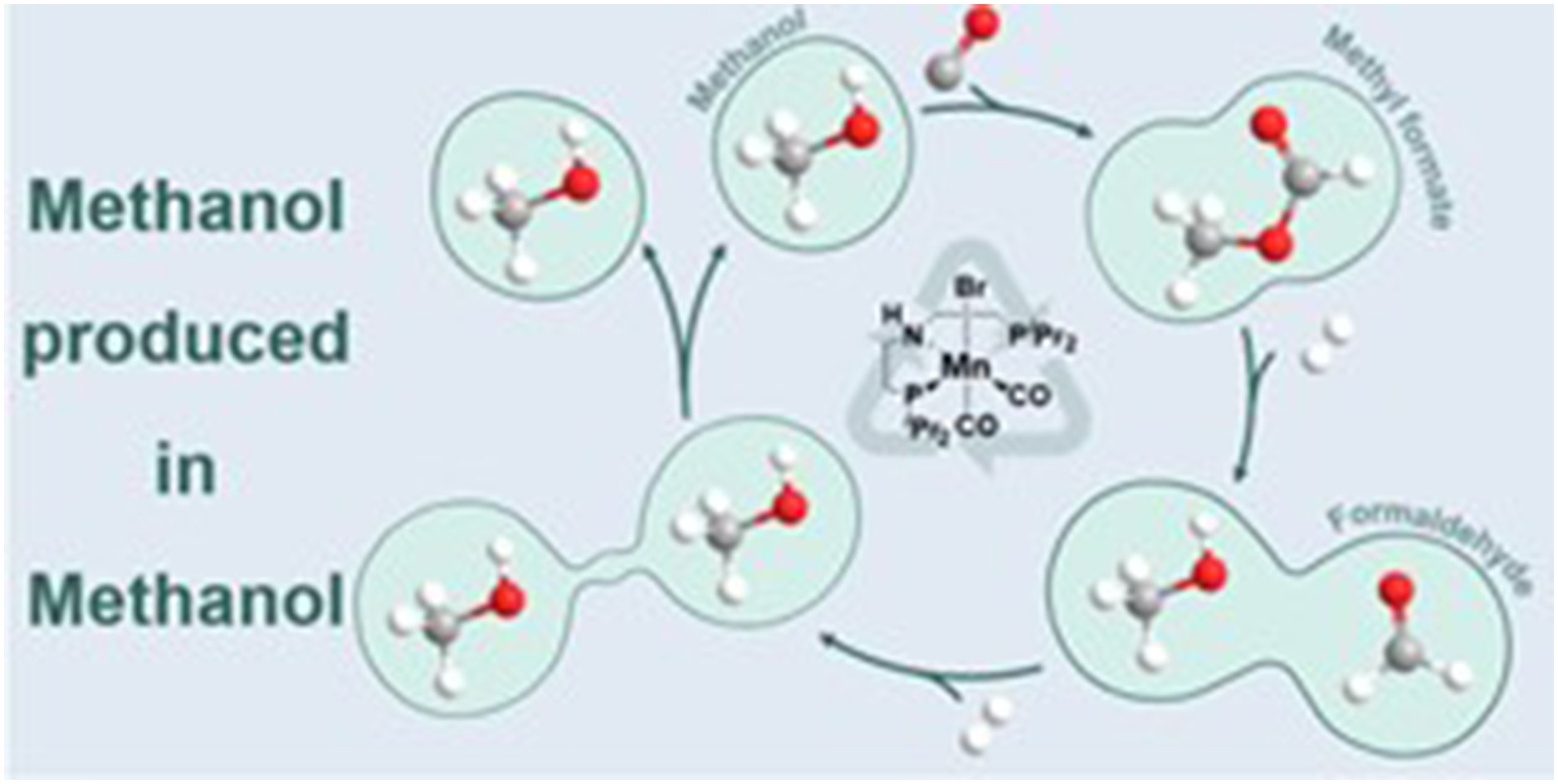
Among the contributions to this themed collection is a Paper where a simple and recyclable homogeneous catalytic system for the hydrogenation of carbon monoxide to methanol was established (DOI: 10.1039/D4GC01050G).

Read our interview with Andreas J. Vorholt, one of the corresponding authors.
Could you briefly explain the focus of your article to the non-specialist?

The homogeneously catalyzed synthesis of methanol overs several advantages over its heterogeneous counterpart such as milder conditions, higher selectivity and one-through conversion. However, catalyst recycling remains an inherited challenge for the industrial application of such processes. This work gives the first demonstration of the recycling of a homogeneous catalyst system based on the earth’s abundant metals manganese with high productivity and excellent selectivity.

How would you set this article in a wider context?

Methanol is considered a central pivot between energy and chemical industry for sustainable transformation. While the established heterogeneous methanol production process benefits from economies of scale, homogeneous catalytic processes are better suited for small to mid-size decentralized production coupled with fluctuating renewable energy supply. This article marks a key step towards such processes by demonstrating the successful, yet inherently challenging, recycling of the employed Mn-based catalyst.

What is the motivation behind this work?

In the past couple of years many systems were developed in the field of homogeneous methanol synthesis either from CO or CO2. However, all those examples were far from industrial applicability as they did not address the challenge of catalyst recycling and simple product separation, which is essential to make such a process economically viable. Therefore, based on our earlier work in this field, we aimed to establish a simplified system that can address these challenges by simple unit operations.

What aspects of this work are you most excited about at the moment and what do you find most challenging about it?

For a transformation that was seen as highly challenging in the past, the simplicity of the developed system, comprising only of the catalyst, the cheap base NaOMe and a long-chain alcohol, is fascinating.

What is the next step? What work is planned?

As we have shown that the catalyst can be recycled batchwise, we are now taking it one step further and employing this system in a continuous operation incl. constant product separation and catalyst recycling. This will get us significantly closer to industrial usability.

Please describe your journey to becoming part of the Green Chemistry community

I started my way in the GC community already in my PhD, when I worked on the conversion of oleochemicals to monomers. Later I wrote a master thesis in my economics studies on the future of renewables under the GC conditions. I was finally caught by the idea after the Gordon Green Chemistry Conference in Hongkong.

Why did you choose to publish in Green Chemistry?

Green Chemistry is at the forefront of the sustainable development of the Chemistry community as a whole. Every article published in this journal aims contribute a small piece to overcoming the great challenges the chemical industry and our entire society are facing today. We are convinced that our manuscript very well aligned with the goals of the journal and it gives us the perfect platform to present to and discuss with an audience that holds the same values and goals to drive the sustainable transformation of chemistry.

What do you think the Green Chemistry journal has done well in the past 25 years, and what do you think are the main challenges our community will face in the next 25 years?

For the past 25 years, Green Chemistry has advanced sustainability in the chemical research from a nice side-bonus to the number one goal of modern-day chemists and engineers. Starting from the 12 Principles of Green Chemistry this journal as a platform has fostered the awareness, importance and acceptance of sustainable chemistry. For the next 25 years ahead one major challenge will be to bring the tons of brilliant ideas that are published in great journals like Green Chemistry out of the lab into practice. Only if we will achieve this fast enough, we will be able to solve the enormous challenges ahead of us.

Digg This
Reddit This
Stumble Now!
Share on Facebook
Bookmark this on Delicious
Share on LinkedIn
Bookmark this on Technorati
Post on Twitter
Google Buzz (aka. Google Reader)

Green Chemistry 25th Anniversary Collection: Interactions of multiple metrics and environmental indicators to assess processes, detect environmental hotspots, and guide future development

Over the past 25 years, Green Chemistry has provided a unique forum for the publication of innovative research on the development of alternative sustainable technologies, efficient utilisation of resources and the concomitant minimisation of waste. We are delighted to bring together a very special issue containing articles by members of the green chemistry community as well as past and present Green Chemistry Board members, to mark and celebrate our first 25 years.

Among the contributions to this themed collection is paper that  offers insights into an assessment approach for evaluating the environmental sustainability of either single chemical transformations or entire processes (DOI: 10.1039/D4GC00302K).  It adopts a multi-dimensional framework, presented in a practical and systematic manner. This approach relies on a clear starting point for all assessments, making use of available data, simulating missing data, to allow for fair comparisons. This comes to improve on the too often used mono-dimensional analyses that have by now proven a potential source for incorrect conclusions and decisions.

Read our interview with the authors, Michael U. Luescher and  Fabrice Gallou:

How would you set this article in a wider context? 

While we do understand that our methodology is far from being 100% accurate, it has proven its reliability against more complex LCA-methodologies in identifying environmental hotspots. This more pragmatic approach enables us to look at, and impact, entire portfolios of industrial companies and guide research interest enabling real returns in the longer term. Besides, we believe that this article should be seen as steppingstone and a first step towards the next generation of metrics, moving away from the one-dimensional approaches, that have served us well in the past and brought us up to this point, and gearing towards LCA-type of analysis.

What is the motivation behind this work? 

Moving away from opinions and one-dimensional assessments, we looked to establish a method to take data driven, educated, sound decisions on a large scale. The timing of such assessments becomes more critical as many transformations can now be done using multiple technologies, which can require extensive investment, and whose overall footprint is not necessarily well understood. Hence the need to establish more tools to support our decision-making process.

What aspects of this work are you most excited about at the moment and what do you find most challenging about it? 

We are very excited at how our methodology has been performing within our organization, the impact it had on our decision taking, and hope that we can share these learnings with the wider community, as we do not consider this a competitive advantage. It is all the more exciting as it has proven to bring real value in terms of multiple aspects of sustainability and can lead to good decisions with tremendous impact on the planet!

What is the next step? What work is planned?

We plan to further streamline the methodology, implementing it company wide, and to illustrate in the future how this approach has helped us select the better options which led to significant impact on the footprint of the syntheses and processes at stake.

Why did you choose to publish in Green Chemistry? 

Green Chemistry has had a long history of gathering the community and disclosing high quality content. It has in our mind further increase its leadership position and authoritative position in this field in the recent years and was thus the obvious choice for us.

What do you think the Green Chemistry journal has done well in the past 25 years, and what do you think are the main challenges our community will face in the next 25 years?

In a first phase, the journal has had tremendous impact raising awareness and educating. More recently, it has in our mind further stepped up being not just a source of inspiration and education, but also really pushing the boundaries of science with impact on sustainability.

Digg This
Reddit This
Stumble Now!
Share on Facebook
Bookmark this on Delicious
Share on LinkedIn
Bookmark this on Technorati
Post on Twitter
Google Buzz (aka. Google Reader)

Call for Papers: Green Liquids and Solvents

Green Chemistry is delighted to announce a call for papers for its latest themed collection on Green Liquids and Solvents, Guest Edited by Zhenzhen Yang (Oak Ridge National Lab, USA), Kecheng Jie (Nanjing University, China) and Jessica Rimsza (Sandia National Laboratories, USA).

About this Themed Collection: 

Sustainable liquid media plays a crucial role in separation, catalysis, energy storage, and beyond, particularly compositions that are biodegradable, non-toxic, renewable, and non-volatile. Ionic liquids (ILs), deep eutectic solvents (DESs), water, supercritical fluids, and bio-based solvents remain at the forefront of green chemistry, demonstrating transformative properties across diverse applications. Beyond their conventional use as single-phase liquid media, recent research has explored innovative strategies to integrate these solvents with other material categories, unlocking new functionalities. A cutting-edge development in this field is the successful engineering of permanent porosities into dense liquid phases forming so-called “porous liquids”, based on ILs, water, and bio-based solvents, enhancing their efficiency in separation and catalysis. In gas storage, the structural design of controllable liquid molecular assemblies has enabled cascade gas trapping in liquid sorbents, significantly outperforming single-component liquid media. This Themed Collection welcomes contributions to recent advances in sustainable liquid technologies, with a particular emphasis on green synthesis strategies, facile fabrication techniques, advanced characterization methods, computational modeling, theoretical frameworks, fundamental structure-function investigations, and cutting-edge applications in separation, catalysis, energy storage, and beyond.

Open for Submissions until 31st March 2026

This call for papers is open for the following article types:

  • Communications
  • Full papers
  • Reviews

How to Submit

If you would like to contribute to this themed collection, articles can be submitted via our website: mc.manuscriptcentral.com/gc. We would be grateful if upon submission you would mention that your manuscript is intended for this themed collection as an open call.

Please note that for publication, manuscripts must meet the usual rigorous and high standards for acceptance in the journal, and all submissions will be subject to initial assessment for suitability for a full peer review before a final decision is made. Accepted articles will be published online in a citeable form, included in the web collection and published in an issue as soon as they are ready. We aim to promote the completed collection in 2026.

Digg This
Reddit This
Stumble Now!
Share on Facebook
Bookmark this on Delicious
Share on LinkedIn
Bookmark this on Technorati
Post on Twitter
Google Buzz (aka. Google Reader)