Thank you to everyone who nominated a candidate for the Soft Matter 2014 Lectureship. The response has been fantastic and we now have an extensive list of excellent nominees for our Editorial Board to consider. We will be announcing the winner next month-do keep an eye on the blog for further news!
Redefining moisturiser – Soft Matter article in Chemistry World

The secret to soft skin is not necessarily increasing its water content but retaining molecular fluidity © Shutterstock
Scientists in Sweden have probed the outermost layer of skin to gain molecular insights into how naturally occurring molecules in this layer protect it from drying out.
Healthy skin with a normal degree of hydration is soft and pliable. This is not the case for dry skin, which is brittle and easily cracks. To treat dry skin it is common to apply a cosmetic containing a humectant ̶ a type of “moisturiser” – like glycerol or urea. These substances are also components of natural moisturising factor (NMF), a group of molecules naturally present in the skin barrier. The beneficial function of these compounds if often claimed to be their capacity for increasing skin hydration, although the underlying mechanisms are generally described with a rather weak molecular basis.
Interested to know more? Read the full news article by Jennifer Newton in Chemistry World here…
Read the paper by Sebastian Björklund et. al for free until 23 May 2014:
Stratum corneum molecular mobility in the presence of natural moisturizers
Sebastian Björklund, Jenny Marie Andersson, Agnieszka Ewa Nowacka, Quoc Dat Pham, Daniel Topgaard and Emma Sparr
Soft Matter, 2014, Accepted Manuscript
DOI: 10.1039/C4SM00137K, Paper
Hot articles for April!
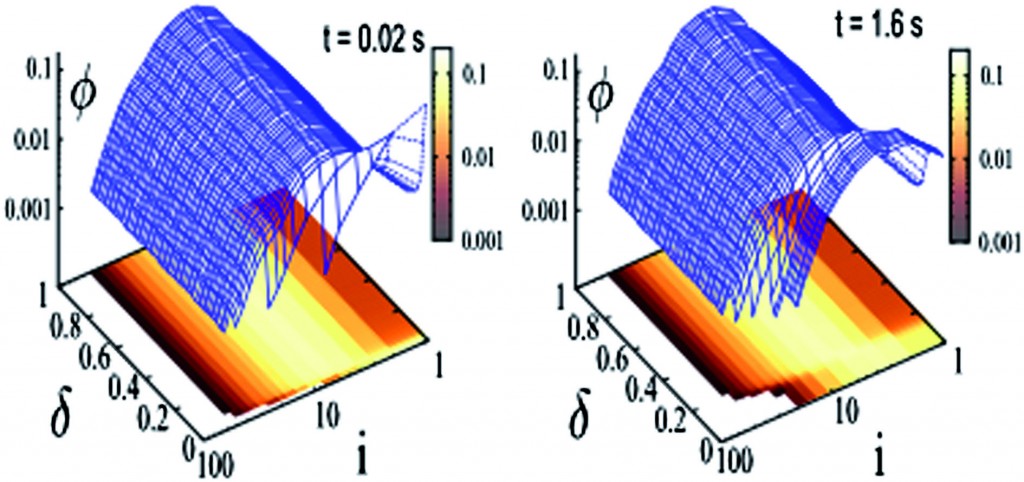
Tunable interactions between paramagnetic colloidal particles driven in a modulated ratchet potential
Arthur V. Straube and Pietro Tierno
Phase behavior of Janus colloids determined by sedimentation equilibrium
Daniel J. Beltran-Villegas, Benjamin A. Schultz, Nguyen H. P. Nguyen, Sharon C. Glotzer and Ronald G. Larson
These papers are free to access until 23rd May 2014
The effect of drop volume and micropillar shape on the apparent contact angle of ordered microstructured surfaces
Luciano Afferrante and Giuseppe Carbone
Rideal Travel Bursaries – Submit Your Application by 15 April 2014
Applications for the Rideal Travel Bursaries of up to £500 are now open to Society of Chemical Industry* (SCI) and Royal Society of Chemistry (RSC) members. Submit your application and reference letters by 15 April 2014.
These bursaries provide funds to promising PhD students and postdoctoral researchers in the general field of colloid and surface science to attend conferences and/or visit relevant research institutions. We are currently inviting applications for travel between 1 July and 31 December 2014.
The bursaries are offered by the Sir Eric Rideal Trust (managed jointly by the RSC and SCI). They are awarded twice a year on a competitive basis.
If you are applying for a bursary to attend a conference between 1 January 2015 and 30 June 2015, applications will re-open in the autumn, with a deadline of 15 October 2014.
See what previous recipients have achieved:
Patricia Esteban Perez, reports on her attendance at Bacteriophage in Medicine, Food and Biotechnology
Alexander Rosu-Finsen, reports on his attendance at 9th International Vacuum Conference in Paris
*This only applies to standard or student members; travel bursaries are not open to e-members.
Find out more:
SOFT Matter – from fundamental aspects to industrial perspectives

The Soft-Fire 2014 conference will be held on July 29 – August 8 | Cargèse, Corse | France
Soft condensed matter is the subject of a large number of investigations all around the world, both from a fundamental point of view and from a more applied side, due to the large number of practical possibilities relying on the aptitude of soft matter to provide large responses to small sollicitations.
Academic talks (confirmed)
- N. Balsara (Univ. Berkeley) : Polymers for electronics
- P. Chaikin (NY University, USA): Active matter
- E. Charlaix (Univ. Grenoble, France): Confined systems: mechanical measurements
- J. Fourkas (Univ. Maryland): Optical techniques for biophysics
- M.-C. Jullien (ESPCI, France) : Microfluidics
- C. Knobler (UCLA, USA) : Physical virology
- K. Kremer (MPI Polymerforshung, Mainz) : Statistical physics – Numerical simulations
- R. Kimmich (Univ. Ulm, Germany): Spectroscopic techniques for the examination of molecular dynamics in mesoscopically confined fluids
- O. Lavrentovich (Kent State Univ.): Dynamics and liquid crystals
- H. Lekkerkerker (Univ. Utrecht, Netherland): Self organization in Colloidal Suspensions of Spheres, Rods, Plates and Boards
- C. Sanchez (Collège de France, Paris): Hybrid materials
- M. Stamm (Institutes für Physikalische Chemie und Physik der Polymere, Leibniz, Germany): Concepts to save energy with polymers
- C. Wilhelm (CNRS, Université Denis Diderot): Bionanomagnetism
Please see here for fees for registration and Abstract submission and pre-registration
PN & G Conference 2014, Tokyo, Japan
The joint symposium of the 22nd Polymer Networks Group Meeting (PNG) and the 10th Gel Symposium sponsored by Institute for Solid State Physics, The University of Tokyo, (PN&G2014) will provide a platform for scientific exchange in all areas relevant to theory and simulation, fabrication, structure, properties, and industrial/medical applications of gels. This symposium will focus on “Cutting Edge of Chemistry, Physics, and Engineering in Polymer Networks (PhysChemEng).”
A list of Plenary and Keynote speakers can be found here.
Please see the conference website to register your attendance or submit an abstract.
Soft Matter now indexed in Medline!
We are delighted to announce that Soft Matter has been accepted for inclusion in the prestigious MEDLINE abstracting / indexing service.
All articles published in Soft Matter will now be included, and searchable using PubMed. This will provide even greater visibility to the great research being published in the journal, particularly in the bio/medical communities.
Proteins, cells, and tissues in patterned environments: themed issue now published!

The Soft Matter themed issue on Proteins, cells, and tissues in patterned environments is now online! Guest Editors Ulrich Schwarz (University of Heidelberg), Celeste Nelson (Princeton University) and Pascal Silberzan (Institut Curie) introduce the issue in their Editorial.
Over the last two decades, the role of spatial coordination has increasingly moved into the focus of researchers working on biological systems. Using tools from materials science, it has been revealed that the amazing capacity of biological systems to organize themselves strongly depends on the way the environment is spatially structured. For this themed issue, researchers from the biophysics, biophysical chemistry, cell biology and bioengineering communities were invited to contribute studies based on spatially controlled environments which can be used as modulators, control elements or sensors for the self-organized assembly of proteins, cells and tissue. Below are just some of the excellent papers we received:
On the cover:
Alignment of nematic and bundled semiflexible polymers in cell-sized confinement José Alvarado, Bela M. Mulder and Gijsje H. Koenderink
Communications:
Co- and distinct existence of Tris-NTA and biotin functionalities on individual and adjacent micropatterned surfaces generated by photo-destruction Atanu Biswas, Abhijit Saha, Dhruba Ghosh, Batakrishna Jana and Surajit Ghosh
Papers:
Three-dimensional patterning of multiple cell populations through orthogonal genetic control of cell motility Joanna L. MacKay, Anshum Sood and Sanjay Kumar
Oscillations of Min-proteins in micropatterned environments: a three-dimensional particle-based stochastic simulation approach Max Hoffmann and Ulrich S. Schwarz
Cellular self-organization on micro-structured surfaces Peter J. F. Röttgermann, Alicia Piera Alberola and Joachim O. Rädler
Optimal shapes and stresses of adherent cells on patterned substrates Shiladitya Banerjee, Rastko Sknepnek and M. Cristina Marchetti
Intracellular stresses in patterned cell assemblies Michel Moussus, Christelle der Loughian, David Fuard, Marie Courçon, Danielle Gulino-Debrac, Hélène Delanoë-Ayari and Alice Nicolas
Hyperswarming adaptations in a bacterium improve collective motility without enhancing single cell motility Maxime Deforet, Dave van Ditmarsch, Carlos Carmona-Fontaine and Joao B. Xavier
Find the full issue here!
Soft Matter Lectureship: Nominations close this Friday 14th March
There are only a few days left to nominate someone for the Soft Matter Lectureship!
A reminder of the details:
Qualification
To be eligible for the Soft Matter Lectureship, the candidate should be in the earlier stages of their scientific career, typically within 15 years of attaining their doctorate or equivalent degree, and will have made a significant contribution to the field.
Description
The recipient of the award will be asked to present a lecture three times, one of which will be located in the home country of the recipient. The Soft Matter Editorial Office will provide the sum of £1000 to the recipient for travel and accommodation costs.
The award recipient will be presented with the award at one of the three award lectures. They will also be asked to contribute a lead article to the journal and will have their work showcased on the back cover of the issue in which their article is published.
Selection
The recipient of the award will be selected and endorsed by the Soft Matter Editorial Board.
Nominations
Those wishing to make a nomination should send details of the nominee, including a brief C.V. (no longer than 2 pages A4) together with a letter (no longer than 2 pages A4) supporting the nomination, to the Soft Matter Editorial Office (softmatter-rsc@rsc.org) by 14 March 2014. Self-nomination is not permitted.
Hot Articles for March!
Andong Wang, Jianbin Huang and Yun Yan

Mikael Mohtaschemi, Antti Puisto, Xavier Illa and Mikko J. Alava