2016 Soft Matter Lectureship is now open!

Do you know an early-career researcher who deserves recognition for their contribution to the soft matter field?

Now is your chance to put them forward for the accolade they deserve.

Soft Matter is pleased to announce that nominations are now being accepted for its Soft Matter Lectureship 2016. This annual lectureship was established in 2009 to honour an early-stage career scientist who has made a significant contribution to the soft matter field.

Previous winners include:


Previous winners Lucio Isa, Eric Dufresne, Eric Furst & Patrick Doyle


2015 – Lucio Isa, ETH Zürich, Switzerland

2014 – Eric Dufresne, Yale Univeristy, USA

2013 – Eric Furst, University of Delaware, USA

2012 – Patrick Doyle, MIT, USA

2011 – Michael J. Solomon, University of Michigan, USA

2010 – Bartosz Grzybowski, Northwestern University, USA

2009 – Emanuela Zaccarelli, University of Rome, Italy

Qualification

To be eligible for the Soft Matter Lectureship, the candidate should be in the earlier stages of their scientific career, typically within 12 years of attaining their doctorate or equivalent degree, and will have made a significant contribution to the field.

Description

The recipient of the award will be asked to present a lecture three times, one of which will be located in the home country of the recipient. The Soft Matter Editorial Office will provide the sum of £1000 to the recipient for travel and accommodation costs.

The recipient will be presented with the award at one of the three award lectures. They will also be asked to contribute a lead article to the journal and will have their work showcased on the back cover of the issue in which their article is published.

Selection

The recipient of the award will be selected and endorsed by the Soft Matter Editorial Board.

Nominations

Those wishing to make a nomination should send details of the nominee, including a brief C.V. (no longer than 2 pages A4) together with a letter (no longer than 2 pages A4) supporting the nomination, to the Soft Matter Editorial Office by 29th January 2016. Self-nomination is not permitted.

Digg This
Reddit This
Stumble Now!
Share on Facebook
Bookmark this on Delicious
Share on LinkedIn
Bookmark this on Technorati
Post on Twitter
Google Buzz (aka. Google Reader)

Top 10 most-read Soft Matter articles – Q3 2015

This month sees the following articles in Soft Matter that are in the top ten most accessed from July – September:

Nanostructures in Superhydrophobic Ti6Al4V Hierarchical Surfaces Control Wetting State Transitions
Yizhou Shen, Jie Tao, Haijun Tao, Shanlong Chen, Lei Pan and Tao Wang
Soft Matter, 2015,11, 3806-3811
DOI: 10.1039/C5SM00024F  

Transition from Cassie to impaled state during drop impact on groove-textured solid surfaces
V. Vaikuntanathan and D. Sivakumar
Soft Matter, 2014,10, 2991-3002
DOI: 10.1039/C4SM00050A  

The effect of drop volume and micropillar shape on the apparent contact angle of ordered microstructured surfaces
Luciano Afferrante and Giuseppe Carbone
Soft Matter, 2014,10, 3906-3914
DOI: 10.1039/C3SM53104J 

Phase and Self-assembly Transition Induced by Glycerol-Borax Interaction in Aqueous Surfactant Two-Phase System
Ying Zhao, Yun Yan, Lingxiang Jiang, Jianbin Huang and Heinz Hoffmann
Soft Matter, 2009,5, 4250-4255
DOI: 10.1039/B911564A  

Manipulation of micro- and nanostructure motion with magnetic fields
Roger S. M. Rikken, Roeland J. M. Nolte, Jan C. Maan, Jan C. M. van Hest, Daniela A. Wilson and Peter C. M. Christianen
Soft Matter, 2014,10, 1295-1308
DOI: 10.1039/C3SM52294F  

Directed Self-Assembly of Block Copolymers: A Tutorial Review of Strategies for Enabling Nanotechnology with Soft Matter
Hanqiong Hu, Manesh Gopinadhan and Chinedum O. Osuji
Soft Matter, 2014,10, 3867-3889
DOI: 10.1039/C3SM52607K  

Wetting process in superhydrophobic disordered surfaces
Francesco Buatier de Mongeot, Daniele Chiappe, Francesco Gagliardi, Andrea Toma, Roberto Felici, Alessandro Garibbo and Corrado Boragno
Soft Matter, 2010,6, 1409-1412
DOI: 10.1039/C001234C  

Self-healing Hydrogels Containing Reversible Oxime Crosslinks
Soma Mukherjee, Megan R. Hill and Brent S. Sumerlin
Soft Matter, 2015,11, 6152-6161
DOI: 10.1039/C5SM00865D  

Introducing high gravity field to enhance infiltration of small molecules into polyelectrolyte multilayer
Xiaolin Liu, Kun Zhao, Chao Jiang, Yue Wang, Lei Shao, Yajun Zhang and Feng Shi
Soft Matter, 2015,11, 5748-5753
DOI: 10.1039/C5SM01055A  

Phase Diagram of Colloidal Hard Superballs: from Cubes via Spheres to Octahedra
Ran Ni, Anjan Prasad Gantapara, Joost de Graaf, René van Roij and Marjolein Dijkstra
Soft Matter, 2012,8, 8826-8834
DOI: 10.1039/C2SM25813G  

Why not take a look at the articles today and blog your thoughts and comments below.

Fancy submitting an article to Soft Matter? Then why not submit to us today!

To keep up-to-date with all the latest research, sign up for the Soft Matter e-Alert or RSS feeds or follow Soft Matter on Twitter or Facebook

Digg This
Reddit This
Stumble Now!
Share on Facebook
Bookmark this on Delicious
Share on LinkedIn
Bookmark this on Technorati
Post on Twitter
Google Buzz (aka. Google Reader)

Bacteria motors guided by liquid crystals

Web writer Morgan Stanton summarises a recent article from the journal

Bacteria play a vital role in digestive, reproductive, and immune health within the human body.  Recently, motile bacteria have been analyzed for their ability to transport cargo in confined environments.  Bacteria convert surrounding chemical energy into mechanical work making them ideal for a micro scale motor.  Although bacteria have proven capable of transporting cargo, directing where they swim and understanding how they interact with the cargo has been a challenge.   A research group from University of Wisconsin-Madison, USA has utilized nematic liquid crystals to guide bacteria swimming and monitor how they associate with their cargo load. The full work is described in a recent communication article in Soft Matter.

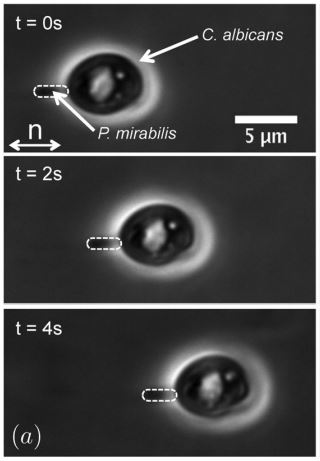
P. mirabillis cell pushes a C. albicans cell

A motile P. mirabilis cell pushes a non-motile C. albicans cell

The motile bacteria, P. mirabilis, were used to push non-motile fungal cells, C. albicans, in a directed path.  Both the bacterial and fungal cells are found in patients with urinary tract infections.  The urinary epithelium secretes layers of mucus within the urinary tract which is guided by external flow; molecules and cells in the urinary tract exhibit directional alignment due to the mucus flow.  The proposed nematic liquid crystal environment with motile and non-motile cells represents a simple model of the human urinary tract.  The alignment of the liquid crystal guides the bacteria and causes them to swim along the director field, similar to cells in the urinary epithelium.  P. mirabilis were mixed with C. albicans and suspended within a 20 µm thick liquid crystal layer composed of disodium cromoglycate.  Single P. mirabilis cells pushed the non-motile C. albicans cells along the director of the liquid crystal, to give straight or curved swimming tracks depending on the crystal orientation.  The P. mirabilis were capable of reaching a velocity of 1 – 2 µm/s-1 while transporting their fungal cell cargo.

For a greater understanding of the cargo transport mechanism, 2 µm diameter beads were mixed with the P. mirabilis. Bacteria transporting beads were capable of reaching velocities of 5 µm/s-1.  The hydrodynamics of the system of swimming bacteria and particles was analyzed with the mathematical model, regularized Stokeslets.  The observed experimental swimming velocity correlated with numerical simulated results, with a clear trend of decreasing speed with increasing cargo size.  The mathematical model suggests hydrodynamic interaction of the bacteria flagella and cargo load are an important for predicting system velocity.  The work helps understand cellular interspecies interaction that is controlled with liquid crystal alignment.

See the full Soft Matter communication here:

Bacterial transport of colloids in liquid crystalline environments
Rishi R. Trivedi, Rina Maeda, Nicholas L. Abbott, Saverio E. Spagnolie, and Douglas B. Weibel
Soft Matter, Advanced Article, 2015
DOI: 10.1039/C5SM02041G


Morgan M. Stanton

Dr. Morgan M. Stanton is currently a postdoctoral researcher at the Max Planck Institute for Intelligent Systems in Stuttgart, Germany.  She completed her Ph.D. in Chemistry from Worcester Polytechnic Institute in 2014.  Read more about Morgan’s research publications here or you can follow her on Twitter @morg368.

Follow the latest Soft Matter publications and updates on Twitter @softmatter or on Facebook

Digg This
Reddit This
Stumble Now!
Share on Facebook
Bookmark this on Delicious
Share on LinkedIn
Bookmark this on Technorati
Post on Twitter
Google Buzz (aka. Google Reader)

Professor Arindam Banerjee awarded 2015 Thomson Reuters Research Excellence – India Citation Award

Congratulations to Soft Matter Advisory Board member Professor Arindam Banerjee of the Indian Association for the Cultivation of Science in India, who was awarded a 2015 Thomson Reuters Research Excellence – India Citation Award. Based on information from scientific research citations within Web of ScienceTM, the awards were presented to the 10 most influential researchers in India, in New Delhi on 18th September, 2015. Arindam is pictured below receiving his award (far left).

See Arindam’s latest Soft Matter papers here:

Time-dependent gel to gel transformation of a peptide based supramolecular gelator
Abhishek Baral, Shibaji Basak, Kingshuk Basu, Ashkan Dehsorkhi, Ian W. Hamley and Arindam Banerjee
Soft Matter, 2015,11, 4944-4951

Sunlight induced unique morphological transformation in graphene based nanohybrids: appearance of a new tetra-nanohybrid and tuning of functional property of these nanohybrids
Abhijit Biswas and Arindam Banerjee
Soft Matter, 2015,11, 4226-4234

Digg This
Reddit This
Stumble Now!
Share on Facebook
Bookmark this on Delicious
Share on LinkedIn
Bookmark this on Technorati
Post on Twitter
Google Buzz (aka. Google Reader)

Hydrogel capable of protein release using red light

Web writer Morgan Stanton summarises a recent article from the journal

Hydrogel synthesis is a well-established method of incorporating cells, proteins, or drugs into a biocompatible polymer network.  The majority of hydrogels are stimulated and cross-linked by a chemical reaction or UV light, but this can limit their use in vivo as these methods damage healthy cells. Using red light-stimulated hydrogels would be better suited for the therapeutic use of hydrogels, as it creates little photo damage to cells and red light can penetrate deeper into tissue than other light wavelengths. Such a hydrogel was developed by a research group at the Max Planck Institute for Polymer Research in Germany and is described in detail in a recently published full article in Soft Matter. The group describes a synthetic method of hydrogel formation using methoxy-modified azobenzene that activates the polymer complex under red light.

azobenzene trans-to-cis transition with β-cyclodextrin using red light

The hydrogel synthesis is based on the spontaneous formation of a supramolecular complex by combining an azobenzene (mAzo) derivative and β-cyclodextrin (β-CD).  The two chemical species were individually grafted onto a poly(acrylic acid) (PAA) polymer backbone and mixed to form the red light-activated hydrogel.  During exposure to red light, the azobenzene moiety in mAzo underwent isomerization from the trans to cis state, which was not hindered by the presence of β-CD.  The process is reversible, with heat or blue light returning mAzo to the trans state.  While the mAzo polymer remained in the trans state, the mAzo/β-CD complex maintained a gelatin formation, but once altered to the cis state by red light, the hydrogel destabilized and became a liquid.  This sol-to-gel transition is explained by the high binding constant between trans mAzo and β-CD (Ka = 1546 M-1) compared to low binding constant between cis mAzo and β-CD (Ka = 82.1 M-1).

To demonstrate the hydrogel’s utility for medical applications, the hydrogel was loaded with the protein, bovine serum albumin (BSA).  Exposure to red light dissolved the hydrogel and released ~83% of the protein into solution.  If a piece of porcine tissue was placed between the red light source and the protein laden hydrogel, mAzo was still capable of transitioning to the cis state for disassembly of the gel and release of the BSA.  The ability of the hydrogel to be activated through tissue using non-invasive and non-detrimental red light is an impressive step for the development of therapeutic and light-stimulated polymers for controlled drug or protein release.

See the full Soft Matter article here:

Supramolecular hydrogels constructed by red-light-responsive host–guest interactions for photo-controlled protein release in deep tissue
Dongsheng Wang, Manfred Wagner, Hans-Jürgen Butt, and  Si Wu
Soft Matter, 2015, Advance Article
DOI: 10.1039/C5SM01888A


Morgan M. StantonDr. Morgan M. Stanton is currently a postdoctoral researcher at the Max Planck Institute for Intelligent Systems in Stuttgart, Germany.  She completed her Ph.D. in Chemistry from Worcester Polytechnic Institute in 2014.  Read more about Morgan’s research publications here or you can follow her on Twitter @morg368.

Follow the latest Soft Matter publications and updates on Twitter @softmatter or on Facebook


Digg This
Reddit This
Stumble Now!
Share on Facebook
Bookmark this on Delicious
Share on LinkedIn
Bookmark this on Technorati
Post on Twitter
Google Buzz (aka. Google Reader)

Active and Adaptive Materials Conference

Announcing the Active and Adaptive Materials Conference, New York City, USA

The CUNY Advanced Science Research Center’s Nanoscience Initiative will focus on active and adaptive nanomaterials for its latest symposium on October 22nd and 23rd, 2015 at CUNY’s Advanced Science Research Center. In addition to presentations from Internationally-recognized leaders in nano-molecular chemistry, there will be contributed talks, opportunities to tour the facility and a poster session to be held in the ground floor lobby.

Confirmed Speakers:

Samuel I. Stupp – Northwestern University
Joanna Aizenberg – Harvard University
Lee Cronin – University of Glasgow
Jan van Esch – Delft University of Technology
David G. Lynn – Emory University
Elisa Riedo – CUNY Advanced Science Research Center & The City College of New York
Nathan Gianneschi – UC San Diego
Adam Braunschweig – University of Miami
Paul Chaikin – New York University

Full program, abstracts and biographies coming soon.

REGISTRATION NOW OPEN

Abstract Submission Deadline – October 1st 2015, 5pm
Earlybird Registration Deadline – September 12th 2015

Digg This
Reddit This
Stumble Now!
Share on Facebook
Bookmark this on Delicious
Share on LinkedIn
Bookmark this on Technorati
Post on Twitter
Google Buzz (aka. Google Reader)

A simple method for preventing nanoparticle-protein aggregation

Web writer Morgan Stanton summarises a recent article from the journal

The interaction of proteins with nanoparticles has significant applications for clinical and biomedical therapies, specifically the field of theranostics, where diagnostic and therapeutic agents are combined into a single entity.  Unfortunately, it has been well documented that attachment of proteins to nanoparticle surfaces leads to deformation of the protein and loss of protein activity.  Aggregates of proteins form on the particle and induce aggregate formation of the particles themselves, hindering any theranostic capability.

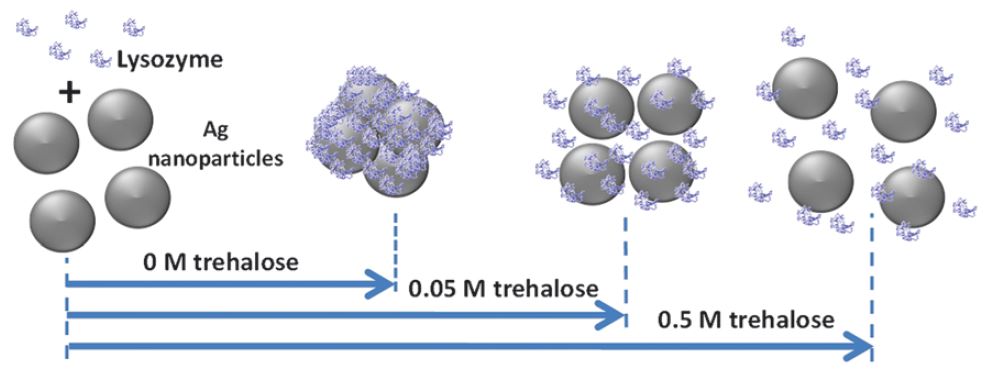
In a recent communication in Soft Matter, researchers from Johns Hopkins University, USA, and Jawaharlal Nehru Centre for Advanced Scientific Research, India, describe a simple chemical method for solving this dilemma; addition of sugar.  The naturally occurring disaccharide, trehalose, has demonstrated the ability to stabilize protein structures and shield them from thermal stress and dehydration.  The protective nature of trehalose has been described by three hypotheses: (1) mechanical entrapment of the protein within the sugar molecules, (2) hydrogen bonding of the trehalose with the protein for chemical stabilization, (3) or water entrapment between the surface of the protein and trehalose.  The research team exploited the protective properties of trehalose to insulate the protein, lysozyme, while the protein was exposed to silver nanoparticles, thus preventing denaturing of the protein.

Silver nanoparticles

Interaction of silver nanoparticles with lysozyme with varying trehalose concentrations

Without chemical stabilization, lysozyme aggregated on the nanoparticle surface and had significant structural deorganization.  In the presence of trehalose, lysozyme maintained its active conformation and exhibited limited or no aggregation.  By adjusting the concentration of trehalose in solution, nanoparticle-protein interactions were modulated.  Analytical methods, including UV-vis absorbance, circular dichroism, and surface enhanced Raman spectroscopy (SERS) illustrated and characterized the changes is binding of the lysozyme to the silver nanoparticle surface and the enhanced stability of the protein.  The proof-of-concept system created a biocompatible environment for nanoparticles and proteins to engage without compromising lysozyme structure or activity.  The proposed method will facilitate the development of nanoparticle theranostics and opens new avenues for nanomedicine design.

See the full Soft Matter article here:

Revealing the trehalose mediated inhibition of protein aggregation through lysozyme-silver nanoparticle interaction
Soumik Siddhanta, Ishan Barman, and Chandrabhas Narayana
Soft Matter, 2015, Advance Article
DOI: 10.1039/C5SM01896J


Morgan M. Stanton Dr. Morgan M. Stanton is currently a postdoctoral researcher at the Max Planck Institute for Intelligent Systems in Stuttgart, Germany.  She completed her Ph.D. in Chemistry from Worcester Polytechnic Institute in 2014.  Read more about Morgan’s research publications here.

Follow the latest Soft Matter publications and updates on Twitter @softmatter or on Facebook

Digg This
Reddit This
Stumble Now!
Share on Facebook
Bookmark this on Delicious
Share on LinkedIn
Bookmark this on Technorati
Post on Twitter
Google Buzz (aka. Google Reader)

Top 10 most-read Soft Matter articles – Q2 2015

This month sees the following articles in Soft Matter that are in the top ten most accessed from April – June:

Crystalline order and topological charges on capillary bridges
Verena Schmid and Axel Voigt
Soft Matter, 2014,10, 4694-4699
DOI: 10.1039/C4SM00228H

Stimuli-responsive Pickering emulsions: recent advances and potential applications
Juntao Tang, Patrick James Quinlan and Kam Chiu Tam
Soft Matter, 2015,11, 3512-3529
DOI: 10.1039/C5SM00247H

Manipulation of micro- and nanostructure motion with magnetic fields
Roger S. M. Rikken, Roeland J. M. Nolte, Jan C. Maan, Jan C. M. van Hest, Daniela A. Wilson and Peter C. M. Christianen
Soft Matter, 2014,10, 1295-1308
DOI: 10.1039/C3SM52294F

Liquid marbles: topical context within soft matter and recent progress
G. McHale and M. I. Newton
Soft Matter, 2015,11, 2530-2546
DOI: 10.1039/C5SM00084J

Biomimetic fabrication of information-rich phenolic-chitosan films
Kelsey M. Gray, Eunkyoung Kim, Li-Qun Wu, Yi Liu, William E. Bentley and Gregory F. Payne
Soft Matter, 2011,7, 9601-9615
DOI: 10.1039/C1SM05293D

Progess in superhydrophobic surface development
Paul Roach, Neil J. Shirtcliffe and Michael I. Newton
Soft Matter, 2008,4, 224-240
DOI: 10.1039/B712575P

Understanding diluted dispersions of superparamagnetic particles under strong magnetic fields: a review of concepts, theory and simulations
Jordi Faraudo, Jordi S. Andreu and Juan Camacho
Soft Matter, 2013,9, 6654-6664
DOI: 10.1039/C3SM00132F

Continuous droplet interface crossing encapsulation (cDICE) for high throughput monodisperse vesicle design
Manouk Abkarian, Etienne Loiseau and Gladys Massiera
Soft Matter, 2011,7, 4610-4614
DOI: 10.1039/C1SM05239J

Droplet mobility on lubricant-impregnated surfaces
J. David Smith, Rajeev Dhiman, Sushant Anand, Ernesto Reza-Garduno, Robert E. Cohen, Gareth H. McKinley and Kripa K. Varanasi
Soft Matter, 2013,9, 1772-1780
DOI: 10.1039/C2SM27032C

Janus particles
Andreas Walther and Axel H. E. Müller
Soft Matter, 2008,4, 663-668
DOI: 10.1039/B718131K

Why not take a look at the articles today and blog your thoughts and comments below.

Fancy submitting an article to Soft Matter? Then why not submit to us today!

To keep up-to-date with all the latest research, sign up for the Soft Matter e-Alert or RSS feeds or follow Soft Matter on Twitter or Facebook

Digg This
Reddit This
Stumble Now!
Share on Facebook
Bookmark this on Delicious
Share on LinkedIn
Bookmark this on Technorati
Post on Twitter
Google Buzz (aka. Google Reader)

5th International Conference on Self-Healing Materials 2015 Oral Presentation Prize winner

Soft Matter oral presentation prize icshm2015

A huge congratulations to Arn Mignon who was awarded the Soft Matter Oral Presentation Prize at the 5th International Conference on Self-Healing Materials (ICSHM2015). The conference took place on the 22 – 24 June 2015 in Durham, USA and was sponsored by Soft Matter.

Arn Mignon is from Ghent University and won the Soft Matter Oral Presentation Prize with his talk titled “Smart super absorbent polymers for self-healing of motar.”

ICSHM2015 focussed on the newly emerging field of self-healing biomaterials, encompassing all classes of self-healing materials including polymers, ceramics, metals, and composites, as well as biomedical implants. Further details about the conference can be found by taking a look at their website.

Digg This
Reddit This
Stumble Now!
Share on Facebook
Bookmark this on Delicious
Share on LinkedIn
Bookmark this on Technorati
Post on Twitter
Google Buzz (aka. Google Reader)

Glass transition in ant traffic jams

Article written by Sam Ivell

Inspired by the fluid-like motion of flocks of birds, researchers in the US have used techniques from soft matter physics to study the way that fire ants move.

At high density collective ant flow can be described by the physics of glass-forming soft materials © Shutterstock

Collective motion is ubiquitous in nature. Fire ants in particular provide a fascinating case study due to the confinement enforced by the foraging tunnels in which they move. A key factor in the motion of fire ants, and other eusocial insects, is the requirement to stop and communicate with each other, leading to traffic jams and blockages along the 50m long underground superhighways in which they travel.

To read the full article visit Chemistry World.

Glass-like dynamics in confined and congested ant traffic
Nick Gravish, Gregory Gold, Andrew Zangwill, Michael A.D. Goodisman and Daniel I Goldman  
Soft Matter, 2015, Accepted Manuscript
DOI: 10.1039/C5SM00693G, Paper

Digg This
Reddit This
Stumble Now!
Share on Facebook
Bookmark this on Delicious
Share on LinkedIn
Bookmark this on Technorati
Post on Twitter
Google Buzz (aka. Google Reader)