HOT: a neat new route to the integrastatin core

Integrastatins display micromolar inhibition of the HIV-1 integrase enzyme, halting replication of the virus.  Medicinal chemists are therefore very interested in being able to synthesise these natural products, and their analogues, to investigate potential HIV therapies.

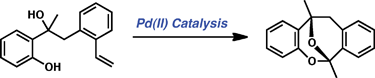
The total synthesis of either integrastatin A or B is yet to be reported, but several groups have reported the synthesis of the tetracycle core, Brian Stoltz and colleagues Caltech being the latest.   Their synthesis differs from previous reports by utilising a palladium-catalyzed oxidative cyclization.  Their four-step route produces the tetracycle core in 30% overall yield.

This HOT piece of synthesis is free to access for 4 weeks:

A rapid and convergent synthesis of the integrastatin core
Pamela M. Tadross, Pradeep Bugga and Brian M. Stoltz
Org. Biomol. Chem., 2011, Advance Article
DOI: 10.1039/C1OB05725A

You may also like to look at the other reports of the integrastatin core synthesis published in RSC journals:

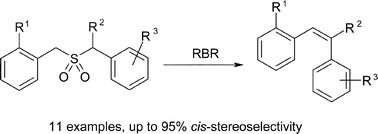
Unexpected Z-stereoselectivity in the Ramberg–Bäcklund reaction of diarylsulfones leading to cis-stilbenes: the effect of aryl substituents and application in the synthesis of the integrastatin nucleus
Jonathan S. Foot, Gerard M. P. Giblin, A. C. Whitwood and R. J. K. Taylor
Org. Biomol. Chem., 2005, 3, 756-763

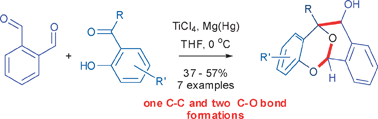
An expeditious one-step entry to the tetracyclic core of integrastatins

C. V. Ramana, Challa Nageswara Reddy and Rajesh G. Gonnade
Chem. Commun., 2008, 3151-3153

Digg This
Reddit This
Stumble Now!
Share on Facebook
Bookmark this on Delicious
Share on LinkedIn
Bookmark this on Technorati
Post on Twitter
Google Buzz (aka. Google Reader)

An easy route to tetrahydrofluorene scaffolds on the cover of Issue 13

View the issue here

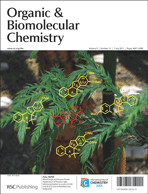
The article highlighted on the cover of our latest issue is work from Gautam Panda and Ritesh Singh at the Central Drug Research Institute, India.

They have reported an efficient, regioselective route to hetero [6,5,6]ABC tetrahydrofluorene cores.  This type of tricyclic hydrofluorene core is found in a class of natural products called Taiwaniaquinoids, which have shown some promising bioactivities.

To access the hetero tetrahydrofluorene skeleton the authors used divinyl alcohols, activated with Sc(OTf)3 in a Nazarov-type cyclisation achieving the desired scaffold under very mild conditions.

Application of Nazarov type electrocyclization to access [6,5,6] and [6,5,5] core embedded new polycycles: an easy entry to tetrahydrofluorene scaffolds related to Taiwaniaquinoids and C-nor-D homosteroids
Ritesh Singh and Gautam Panda
Org. Biomol. Chem., 2011, 9, 4782-4790
DOI: 10.1039/C0OB00892C

Digg This
Reddit This
Stumble Now!
Share on Facebook
Bookmark this on Delicious
Share on LinkedIn
Bookmark this on Technorati
Post on Twitter
Google Buzz (aka. Google Reader)

Dioxazaborocanes: old adducts, new tricks

This Emerging Area article from Hélène Bonin and Emmanuel Gras (CNRS) discusses the recent developments in dioxazaborocane chemistry that the authors believe may make it a viable fluoride-free alternative to organotrifluoroborate salts.
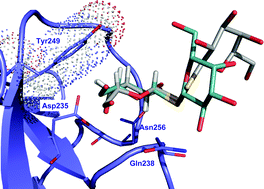
The review covers the synthesis and properties as well as the applications of dioxazaboracanes in organic chemistry.  The recent uses of dioxazaboracanes as direct reactants, rather than as boronic ester or acid protecting groups, are highlighted and the authors hope that a better understanding of their structures in solution will increase the use of these compounds in direct synthesis.

Dioxazaborocanes: old adducts, new tricks
Hélène Bonin, Thomas Delacroix and Emmanuel Gras
Org. Biomol. Chem., 2011,
DOI: 10.1039/C1OB05330B

Digg This
Reddit This
Stumble Now!
Share on Facebook
Bookmark this on Delicious
Share on LinkedIn
Bookmark this on Technorati
Post on Twitter
Google Buzz (aka. Google Reader)

Most cited OBC Perspective articles free to access!

The OBC Editorial team has collected the most cited Perspectives published in our journal in the last 5 years and you can now download them for free!

Perspective articles are either a concise and critical appraisal, or a personal viewpoint of activity in a specialist area of organic chemistry of current interest, and are not intended to be comprehensive reviews of the literature. They are normally published by invitation of the Editorial team but suggestions from authors are welcome and enquiries should be directed to the Editor.

Find the top 5 most cited Perspectives in the last 5 years below. Our congratulations and thanks to the authors!

Recognition and activation by ureas and thioureas: stereoselective reactions using ureas and thioureas as hydrogen-bonding donors
Yoshiji Takemoto
Org. Biomol. Chem., 2005, 3, 4299-4306
DOI: 10.1039/B511216H

DNA-programmed assembly of nanostructures
Kurt V. Gothelf and Thomas H. LaBean
Org. Biomol. Chem., 2005, 3, 4023-4037
DOI: 10.1039/B510551J

Bifunctional transition metal-based molecular catalysts for asymmetric syntheses
Takao Ikariya, Kunihiko Murata and Ryoji Noyori
Org. Biomol. Chem., 2006, 4, 393-406
DOI: 10.1039/B513564H

Analysis of the reactions used for the preparation of drug candidate molecules
John S. Carey, David Laffan, Colin Thomson and Mike T. Williams
Org. Biomol. Chem., 2006, 4, 2337-2347
DOI: 10.1039/B602413K

Density functional theory with dispersion corrections for supramolecular structures, aggregates, and complexes of (bio)organic molecules
Stefan Grimme, Jens Antony, Tobias Schwabe and Christian Mück-Lichtenfeld
Org. Biomol. Chem., 2007, 5, 741-758
DOI: 10.1039/B615319B

Digg This
Reddit This
Stumble Now!
Share on Facebook
Bookmark this on Delicious
Share on LinkedIn
Bookmark this on Technorati
Post on Twitter
Google Buzz (aka. Google Reader)

HOT: glycosyldisulfide lectin ligands

S-glycosides are resistant to hydrolytic cleavage, which gives them a distinct pharmacological advantage over O-glycosides as ligands for lectins, but inherently present different biological activity.  This HOT article evaluates the ability of dithiodigalactoside (DTDG) – which was identified through a dynamic combinatorial library approach in a previous study – to protect human cells from toxin binding.
Jésus Jiménez-Barbero, CSIC, and an international team of researchers show that DTDG is capable of selecting between the mistletoe toxin and human lectins and conclude that glycosyldisulfides have potential as chemical platform for inhibitor design.

Interested? The article is free to download for the next 4 weeks:

Symmetric dithiodigalactoside: strategic combination of binding studies and detection of selectivity between a plant toxin and human lectins
Sonsoles Martín-Santamaría, Sabine André, Eliza Buzamet, Rémi Caraballo, Gloria Fernández-Cureses, Maria Morando, João P. Ribeiro, Karla Ramírez-Gualito, Beatriz de Pascual-Teresa, F. Javier Cañada, Margarita Menéndez, Olof Ramström, Jesús Jiménez-Barbero, Dolores Solís and Hans-Joachim Gabius
Org. Biomol. Chem., 2011, Advance Article
DOI: 10.1039/C0OB01235A

Digg This
Reddit This
Stumble Now!
Share on Facebook
Bookmark this on Delicious
Share on LinkedIn
Bookmark this on Technorati
Post on Twitter
Google Buzz (aka. Google Reader)

OBC Issue 12 now available online!

View the issue online here

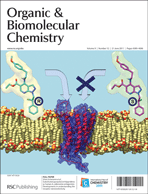
On our cover this issue is work from Silvia Schenone (University of Genoa, Italy) describing the separation of enantiomers of newly-synthesised A1 adenosine antagonists.  The group had previously synthesised a family of pyrazolo[3,4-b]pyridine derivatives, and here show that the enantiomers of the most active compound have different affinity for the receptor.

Substituted pyrazolo[3,4-b]pyridines as human A1 adenosine antagonists: Developments in understanding the receptor stereoselectivity
Tiziano Tuccinardi, Alessandra Tania Zizzari, Chiara Brullo, Simona Daniele, Francesca Musumeci, Silvia Schenone, Maria Letizia Trincavelli, Claudia Martini, Adriano Martinelli, Gianluca Giorgi and Maurizio Botta
Org. Biomol. Chem., 2011, 9, 4448-4455
DOI: 10.1039/C0OB01064B

As with all our cover articles, this paper is free to access for 6 weeks – why not download it today!

Digg This
Reddit This
Stumble Now!
Share on Facebook
Bookmark this on Delicious
Share on LinkedIn
Bookmark this on Technorati
Post on Twitter
Google Buzz (aka. Google Reader)

HOT: ultra-sensitive fluorescence quenching to detect molecular recognition events

Achieving sensitive signal detection in fluorescence-based assays often involves chemically pre-amplifying the signal to detectable levels.   There are currently several methods of achieving amplification, but here Andrei Kutateladze and colleagues at the University of Denver come up with a concept different from previous methods based on photoamplified fluorescence quenching.

General concept for the amplified unmasking of benzophenone resulting in fluorescence quenching

They are able to detect molecular recognition events in the biotin-avidin system through the autocatalytic photo-unmasking of benzophenone – which acts as both the amplification chain carrier and the quencher for the reporter fluorophore – achieving attomolar detection limits with a relatively cheap CCD camera.  They even demonstrate the possibility of imaging the binding assay with an ordinary mobile phone camera, showing that sensitive analysis can be carried out when expensive state-of-the-art equipment is not available.

To read more, download the article – it’s free to access for the next four weeks:

Photochemically amplified detection of molecular recognition events: an ultra-sensitive fluorescence turn-off binding assay
Tiffany P. Gustafson, Greg A. Metzel and Andrei G. Kutateladze
Org. Biomol. Chem., 2011, Advance Article
DOI: 10.1039/C1OB05289F

Digg This
Reddit This
Stumble Now!
Share on Facebook
Bookmark this on Delicious
Share on LinkedIn
Bookmark this on Technorati
Post on Twitter
Google Buzz (aka. Google Reader)

HOT: multivalent strategies for RGD peptide-integrin binding

Integrins play important roles in cell adhesion and signalling, and crucially are over-expressed in certain cancer cells.  The tripeptide Arg-Gly-Asp (RGD) is known to bind to integrins, and understanding exactly how they bind is obviously of fundamental importance for the development of structures with higher integrin affinities for possible therapeutic applications.

Here, Daniel Welsh and David K. Smith (University of York) investigate different ways in which the peptide ligands can be organised for multivalent binding to integrins. Although integrins only posses a single binding site they often grouped together in cell membranes, so mutlivalent binding to multiple integrins is possible.  They investigate both dendritic (covalent) and self-assembly (non-covalent) strategies, finding both can be used in similar ways to enhance the binding of RGD peptides to integrins, but that the self-assembly approach appears to give rise to slightly higher affinity integrin binding.

To find out more download this article – it’s free for the next four weeks:

Comparing dendritic and self-assembly strategies to multivalency—RGD peptide–integrin interactions
Daniel J. Welsh and David K. Smith
Org. Biomol. Chem., 2011, Advance Article
DOI: 10.1039/C1OB05241A

Digg This
Reddit This
Stumble Now!
Share on Facebook
Bookmark this on Delicious
Share on LinkedIn
Bookmark this on Technorati
Post on Twitter
Google Buzz (aka. Google Reader)

HOT: sweet but not sickly – non-cytotoxic sugar amino acid-containing antimicrobial agents

As bacteria continue to resist our efforts to eradicate them, the development of new antibiotics with alternative modes of action are required to augment existing treatments.  Cationic antimicrobial peptides (CAPs) show potential, but are often too cytotoxic to be developed as new antibiotics.  One way to get around the cytotoxic mechanisms is to attach agents to carriers, such as gold nanoparticles which are non-toxic to cells and biocompatible.

In this HOT paper Tushar Kanti Chakraborty and colleagues from the Central Drug Research Institute, India, have synthesised some novel sugar amino acid-containing cyclic cationic peptides and attach them to gold nanoparticles to study their therapeutic effects. The preliminary studies found that the sugar amino acid-containing CAPs retained their antimicrobial activity on conjugation with the nanoparticles, but with significantly reduced cytotoxic effects.

Download the article to discover more about the study and the potential mechanism for these CAPs – it’s free to access for four weeks:

Towards the synthesis of sugar amino acid containing antimicrobial noncytotoxic CAP conjugates with gold nanoparticles and a mechanistic study of cell disruption
Sudip Pal, Kalyan Mitra, Sarfuddin Azmi, Jimut Kanti Ghosh and Tushar Kanti Chakraborty
Org. Biomol. Chem., 2011, Advance Article
DOI: 10.1039/C1OB05338H

Digg This
Reddit This
Stumble Now!
Share on Facebook
Bookmark this on Delicious
Share on LinkedIn
Bookmark this on Technorati
Post on Twitter
Google Buzz (aka. Google Reader)

Free Radical Chemistry themed issue in memory of Athel Beckwith

Professor Athel Beckwith who inspired a generation of free radical chemists

View the Free Radical Chemistry web themed issue

It was a stunned international chemistry community that learnt of the tragic death of Athel Beckwith on 15 May 2010. As word spread, shock and disbelief were the overwhelming sentiments; the world had lost a scientific treasure.

Athel Beckwith was born in Perth on 20 February 1930. His father was a pharmacist and both of his parents were gifted musicians, a trait passed on to Athel at an early age. He attended Perth Modern School where he excelled. He matriculated with Distinction in all seven subjects and went on to the University of Western Australia for his chemical education. It was during his undergraduate studies that Athel learnt that the most interesting chemistry occurs when there is an unexpected outcome and that it is through these unexpected outcomes that we learn new things. These are principles that he passed on to his students during his academic career including myself.

Athel spent his Honours year working on natural product chemistry under the guidance of Doug White, and later on reaction mechanisms with Joe Miller. After a period as a graduate assistant he moved to Adelaide to take up a position as a junior lecturer, but eventually doctoral studies lured Athel to Oxford where he worked with Professor Waters on relatively unknown entities known as “free radicals”, a “wise choice” according to Athel.

After a year at Imperial College on a Nuffield Foundation grant he returned to Adelaide where he established a research group working on free radicals and shortly after became Professor of Organic Chemistry at the age of 35. This was a very important period in the development of free radical chemistry and led to “Beckwith’s Rules” for predicting the outcomes of free radical cyclization reactions. In 1981 he moved to the Australian National University where he remained until his retirement in 1995.

I know of only three reactions that are named after Australian chemists (Birch, Liepa and Beckwith–Dowd) and, it is significant that they all involve free radicals. It was carrying out a Birch reduction as an undergraduate that swayed me toward chemistry and eventually free radicals and I was fortunate to work under Athel’s guidance during my PhD studies. Athel was at the cutting edge of free radical chemistry during what I have referred to as the “Free Radical Renaissance Period” and others have called the “Golden Age” during which the factors that govern radical chemistry were being teased out to provide guidelines that we now all take for granted. His contributions to the understanding of factors that govern the region- and stereo-selectivity of radical reactions are profound and enduring and established Australia as a major hub of activity in the field, a hub that several of his “academic children” have inherited. He also made significant contributions to radical clock reactions, nitroxide chemistry, the neophyl and other rearrangements, ESR spectroscopy, as well as other chemistries.

I have tried to model my role as supervisor to his “scientific grandchildren” on the principles that he taught me; even if I perform my role to only a fraction of Athel’s ability, I would consider that to be a great achievement. In addition to being a brilliant scientist, Athel was always kind, a gentleman and a scholar in the truest sense, a wonderful human being.  Further information about Athel can be found in a recent interview for the Australian Academy of Science (http://www.science.org.au/scientists/interviews/b/ab.html).

It has been a pleasure to be the guest editor of this special free radical themed issue of Organic & Biomolecular Chemistry dedicated to Athel. It is timely that the latest free radical chemistry be showcased in such a manner, and I am confident that Athel would have appreciated reading each of the cutting-edge articles presented in this special issue. Fittingly, a diversity of radical chemistry from around the world is represented in this issue, of which about 25% of articles have been flagged as being HOT. The overwhelmingly positive responses from members of the international free radical community to invitations to contribute to this issue is a measure of the fondness and esteem that Athel Beckwith was held in and I thank each of you for making this issue such a success.  I also thank the Team at Organic & Biomolecular Chemistry, in particular Lorena Tomas Laudo, Roxane Owen and Richard Kelly for their professional expert assistance, guidance and good humour.

Carl Schiesser – Guest Editor


Carl Schiesser is Professor of Chemistry in the School of Chemistry at The University of Melbourne and Director of the Australian Research Council Centre of Excellence for Free Radical Chemistry and Bio­technology. He received his PhD in 1987 from the Australian National University working with Professor Athel Beckwith and was a postdoc with Professor Alwyn Davies at University College London from 1988–1990. Professor Schiesser received a DSc from the University of Adelaide in 2000 and was awarded the prestigious A. J. Birch medal of the Royal Australian Chemical Institute in 2006.  Carl is a Fellow of the Royal Australian Chemical Institute and the Royal Society of Chemistry. He has extensive experience in free radical chemistry, ranging from molecular modelling, through to mechanistic and kinetic studies, the development of new chemical methodology, synthesis of bioactive molecules and cultural materials conservation.

Digg This
Reddit This
Stumble Now!
Share on Facebook
Bookmark this on Delicious
Share on LinkedIn
Bookmark this on Technorati
Post on Twitter
Google Buzz (aka. Google Reader)