Hot: Novel natural products from the stem bark of Toona ciliata var. pubescens

In a quest for bioactive metabolites from Chinese medicinal plants, Yue-Wei Guo et al. have isolated and characterised a number of novel and exciting natural products from Toona ciliata var. Pubescens, a tall timber tree which can be found widely in south China.

The Toona species have previously led to the isolation of limonoids and protolimonoids. These complex molecules, bearing an elaborate polycyclic skeleton, represent challenging targets for total synthesis and are particularly attractive due to their range of biological activities.

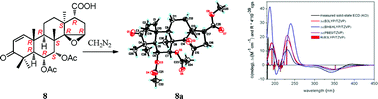
In this paper, the team of collaborative researchers from China and Hungary have isolated nine new limonoids, three of them possessing unprecedented carbon skeletons, along with 5 known analogs. Using advanced NMR techniques, a solid-state TDDFT ECD approach and X-ray analysis, a complete evaluation of their relative and absolute configuration was determined. Biological activities were found for Toonapubesin G (7), showing promising inhibitory activity against the aggressive tumor cell line CDC25B and compound 8a showed significant cell protecting activity against H2O2-induced SH-SY5Y cell damage.

This article will be FREE to access for the next 4 weeks:

Protolimonoids and norlimonoids from the stem bark of Toona ciliata var. pubescens
Jian-Rong Wang, Hai-Li Liu, Tibor Kurtán, Attila Mándi, Sándor Antus, Jia Li, Hai-Yan Zhang and Yue-Wei Guo
Org. Biomol. Chem., 2011, Advance Article
DOI: 10.1039/C1OB06150J, Paper

  • Interested in Natural Products? Why not also take a look at our sister journal Natural Product Reports and keep up-to-date with high impact, critical reviews in natural products research.
  • Digg This
    Reddit This
    Stumble Now!
    Share on Facebook
    Bookmark this on Delicious
    Share on LinkedIn
    Bookmark this on Technorati
    Post on Twitter
    Google Buzz (aka. Google Reader)

    Hot: Elegant (-)-erycibelline synthesis

    Chu-Yi Yu and colleagues present the first stereoselective synthesis of (-)-Erycibelline in this OBC hot article.

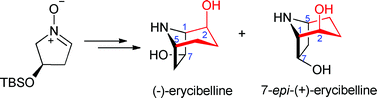
    (-)-Erycibelline is a naturally occurring dihydroxynortropane alkaloid isolated from the Chinese herb medicine Erycibe elliptilimba, which is used to treat rheumatic disease and is a useful pain-killer.

    Yu’s team first synthesized a cyclic nitrone with both nitrone and aldehyde functional groups as the key intermediate by organometallic addition of nitrone followed by oxidation and deprotecton. Subsequent SmI2-induced intramolecular reductive coupling and reductions produced (-)-Erycibelline with good yields.

    Graphical abstract: A concise stereoselective synthesis of (−)-erycibelline

    This neat approach to the nortropane skeleton is versatile and could allow general access to hydroxylated nortropane alkaloids and their analogues, which could be beneficial for treating other diseases.

    Download the article now to read more details of this elegant synthesis – it’s free to access for 4 weeks!

    A concise stereoselective synthesis of (−)-erycibelline
    Z.-L. Zhang, S. Nakagawa, A. Kato, Y.-M. Jia, X.-G. Hu and C.-Y. Yu
    Org. Biomol. Chem., 2011, DOI: 10.1039/C1OB06244A

    Digg This
    Reddit This
    Stumble Now!
    Share on Facebook
    Bookmark this on Delicious
    Share on LinkedIn
    Bookmark this on Technorati
    Post on Twitter
    Google Buzz (aka. Google Reader)

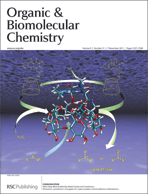
    On the cover: perspective on cation-pi interactions in asymmetric synthesis and alloxazine–cyclodextrin conjugates for sulfoxidations

    On the outside cover of Issue 21 we have a hot perspective article from Shinji Yamada and John S. Fossey describing nitrogen cation-π interactions in asymmetric synthesis and summarises the areas where these interactions play an important role.

    Areas covered:

    • Iminium–π interactions
    • Pyridinium–π interactions
    • Imidazolium, thiazolium and related structure–π interactions

    Nitrogen cation–π interactions in asymmetric organocatalytic synthesis
    Shinji Yamada and John S. Fossey
    Org. Biomol. Chem., 2011, 9, 7275-7281
    DOI: 10.1039/C1OB05228D

    The inside cover highlights work from Radek Cibulka and Tomas Kraus et al. who have used four alloxazine–cyclodextrin conjugates as catalysts for enantioselective oxidation of prochiral sulfides to sulfoxides.  Their method avoids the problems of overoxidation to sulfones that sometimes occur when transition metal catalysts are used, and provides better enantioselectivity (up to 77% ee) than other sulfoxidation organocatalysts.

    Alloxazine–cyclodextrin conjugates for organocatalytic enantioselective sulfoxidations
    Viktor Mojr, Miloš Buděšínský, Radek Cibulka and Tomáš Kraus
    Org. Biomol. Chem., 2011, 9, 7318-7326
    DOI: 10.1039/C1OB05934C

    Both articles are free to access for the next 6 weeks.

    Digg This
    Reddit This
    Stumble Now!
    Share on Facebook
    Bookmark this on Delicious
    Share on LinkedIn
    Bookmark this on Technorati
    Post on Twitter
    Google Buzz (aka. Google Reader)

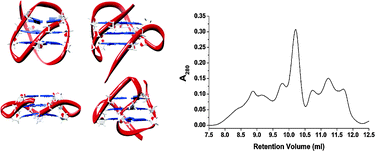
    HOT: Investigating polymorphism in quadruplexes without the need for sequence modification

    This hot article from John O. Trent et al. at the University of Louisville describes a method for using size exclusion chromatography (SEC) to determine polymorphism in G-quadruplexes.  Current methods for investigating polymorphism rely on modification at either the 3′ or 5′ ends of the sequence, shortening or lengthening putative loop regions to try to produce an enriched configuration to study. But this manipulation of the equilibrium may result in the creation of unnatural species that are not present in vivo.

    Trent’s method allows the separation and analysis of quadruplex species without any of the above modifications and has been demonstrated successfully in ten promoter sequences:

    Polymorphism and resolution of oncogene promoter quadruplex-forming sequences
    M. Clarke Miller, Huy T. Le, William L. Dean, Patrick A. Holt, Jonathan B. Chaires and John O. Trent
    Org. Biomol. Chem., 2011, Advance Article
    DOI: 10.1039/C1OB05891F

    Digg This
    Reddit This
    Stumble Now!
    Share on Facebook
    Bookmark this on Delicious
    Share on LinkedIn
    Bookmark this on Technorati
    Post on Twitter
    Google Buzz (aka. Google Reader)

    Self-cleaving DNAzymes on the cover of Issue 20

    On the cover of this month’s issue we have an article from David M. Perrin and colleagues from the University of British Columbia, Canada.

    In order to expand the repertoire of side chain functionality in DNAzymes Perrin and coworkers have explored the use of the phenol group, which is characteristic of the tyrosine side chain found in many active sites of protein enzymes. They have used a phenol-modified 2′-deoxyuridine triphosphate to produce a modified DNA library, which was then used to select DNAzymes capable of self cleaving in the presence of Mg2+ and Zn2+.  The most active DNAzyme, Dz11-17PheO, has an activity of 0.2 min-1.

    A divalent metal-dependent self-cleaving DNAzyme with a tyrosine side chain
    Curtis H. Lam, Christopher J. Hipolito, Marcel Hollenstein and David M. Perrin
    Org. Biomol. Chem., 2011,
    DOI: 10.1039/C1OB05359K, Paper

    Digg This
    Reddit This
    Stumble Now!
    Share on Facebook
    Bookmark this on Delicious
    Share on LinkedIn
    Bookmark this on Technorati
    Post on Twitter
    Google Buzz (aka. Google Reader)

    Two new Associate Editors for OBC

    Jin-Quan Yu from the Scripps Research Institute and Andrei Yudin from the University of Toronto join OBC to handle manuscripts.

    We are delighted to announce the appointment of two new Associate Editors, Professor Jin-Quan Yu and Professor Andrei Yudin, to handle manuscripts for OBC.

    Professor Jin-Quan Yu has worked at the Scripps Research Institute since July 2007, where his research centres around the discovery of novel reactions based on C-H activation.  Prior to this he held an Assistant Professorship at Brandeis University and has also worked at the University of Cambridge where he received his PhD under the supervision of Professor Jonathan B. Spencer.

    Jin-Quan Yu has received numerous awards throughout his career, most recently the 2012 Mukaiyama Award, the 2012 Arthur C. Cope Scholar Award, and the 2011 Novartis Early Career Award. He has authored over 85 publications to date, many of which have been highlighted in the scientific press.

    Professor Andrei Yudin obtained his B.Sc. degree at Moscow State University and his Ph.D. degree at the University of Southern California under the direction of Professors G. K. Surya Prakash and George A. Olah. He subsequently took up a postdoctoral position in the laboratory of Professor K. Barry Sharpless at the Scripps Research Institute. In 1998, he started his independent career at the University of Toronto. He received early tenure, becoming an Associate Professor in 2002, and received an early promotion to the rank of a Full Professor in 2007.

    Amongst Professor Yudin’s awards are the CSC Award in Combinatorial Chemistry, the 2004 Amgen New Faculty Award, the 2010 CSC Merck-Frosst Therapeutic Center Award, the 2010 Rutherford Medal of the Royal Society of Canada, and the 2011 University of Toronto Inventor of the Year Award.

    The appointment of the two Associate Editors to the OBC Board means that authors now have a choice of submission routes when sending their articles to the journal. Using our online submission system, authors can choose for their articles to be handled by either Professor Yu, Professor Yudin (from October), or a Publishing Editor at the Cambridge Editorial office. More details on the submission procedures for OBC can be found in the journal’s guidelines.

    Digg This
    Reddit This
    Stumble Now!
    Share on Facebook
    Bookmark this on Delicious
    Share on LinkedIn
    Bookmark this on Technorati
    Post on Twitter
    Google Buzz (aka. Google Reader)

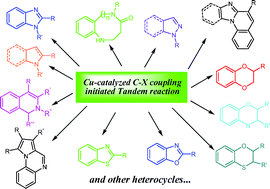
    Perspective: heterocycle synthesis via tandem copper cross-coupling reactions

    Yunyun Liu and Jie-Ping Wan from Jiangxi Normal University in China review recent research progress in heterocycle syntheses using tandem reactions initiated by copper-catalysed coupling transformations.

    Areas they include are:

    • Reactions initiated by C–N coupling
    • Reactions initiated by C–O coupling
    • Reactions initiated by C–S coupling
    • Reactions involving a double C–X coupling process

    Our sister journal Chemical Society Reviews has just published a themed issue on cross-coupling reactions – why not take a look?

    Tandem reactions initiated by copper-catalyzed cross-coupling: A new strategy towards heterocycle synthesis
    Yunyun Liu and Jie-Ping Wan
    Org. Biomol. Chem., 2011, Advance Article
    DOI: 10.1039/C1OB05769C

    Digg This
    Reddit This
    Stumble Now!
    Share on Facebook
    Bookmark this on Delicious
    Share on LinkedIn
    Bookmark this on Technorati
    Post on Twitter
    Google Buzz (aka. Google Reader)

    Top ten most accessed articles in August

    This month sees the following articles in Organic & Biomolecular Chemistry that are in the top ten most accessed:

    Efficient and simple zinc-mediated synthesis of 3-amidoindoles
    Anahit Pews-Davtyan and Matthias Beller
    Org. Biomol. Chem., 2011, 9, 6331-6334
    DOI: 10.1039/C1OB05576C

    Total synthesis of clavaminol A, C and H
    Ahmed M. Zaed and Andrew Sutherland
    Org. Biomol. Chem., 2011, Advance Article
    DOI: 10.1039/C1OB06060K

    A synergistic approach to polycyclics via a strategic utilization of Claisen rearrangement and olefin metathesis
    Sambasivarao Kotha, Nimita G. Krishna, Somnath Halder and Shilpi Misra
    Org. Biomol. Chem., 2011, 9, 5597-5624
    DOI: 10.1039/C1OB05413A

    Direct enantioselective access to 4-substituted tetrahydroquinolines by catalytic asymmetric transfer hydrogenation of quinolines
    Magnus Rueping, Thomas Theissmann, Mirjam Stoeckel and Andrey P. Antonchick
    Org. Biomol. Chem., 2011, 9, 6844-6850
    DOI: 10.1039/C1OB05870C

    Catalytic oxidative cleavage of olefins promoted by osmium tetroxide and hydrogen peroxide
    Stewart R. Hart, Daniel C. Whitehead, Benjamin R. Travis and Babak Borhan
    Org. Biomol. Chem., 2011, 9, 4741-4744
    DOI: 10.1039/C0OB01189D

    Irreversible inhibitors and activity-based probes as research tools in chemical glycobiology
    Martin D. Witte, Gijsbert A. van der Marel, Johannes M. F. G. Aerts and Herman S. Overkleeft
    Org. Biomol. Chem., 2011, 9, 5908-5926
    DOI: 10.1039/C1OB05531C

    The synthesis of dehydrotryptophan and dehydrotryptophan-containing peptides
    Harveen Kaur, Amanda M. Heapy and Margaret A. Brimble
    Org. Biomol. Chem., 2011, 9, 5897-5907
    DOI: 10.1039/C1OB05777D

    Copper-catalyzed reductive coupling of tosylhydrazones with amines: A convenient route to α-branched amines
    Abdallah Hamze, Bret Tréguier, Jean-Daniel Brion and Mouâd Alami
    Org. Biomol. Chem., 2011, 9, 6200-6204
    DOI: 10.1039/C1OB05664F

    N-Heterocyclic carbene-catalyzed cascade epoxide-opening and lactonization reaction for the synthesis of dihydropyrone derivatives
    Jing Qi, Xingang Xie, Jinmei He, Ling Zhang, Donghui Ma and Xuegong She
    Org. Biomol. Chem., 2011, 9, 5948-5950
    DOI: 10.1039/C1OB05854A

    Palladium-catalyzed C–H acetoxylation of 2-methoxyimino-2-aryl-acetates and acetamides
    Liang Wang, Xu-Dong Xia, Wei Guo, Jia-Rong Chen and Wen-Jing Xiao
    Org. Biomol. Chem., 2011, Advance Article
    DOI: 10.1039/C1OB05887H

    Why not take a look at the articles today and blog your thoughts and comments below.

    Fancy submitting an article to Organic & Biomolecular Chemistry? Then why not submit to us today or alternatively email us your suggestions.

    Digg This
    Reddit This
    Stumble Now!
    Share on Facebook
    Bookmark this on Delicious
    Share on LinkedIn
    Bookmark this on Technorati
    Post on Twitter
    Google Buzz (aka. Google Reader)

    Emerging Area: the versatility of the Photo-Deyhdro-Diels-Alder reaction

    In this concise review article, Pablo Wessig and colleagues at University Potsdam (Germany) highlight the benefits of the Photo-Deyhdro-Diels-Alder (PDDA) reaction as a synthetically interesting and useful photochemical reaction. While often overlooked in the past, the PDDA reaction enables the synthesis of molecules which are often not accessible via the Diels–Alder (DA) or dehydro-Diels–Alder (DDA) reactions, thanks to the large amount of energy generated by the photoactivation of the reactants.

    How would you use the PDDA reaction?

    From phenylnaphthalenes, N-heterocyclic biaryls and naphthalenophanes, check out its considerable scope in this OBC article!

    The photo-dehydro-Diels–Alder (PDDA) reaction
    Pablo Wessig, Annika Matthes and Charlotte Pick
    Org. Biomol. Chem., 2011, Advance Article
    DOI: 10.1039/C1OB06066J, Emerging Area

    Digg This
    Reddit This
    Stumble Now!
    Share on Facebook
    Bookmark this on Delicious
    Share on LinkedIn
    Bookmark this on Technorati
    Post on Twitter
    Google Buzz (aka. Google Reader)

    HOT: Triggering protein assembly using synthetic recognition motifs

    While protein assemblies are key to biological processes, their mis-assembly often leads to altered functions such as those found in neurodegenerative diseases. Considerable efforts are ongoing towards the understanding of the assembly processes, either using native or artificial systems.

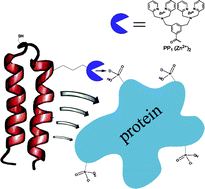
    In this OBC Hot article, Mingming Ma and Dennis Bong at the Ohio State University (Columbus, USA) construct a protein-protein artificial interface and demonstrate that when functionalized with synthetic cyanuric acid and melamine, the streptavidin proteins are able to assemble selectively, based on reversible supramolecular recognition. Such synthetic modules could be used to direct the molecular interactions for the construction of novel biomaterials and functional molecular assemblies.


      Interested in proteins, biomaterials or supramolecular chemistry? This OBC Communication is for you!


    Protein assembly directed by synthetic molecular recognition motifs
    Mingming Ma and Dennis Bong
    Org. Biomol. Chem., 2011, Advance Article
    DOI: 10.1039/C1OB05998J, Communication

    Digg This
    Reddit This
    Stumble Now!
    Share on Facebook
    Bookmark this on Delicious
    Share on LinkedIn
    Bookmark this on Technorati
    Post on Twitter
    Google Buzz (aka. Google Reader)