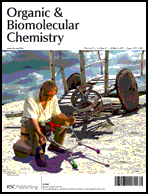
Asymmetric catalytic Mannich-type reaction of hydrazones using Zn(II) complexes on the cover of OBC issue 13

The cover of this week’s OBC features work from Min Shi et al. at Shanghai Institute of Organic Chemistry and Texas Tech University, who have used chiral zinc(II)–imidazoline–phosphine complexes in a novel catalytic system for the asymmetric Mannich-type difluorination of hydrazones with difluoroenoxysilanes.

Asymmetric catalytic Mannich-type reaction of hydrazones with difluoroenoxysilanes using imidazoline-anchored phosphine ligand–zinc(II) complexes
Zhiliang Yuan, Liangyong Mei, Yin Wei, Min Shi, Padmanabha V. Kattamuri, Patrick McDowell and Guigen Li
Org. Biomol. Chem., 2012, 10, 2509-2513
DOI: 10.1039/C2OB07022G

Read the full Communication; it is FREE to access for the next 6 weeks.

This issue also contains:

A Perspective review article: On a so-called “kinetic anomeric effect” in chemical glycosylation, by Ian Cumpstey

as well as the HOT article:

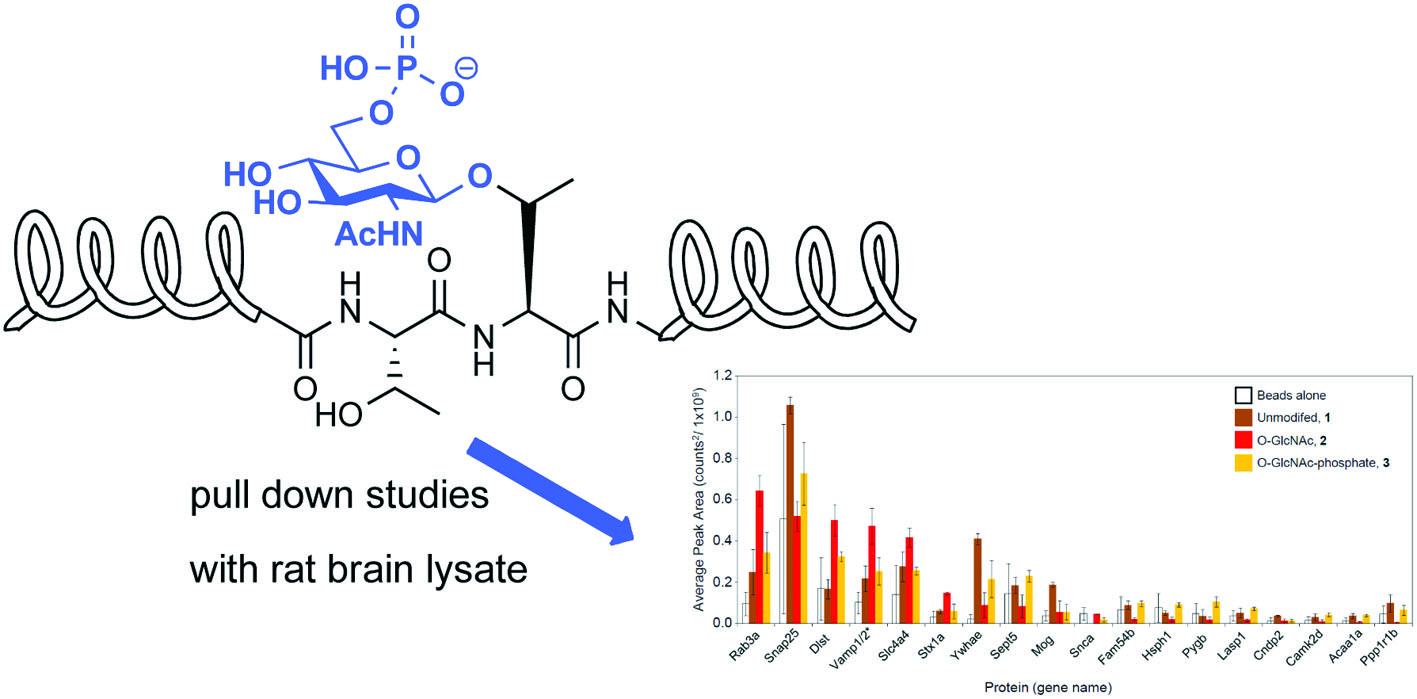
Synthesis and protein binding studies of a peptide fragment of clathrin assembly protein AP180 bearing an O-linked β-N-acetylglucosaminyl-6-phosphate modification
Mark E. Graham, Robin S. Stone, Phillip J. Robinson and Richard J. Payne

If you liked these why not have a look at the rest of the issue here

Digg This
Reddit This
Stumble Now!
Share on Facebook
Bookmark this on Delicious
Share on LinkedIn
Bookmark this on Technorati
Post on Twitter
Google Buzz (aka. Google Reader)

Top ten most accessed articles in January

This month sees the following articles in Organic & Biomolecular Chemistry that are in the top ten most accessed:

Asymmetric organocatalytic formation of protected and unprotected tetroses under potentially prebiotic conditions
Laurence Burroughs, Paul A. Clarke, Henrietta Forintos, James A. R. Gilks, Christopher J. Hayes, Matthew E. Vale, William Wade and Myriam Zbytniewski
Org. Biomol. Chem., 2012, 10, 1565-1570
DOI: 10.1039/C1OB06798B

Total synthesis of (+)-anamarine
Krishnammagari Suresh Kumar and Cirandur Suresh Reddy
Org. Biomol. Chem., 2012, 10, 2647-2655
DOI: 10.1039/C2OB06940G

Olefin cross-metathesis for the synthesis of heteroaromatic compounds
Timothy J. Donohoe, John F. Bower and Louis K. M. Chan
Org. Biomol. Chem., 2012, 10, 1322-1328
DOI: 10.1039/C2OB06659A

Highly selective, naked-eye and fluorescent “off-on” probe for detection of histidine/histidine-rich proteins and its application in living cell imaging
Shenyi Zhang, Chunmei Yang, Weiping Zhu, Bubing Zeng, Youjun Yang, Yufang Xu and Xuhong Qian
Org. Biomol. Chem., 2012, 10, 1653-1658
DOI: 10.1039/C2OB06520G

Direct C–H cross-coupling approach to heteroaryl coumarins
Minsik Min, Bomi Kim and Sungwoo Hong
Org. Biomol. Chem., 2012, Advance Article
DOI: 10.1039/C2OB07137A

Bioinspired organocatalytic asymmetric reactions
Luca Bernardi, Mariafrancesca Fochi, Mauro Comes Franchini and Alfredo Ricci
Org. Biomol. Chem., 2012, Advance Article
DOI: 10.1039/C2OB07037E

Imidazole derivatives: A comprehensive survey of their recognition properties
Pedro Molina, Alberto Tárraga and Francisco Otón
Org. Biomol. Chem., 2012, 10, 1711-1724
DOI: 10.1039/C2OB06808G

An iterative Shimizu non-aldol approach for the stereoselective synthesis of C13-C22 fragment of callystatin A
Sandip A. Pujari and Krishna P. Kaliappan
Org. Biomol. Chem., 2012, 10, 1750-1753
DOI: 10.1039/C2OB06838A

Organocatalytic stereoselective synthesis of passifloricin A
Pradeep Kumar, Menaka Pandey, Priti Gupta and Dilip D. Dhavale
Org. Biomol. Chem., 2012, 10, 1820-1825
DOI: 10.1039/C2OB06711K

Direct preparation of thiazoles, imidazoles, imidazopyridines and thiazolidines from alkenes
Timothy J. Donohoe, Mikhail A Kabeshov, Akshat H. Rathi and Ian E. D. Smith
Org. Biomol. Chem., 2012, 10, 1093-1101
DOI: 10.1039/C1OB06587D

Why not take a look at the articles today and blog your thoughts and comments below.

Fancy submitting an article to Organic & Biomolecular Chemistry? Then why not submit to us today or alternatively email us your suggestions.

Digg This
Reddit This
Stumble Now!
Share on Facebook
Bookmark this on Delicious
Share on LinkedIn
Bookmark this on Technorati
Post on Twitter
Google Buzz (aka. Google Reader)

Room temperature syntheses of substituted beta-fluorofurans on the cover of OBC issue 12

On the cover this week is work by Roman Dembinski et al. at Oakland University and Eastern Illinois University, highlighting facile synthetic methods for the preparation of 3-fluorofurans, 3-bromo-4-fluorofurans, and 3-fluoro-4-iodofurans in good yields and at room temperature.

Read all about the synthetic sequences employed: this article will be FREE to access for a period of 6 weeks.

Room temperature syntheses of entirely diverse substituted β-fluorofurans
Yan Li , Kraig A. Wheeler and Roman Dembinski
Org. Biomol. Chem., 2012, 10, 2395-2408
DOI: 10.1039/C1OB06693E

Also in this issue, take a look at a hot article by Taku Shoji et al. presenting  novel developments in the field of donor-acceptor chromophores, which can be synthesised using the [2+2] cycloaddition-cycloreversion (CA/CR) reaction; or read a timely Perspective showcasing recent advancement in the stereoselective synthesis of 2-C-branched sugar analogs, by Torsten Linker et al., and much more!

View the full issue here

Digg This
Reddit This
Stumble Now!
Share on Facebook
Bookmark this on Delicious
Share on LinkedIn
Bookmark this on Technorati
Post on Twitter
Google Buzz (aka. Google Reader)

Join ICPO21: 21st IUPAC International Conference on Physical Organic Chemistry

The Organic Division of the RSC on behalf of IUPAC is now inviting contributions to ICPO21: 21st IUPAC International Conference on Physical Organic Chemistry to be held 9 – 13 September 2012 at Durham University.

The submission deadline dates are:


  • Oral abstracts               23 March 2012
  • Poster abstracts           13 July 2012


Key topics that will be covered in the meeting include:

  • Physical underpinnings
  • Mechanism and Catalysis
  • Supramolecular and Systems Chemistry


Why join ICPOC21?

A broad range of scientists from across the whole community who share a quantitative perspective on chemistry will be there, providing an opportunity to discuss and celebrate the current status, development, and the future of physical organic chemistry.


In addition to outstanding plenary sessions, there will be three parallel sessions over the five days comprising invited lectures and contributed talks, as well as poster sessions.

Digg This
Reddit This
Stumble Now!
Share on Facebook
Bookmark this on Delicious
Share on LinkedIn
Bookmark this on Technorati
Post on Twitter
Google Buzz (aka. Google Reader)

RSC Publishing poster prizes awarded at ISMSC

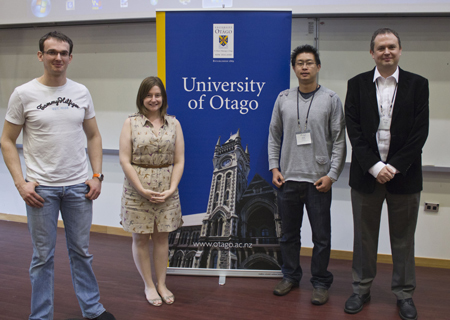
Congratulations to the following students who were awarded ChemComm, Dalton Transactions and Organic & Biomolecular Chemistry poster prizes at the 2012 International Symposium on Macrocyclic and Supramolecular Chemistry (ISMSC) at the University of Otago in Dunedin, New Zealand:

  • Jean-Francois Ayme (Edinburgh) – “Pentameric Circular Helicates as a Scaffold for a Molecular Pentafoil Knot”
  • Jessica Holmes (Melbourne) –  “Supramolecular Systems of Cyclotricatechylene”
  • David Hvasanov (UNSW) –  “Photoinduced membrane proton-pumping via polymersomes as chloroplast mimics”

The poster prize winners with Professor Phil Gale from the ISMSC-2012 International Advisory Committee (photo courtesy of Scott Cameron from the Brooker group)

Nominations for the 2013 Cram Lehn Pedersen prize to be awarded at ISMSC-8 in Crystal City, Virginia, USA, will open later in the year. Stay tuned to the ChemComm blog for details.

Related news:
Cram Lehn Pedersen Prize awarded at ISMSC

Posted on behalf of Joanne Thomson

Digg This
Reddit This
Stumble Now!
Share on Facebook
Bookmark this on Delicious
Share on LinkedIn
Bookmark this on Technorati
Post on Twitter
Google Buzz (aka. Google Reader)

Computers look at life-giving reactions in space

Theoretical chemistry could answer some questions about how life on earth originated, say Australian researchers.

Although we know amino acids were vital in the genesis of life, how they first appeared on earth is still under much debate. One theory is that they were introduced from space, having been synthesised in molecular clouds from simpler radicals. However, at almost absolute zero temperatures, it would be very difficult for any molecular collision to overcome the activation energy barrier. Unfortunately, owing to these extreme conditions, it is impossible to conduct laboratory experiments to investigate this.

Noticing that a number of possible interstellar reactions involve hydrogen transfer, John Bowie and Tianfang Wang at the University of Adelaide considered the possibility that they may be assisted by hydrogen tunnelling effects. Hydrogen tunnelling occurs when hydrogen atoms or nuclei take part in a reaction without having to overcome an energy barrier; instead they ‘tunnel’ through it. The team used high level computational methods to study how tunnelling affects isomerisation reactions that may either help or hinder the synthesis of biologically important molecules.

Meteorite

Molecules of life are thought to have been introduced to earth by collisions from comets or meteorites

‘Let us propose, for example, that ?CH2NH2 and ?CN react to form the glycine precursor NH2CH2CN,’ explains Bowie, ‘if [?CH2NH2] isomerises rapidly to CH3NH?, then the proposed synthesis is not practical.’

They found that although these reactions show significant tunnelling effects, the rate constants for most of them would still be too slow for reaction to occur.

Holger Somnitz, a theoretical chemistry expert at the University of Duisburg-Essen, Germany, appreciates the information obtained. ‘The [researchers] have quantified the effect of tunnelling. and provided valuable information on the potential energy along the minimum energy path,’ he says. However, he points out that the true impact of the work will only be revealed after experimental confirmation of the interstellar existence of the studied radicals.

Recognising the usefulness of the information obtained from their calculations, the researchers are now turning their attention to tunnelling effects in other fields of interest, such as in proteomics.

Hydrogen tunnelling influences the isomerisation of some small radicals of interstellar importance. A theoretical investigation.
Tianfang Wang and John H. Bowie
DOI: 10.1039/C2OB07102A

Read the original article at Chemistry World

Digg This
Reddit This
Stumble Now!
Share on Facebook
Bookmark this on Delicious
Share on LinkedIn
Bookmark this on Technorati
Post on Twitter
Google Buzz (aka. Google Reader)

HOT: Uncovering a key enzyme in antibiotic D-cycloserine biosynthesis

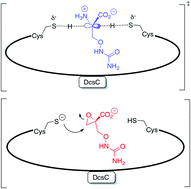
In this OBC ‘Hot paper’ John C. Vederas and coworkers describes studies on a key enzyme (DscC) in the biosynthesis of the important antibiotic D-cycloserine – commonly used against Mycobacterium tuberculosis when resistance to other antibiotics is observed.

The enzyme is proposed to be an epimerase based on sequence similarity to a known enzyme DapF (diaminopimelate epimerase), and the authors show that DscC indeed displays the predicted activity, namely O-ureidoserine racemization.

The determination of the 3D stucture of the enzyme is underway.

‘Comparison of the enzymatic residues that are responsible for recognition of the non-reacting distal site of the enzyme could lead to the ability to rationally design enzymes that can induce epimerization of other amino acids’, conclude the authors.

Read more and access the full article hereFREE to download for a period of four weeks!


Characterization of DcsC, a PLP-independent racemase involved in the biosynthesis of D-cycloserine
David Dietrich, Marco J. van Belkum and John C. Vederas
Org. Biomol. Chem., 2012, 10, 2248-2254
DOI: 10.1039/C2OB06864H,

Digg This
Reddit This
Stumble Now!
Share on Facebook
Bookmark this on Delicious
Share on LinkedIn
Bookmark this on Technorati
Post on Twitter
Google Buzz (aka. Google Reader)

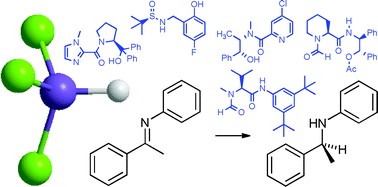
Hot Perspective: Using trichlorosilane for the organocatalysed reduction of ketimines

Following the recent highlight of topical reviews in OBC, here is our latest ‘Hot Perspective’:

  •  read about the most advanced developments on Trichlorosilane mediated asymmetric reductions of the C=N bond in this review article by Simon Jones and Christopher J. A. Warner.

Concise but thorough, the review will take you through efficient and economical ways to access chiral amines via the trichlorosilane mediated organocatalytic reduction of ketimines, and provide a direct quantitative comparison to transition-metal mediated process.

Trichlorosilane mediated asymmetric reductions of the C=N bond
Simon Jones and Christopher J. A. Warner
Org. Biomol. Chem., 2012, 10, 2189-2200
DOI: 10.1039/C2OB06854K, Perspective

This Perspective will be FREE to access for the next 4 weeks 
Digg This
Reddit This
Stumble Now!
Share on Facebook
Bookmark this on Delicious
Share on LinkedIn
Bookmark this on Technorati
Post on Twitter
Google Buzz (aka. Google Reader)

Coupling of unactivated aldehydes and Anticancer activity of oleanolic acid derivatives on the cover of OBC issue 11

Welcome to OBC issue 11, 2012 

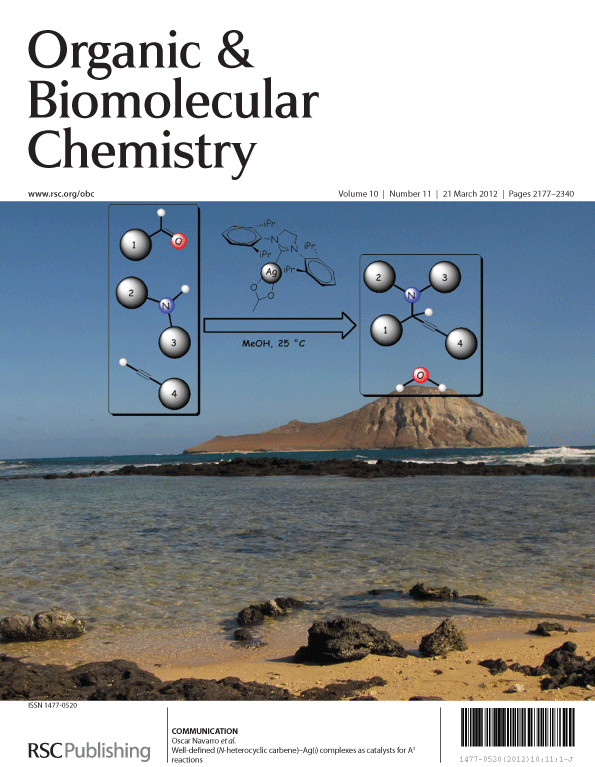
Oscar Navarro and colleagues at the University of Hawaii at Manoa have used well-defined (N-heterocyclic carbene)–Ag(I) complexes for the A3 reaction, thereby allowing for the coupling of unactivated aldehydes at room temperature with very short reaction times. This work is featured on OBC‘s outside front cover, showcasing a scheme of the reaction depicted in their article over a picture of the coast of Lanikai, in Hawaii.

Well-defined (N-heterocyclic carbene)–Ag(I) complexes as catalysts for A3 reactions
Ming-Tsz Chen, Brant Landers and Oscar Navarro 
DOI: 10.1039/C2OB06900H 

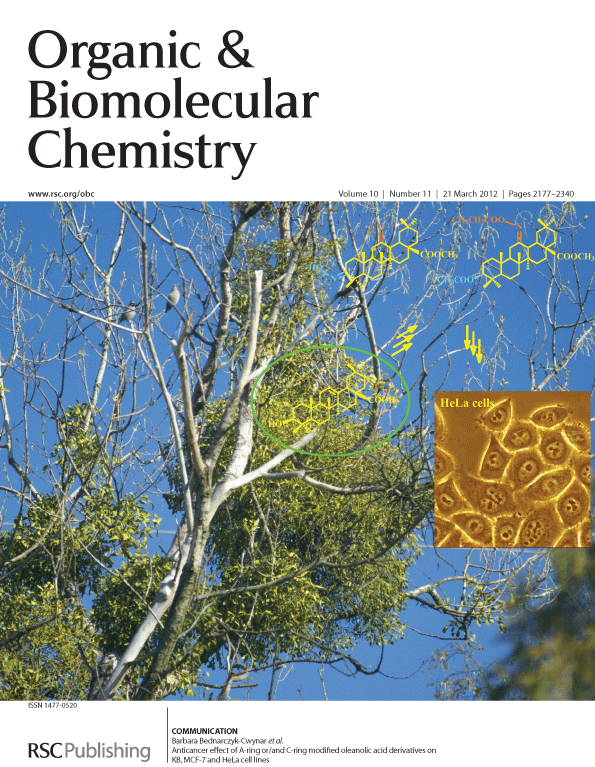
The inside front cover illustrates work by Barbara Bednarczyk–Cwynar et al. at Poznan University of Medical Sciences, Poland, who highlight the strong cytotoxic activity on KB, MCF-7 and HeLa cell lines of novel A-ring or/and C-ring modified methyl oleanolate derivatives.

Anticancer effect of A-ring or/and C-ring modified oleanolic acid derivatives on KB, MCF-7 and HeLa cell lines
Barbara Bednarczyk–Cwynar, Lucjusz Zaprutko, Piotr Ruszkowski and Bogusław Hładoń
DOI: 10.1039/C2OB06923G

Interested? Why not read both communications, they are FREE to access for the next 6 weeks.


Digg This
Reddit This
Stumble Now!
Share on Facebook
Bookmark this on Delicious
Share on LinkedIn
Bookmark this on Technorati
Post on Twitter
Google Buzz (aka. Google Reader)

Countdown to OBC’s 10th anniversary continues with tin and aluminium!

Continuing our countdown to OBC’s 10th anniversary issue, we’ve collected together 10 tin and aluminium related articles published in the journal. Why? An old tradition in the UK is to give gifts of made of symbolic materials on significant wedding anniversaries, and the metals associated with a 10th wedding anniversary are tin and aluminium. Now, we don’t have any trinkets for you, but why not take a look at some of these interesting tin and aluminium-themed articles!

Effective 1,5-, 1,6- and 1,7-remote stereocontrol in reactions of alkoxy- and hydroxy-substituted allylstannanes with aldehydes
John S. Carey, Somhairle MacCormick, Steven J. Stanway, Aphiwat Teerawutgulrag and Eric J. Thomas
DOI: 10.1039/C0OB01084G

A selective, cell-permeable fluorescent probe for Al3+ in living cells
Lina Wang, Wenwu Qin, Xiaoliang Tang, Wei Dou, Weisheng Liu, Qingfeng Teng and Xiaojun Yao
DOI: 10.1039/C0OB00123F, Paper

Microwave-assisted regioselective ring opening of non-activated aziridines by lithium aluminium hydride
Sonja Stanković, Matthias D’hooghe and Norbert De Kimpe
DOI: 10.1039/C004960C

Synthesis of Biginelli dihydropyrimidinone derivatives with various substituents on aluminium-planted mesoporous silica catalyst
Hiroaki Murata, Haruro Ishitani and Masakazu Iwamoto
DOI: 10.1039/B920821F, Paper

Intramolecular carbolithiation reactions for the preparation of 3-alkenylpyrrolidines
Iain Coldham, Kathy N. Price and Richard E. Rathmell
DOI: 10.1039/B303670G

Rapid methylation on carbon frameworks useful for the synthesis of 11CH3-incorporated PET tracers: Pd(0)-mediated rapid coupling of methyl iodide with an alkenyltributylstannane leading to a 1-methylalkene
Takamitsu Hosoya, Kengo Sumi, Hisashi Doi, Masahiro Wakao and Masaaki Suzuki
DOI: 10.1039/B515215A

Aluminium triflate: a remarkable Lewis acid catalyst for the ring opening of epoxides by alcohols
D. Bradley G. Williams and Michelle Lawton
DOI: 10.1039/B508924G

Cyclizative radical carbonylations of azaenynes by TTMSS and hexanethiol leading to α-silyl- and thiomethylene lactams. Insights into the E/Z stereoselectivities
Mami Tojino, Noboru Otsuka, Takahide Fukuyama, Hiroshi Matsubara, Carl H. Schiesser, Hiroki Kuriyama, Hironari Miyazato, Satoshi Minakata, Mitsuo Komatsu and Ilhyong Ryu
DOI: 10.1039/B309944J

Photochemical intramolecular aromatic substitutions of the imidazol-2-yl radical are superior to those mediated by Bu3SnH
Mairéad A. Clyne and Fawaz Aldabbagh
DOI: 10.1039/B512729G

On the use of mixtures of organotin species for catalytic enantioselective ketone allylation—a detective story
Anthony Cunningham, Vijaya Mokal-Parekh, Claire Wilson and Simon Woodward
DOI: 10.1039/B313384B

Missed our other 10th anniversary posts? Take a look here for some of our top cited work.

Digg This
Reddit This
Stumble Now!
Share on Facebook
Bookmark this on Delicious
Share on LinkedIn
Bookmark this on Technorati
Post on Twitter
Google Buzz (aka. Google Reader)