Picking out cysteine for health study

A highly selective indicator for the amino acid cysteine has been designed by scientists from the US and China to monitor levels in human plasma. Elevated cysteine levels have been linked with motor neurone disease, Parkinson’s disease and Alzheimer’s disease.

Cysteine is an essential amino acid and plays an important role in cell functions. Its structure contains both a sulfhydryl (-SH) and an amino group (-NH2), both of which are reactive. Previous detectors have focused on reactions with the sulfhydryl group, but it has been tricky to detect cysteine over other SH-containing biomolecules in the blood, such as glutathione and the closely related homocysteine.
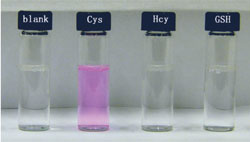
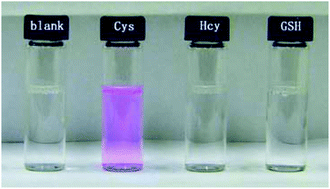
Row of sample vials with a blank control (clear and colourless), cysteine (pink), homocysteine (clear and colourless) and glutathione (clear and colourless)

The indicator molecule reacts with the sulfhydryl and amino parts of the cysteine molecule to form a pink compound that's fluorescent under UV light. No such reaction is seen with other biothiols

Robert Strongin from Portland State University, Portland, and co-workers, have found a way to overcome this problem, by designing a fluorescent sensor called a chemodosimeter (so called because the visible change is due to an irreversible reaction). They used an indicator molecule that reacts with both the sulfhydryl and amino parts of the cysteine molecule.

‘We can detect cysteine selectively due to its unique chemistry, which we have complemented with our indicator design,’ explains Strongin. ‘There is a very selective reaction that turns the indicator on.’ The cysteine’s sulfhydryl group reacts with the indicator molecule to form a colourless compound. The amino part attacks an ester group on the indicator molecule to form a pink compound that is fluorescent under UV light. When tested with other amino acids or SH-containing molecules, no colour change or fluorescence could be seen.

‘Compared to designing probes for the detection of metal ions or inorganic anions, analytes such as cysteine tend to be far more problematic. The work provides convincing evidence that a clever design can overcome such obstacles,’ says Michael Heagy, an expert in fluorescent chemosensors for biological molecules at the New Mexico Institute of Mining and Technology, US.

In the future, Strongin plans to develop the approach to make other specialised indicators for non-polar metabolites, such as amino acids, sugars and phospholipids.

A seminaphthofluorescein-based fluorescent chemodosimeter for the highly selective detection of cysteine
Xiaofeng Yang , Yixing Guo and Robert M. Strongin
DOI: 10.1039/C2OB25178G

Read the original article at Chemistry World

Digg This
Reddit This
Stumble Now!
Share on Facebook
Bookmark this on Delicious
Share on LinkedIn
Bookmark this on Technorati
Post on Twitter
Google Buzz (aka. Google Reader)

Organic & Biomolecular Chemistry International Symposium

The first Organic & Biomolecular Chemistry International Symposium will take place in China in April 2012. The symposium will be comprised of three one-day meetings, each one featuring a selection of lectures covering organic and bioorganic chemistry by some of the world’s leading international scientists.

The meetings will be held at Shanghai Institute of Organic Chemistry, Lanzhou University and Peking University. The symposium is organised by Organic & Biomolecular Chemistry, the Royal Society of Chemistry and the local host organisations. The OBC International Symposium will take place as follows:
• Monday 16th April 2012 – Shanghai Institute of Organic Chemistry, Shanghai, China
• Wednesday 18th April 2012 – Lanzhou University, Lanzhou, China
• Friday 20th April 2012 – Peking University, Beijing, China

For more information please visit the symposium website.

Digg This
Reddit This
Stumble Now!
Share on Facebook
Bookmark this on Delicious
Share on LinkedIn
Bookmark this on Technorati
Post on Twitter
Google Buzz (aka. Google Reader)

An aerobic copper relay race and pharmacological chaperones for Gaucher disease treatment on the OBC covers

This week’s issue of OBC features art work from Qing Xu and Xin-Shan Ye et al.

Qing Xu and colleagues from Wenzhou University have developed a green copper catalyzed N-alkylation method for various amides and amines with alcohols, employing aerobic oxidation of the alcohols to aldehydes for a more effective way of activating the alcohols. This advantageous method uses a ligand-free catalyst and its only byproduct is water!

Copper-catalyzed N-alkylation of amides and amines with alcohols employing the aerobic relay race methodology
Qiang Li, Songjian Fan, Qing Sun, Haiwen Tian, Xiaochun Yu and Qing Xu
Org. Biomol. Chem., DOI: 10.1039/C1OB06743E

Xin-Shan Ye and co-workers at Peking University and University of Oxford have designed a concise route to a series of N-substituted ε-hexonolactams employing a tandem ring-expansion as the key step. These novel N-alkylated iminosugars are promising pharmacological chaperones for the treatment of N370S mutant Gaucher disease.

Synthesis of N-substituted ε-hexonolactams as pharmacological chaperones for the treatment of N370S mutant Gaucher disease
Guan-Nan Wang, Gabriele Twigg, Terry D. Butters, Siwei Zhang, Liangren Zhang, Li-He Zhang and Xin-Shan Ye
Org. Biomol. Chem., DOI: 10.1039/C2OB06987C

Both of these articles can be accessed for free for the next 6 weeks!

Other interesting articles in this issue are:

A perspective by Alfredo Ricci et al. about bioinspired organocatalytic asymmetric reactions

and 2 HOT articles which are free to access for the next 4 weeks:

Fluorimetric detection of Mg2+and DNA with 9-(alkoxyphenyl)benzo[b]quinolizinium derivatives
Maoqun Tian, Heiko Ihmels and Shite Ye
Org. Biomol. Chem., DOI: 10.1039/C2OB06948B

Substituted oxines inhibit endothelial cell proliferation and angiogenesis
Shridhar Bhat, Joong Sup Shim, Feiran Zhang, Curtis Robert Chong and Jun O. Liu
Org. Biomol. Chem., DOI: 10.1039/C2OB06978D

If you liked those why not view the rest of the issue HERE!

Digg This
Reddit This
Stumble Now!
Share on Facebook
Bookmark this on Delicious
Share on LinkedIn
Bookmark this on Technorati
Post on Twitter
Google Buzz (aka. Google Reader)

HOT: Substituted oxines inhibit endothelial cell proliferation and angiogenesis

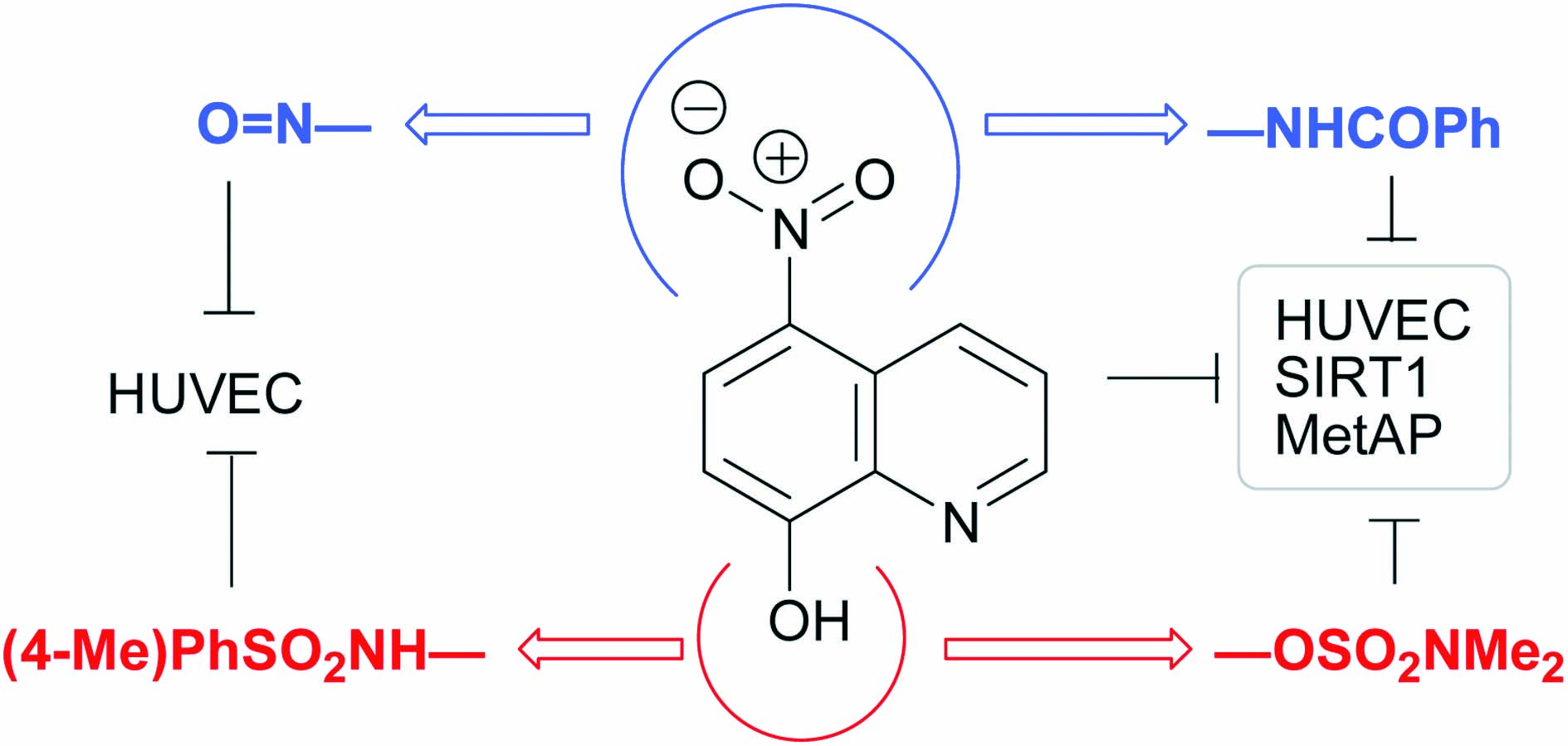
In this HOT OBC paper Jun O. Liu and co-workers at Johns Hopkins University School of Medicine report structure–activity relationship studies of two oxines, which have been previously identified as hits in a high-throughput screen aimed at finding new anti-angiogenic agents, by characterising different analogues in human umbilical vein endothelial cell assays. In addition they have determined the effects of a subset of oxine derivatives on human methionine aminopeptidase and sirtuin 1 activities in endothelial cells and screened a selection of the potent inhibitors of human umbilical vein endothelial cells against two other malignant cells.

Through this they have been able to identify new oxine derivatives that exhibit improved inhibitory activity against endothelial cell proliferation, and furthermore, have made the surprising finding that subtle structural alterations can lead to dramatic changes in the mechanism of action of the resulting derivatives.

For all the in-depth details of this study check out this paper today! It’s free to access for the next 4 weeks!

Substituted oxines inhibit endothelial cell proliferation and angiogenesis
Shridhar Bhat, Joong Sup Shim, Feiran Zhang, Curtis Robert Chong and Jun O. Liu
Org. Biomol. Chem.,  2012, 10, 2979–2992
DOI: 10.1039/C2OB06978D

Digg This
Reddit This
Stumble Now!
Share on Facebook
Bookmark this on Delicious
Share on LinkedIn
Bookmark this on Technorati
Post on Twitter
Google Buzz (aka. Google Reader)

HOT: Fluorimetric probe detects both Mg2+ and DNA

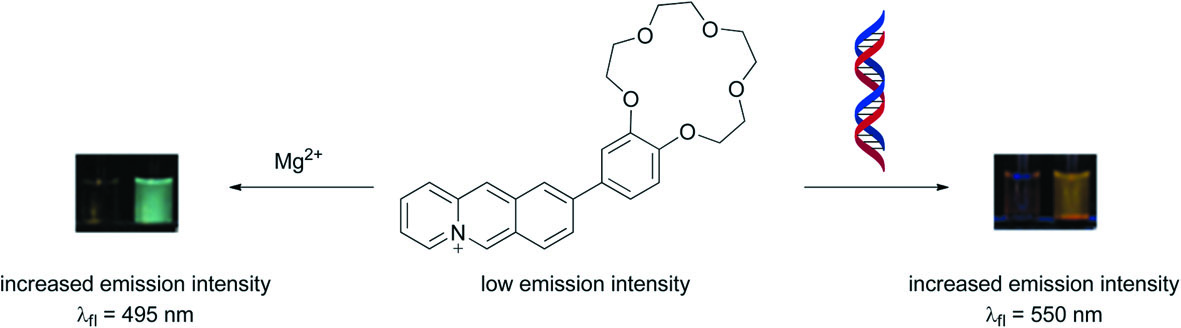
In this HOT OBC paper Heiko Ihmels and colleagues at University of Siegen present the fluorimetric detection of Mg2+ and DNA with 9-(alkoxyphenyl)benzo[b]-quinolizinium derivatives. Although there are quite a few fluorescent probes that enable the detection of different analytes from the same class of compounds, probes that allow optical detection of different types of analytes are much rarer. In this paper Heiko Ihmels et al. show that a benzo[b]quinolizinium-benzo-15-crown-5 ether conjugate can be used for the detection of both Mg2+ and DNA by a significant light-up effect and with different emission wavelengths for the two different analytes.

The authors investigated the light-up mechanism by comparison with the photophysical properties of methoxyphenyl-substituted benzo[b]quinolizinium reference compounds, revealing that the position of the methoxy functionality had a significant influence on the emission properties of the donor–acceptor systems.

Find the full paper here. It’s FREE to access for the four weeks, so why not take a peek!

Fluorimetric detection of Mg2+ and DNA with 9-(alkoxyphenyl)benzo[b]quinolizinium derivatives
Maoqun Tian, Heiko Ihmels and Shite Ye
Org. Biomol. Chem., 2012, 10, 3010–3018
DOI: 10.1039/C2OB06948B

Digg This
Reddit This
Stumble Now!
Share on Facebook
Bookmark this on Delicious
Share on LinkedIn
Bookmark this on Technorati
Post on Twitter
Google Buzz (aka. Google Reader)

Modern microwave chemistry opportunities to develop new antibiotics and antiviral drugs on OBC Issue 14’s cover

Welcome to OBC issue 14, 2012

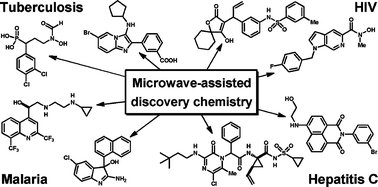
On the cover features work by Mats Larhed et al. at Uppsala University, Sweden, who describe in this highly topical review the use of controlled microwave heating in discovery chemistry to combat four of the most prevalent and serious infectious diseases: tuberculosis, HIV/AIDS, malaria and hepatitis C.

This Perspective highlights the large number of diverse chemical transformations that can be accomplished using controlled and automated single-mode microwave heating.

Why not read it now, it will be FREE to access for the next 6 weeks!


 Microwave-assisted synthesis of small molecules targeting the infectious diseases tuberculosis, HIV/AIDS, malaria and hepatitis C
Johan Gising, Luke R. Odell and Mats Larhed
Org. Biomol. Chem., 2012, Advance Article
DOI: 10.1039/C2OB06833H, Perspective

Also in this issue, a Hot Article by Robert M. Strongin et al. on a cysteine selective indicator based on a seminaphthofluorescein, and much more!

View the full issue here

Digg This
Reddit This
Stumble Now!
Share on Facebook
Bookmark this on Delicious
Share on LinkedIn
Bookmark this on Technorati
Post on Twitter
Google Buzz (aka. Google Reader)

HOT: Sensing cysteine only for health tests

A sensing system to detect cysteine (Cys), an essential amino acid, has been developed by scientists in the US and China. Elevated levels of Cys have been associated with neurotoxicity, while Cys deficiency is involved in a number of other disorders.

The sensing system works as a fluorescent chemodosimeter, which displays discrimination for cysteine over commonly occurring analytes that would be expected to co-exist in real samples, such as homocysteine and glutathione. Moreover, the system is desirable in that it displays off-to-on response to the target analyte and does so at a desirable long wavelength, which minimises potential interference by endogenous chromophores.

Due to its simplicity and very high selectivity, this chemodosimeter can be used to detect Cys at physiological levels.

Highly rated by the reviewers and Editorial office alike, this article has been selected as ‘Hot’ and will be FREE to access for the next 4 weeks – why not read it now!

A seminaphthofluorescein-based fluorescent chemodosimeter for the highly selective detection of cysteine
Xiaofeng Yang, Yixing Guo and Robert M. Strongin
Org. Biomol. Chem., 2012, Advance Article
DOI: 10.1039/C2OB25178G, Communication

Digg This
Reddit This
Stumble Now!
Share on Facebook
Bookmark this on Delicious
Share on LinkedIn
Bookmark this on Technorati
Post on Twitter
Google Buzz (aka. Google Reader)

HOT: Probing the effects of a novel post-translational modification on synaptic protein binding

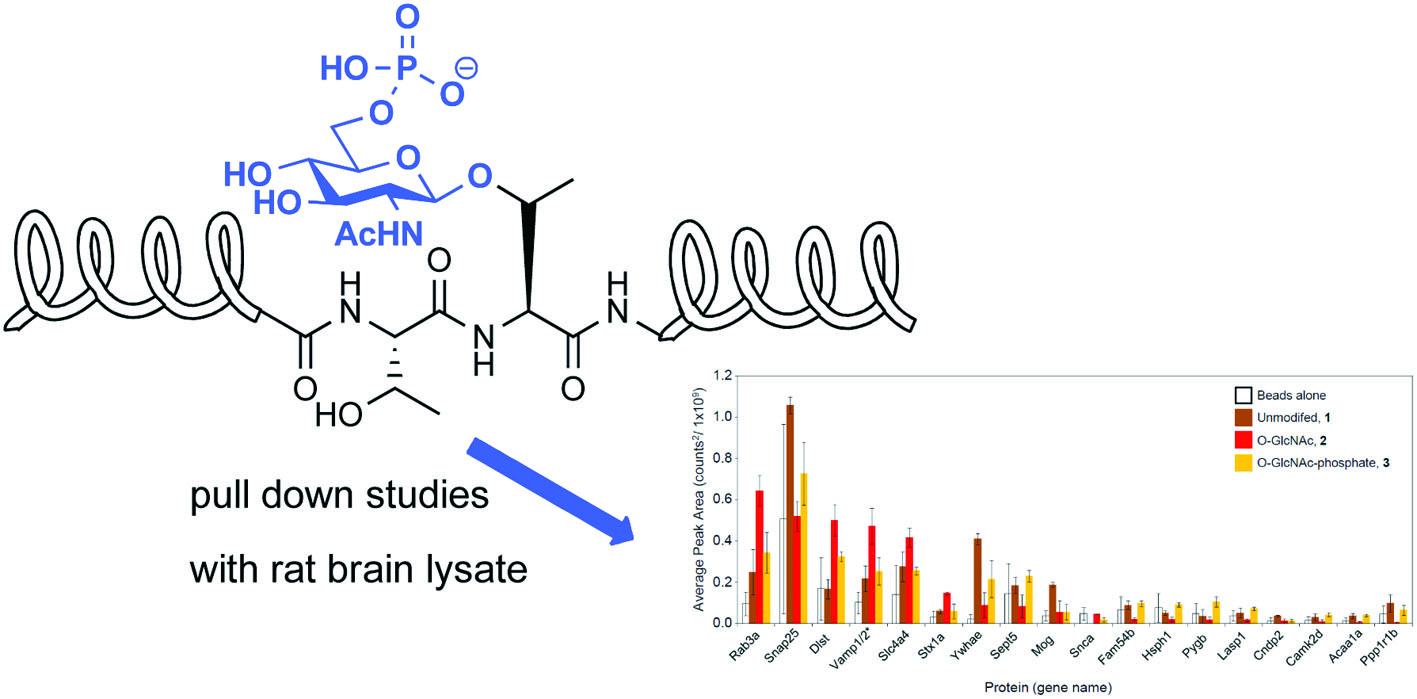
In this HOT OBC Communication Mark E. Graham, Richard J. Payne and co-workers probe the effect of a recently discovered post-translational modification of threinine of the assembly protein AP180, a protein which plays a crucial role in clathrin coated vesicle formation in synaptic vesicle endocytosis.


Using pull down experiments on AP180 peptide fragments they aimed to explore how binding to proteins in rat brain lysate is influenced by this modification.

Read the article to find out more about the peptides used and the effect of this modification on the affinity towards synaptic proteins.

Go on, it’s FREE to access for the next 4 weeks!


Synthesis and protein binding studies of a peptide fragment of clathrin assembly protein AP180 bearing an O-linked β-N-acetylglucosaminyl-6-phosphate modification
Mark E. Graham, Robin S. Stone, Phillip J. Robinson and Richard J. Payne
Org. Biomol. Chem., 2012, 10, 2545-2551
DOI: 10.1039/C2OB07139H

Digg This
Reddit This
Stumble Now!
Share on Facebook
Bookmark this on Delicious
Share on LinkedIn
Bookmark this on Technorati
Post on Twitter
Google Buzz (aka. Google Reader)

Asymmetric catalytic Mannich-type reaction of hydrazones using Zn(II) complexes on the cover of OBC issue 13

The cover of this week’s OBC features work from Min Shi et al. at Shanghai Institute of Organic Chemistry and Texas Tech University, who have used chiral zinc(II)–imidazoline–phosphine complexes in a novel catalytic system for the asymmetric Mannich-type difluorination of hydrazones with difluoroenoxysilanes.

Asymmetric catalytic Mannich-type reaction of hydrazones with difluoroenoxysilanes using imidazoline-anchored phosphine ligand–zinc(II) complexes
Zhiliang Yuan, Liangyong Mei, Yin Wei, Min Shi, Padmanabha V. Kattamuri, Patrick McDowell and Guigen Li
Org. Biomol. Chem., 2012, 10, 2509-2513
DOI: 10.1039/C2OB07022G

Read the full Communication; it is FREE to access for the next 6 weeks.

This issue also contains:

A Perspective review article: On a so-called “kinetic anomeric effect” in chemical glycosylation, by Ian Cumpstey

as well as the HOT article:

Synthesis and protein binding studies of a peptide fragment of clathrin assembly protein AP180 bearing an O-linked β-N-acetylglucosaminyl-6-phosphate modification
Mark E. Graham, Robin S. Stone, Phillip J. Robinson and Richard J. Payne

If you liked these why not have a look at the rest of the issue here

Digg This
Reddit This
Stumble Now!
Share on Facebook
Bookmark this on Delicious
Share on LinkedIn
Bookmark this on Technorati
Post on Twitter
Google Buzz (aka. Google Reader)

Top ten most accessed articles in January

This month sees the following articles in Organic & Biomolecular Chemistry that are in the top ten most accessed:

Asymmetric organocatalytic formation of protected and unprotected tetroses under potentially prebiotic conditions
Laurence Burroughs, Paul A. Clarke, Henrietta Forintos, James A. R. Gilks, Christopher J. Hayes, Matthew E. Vale, William Wade and Myriam Zbytniewski
Org. Biomol. Chem., 2012, 10, 1565-1570
DOI: 10.1039/C1OB06798B

Total synthesis of (+)-anamarine
Krishnammagari Suresh Kumar and Cirandur Suresh Reddy
Org. Biomol. Chem., 2012, 10, 2647-2655
DOI: 10.1039/C2OB06940G

Olefin cross-metathesis for the synthesis of heteroaromatic compounds
Timothy J. Donohoe, John F. Bower and Louis K. M. Chan
Org. Biomol. Chem., 2012, 10, 1322-1328
DOI: 10.1039/C2OB06659A

Highly selective, naked-eye and fluorescent “off-on” probe for detection of histidine/histidine-rich proteins and its application in living cell imaging
Shenyi Zhang, Chunmei Yang, Weiping Zhu, Bubing Zeng, Youjun Yang, Yufang Xu and Xuhong Qian
Org. Biomol. Chem., 2012, 10, 1653-1658
DOI: 10.1039/C2OB06520G

Direct C–H cross-coupling approach to heteroaryl coumarins
Minsik Min, Bomi Kim and Sungwoo Hong
Org. Biomol. Chem., 2012, Advance Article
DOI: 10.1039/C2OB07137A

Bioinspired organocatalytic asymmetric reactions
Luca Bernardi, Mariafrancesca Fochi, Mauro Comes Franchini and Alfredo Ricci
Org. Biomol. Chem., 2012, Advance Article
DOI: 10.1039/C2OB07037E

Imidazole derivatives: A comprehensive survey of their recognition properties
Pedro Molina, Alberto Tárraga and Francisco Otón
Org. Biomol. Chem., 2012, 10, 1711-1724
DOI: 10.1039/C2OB06808G

An iterative Shimizu non-aldol approach for the stereoselective synthesis of C13-C22 fragment of callystatin A
Sandip A. Pujari and Krishna P. Kaliappan
Org. Biomol. Chem., 2012, 10, 1750-1753
DOI: 10.1039/C2OB06838A

Organocatalytic stereoselective synthesis of passifloricin A
Pradeep Kumar, Menaka Pandey, Priti Gupta and Dilip D. Dhavale
Org. Biomol. Chem., 2012, 10, 1820-1825
DOI: 10.1039/C2OB06711K

Direct preparation of thiazoles, imidazoles, imidazopyridines and thiazolidines from alkenes
Timothy J. Donohoe, Mikhail A Kabeshov, Akshat H. Rathi and Ian E. D. Smith
Org. Biomol. Chem., 2012, 10, 1093-1101
DOI: 10.1039/C1OB06587D

Why not take a look at the articles today and blog your thoughts and comments below.

Fancy submitting an article to Organic & Biomolecular Chemistry? Then why not submit to us today or alternatively email us your suggestions.

Digg This
Reddit This
Stumble Now!
Share on Facebook
Bookmark this on Delicious
Share on LinkedIn
Bookmark this on Technorati
Post on Twitter
Google Buzz (aka. Google Reader)