Christina Moberg elected as President of the Royal Swedish Academy of Sciences

Graphical AbstractProfessor Christina Moberg (Editorial Board Member, New Journal of Chemistry),  was recently elected as the new President of the Royal Swedish Academy of Sciences.

Upon her election as President in July, Professor Moberg said:
As the new President, I see one important task being to emphasise the significance of basic science in social development. There is a risk that we concentrate too many resources on contemporary problems, forgetting that the primary task of scholarly research is to find solutions for as yet unidentified questions, thus fulfilling the needs of future generations

Graphical AbstractProfessor Moberg’s own research, at the Royal Institute of Technology, KTH focuses on organic chemistry.

In 1998, Professor Moberg was awarded the Göran Gustafsson Prize in Chemistry, for her achievements in synthetic organic chemistry, particularly for the methods with which she succeeded in solving the problem of dangerous mirror forms of molecules. She has also received an honorary doctorate from the Faculty of Science at Lund University.

Source: http://www.kva.se/en/pressroom/Press-releases-2014/ny-preses-och-standig-sekreterare

Please join us in congratulating Professor Moberg on her new appointment!

Digg This
Reddit This
Stumble Now!
Share on Facebook
Bookmark this on Delicious
Share on LinkedIn
Bookmark this on Technorati
Post on Twitter
Google Buzz (aka. Google Reader)

NJC issue 12 now online

Read our authors’ work in this year’s last issue of New Journal of Chemistry. The NJC team wishes you the best for 2016!

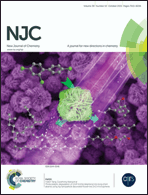
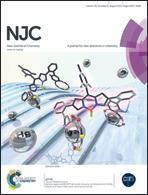
NJC Dec 15 OFC - Dr Tsunashima

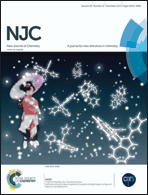
The seasonal design of December’s outside cover from Dr Ryo Tsunashima (Yamaguchi University, Japan) illustrates a study in which the authors report the synthesis and acid-base properties of a proton-bridged biaryl compound based on pyridylazulene.

Dr Tsunashima and his colleagues show that the intramolecular proton bridge between bipyridyl groups behaves as a chelating ligand to accommodate protons in solution, followed by stabilization of a unique steric structure.

Synthesis and acid–base properties of a proton-bridged biaryl compound based on pyridylazulene
Kazuki Ninomiya, Yumi Harada, Tomoaki Kanetou, Yuma Suenaga, Toshihiro Murafuji and Ryo Tsunashima. New J. Chem., 2015, 39, 9079-9085. DOI: 10.1039/C5NJ01651G.

NJC Dec 15 IFC - Dr De Luca
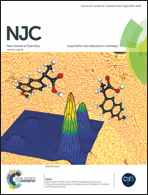
The inside cover of NJC is proposed by Dr Giuseppina De Luca (Università della Calabria, Italy). Dr De Luca and her co-authors focused their study on the behavior of naproxen and flurbiprofen—common anti-inflammatory drugs—in solution using NMR spectroscopy for understanding and rationalizing their biological role and possibly for designing improved analogues.

The strategy adopted in this work represents an effective way for probing the probability distributions of dissolved small to medium-size flexible molecules.

The conformational behaviour of naproxen and flurbiprofen in solution by NMR spectroscopy
Maria Enrica Di Pietro, Christie Aroulanda, Giorgio Celebre, Denis Merlet and Giuseppina De Luca. New J. Chem., 2015, 39, 9086-9097. DOI: 10.1039/C5NJ01753J.

See the full content of the December issue here

Digg This
Reddit This
Stumble Now!
Share on Facebook
Bookmark this on Delicious
Share on LinkedIn
Bookmark this on Technorati
Post on Twitter
Google Buzz (aka. Google Reader)

NJC issue 11 now online

Discover our authors’ work in the November 2015 issue of New Journal of Chemistry.

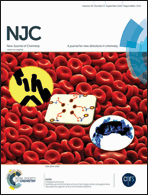
NJC Nov 2015 OFC - Dr Ohmura

The November outside cover was designed by Dr Ryo Ohmura (Keio University, Japan).

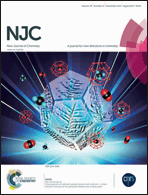
Clathrate hydrates are crystalline solid compounds enclosing molecules called the “guest” in the cages consisting of hydrogen-bonded water molecules called the “host”.

In their study, Dr Ohmura and his co-workers observed the formation and growth of hydrate crystals formed with CH4 + CO2 mixed gas at the gas/liquid interface and in liquid water saturated with the guest gas. They also observed the morphology and the lateral growth rate of CO2 hydrates to compare with CH4 + CO2 hydrates.

Their results suggest that the crystal morphology of the CH4 + CO2 hydrate may be controlled by the guest composition dissolved in the liquid phase and not on the feed gas composition. Based on these observations, the authors discuss the implications for the process design of hydrate-based technologies.

Crystal growth of clathrate hydrates formed with methane + carbon dioxide mixed gas at the gas/liquid interface and in liquid water

Hiroki Ueno, Hotaka Akiba, Satoru Akatsu and Ryo Ohmura.

New J. Chem., 2015, 39, 8254-8262. DOI: 10.1039/C5NJ01080B.

Access the entire table of contents of this issue here

Digg This
Reddit This
Stumble Now!
Share on Facebook
Bookmark this on Delicious
Share on LinkedIn
Bookmark this on Technorati
Post on Twitter
Google Buzz (aka. Google Reader)

NJC issue 10 now online

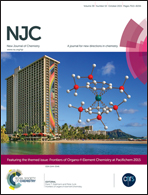
Discover the themed collection of papers entitled ‘Frontiers of Organo-f-element Chemistry’ and other research articles in the October 2015 issue of New Journal of Chemistry.

NJC Oct OFC -  Prof. EldemannThis month, guest editors Professors Frank T. Edelmann (Madgeburg, Germany) and Peter Junk (James Cook University, Australia) are pleased to present a part-themed issue on ‘Frontiers of Organo-f-element Chemistry‘. The 26 contributions show that organo-f-element chemistry continues to be one of the most attractive fields for potential applications in homogeneous catalysis and organic synthesis.

As part of the Pacifichem 2015 conference in Honolulu, Hawaii, USA (December 15–20, 2015), there will be a symposium devoted to the same topic as this themed issue. This symposium will focus on recent advances and future directions in the organometallic chemistry of lanthanide and actinide elements. It is intended to cover all fundamental and technological aspects of organo-f-element chemistry.

NJC Oct IFC - Prof. Wang

Read the Editorial here

The inside cover illustrates an article by Professor Guozhong Wang (Chinese Academy of Sciences, China) and his co-workers. Focusing on removing persistent organic pollutants, the authors present a new photocatalytic degradation pathway of 2,4,4′-trichlorobiphenyl, involving the outright degradation into long-chain alkanes via ring-opening reactions, using a highly-active photocatalyst: Ag nanoparticle decorated flower-like ZnO-nanosheet-assembled ZnO microspheres.

Photocatalytic degradation of 2,4,4′-trichlorobiphenyl into long-chain alkanes using Ag nanoparticle decorated flower-like ZnO microspheres

Quan Deng, Haibin Tang, Gang Liu, Xiaoping Song, Shenhong Kang, Huimin Wang, Dickon H. L. Ng and Guozhong Wang, New J. Chem., 2015, 39, 7781-7785. DOI: 10.1039/C5NJ00343A.

Access the full issue table of contents here

Digg This
Reddit This
Stumble Now!
Share on Facebook
Bookmark this on Delicious
Share on LinkedIn
Bookmark this on Technorati
Post on Twitter
Google Buzz (aka. Google Reader)

NJC issue 09 now online

Discover the variety of letters and articles that comprise the September 2015 issue of New Journal of Chemistry.

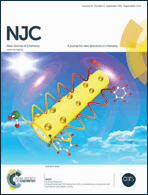
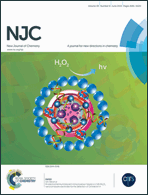
NJC OFC Sept 2015 - Dr KumarDr Pradeep Kumar (CSIR-Institute of Genomics and Integrative Biology, India) proposed the outside cover this month to illustrate a paper in which he and his colleagues synthesize, characterize and evaluate aminoglycoside-conjugated silica nanoparticles [S–X NPs, where X = gentamicin (G), neomycin (N) or kanamycin (K)] for their antimicrobial activity against clinical pathogens and kanamycin-resistant E. coli. The results demonstrate the excellent efficacy of nanomaterial-based antimicrobial agents against nosocomial as well as antibiotic-resistant bacteria.

Synthesis and antimicrobial activity of aminoglycoside-conjugated silica nanoparticles against clinical and resistant bacteria
Shrish Agnihotri, Rajiv Pathak, Diksha Jha, Indrajit Roy, Hemant K. Gautam, Ashwani K. Sharma and Pradeep Kumar, New J. Chem., 2015, 39, 6746-6755. DOI: 10.1039/C5NJ00007F.NJC IFC Sept 2015 - Dr Tang

The inside cover was designed by Dr Zi-Rong Tang (Fuzhou University, China). In their paper, the authors synthesize one-dimensional (1D) CdS nanowire—CeO2 nanoparticle composites. According to Dr Tang and co-workers, this study provides useful information on the fabrication of 1D semiconductor—metal oxide composites with improved photoactivity for selective organic transformations and water splitting to hydrogen under ambient conditions.

One-dimensional CdS nanowires–CeO2 nanoparticles composites with boosted photocatalytic activity
Xin Zhang, Nan Zhang, Yi-Jun Xu and Zi-Rong Tang, New J. Chem., 2015, 39, 6756-6764. DOI: 10.1039/C5NJ00976F.

Find out more about the September issue here

Digg This
Reddit This
Stumble Now!
Share on Facebook
Bookmark this on Delicious
Share on LinkedIn
Bookmark this on Technorati
Post on Twitter
Google Buzz (aka. Google Reader)

NJC issue 08 now online

Access our authors’ work published in the August 2015 issue of New Journal of Chemistry.

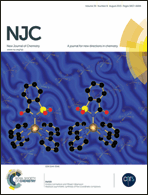
NJC Aug OFC 2015 - Dr LennartsonThis month, the outside cover was created by Dr Anders Lennartson (Chalmers University of Technology, Sweden).

In their Paper article, Dr Lennartson and his colleague, Dr Håkansson, discuss the chirality of five-coordinate enantiomers displaying mono- and bi-dentate ligands by optical resolution of three complexes. They discovered that the crystallization of two of the complexes was influenced by undetectable amounts of an unidentified source of optical activity.

Absolute asymmetric synthesis of five-coordinate complexes
Anders Lennartson and Mikael Håkansson.
New J. Chem., 2015, 39, 5936-5943. DOI: 10.1039/C5NJ00254K.

NJC Aug IFC 2015 - Prof. Nabeshima

The inside cover, designed by Prof. Tatsuya Nabeshima (University of Tsukuba, Japan), illustrates a Letter article in which the authors focus on the photophysical and heavy metal cation sensing properties of a series of novel BODIPY derivatives. These, or similar compounds, might find application as tools for the detection of environmental polarity changes in biological samples, as well as for monitoring Hg2+ and Pb2+ contamination in such samples.

Biphenyl appended BODIPY derivatives showing combined environmental polarity and heavy metal cation sensing functionality
Gary James Richards, Yuki Gobo, Masaki Yamamura and Tatsuya Nabeshima.
New J. Chem., 2015, 39, 5886-5889. DOI: 10.1039/C5NJ00611B.

Click here to read the full August issue.

Digg This
Reddit This
Stumble Now!
Share on Facebook
Bookmark this on Delicious
Share on LinkedIn
Bookmark this on Technorati
Post on Twitter
Google Buzz (aka. Google Reader)

Origin of Life article in NJC highlighted in Chemistry World

Discover why a recent article by Jonathan Lindsey and colleagues questions the wisdom of always using pure compounds.

The Chemistry World article Study probes role of chemical corruption in origin of life written by Heather Powell covers a recently published NJC article by Prof. Lindsey. Find out why using pure compounds might not always be the best strategy.

PrebioticChemistry_shutterstock_120155071_630m

You can also access the original article by Prof. Jonathan Lindsey (North Carolina State University) and his colleagues:

Complexity in structure-directed prebiotic chemistry. Effect of a defective competing reactant in tetrapyrrole formation
Richard M. Deans, Vanampally Chandrashaker, Masahiko Taniguchi and Jonathan S. Lindsey.
New J. Chem., 2015, Advance Article. DOI: 10.1039/C5NJ01474C.

Digg This
Reddit This
Stumble Now!
Share on Facebook
Bookmark this on Delicious
Share on LinkedIn
Bookmark this on Technorati
Post on Twitter
Google Buzz (aka. Google Reader)

NJC issue 07 now online

Discover the new articles published in the July issue of New Journal of Chemistry.

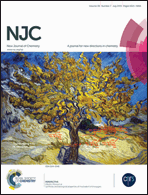
NJC July 2015 OFC - Prof. MarraProfessor Alberto Marra (Ecole Nationale Supérieure de Chimie de Montpellier, France) designed the outside cover of this month’s issue, based on the van Gogh painting The Mulberry Tree. In the accompanying Perspective article, Professor Marra and his co-workers review the different strategies developed to synthesize multivalent architectures, from the total synthesis of divalent iminosugars to the preparation of complex systems bearing twenty-five iminosugar units. They also compare the enzyme inhibitory properties of the various multivalent iminosugars prepared to date in order to infer the valence and the three-dimensional arrangement required for the most efficient inhibition activity.

Synthesis and biological properties of multivalent iminosugars
Renaud Zelli, Jean-François Longevial, Pascal Dumy and Alberto Marra
New J. Chem., 2015, 39, 5050-5074. DOI: 10.1039/C5NJ00462D.

Access the full table of contents of this issue here

Digg This
Reddit This
Stumble Now!
Share on Facebook
Bookmark this on Delicious
Share on LinkedIn
Bookmark this on Technorati
Post on Twitter
Google Buzz (aka. Google Reader)

NJC issue 06 now online

Read our authors’ work in the latest issue of New Journal of Chemistry online.

NJC June 2015 OFC - Dr RochaThis month, the outside cover illustrates a paper written by Dr João Rocha (University of Aveiro, Portugal) and his three colleagues.

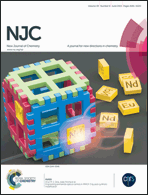
The authors have been interested in the design of new metal organic frameworks (MOFs) with Ln active sites for light-emitting devices. Recently, they have shown that post-synthetic modification of MOFs is an excellent route for preparing infrared and visible-light emitters. In this article, they wish to extend their studies to other linker modifications, in order to firmly establish the general character of this approach. Their method allows preservation of the original MOFs structure with the addition of new properties, combining the microporosity of the MOFs host and the functionality of lanthanide ions.

Engineering lanthanide-optical centres in IRMOF-3 by post-synthetic modification
Reda M. Abdelhameed, Luis D. Carlos, Artur M. S. Silva and João Rocha.
New J. Chem., 2015, 39, 4249-4258. DOI: 10.1039/C4NJ02382J.

Our inside cover is proposed by Professor Qin Wei (University of Jinan, China).NJC June 2015 IFC - Prof. Wei

Professor Wei and his co-workers developed an electrochemiluminescent immunosensor based on CdS–Fe3O4 nanocomposites for the detection of Ochratoxin A. Their method provides a powerful avenue for the design of an ultrasensitive electrochemiluminescence detection method, showing great promise in food detection.

An electrochemiluminescent immunosensor based on CdS–Fe3O4 nanocomposite electrodes for the detection of Ochratoxin A
Xiaohui Lv, Yueyun Li, Tao Yan, Xuehui Pang, Lihua Hu, Bin Du and Qin Wei.
New J. Chem., 2015, 39, 4259-4264. DOI: 10.1039/C5NJ00320B.

Discover the full June issue here

Digg This
Reddit This
Stumble Now!
Share on Facebook
Bookmark this on Delicious
Share on LinkedIn
Bookmark this on Technorati
Post on Twitter
Google Buzz (aka. Google Reader)

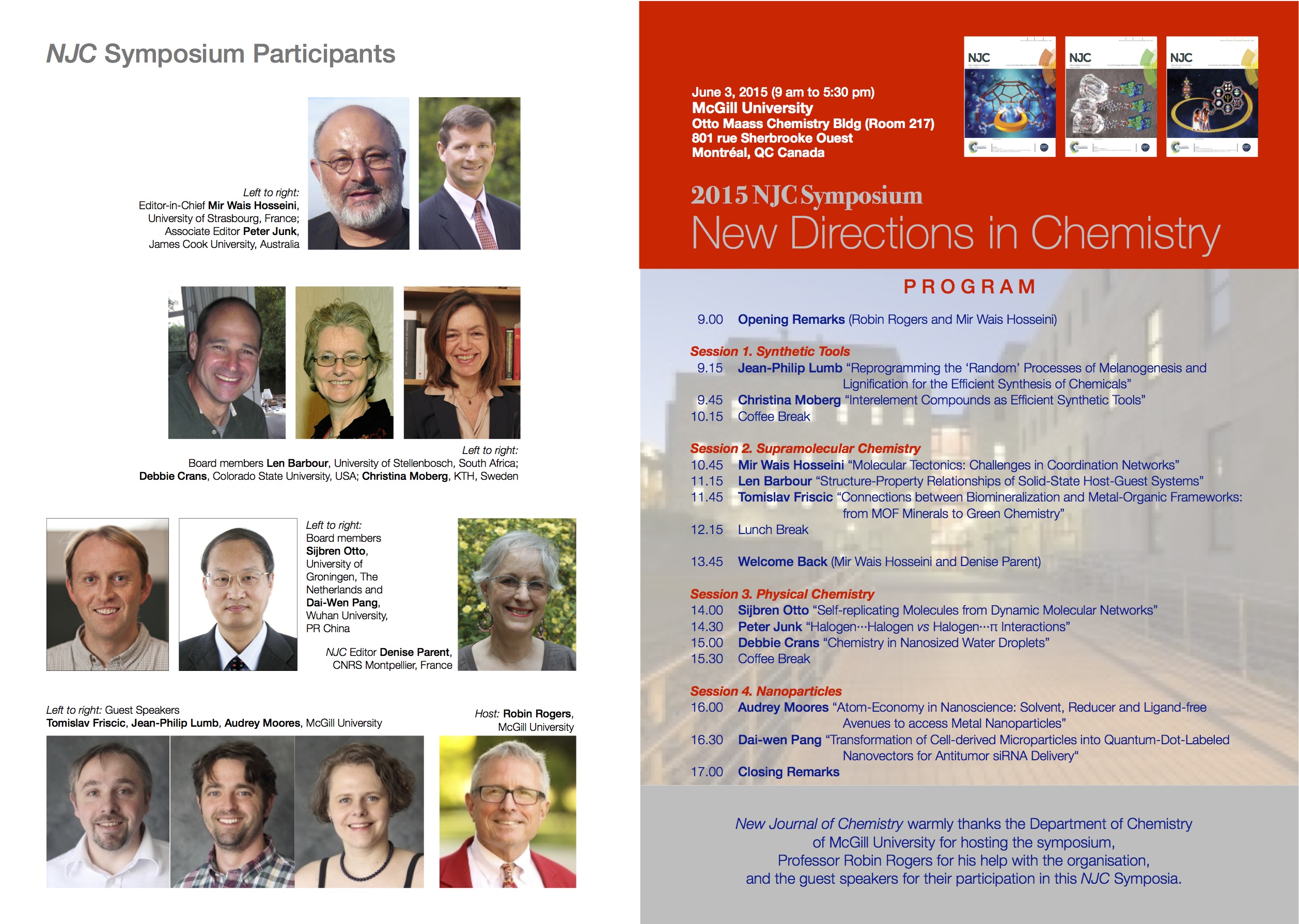
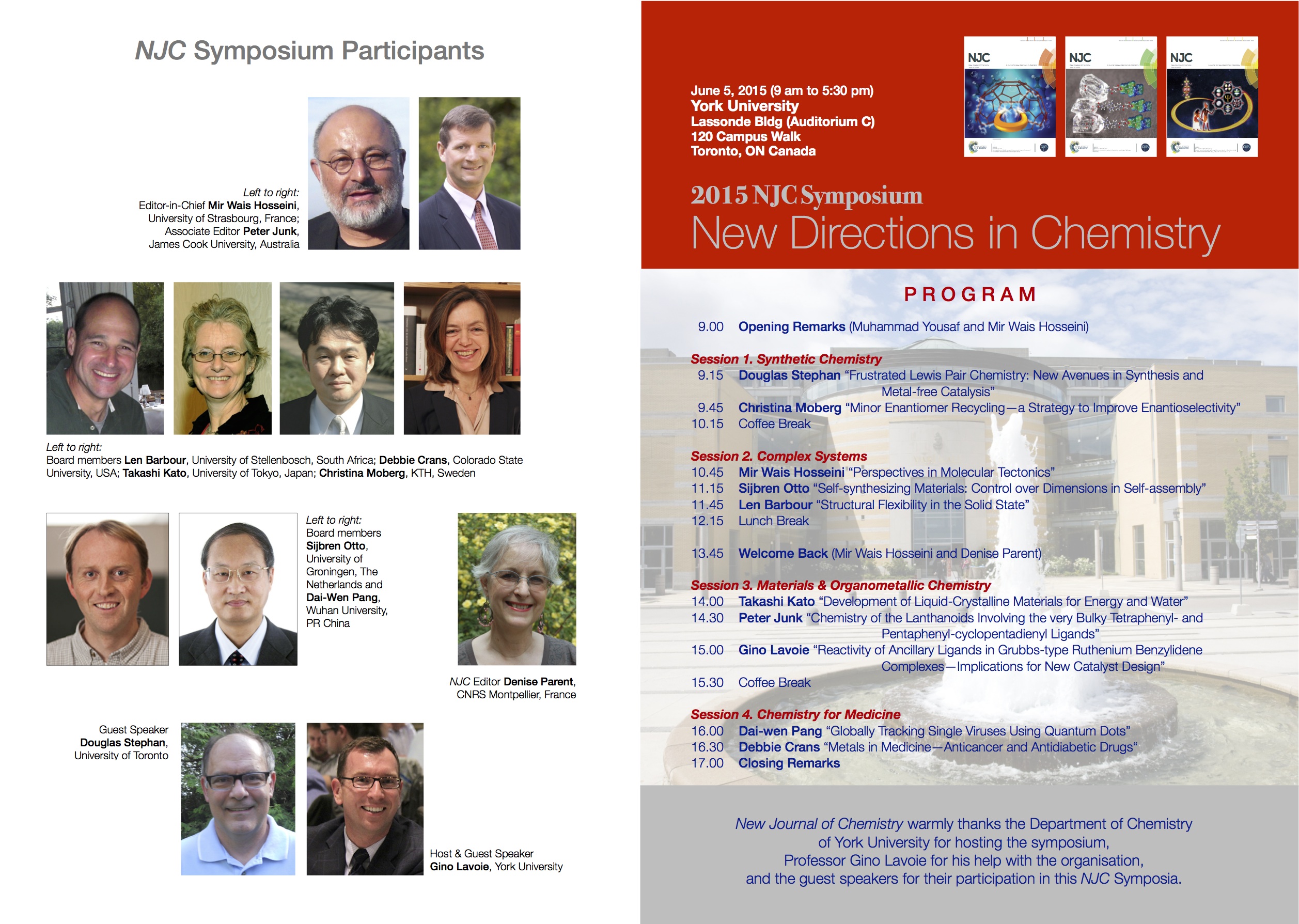
Programs of the NJC Symposia in Canada (June 2015)

The detailed programs of the three New Journal of Chemistry symposia in Montreal and Toronto are now available.

The 4th series of NJC Symposia: New Directions in Chemistry is just two weeks away. Be sure to register now to meet the editors and Editorial Board of NJC during one of the three days on our schedule.


Dates:

June 2 at the Université de Montréal (Host: Professor Davit ZARGARIAN) Pavillon J-A Bombardier, Salle 1035

June 3 at McGill University (Host: Professor Robin ROGERS) Otto Maass Chemistry Bldg, Room 217

June 5 at York University (Host: Professor Gino LAVOIE) Lassonde Bldg, Auditorium C

Each day-long symposium begins at 9 am. The detailed scientific programs are given below (click on an image to see a larger view).

These symposia are free and open to all interested persons. You are kindly asked to register (so that we know how many of you to expect for coffee). Once on the Announcement page, you can click on the name of the university where you wish to attend the symposium. You will then be connected to the EventBrite website to order your free ticket.

New Journal of Chemistry 2015 Symposium

Program of the NJC Symposium at University of Montreal on June 2nd

New Journal of Chemistry 2015 Symposium

Program of the NJC Symposium at McGill University on June 3rd

New Journal of Chemistry 2015 Symposium

Program of the NJC Symposium at York University on June 5th

Digg This
Reddit This
Stumble Now!
Share on Facebook
Bookmark this on Delicious
Share on LinkedIn
Bookmark this on Technorati
Post on Twitter
Google Buzz (aka. Google Reader)