NJC issue 07 now online

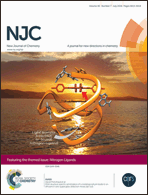
New Journal of Chemistry presents the July issue, a part-themed one devoted to Nitrogen Chemistry.

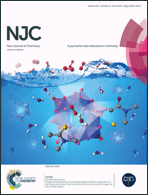
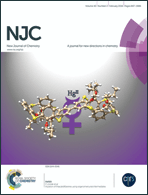
NJC July 2016 OFC NLigands - Dr Monchaud

This month’s issue includes a themed collection put together by guest editors Claude Gros and Franck Denat (Université Bourgogne Franche-Comté, France). It reports recent advances in the chemistry of Nitrogen Ligands, including organic, coordination, metal-organic and bioinorganic chemistry, and also materials science and catalysis. This themed issue follows the 6th EuCheMS Conference on Nitrogen Ligands held in Beaune in September 2015. The Editors and the NJC team are very grateful to all the authors (representing 13 countries) and reviewers of the 39 contributions to this themed issue.

Access the Editorial here.

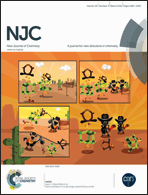
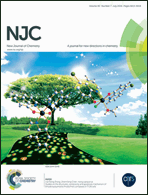
We would like to thank Dr David Monchaud (Université Bourgogne Franche-Comté, France) for designing the outside cover. It illustrates an article reporting a palladated porphyrin named Pd·TEGPy. The authors show that its efficiency as a quadruplex-selective fluorescent dye relies on a structural design that endows it with attractive supramolecular and electronic properties and makes it an efficient turn-on, fluorescent stain thanks to a DNA-mediated sensitization mechanism that ensures a high level of specificity.

DNA structure-specific sensitization of a metalloporphyrin leads to an efficient in vitro quadruplex detection molecular tool
Pape Diaba Diabate, Aurélien Laguerre, Marc Pirrotta, Nicolas Desbois, Julien Boudon, Claude P. Gros and David Monchaud, New J. Chem., 2016, 40, 5683-5689. DOI: 10.1039/C6NJ01012A.
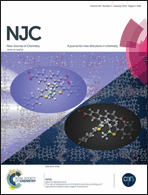
NJC IFC July 2016 - Dr HR Zhang

The inside cover is proposed by Dr Hai-Rong Zhang (Guangxi Normal University, China) to illustrate a paper showing the authors’ interest in finding novel non-platinum metal-based complexes with maximal beneficial antitumor properties and minimal side effects. In their study, Dr Zhang and his colleagues synthesize and structurally characterize two rhodium(III) complexes of 8-hydroxyquinoline (HOQ) and its derivative 5-bromo-8-hydroxyquinoline (HBrQ). They also screen the in vitro cytotoxicity against a series of human cancer cell lines and study the DNA binding properties of the best cytotoxic complex.

Studies on the structures, cytotoxicity and apoptosis mechanism of 8-hydroxylquinoline rhodium(III) complexes in T-24 cells
Hai-Rong Zhang, Yan-Cheng Liu, Zhen-Feng Chen, Ting Meng, Bi-Qun Zou, You-Nian Liu and Hong Liang, New J. Chem., 2016, 40, 6005-6014. DOI: 10.1039/C6NJ00182C.

We invite you to browse the complete table of contents of the July issue to discover other reports that are not part of the themed collection.

Digg This
Reddit This
Stumble Now!
Share on Facebook
Bookmark this on Delicious
Share on LinkedIn
Bookmark this on Technorati
Post on Twitter
Google Buzz (aka. Google Reader)

NJC issue 06 now online

New Journal of Chemistry is pleased to share its authors’ work appearing in the June 2016 issue!

NJC June 2016 OFC - Prof. MizunoProf. Noritaka Mizuno (The University of Tokyo, Japan) designed this month’s outside cover. It illustrates an NJC Letter in which Prof. Mizuno and his colleagues present for the first time the efficient catalytic desulfurization-oxygenation of secondary and tertiary thioamides into amides using O2 as the terminal oxidant and water as the oxygen source. Their results show that various kinds of structurally diverse thioamides could be applied to this catalytic system. They use phosphovanadomolybdic acids, possessing both acidic and oxidation properties, the key to realizing this transformation as the efficient catalytic one.

Phosphovanadomolybdic acid catalyzed desulfurization–oxygenation of secondary and tertiary thioamides into amides using molecular oxygen as the terminal oxidant, Ning Xu, Xiongjie Jin, Kosuke Suzuki, Kazuya Yamaguchi and Noritaka Mizuno, New J. Chem., 2016, 40, 4865-4869. DOI: 10.1039/C5NJ03579A.

_____________________

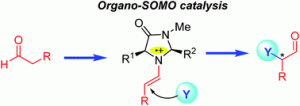
This month’s issue also features a Perspective review by Dr Radovan Šebesta (Comenius University in Bratislava, Slovakia) and his two co-workers, which focuses on a methodology affording diversely substituted chiral carbonyl compounds. Enamines, formed from the corresponding carbonyl compounds and appropriate chiral amine catalysts, can be oxidized to radical cation species. These radical cations can be intercepted by a range of SOMO-philic reagents, such as alkenes, arenes and some heteroatom-based reagents. They show that asymmetric singly occupied molecular orbital (SOMO) catalysis is a useful tool for enantioselective allylic alkylation, enolation, arylation, carbo-oxidation, vinylation, alkynylation, or intermolecular alkylation of carbonyl compounds, predominantly aldehydes. This new bond-forming methodology can find application in the construction of both natural products as well as medicinal agents.

GA - NJC 10.1039/C6NJ00079G

Enantioselective organocatalysis using SOMO activation, Mária Mečiarová, Pavol Tisovský and Radovan Šebesta, New J. Chem., 2016, 40, 4855-4864. DOI: 10.1039/C6NJ00079G.

To browse the entire table of contents of the June issue, click here. And to sign up for the free e-alerts, so as not to miss a single issue of NJC, click here.

Digg This
Reddit This
Stumble Now!
Share on Facebook
Bookmark this on Delicious
Share on LinkedIn
Bookmark this on Technorati
Post on Twitter
Google Buzz (aka. Google Reader)

NJC issue 05 now online

Discover our authors’ work in the New Journal of Chemistry May part-themed issue “An exciting journey in the creative world of ordered porous materials and their applications”.

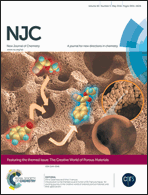
NJC May 2016 OFC - Themed issue in honor of François FajulaThis month, Guest Editors Professors Anne Galarneau (Institut Charles Gerhardt Montpellier, France) and Irina I. Ivanova (M.V. Lomonosov Moscow State University, Russia) are pleased to present a part-themed issue in honor of Dr François Fajula entitled The Creative World of Porous Materials.

This collection of 12 Reviews, 2 Letters and 39 research Papers expresses the materials community’s deep appreciation and conveys thanks to Dr François Fajula for his outstanding contributions to the fields of zeolites and ordered porous materials, and for his hard wok on behalf of the materials community. Additional contributions to this themed collection that are not published in the May issue can be found here as they are added.

NJC would also like to thank Alexander Yakimov and the Guest Editors for the design of the outside cover which illustrates this themed issue.

Read the Editorial here.

We invite you to browse the complete table of contents of the May issue to discover other authors’ contributions that are not part of the themed collection.

Digg This
Reddit This
Stumble Now!
Share on Facebook
Bookmark this on Delicious
Share on LinkedIn
Bookmark this on Technorati
Post on Twitter
Google Buzz (aka. Google Reader)

NJC issue 4 now online

Discover the April issue of New Journal of Chemistry. The NJC team wishes you a happy spring!

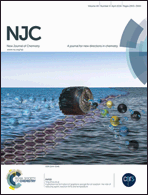
NJC April OFC - Dr ZhouThe first spring issue cover was designed by Prof. Ying Zhou (Southwest Petroleum University, China) to illustrate a study in which the authors stress the important role of hydrothermal treatment parameters for the oil remediation performance of the material.

The authors investigated the effects of various reducing agents with different temperatures and reaction times on the density, specific surface area, strength, morphology and adsorption performance of the prepared graphene aerogels. Their results provide hints to select a reducing agent to prepare a graphene aerogel for oil sorption.

Hydrothermal formation of graphene aerogel for oil sorption: the role of reducing agent, reaction time and temperature. Wenchao Wan, Fei Zhang, Shan Yu, Ruiyang Zhang and Ying Zhou, New J. Chem., 2016, 40, 3040-3046. DOI: 10.1039/C5NJ03086B.

_______________________

NJC also invites you to read the two Perspective reviews in this month’s issue:

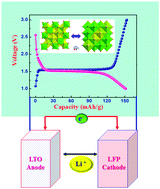
  • Profs. Wen He and Xudong Zhang (Qilu University of Technology, China) and their co-workers focused their review of hybrid cathode materials on composites of LiFePO4 or Li3V2(PO4)3 with other lithium-metal compounds. They note the challenges still facing researchers to bring the understanding of these materials to the point where they can be used in lithium ion batteries.

Recent progress in hybrid cathode materials for lithium ion batteries. Chuanliang Wei, Wen He, Xudong Zhang, Jianxing Shen and Jingyun Ma, New J. Chem., 2016, 40, 2984-2999. DOI: 10.1039/C5NJ02212F.

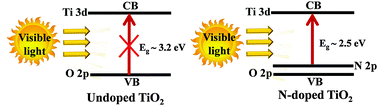
  • In the second review, Prof. Moo Hwan Cho (Yeungnam University, South Korea) and his colleagues focus on the major developments in the synthesis of N-doped TiO2 and its possible applications for the photocatalytic degradation of organic pollutants and environmental remediation under visible light irradiation.

Nitrogen-doped titanium dioxide (N-doped TiO2) for visible light photocatalysis. Sajid Ali Ansari, Mohammad Mansoob Khan, Mohd Omaish Ansari and Moo Hwan Cho, New J. Chem., 2016, 40, 3000-3009. DOI: 10.1039/C5NJ03478G.

Access the full issue table of contents

Digg This
Reddit This
Stumble Now!
Share on Facebook
Bookmark this on Delicious
Share on LinkedIn
Bookmark this on Technorati
Post on Twitter
Google Buzz (aka. Google Reader)

NJC issue 03 now online

Read our authors’ work in the March 2016 issue of New Journal of Chemistry accessible online.

NJC March 16 OFC - Dr BloomfieldThis month, the humorous outside cover was designed by Dr Subhajyoti Chaudhuri, in the group of Dr Aaron Bloomfield (Yale University, USA). The authors report in their study the preparation and solvolysis of three bicyclooctyl carboxamides (1–3), compare their structures to those of other reported amides, and investigate the observed trends using computational methods. They also discuss a possible explanation for the cis-preference of N-alkyl-N-aryl amides.

Facile solvolysis of a surprisingly twisted tertiary amide
Aaron J. Bloomfield, Subhajyoti Chaudhuri, Brandon Q. Mercado, Victor S. Batista and Robert H. Crabtree, New J. Chem., 2016, 40, 1974-1981. DOI: 10.1039/C5NJ02449H.NJC March 16 IFC - Dr Zhang

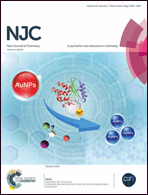
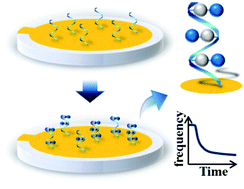
The inside cover is proposed by Dr Juan Zhang (Shanghai University, China) to illustrate an article in which the authors highlight the increased resistance of bacterial infections to antibiotic treatment. In this study, they developed a colorimetric method for the determination of the activity of β-lactamase (β-Lac) and the screening of its inhibitors based on cysteine-induced gold nanoparticle (AuNP) aggregation.

Colorimetric β-lactamase inhibitor assay with double catalyzed signal amplification
Chen Chen, Jun Lv, Wanyi Chen, Yang Xiang and Juan Zhang, New J. Chem., 2016, 40, 1982-1987. DOI: 10.1039/C5NJ02356D.

You can read these and the other 123 articles in the March issue, covering a broad range of topics, online here or through the NJC website.

Digg This
Reddit This
Stumble Now!
Share on Facebook
Bookmark this on Delicious
Share on LinkedIn
Bookmark this on Technorati
Post on Twitter
Google Buzz (aka. Google Reader)

Top 25 most accessed NJC articles from October – December 2015

From October – December 2015, our most downloaded NJC articles were:

Sangmyung Lee, Kuewhan Jang, Chanho Park, Juneseok You, Taegyu Kim, Chulhwan Im, Junoh Kang, Haneul Shin, Chang-Hwan Choi, Jinsung Park and Sungsoo Na
New J. Chem., 2015, 39, 8028-8034
DOI: 10.1039/C5NJ00668F, Paper
Christoph Janiak and Jana K. Vieth
New J. Chem., 2010,34, 2366-2388
DOI: 10.1039/C0NJ00275E, Perspective
Felix Jeremias, Dominik Fröhlich, Christoph Janiak and Stefan K. Henninger
New J. Chem., 2014, 38, 1846-1852
DOI: 10.1039/C3NJ01556D, Focus
Jianhua Shen, Yihua Zhu, Xiaoling Yang, Jie Zong, Jianmei Zhang and Chunzhong Li
New J. Chem., 2012, 36, 97-101
DOI: 10.1039/C1NJ20658C, Paper
Naoki Toshima and Tetsu Yonezawa
New J. Chem., 1998, 22, 1179-1201
DOI: 10.1039/A805753B, Paper
Sadia Khalid, Ejaz Ahmed, M. Azad Malik, David J. Lewis, Shahzad Abu Bakar, Yaqoob Khan and Paul O’Brien
New J. Chem., 2015, 39, 1013-1021
DOI: 10.1039/C4NJ01461H, Paper
Huihui Lin, Chuanxi Wang, Jiapeng Wu, Zhenzhu Xu, Yijun Huang and Chi Zhang
New J. Chem., 2015, 39, 8492-8497
DOI: 10.1039/C5NJ01698C, Paper
Xiangcheng Sun, Pavle V. Radovanovic and Bo Cui
New J. Chem., 2015, 39, 38-63
DOI: 10.1039/C4NJ01390E, Perspective
Monika Bilska-Markowska, Magdalena Rapp, Tomasz Siodła, Andrzej Katrusiak, Marcin Hoffmann and Henryk Koroniak
New J. Chem., 2014, 38, 3819-3830
DOI: 10.1039/C4NJ00317A, Paper
Jiangsheng Yu, Baofeng Zhao, Xuemei Nie, Baojin Zhou, Yang Li, Jiefeng Hai, Enwei Zhu, Linyi Bian, Hongbin Wu and Weihua Tang
New J. Chem., 2015, 39, 2248-2255
DOI: 10.1039/C4NJ02192D, Paper
Didier Astruc
New J. Chem., 2005, 29, 42-56
DOI: 10.1039/B412198H, Perspective
Zheng Ma, Hai Ming, Hui Huang, Yang Liu and Zhenhui Kang
New J. Chem., 2012, 36, 861-864
DOI: 10.1039/C2NJ20942J, Letter
Hongyu Zhen and Kan Li
New J. Chem., 2015, 39, 9031-9031
DOI: 10.1039/C5NJ90049B, Retraction

Graphical Abstract

Xu Lu, Yohei Ishida and Tetsu Yonezawa
New J. Chem., 2015, 39, 6267-6273
DOI: 10.1039/C5NJ00909J, Paper
Shenguang Ge, Feifei Lan, Feng Yu and Jinghua Yu
New J. Chem., 2015, 39, 2380-2395
DOI: 10.1039/C4NJ01783H, Perspective
Teruhisa Ohno, Koji Sarukawa and Michio Matsumura
New J. Chem., 2002, 26, 1167-1170
DOI: 10.1039/B202140D, Paper
Kangfu Zhou, Yihua Zhu, Xiaoling Yang, Xin Jiang and Chunzhong Li
New J. Chem., 2011, 35, 353-359
DOI: 10.1039/C0NJ00623H, Paper
Marta Sowinska and Zofia Urbanczyk-Lipkowska
New J. Chem., 2014, 38, 2168-2203
DOI: 10.1039/C3NJ01239E, Perspective
Naresh Balsukuri, Sudipta Das and Iti Gupta
New J. Chem., 2015, 39, 482-491
DOI: 10.1039/C4NJ01086H, Paper
Luis M. Liz-Marzán and Paul Mulvaney
New J. Chem., 1998, 22, 1285-1288
DOI: 10.1039/A801214H, Paper
Xin Liu, Yuan Xie, Haobin Zhao, Xinyi Cai, Hongbin Wu, Shi-Jian Su and Yong Cao
New J. Chem., 2015, 39, 8771-8779
DOI: 10.1039/C5NJ01893E, Paper
Sailaja S. Sunkari, Bhagwan Kharediya, Satyen Saha, Bahjat Elrez and Jean-Pascal Sutter
New J. Chem., 2014, 38, 3529-3539
DOI: 10.1039/C4NJ00374H, Paper
Ananthakumar Ramadoss, Taehyun Kim, Gui-Shik Kim and Sang Jae Kim
New J. Chem., 2014, 38, 2379-2385
DOI: 10.1039/C3NJ01558K, Paper
Magdalena B. Foreiter, H. Q. Nimal Gunaratne, Peter Nockemann, Kenneth R. Seddon, Paul J. Stevenson and David F. Wassell
New J. Chem., 2013, 37, 515-533
DOI: 10.1039/C2NJ40632B, Paper
Chenglin Yan and Federico Rosei
New J. Chem., 2014, 38, 1883-1904
DOI: 10.1039/C3NJ00888F, Perspective
Digg This
Reddit This
Stumble Now!
Share on Facebook
Bookmark this on Delicious
Share on LinkedIn
Bookmark this on Technorati
Post on Twitter
Google Buzz (aka. Google Reader)

Protecting marble monuments

New Journal of Chemistry is pleased to announce that a paper written by our authors was selected to feature in Chemistry World. Do not hesitate to read the study online.

Chemistry World has highlighted, in a recent article, work published in NJC by Dr Massimiliano Arca (Dipartimento di Scienze Chimiche e Geologiche, Università degli Studi di Cagliari, Italy) and his colleagues. The authors have made a new oxamate salt that could help protect monuments from weathering. In their study, they show that the introduction of structural modifications on the oxamate anion provides a promising tool for the development of protective agents for calcareous stones.

Restoration-of-marble_DSC_0082_630m

The treatment was tested on marble statues by Giuseppe Maria Sartorio in the Monumental Cemetery of Bonaria in Cagliari, Sardinia © Paola Meloni

You can access the original NJC article:
Oxamate salts as novel agents for the restoration of marble and limestone substrates: case study of ammonium N-phenyloxamate
Laura Maiore, M. Carla Aragoni, Gianfranco Carcangiu, Ombretta Cocco, Francesco Isaia, Vito Lippolis, Paola Meloni, Arianna Murru, Alexandra M. Z. Slawin, Enrica Tuveri, J. Derek Woollins and Massimiliano Arca.
New J. Chem., 2016, Advance Article. DOI: 10.1039/C5NJ02505B.

Digg This
Reddit This
Stumble Now!
Share on Facebook
Bookmark this on Delicious
Share on LinkedIn
Bookmark this on Technorati
Post on Twitter
Google Buzz (aka. Google Reader)

NJC issue 02 now online

Discover our authors’ work in the February part-themed issue of New Journal of Chemistry on “Emergent Polyoxometalates and Soft-oxometalates”.

NJC Feb 2016 OFC - themed issue POMs-SOMsThe February issue of NJC is a part-themed one devoted to Emergent Polyoxometalates and Soft-oxometalates. The NJC team thanks all of the authors for their contributions, as well as the two Guest Editors, Professors Debbie Crans (Colorado State University, USA) and Soumyajit Roy (Indian Institute of Science Education and Research Kolkata, India). Two Perspectives, 4 Letters and 16 research papers illustrate new advances in polyoxometalate-containing systems, with emphasis on those for which non-covalent organization creates new structures with new properties.

Read the Themed Issue Editorial

NJC Feb 2016 IFC - Prof. LhotakThe inside cover is proposed by Prof. Pavel Lhoták (University of Chemistry and Technology Prague, Czech Republic) to illustrate a Paper in which the authors report on the application of organomercurial intermediates for the introduction of aryl moieties using Pd-catalyzed arylation, and for the preparation of the corresponding thiacalixarene dimers, so far unknown in thiacalixarene chemistry.

They show that their reaction enables the introduction of aryl moieties into the meta– or para-positions of the thiacalix[4]arene skeleton, thus leading to unique substitution patterns in thiacalixarene chemistry.

Arylation of thiacalix[4]arenes using organomercurial intermediates
F. Botha, V. Eigner, H. Dvořáková and P. Lhoták.
New J. Chem., 2016, 40, 1104-1110. DOI: 10.1039/C5NJ02427G.

See the full issue table of contents

Digg This
Reddit This
Stumble Now!
Share on Facebook
Bookmark this on Delicious
Share on LinkedIn
Bookmark this on Technorati
Post on Twitter
Google Buzz (aka. Google Reader)

NJC issue 01 now online

Discover the first issue of New Journal of Chemistry for the year 2016!

NJC Jan 16 OFC - Dr BenedictThis first issue of 2016 features a cover designed by Dr Jason Benedict (University at Buffalo, USA) to illustrate an article in which he and his co-workers show the design, synthesis and characterization of a photo-responsive linker that is subsequently reacted to yield metal–organic framework (MOF) single crystals.
Their analysis of the potential energy surface associated with rotation of one thiophene group reveals a number of key energetic minima, only one of which is expected to be photoactive. This study shows that future photo-responsive MOFs can utilize the unique microenvironment of void spaces to stabilize selected atropisomers for advanced light-responsive crystalline materials.

The role of atropisomers on the photo-reactivity and fatigue of diarylethene-based metal–organic frameworks
Ian M. Walton, Jordan M. Cox, Cassidy A. Benson, Dinesh (Dan) G. Patel, Yu-Sheng Chen and Jason B. Benedict.
New J. Chem., 2016, 40, 101-106. DOI: 10.1039/C5NJ01718A.
NJC Jan 2016 IFC - Dr Liang

The inside cover was proposed by Dr Erjun Liang (Zhengzhou University, China). In their work, the authors demonstrate that introducing amorphous NiO electrocatalysts onto the surface of ZnO nanorod photoanodes can largely improve their photoelectrochemical performance. Their results seem to be a promising solution to develop a high-performance photoelectrochemical photoanode.

Amorphous NiO electrocatalyst overcoated ZnO nanorod photoanodes for enhanced photoelectrochemical performance
Yanchao Mao, Yongguang Cheng, Junqiao Wang, Hao Yang, Mingyang Li, Jian Chen, Mingju Chao, Yexiang Tong and Erjun Liang.
New J. Chem., 2016, 40, 107-112. DOI: 10.1039/C5NJ01815C.

To access the table of contents of the January 2016 issue, click here.

Digg This
Reddit This
Stumble Now!
Share on Facebook
Bookmark this on Delicious
Share on LinkedIn
Bookmark this on Technorati
Post on Twitter
Google Buzz (aka. Google Reader)

2015 Winners of the New Journal of Chemistry Poster Prize

Profiles of the 5 NJC Poster Prize winners in 2015 and their award-winning work are presented.

New Journal of Chemistry is delighted to present the five winners of the NJC poster prizes awarded in 2015.

WGidt - NJC Poster prize 2015Wjatscheslaw Gidt (Ph.D. student working in the group of Prof. Helmut Sitzmann at the Technischen Universität Kaiserslautern, Germany) received the award at the 13th Ferrocene Colloquium (held in Leipzig last winter) for his poster entitled “Synthesis, Structure and Reactivity of the Chromium Complexes [4CpCrX]2 (X = OAc, Cl, I, OTf)”.

His study shows that paramagnetic cyclopentadienylmetal halides of nickel, cobalt and iron, with bulky alkylcyclopentadienyl ligands, are very reactive starting materials for the formation of novel organometallic compounds capable of carbon-carbon bond formation or cleavage.

__________________________________________________________

This summer, at the International Conference on Advanced Inorganic Complex Nanomaterials held in Namur, Belgium, two young scientists were honoured.SoraChoi - NJC Poster prize 2015

Sora Choi (Ph.D. student under the supervision of Prof. Moonhyun Oh at the Yonsei University, Korea) won a poster prize for her work “Structural and Morphological Transformation of Metal-Organic Frameworks via Destruction and Reconstruction Pathways” in which she reports the structural and morphological transformations of three-dimensional Kagome-like structured hexagonal lumps (In-MIL-68, [In(OH)(BDC)]n) with blunted ends, into three-dimensional quartz structured hexagonal rods (QMOF-2, [InH(BDC)2]n) with pointed ends.

CedricMarien - NJC Poster prize 2015

Cédric Marien (Ph.D. student with Didier Robert at the University of Strasbourg, France and the INRS, Canada) received the award for his research that aims to develop TiO2 based nanostructures for the photo(electro)catalytic removal of organic compounds in water. His poster “Removal of organic pollutants by photocatalysis with TiO2 nanotubes” reported TiO2 nanotubes electrochemically grown on titanium foils. The study shows that the photocatalytic activity of the tubes depends on their morphology, particularly on the internal diameter and wall thickness.

__________________________________________________________

The XIII International Symposium on Bioinorganic Chemistry held in Karpacz, Poland, in September, also revealed two young talented chemists.

KSokolowski- NJC Poster prize 2015The award-winning poster of Kamil Sokołowski (postdoctoral researcher at the Institute of Physical Chemistry of the Polish Academy of Sciences in the research group of Prof. Janusz Lewiński), entitled “Bio-inspired fixation of CO2 on organozinc hydoxides: efficient routes to novel nanomaterials based on zinc carbonates”, summarized his Ph.D. project. The presented research demonstrated that carbon dioxide in combination with well-defined organozinc hydroxides of the type [RZnOH]n or [(R)xZny(L)z(OH)n], can be successfully utilized for the formation of novel molecular organozinc carbonates, as well as meso- and microporous materials with unique physicochemical properties. The studies underline the great potential of simple organozinc precursors featuring CO2-reactive Zn–OH groups and proton-reactive Zn–C bonds for the design of new functional materials based on zinc carbonate components.

Joanna_Watly - NJC Poster prize 2015Joanna Wątły (Ph.D. student under the supervision of Prof. Henryk Kozlowski at the University of Wroclaw, Poland) was also recognised for her work, “The Impact of the Cu(II) Coordination on the Structural and Thermodynamic Properties of Poly-His Peptides”, in which she studied the coordination of Cu(II) with (His)6-tag peptide (used in IMAC chromatography) and peptide fragments from snake venoms. The results showed that all studied peptides have a high affinity towards Cu(II) ions. Formation of an α-helical structure induced by metal-ion coordination and the occurrence of polymorphic binding states is very characteristic for these peptides, but the most interesting results were obtained for a snake venom peptide fragment with nine histidine residues. The specific role of these nine His residues in venom is unknown, but this peptide may play a key role in the interaction with metal ions and consequently in the inhibition of the snake metalloproteases.

Congratulations to all five winners !

We wish them continuing success in their research and send them our best wishes for 2016!

Digg This
Reddit This
Stumble Now!
Share on Facebook
Bookmark this on Delicious
Share on LinkedIn
Bookmark this on Technorati
Post on Twitter
Google Buzz (aka. Google Reader)