


Nanoscale Horizons is a leading journal for the publication of exceptionally high-quality, innovative nanoscience and nanotechnology. To celebrate the excellent articles that are published in the journal, we asked some of our authors to discuss their research in more detail.
In this post, we hear from Seth B. Darling as they discuss their recent review article, ‘Sharpening the cut: physical origins of rejection-curve broadening and routes to precision ultrafiltration‘.
Insights from the author
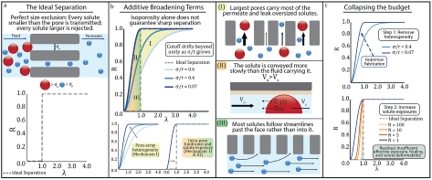
Anyone who has used a kitchen sieve expects filtering by size to be simple: small things pass through and large things stay behind. Ultrafiltration membranes, which are essential to water treatment, protein purification, and oil/water separations, are built on this idea, but they have never worked that cleanly. Their “rejection curves” are soft, S-shaped slopes rather than crisp steps. Molecules smaller than the average-sized pores are partly held back, and some larger ones slip through. For about fifty years, the field has largely accepted this as an inherent limit, with classical hindered-transport theory often read as a hard ceiling on precision. In our new article, ‘Sharpening the Cut: Physical Origins of Rejection-Curve Broadening and Routes to Precision Ultrafiltration’, my co-authors at Argonne National Laboratory and the University of Chicago and I argue that this softness is not a law of nature. It is the sum of several separate problems, and each one can be solved.
We describe the gap between the ideal step and the real slope as a “broadening budget” with three main entries. First, conventional membranes have a wide spread of pore sizes. Because flow scales with the fourth power of pore radius, the largest pores carry most of the fluid and leak oversized molecules. Second, even in a perfectly uniform pore, a molecule close to the pore size is slowed by the walls due to solvent (water) drag. Third, a molecule has to reach a pore mouth to pass through, and in a single pass many never get the chance. The deceptively simple insight that excited us is that a molecule smaller than the pore is only slowed, not blocked. If the feed is recirculated, it gets another try. If a single pass retains a fraction of the population of a solute, then after a sufficient number of passes the remaining solutes will find their way through, while a solute too large to enter is rejected every time. Our team tested this idea in earlier work published in Nature Water. We used silicon nitride membranes with exceptionally uniform nanoscale pores, with a coefficient of variation of about 0.07 compared with roughly 0.2 for commercial membranes. After recirculating the feed more than 900 times over about 200 hours, the rejection curve became much sharper than classical single-pass theory predicts, and the cutoff stayed locked at the pore size.
We still did not reach a perfect step, and the reason points to the next challenge. Simulations showed that most of the flow ran along the membrane rather than into it, so many passes were not true encounters with a pore. The path forward therefore runs increasingly through process design, but there is a catch. Water moves through pores faster than dissolved solutes do, so any process that maximizes encounters also has to keep resupplying water at the membrane surface to prevent concentration build-up and fouling. Flow cells that steer solutes toward the membrane, pulsed flows, and pore walls that let water “slip” are all promising next steps. More broadly, I hope this work encourages researchers in any field to look again at limits that seem fundamental. Sometimes they turn out to be several smaller, solvable problems stacked on top of each other.
Meet the authors
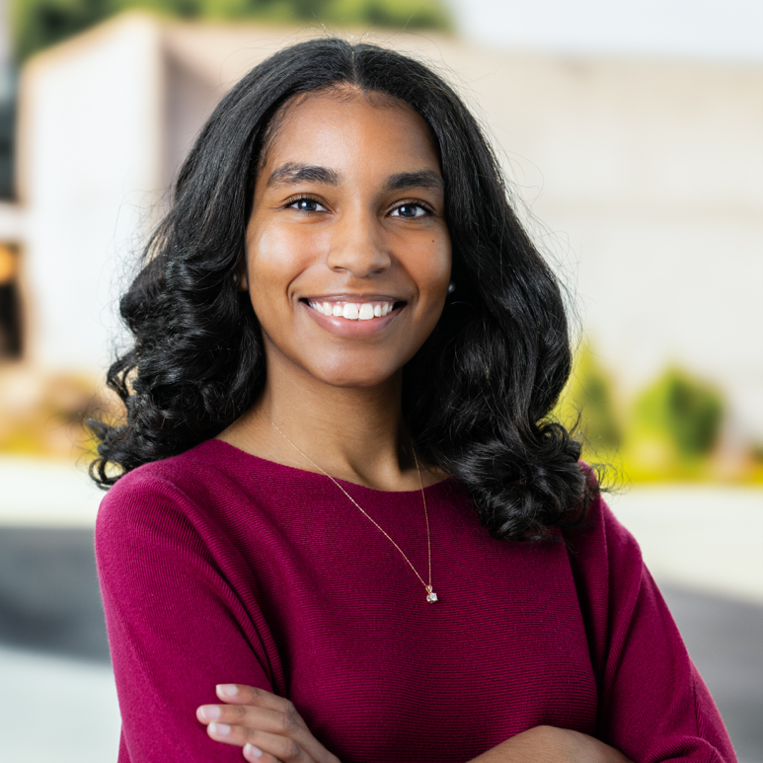 |
Jamila G. Eatman graduated from Spelman College in 2022 and is a Ph.D. candidate in the Pritzker School of Molecular Engineering at the University of Chicago. As part of her studies, she holds a visiting graduate student appointment at Argonne National Laboratory. In the Darling group at Argonne, she investigates the theory and practice of ultrafiltration. Her research characterizes the behavior of state-of-the-art isoporous membranes, from size-selective separations to fouling phenomena. By studying membranes with precisely controlled pore geometry, she tests whether it is possible to separate solutes and maintain performance beyond the limits predicted by classical models and by conventional membranes with randomly distributed pores.
|
 |
Chaoqiuyu Wang is a Postdoctoral Scholar in the Pritzker School of Molecular Engineering at the University of Chicago. She obtained her Ph.D. in Chemistry and Chemical Biology from Cornell University in 2024, where her research focused on ion transport in liquid crystalline materials. In early 2025, she joined the group of Prof. Paul Nealey, where her focus shifted toward the self-assembly of block copolymers, exploiting the morphology of the assembled patterns to fabricate nanoporous membranes with precisely defined pore size.
|
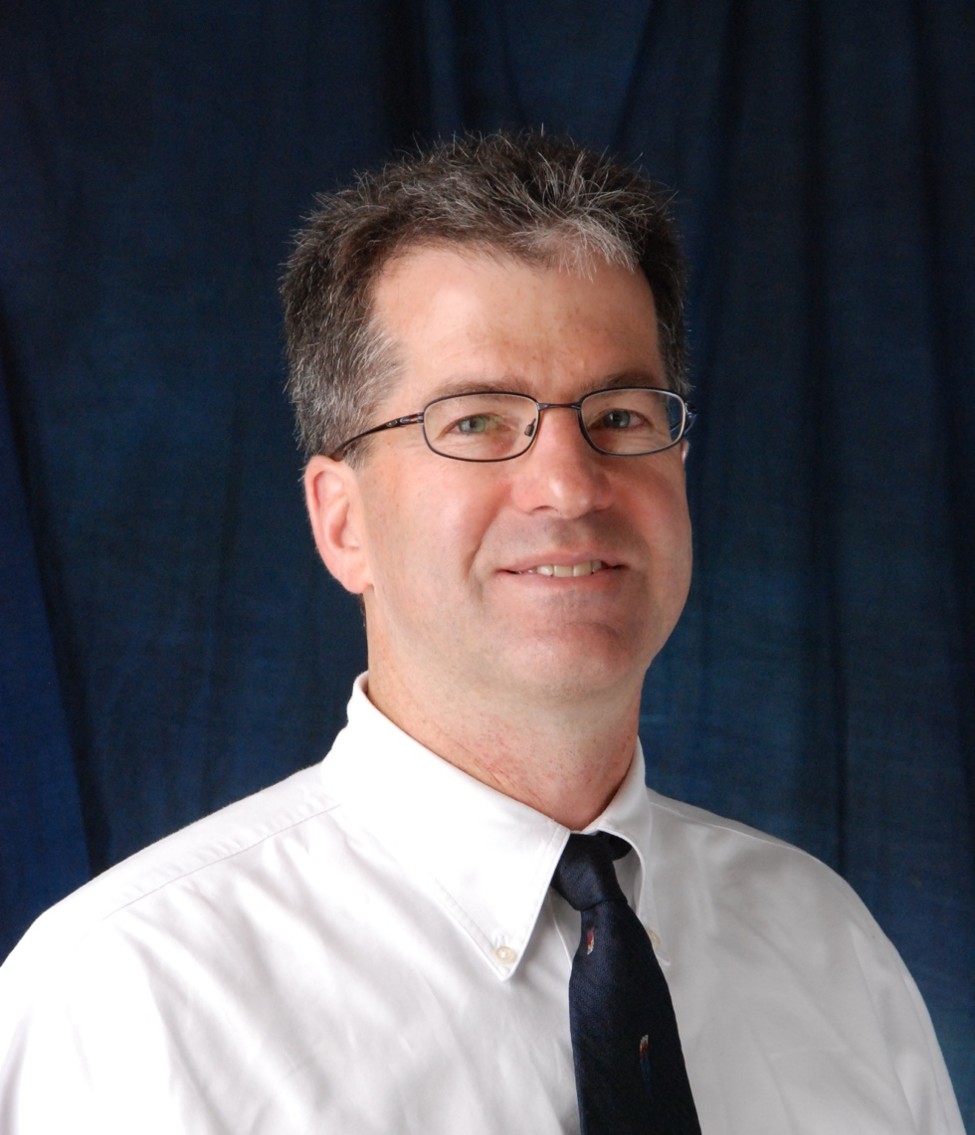 |
Paul F. Nealey is currently the Brady W. Dougan Family Professor in Molecular Engineering at the Pritzker School of Molecular Engineering of the University of Chicago, and a Senior Scientist at Argonne National Laboratory. His research interests include nanofabrication techniques based on advanced lithography and directed self-assembly, dimension dependent material properties of nanoscopic macromolecular systems, quantitative three-dimensional characterization of the structure and dynamics of soft materials, and transport in nanostructured polymers and membranes. He is a fellow of the American Physical Society and member of the National Academy of Engineering.
|
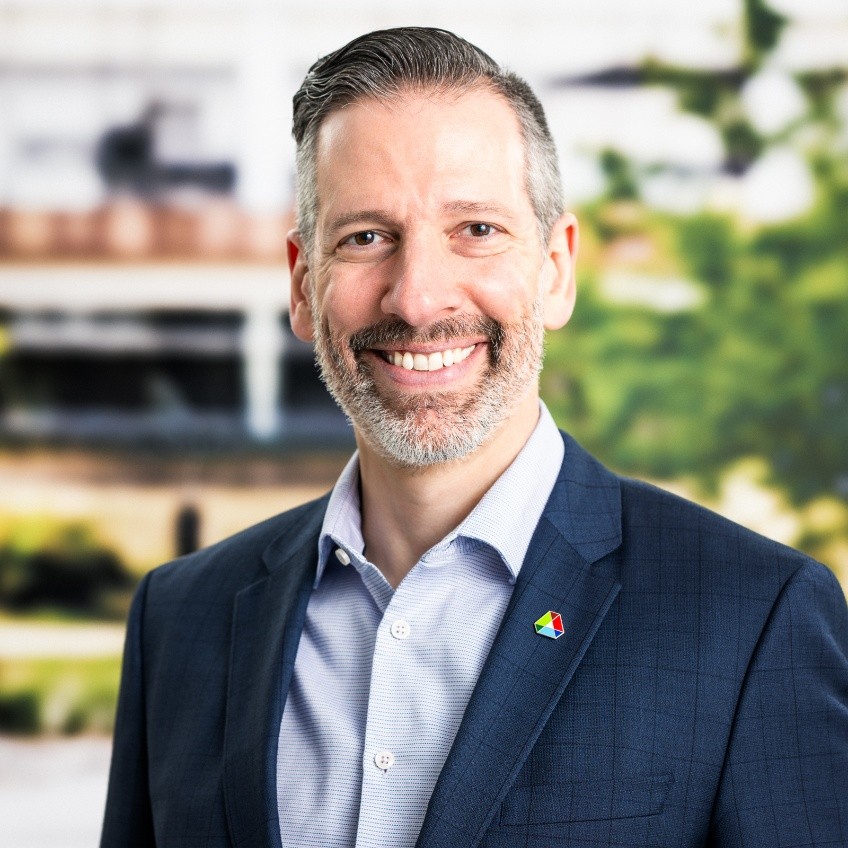 |
Seth Darling is an Argonne Distinguished Fellow in the Chemical Sciences & Engineering Division at the U.S. Department of Energy’s Argonne National Laboratory, where he has worked for over 20 years. He also serves as the Director of the Advanced Materials for Energy-Water Systems (AMEWS) Energy Frontier Research Center (EFRC) and is a Senior Scientist with the Pritzker School of Molecular Engineering at the University of Chicago. His group’s research centers around molecular engineering with a current emphasis on advanced chemistry and materials for cleaning and recovering critical resources from water.
|
Sharpening the cut: physical origins of rejection-curve broadening and routes to precision ultrafiltration
Jamila G. Eatman; Chaoqiuyu Wang; Paul F. Nealey; Seth B. Darling
Nanoscale Horiz. (2026). DOI: 10.1039/d6nh00362a
 |
Nanoscale Horizons is a leading journal for the publication of exceptionally high-quality, innovative nanoscience and nanotechnology. The journal places an emphasis on original research that demonstrates a new concept or a new way of thinking (a conceptual advance), rather than primarily reporting technological improvements. However, outstanding articles featuring truly breakthrough developments such as record performance alone may also be published in the journal. |


