Archive for April, 2024

Outstanding Paper Award 2023

Announcing our Nanoscale Horizons Outstanding Paper Award winners

Our annual Outstanding Paper Award recognises some of the exceptional work published in Nanoscale Horizons, and the authors behind those articles. The winners are chosen by the Editorial and Advisory Boards based on the science presented and the work’s potential future impact.

Discover our 2023 winners here

Please join us in congratulating the winners of the 2023 Outstanding Paper Award! We hope that you enjoy reading their outstanding articles as much as we did! Read more about the prize winners and their research in our Editorial. Our companion journal Materials Horizons has also announced its Outstanding Paper Award winners. You can read all of the Materials Horizons and Nanoscale Horizons 2023 Outstanding Papers in our online collection.

Explore the full collection

To be eligible to receive a Nanoscale Horizons Outstanding Paper Award you must have published an article in the journal in the previous calendar year. All submissions will be subject to initial assessment and peer review as appropriate according to the journal’s guidelines. We would be delighted if you would consider Nanoscale Horizons for your next exceptionally high-quality and innovative nanoscience and nanotechnology submission. Find out more about the journal and submit your work now!

Digg This
Reddit This
Stumble Now!
Share on Facebook
Bookmark this on Delicious
Share on LinkedIn
Bookmark this on Technorati
Post on Twitter
Google Buzz (aka. Google Reader)

Nanoscale Horizons Emerging Investigator Series – Baisheng Sa

Nanoscale Horizons Emerging Investigator Series

Congratulations to our latest Emerging Investigator Dr Baisheng Sa (Fuzhou University, China)!

Since the launch of Nanoscale Horizons, the journal has had a clear vision to publish exceptionally high-quality work whilst acting as a resource to researchers working at all career levels. We continue to be impressed by the quality of the research published and at the same time are looking for new ways of recognising and promoting the outstanding authors behind articles published in the journal.

We launched our Emerging Investigator Series to showcase the exceptional work published by early-career researchers in the journal and regularly select a recently published Communication article to feature in an interview-style Editorial article with the corresponding author. We hope that the series will also benefit the nanoscience community by highlighting the exciting work being done by its early-career members.

We are excited to share our latest Emerging Investigator, Dr Baisheng Sa (Fuzhou University, China)!

Photo of Baisheng Sa.


Dr Baisheng Sa received his B.Sc. (2008) in Materials Science and Engineering and Ph.D. (2014) in Materials Physics and Chemistry from Xiamen University. He is currently a professor in the School of Materials Science and Engineering at Fuzhou University. His research focuses on integrated computational modelling, density functional theory calculations and machine learning design of novel low-dimensional materials and van der Waals heterostructures for energy, environment, and electronic applications.


Read our interview with Baisheng here

Congratulations to Dr Baisheng Sa for his excellent work! You can read his featured Emerging Investigator article from Nanoscale Horizons below, which is free to access until the end of May 2024.

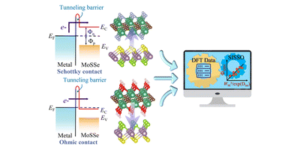
Graphical abstract image for Contact engineering for 2D Janus MoSSe/metal junctions.

Contact engineering for 2D Janus MoSSe/metal junctions
Yu Shu, Ting Li, Naihua Miao, Jian Gou, Xiaochun Huang, Zhou Cui, Rui Xiong, Cuilian Wen, Jian Zhou, Baisheng Sa and Zhimei Sun
Nanoscale Horiz., 2024, DOI: 10.1039/ D3NH00450C


We hope you enjoy reading our interview and featured article and are looking forward to sharing our future Emerging Investigators with you!

Do you publish innovative nanoscience and nanotechnology research? Submit your latest work to Nanoscale Horizons now. If you are eligible for the Emerging Investigators series, you could be considered to feature in one of our future interviews! Find out more about the eligibility criteria and the process in this editorial introducing the series.


Digg This
Reddit This
Stumble Now!
Share on Facebook
Bookmark this on Delicious
Share on LinkedIn
Bookmark this on Technorati
Post on Twitter
Google Buzz (aka. Google Reader)

In vitro nanomaterial testing: unveiling biases through biomolecular corona influence

Currently, nanomaterials (NM) are attracting significant attention in the field of biomedicine. However, once these nanomaterials are utilized for in vivo treatments they interact with the surrounding physiological environment, leading to the adsorption of various biomolecules onto their surfaces, forming a biomolecular corona (BMC) and thereby influencing the performance and behavior of the nanomaterials. Presently, the in vitro studies of NM primarily involve dispersing the nanoparticles in 10% fetal bovine serum (FBS) and then evaluating their toxicity and therapeutic effects. However, this evaluation method is insufficient as it cannot accurately simulate the conditions of human blood. Moreover, this practical issue remains unresolved to date.
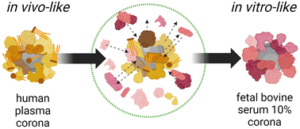
 

Yellow structure representing human plasma corona with the label in vivo like. Red structure representing fetal bovine serum 10% corona. In between these is a circle inside of which the yellow structure sits with components of the red structure being added.

Fig 1. Schematic illustrating the molecular and biological biases arising from the well-known in vitro/in vivo mismatch in nanomedicine due to the biomolecular corona. Reproduced from DOI: 10.1039/D3NH00510K with permission from the Royal Society of Chemistry.

To validate the series of biases existing in established experimental practices and to advance the fields of nanomedicine and nanotoxicology, this study investigated two NM types with vastly different physicochemical properties commonly used in biomedicine. The research compared the molecular and biological biases resulting from the mismatch between NM dispersed in 10% FBS (utilized for in vitro biological assays) and whole human plasma (HP, closer to in vivo administration schemes). Through comparative analysis using proteomics, lipidomics, high-throughput multi-parameter in vitro screening, and single-molecule feature analysis, it was demonstrated that the dynamic changes in BMC composition are material dependent and that cell viability, transport pathways, and autophagic cascades are influenced by the presence or absence of pre-formed BMC corona. These findings underscore the potential limitations of NM in vitro testing in accurately representing real in vivo conditions. Therefore, it is necessary to establish new shared protocols to enhance the accuracy and predictive capability of NM testing.

In summary, this study confirms the biases that may exist when using standard in vitro conditions for NM toxicology assessments, reminding us of the need to establish a comprehensive experimental framework to generate and support new knowledge in the field of biologically relevant nanomaterial interactions. For instance, integrating advanced predictive tools such as artificial intelligence and machine learning will enable nanotoxicology and nanomedicine to progress towards personalized solutions for precision healthcare.


To find out more, please read:

Sources of biases in the in vitro testing of nanomaterials: the role of the biomolecular corona
Valentina Castagnola, Valeria Tomati, Luca Boselli, Clarissa Braccia, Sergio Decherchi, Pier Paolo Pompa, Nicoletta Pedemonte, Fabio Benfenati and Andrea Armirotti
Nanoscale Horiz., 2024, Advance Article


About the blogger



Fangfang Cao is a Research Fellow at National University of Singapore and a member of the Nanoscale Horizons Community Board. Dr Cao’s research focuses on nanocatalytic medicine and microbial therapy.

Digg This
Reddit This
Stumble Now!
Share on Facebook
Bookmark this on Delicious
Share on LinkedIn
Bookmark this on Technorati
Post on Twitter
Google Buzz (aka. Google Reader)

Celebrating the 20th anniversary of NCNST

Celebrating the 20th anniversary of NCNST

Guest edited by Xinfeng Liu, Qing Dai, Zhixiang Wei, Chunying Chen and Yuliang Zhao


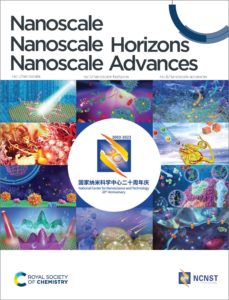
Cover for NCNST anniversary collection featuring some of the previous Nanoscale Horizons and Nanoscale covers from NCNST researchers over the last 20 years.


Last year we were delighted to celebrate the 20th anniversary of the National Center for Nanoscience and Technology (NCNST) with a special collection in Nanoscale Horizons, Nanoscale and Nanoscale Advances highlighting the breadth of high-quality work from the institute. We’re pleased to share this collection of research and reviews covering the most recent research progress in a wide spectrum of nanoscience and nanotechnology from researchers currently affiliated with NCNST as well as esteemed alumni.

You can explore the collection and read the introductory editorial from our guest editors below, with all articles free to access until the end of April 2024.

Read the collection

Professor Xinfeng Liu, Professor Qing Dai, Professor Zhixiang Wei, Professor Chunying Chen and Professor Yuliang Zhao served as guest editors for this collection and highlight the history of NCNST and significance of this anniversary in their introductory editorial.

Photos of Xinfeng Liu, Qing Dai, Zhixiang Wei, Chunying Chen and Yuliang Zhao.

Read the introductory editorial

All of the articles in the collection are free to access until the end of April 2024. Read some of the featured articles below.

Reviews

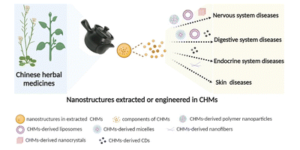
Graphical abstract image for Nanostructures in Chinese herbal medicines (CHMs) for potential therapy.

Nanostructures in Chinese herbal medicines (CHMs) for potential therapy
Ya-Li Zhang, Ya-Lei Wang, Ke Yan, Qi-Qi Deng, Fang-Zhou Li, Xing-Jie Liang and Qian Hua
Nanoscale Horiz., 2023, DOI: 10.1039/D3NH00120B


Graphical abstract image for Strategies and applications of generating spin polarization in organic semiconductors.

Strategies and applications of generating spin polarization in organic semiconductors
Ke Meng, Lidan Guo and Xiangnan Sun
Nanoscale Horiz., 2023, DOI: 10.1039/D3NH00101F


Communications

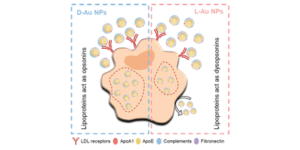
Graphical abstract image for Stereoselective coronas regulate the fate of chiral gold nanoparticles in vivo.

Stereoselective coronas regulate the fate of chiral gold nanoparticles in vivo
Didar Baimanov, Liming Wang, Ke Liu, Mengmeng Pan, Rui Cai, Hao Yuan, Wanxia Huang, Qingxi Yuan, Yunlong Zhou, Chunying Chen and Yuliang Zhao
Nanoscale Horiz., 2023, DOI: 10.1039/D3NH00124E


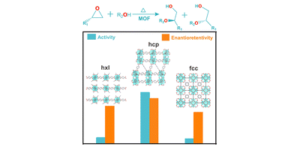
Graphical abstract image for Modulation of the assembly fashion among metal–organic frameworks for enantioretentive epoxide activation.

Modulation of the assembly fashion among metal–organic frameworks for enantioretentive epoxide activation
Jun Guo, Xiaomin Xue, Fangfang Li, Meiting Zhao, Youcong Xing, Yanmin Song, Chang Long, Tingting Zhao, Yi Liu and Zhiyong Tang
Nanoscale Horiz., 2024, DOI: 10.1039/D3NH00419H


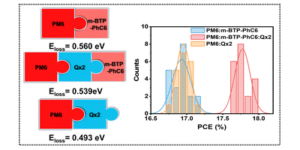
Graphical abstract image for Improving the efficiency of ternary organic solar cells by reducing energy loss.

Improving the efficiency of ternary organic solar cells by reducing energy loss
Mengni Wang, Yanan Shi, Ziqi Zhang, Yifan Shen, Min Lv, Yangjun Yan, Huiqion Zhou, Jianqi Zhang, Kun Lv, Yajie Zhang, Hailin Peng and Zhixiang Wei
Nanoscale Horiz., 2023, DOI: 10.1039/D3NH00122A


Nanoscale Horizons and Nanoscale are high-impact international journals, publishing high-quality experimental and theoretical work across the breadth of nanoscience and nanotechnology. Nanoscale Advances is our gold open access member of the nanoscale journal family. Our broad scope covers cross-community research that bridges various disciplines, and the journal series allows full coverage of interdisciplinary advances in nanoscience and nanotechnology. We hope you will consider Nanoscale Horizons, Nanoscale and Nanoscale Advances for your future submissions.

We hope you enjoy reading this collection and look forward to showcasing more work from NCNST in the future. Please continue to submit your exciting work to Nanoscale Horizons, Nanoscale and Nanoscale Advances.

Digg This
Reddit This
Stumble Now!
Share on Facebook
Bookmark this on Delicious
Share on LinkedIn
Bookmark this on Technorati
Post on Twitter
Google Buzz (aka. Google Reader)