



Nanoscale Horizons is a leading journal for the publication of exceptionally high-quality, innovative nanoscience and nanotechnology. To celebrate the excellent articles that are published in the journal, we asked some of our authors to discuss their research in more detail.
In this post, we hear from Dr Jake McClements from Newcastle University, UK, as they discuss their recent article, ‘Unlocking interstitial fluid for acute coronary syndrome diagnosis: ultrasensitive troponin I detection using imprinted polymer nanoparticles‘.
An introduction from Jake McClements
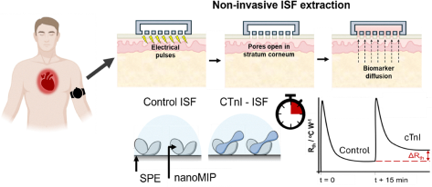
Acute coronary syndrome (ACS), including heart attacks, is usually diagnosed by measuring cardiac troponin I (cTnI) in a blood sample. However, this relies on venous blood collection, sample processing, and laboratory analysis, which can take several hours; a serious problem when faster diagnosis and treatment can save lives. In this study, we asked whether interstitial fluid (ISF), the fluid that surrounds the body’s tissue cells and can be accessed just beneath the skin, could offer a less invasive alternative to blood for this type of testing.
Working with collaborators across Newcastle University, the University of Manchester, Manchester Metropolitan University, Tozaro, and Kiffik Biomedical, we analysed human ISF samples collected using KIFFIK’s non-invasive, electroporation-based extraction technology. To create a rapid testing platform, we combined molecularly imprinted polymer nanoparticles (nanoMIPs), which act as synthetic, antibody-mimicking recognition elements, with a heat-transfer sensing method. This enabled us to detect cTnI in spiked human ISF samples for the first time, achieving a detection limit of 1.85 pg/mL in a 15–20-minute assay using just 120 µL of sample. Encouragingly, when we repeated the experiments in spiked serum and plasma, we obtained very similar results, suggesting that ISF performs comparably to traditional blood-derived fluids for this purpose.
What excites me most about this work is its potential for point-of-care diagnostics. NanoMIPs do not require refrigeration and have a longer shelf life than antibodies, while the heat-transfer method itself requires no labels, redox probes, or large-scale instrumentation. Paired with a wearable, non-invasive ISF extraction device, this type of platform could eventually support rapid chest-pain triage in ambulances or A&E departments without venous blood draws. There is still work to do, particularly in confirming endogenous, rather than spiked, cTnI levels in human ISF and validating selectivity directly in this matrix. However, for us, the most exciting message is that ISF should no longer be viewed as a difficult or niche sample type, but as a promising diagnostic medium that could help bring rapid biomarker testing closer to patients, not only for cardiac conditions but much more broadly.
Meet the author
 |
Dr Jake McClements is a Newcastle University Academic Track (NUAcT) Fellow in Ageing and Health, based in the School of Engineering. He obtained his PhD in Materials Engineering from the University of Edinburgh in 2019, where his research explored the interfacial behaviour of polymers at surfaces across multiple length scales. After a one-year postdoctoral position in the same department at Edinburgh, in collaboration with Michelin, he moved to Chemical Engineering at Newcastle University in 2020 to take up a postdoctoral role developing polymer-based diagnostics for cardiovascular conditions.
In 2024, he was awarded a NUAcT Fellowship at Newcastle. His research group develops polymeric recognition elements and associated sensors for a range of diagnostic and industrial applications, with a particular focus on next-generation wearable and point-of-care devices that use minimally invasive sampling methods, such as interstitial fluid extraction. Beyond research, he also serves as an Editor for the Elsevier journal Sustainable Materials and Technologies. Find out more about Dr McClements’ research group here. |
Unlocking interstitial fluid for acute coronary syndrome diagnosis: ultrasensitive troponin I detection using imprinted polymer nanoparticles
Joshua Saczek, Amy Dann, Robert D. Crapnell, Craig E. Banks, Rhiannon E. Johnson, Francesco Canfarotta, Joanna Czulak, Alan Thomson, Azfar Zaman, Ioakim Spyridopoulos, Katarina Novakovic, Marloes Peeters and Jake McClements
Nanoscale Horiz. (2026) 11 (3): 803–816. DOI: 10.1039/d5nh00441a
 |
Nanoscale Horizons is a leading journal for the publication of exceptionally high-quality, innovative nanoscience and nanotechnology. The journal places an emphasis on original research that demonstrates a new concept or a new way of thinking (a conceptual advance), rather than primarily reporting technological improvements. However, outstanding articles featuring truly breakthrough developments such as record performance alone may also be published in the journal. |


