New Editorial Board Member: Katye Altieri

We are very pleased to announce that Katye Alteri has joined the ESPI Editorial Board!

Katye Altieri is a Senior Lecturer in the Oceanography Department at the University of Cape Town. Katye has a B.Sc. in Chemistry (2004; College of New Jersey) and a Ph.D. in Oceanography (2009; Rutgers University). She was a NOAA Climate and Global Change Postdoctoral Fellow for two years and then spent another two years as a Postdoctoral Research Associate, jointly appointed at Princeton University and Brown University. After her postdoctoral time, she pursued a Masters in Public Policy at the Woodrow Wilson School of Public and International Affairs at Princeton University (2014).

Katye received the Claude Leon Merit Award in 2017 and the Peter B. Wagner Award for Women in Atmospheric Sciences in 2008.

Her current research interests include: air pollution in coastal cities, the impact of human activities on surface ocean biogeochemistry, and studying the remote marine atmosphere of the Southern Ocean as a proxy to understand more about atmospheric chemistry and climate during the preindustrial.

Katye says “I am excited to join the Editorial Board of ESPI and I look forward to continuing the great tradition of high quality research and strong community that exists at ESPI.”

Digg This
Reddit This
Stumble Now!
Share on Facebook
Bookmark this on Delicious
Share on LinkedIn
Bookmark this on Technorati
Post on Twitter
Google Buzz (aka. Google Reader)

New Editorial Board Member: Mingliang (Thomas) Fang


We are pleased to announce that Mingliang (Thomas) Fang has joined the Environmental Science: Processes & Impacts Editorial Board.

Mingliang (Thomas) Fang is currently an Assistant Professor in School of Civil and Environmental Engineering at Nanyang Technological University, Singapore. Prior to that, he studied his PhD degree majoring in environmental chemistry and toxicology at Duke University and received metabolomics training in The Scripps Research Institute. His previous research experience primarily includes applications of mass spectrometry methods to identify emerging organic contaminants, measure human exposure, and assess potential health effects. He is also interested in investigating emerging organic contaminants using in vivo and in vitro bioassays and omic technologies to conduct risk assessment and identify toxicity mechanisms.


Read his recent work in our sister journal, Environmental Science: Nano:
A high-throughput method to characterize the gut bacteria growth upon engineered nanomaterial treatment
Qin Yang, Tharushi Prabha Keerthisinghe, Tiffany Rou Jie Tan, Xiaoqiong Cao, Magdiel Inggrid Setyawati, Glen DeLoid, Kee Woei Ng, Say Chye Joachim Loo, Philip Demokritoucd and Mingliang Fang*
https://doi.org/10.1039/D0EN00568A


Digg This
Reddit This
Stumble Now!
Share on Facebook
Bookmark this on Delicious
Share on LinkedIn
Bookmark this on Technorati
Post on Twitter
Google Buzz (aka. Google Reader)

New Editorial Board Member: Weihua Song

We are delighted to announce that Weihua Song has joined the Environmental Science: Processes & Impacts Editorial Board!

Weihua is currently a full professor of Department of Environmental Science and Engineering at Fudan University. He received a B.S. in Environmental Chemistry and M.S. in Environmental Engineering from Nanjing University in 1999 and 2002. He completed his Ph.D. with Professor Kevin E. O’Shea at Florida International University in 2006. He was a postdoctoral fellow, working with Prof. William J. Cooper at University of California, Irvine from 2007 to 2010. His research interests are in the area of Environmental Chemistry. Particularly, he focuses on the occurrence, transformation, and fate of emerging contaminants in aqueous environments.

Read his work in our sister journal, Environmental Science: Nano:
Effects of ozone and produced hydroxyl radicals on the transformation of graphene oxide in aqueous media
Tingting Du, Adeyemi S. Adeleye,  Tong Zhang, Nan Yang, Rongjie Hao, Yao Li,* Weihua Song and Wei Chen*
https://doi.org/10.1039/C9EN00361D

Digg This
Reddit This
Stumble Now!
Share on Facebook
Bookmark this on Delicious
Share on LinkedIn
Bookmark this on Technorati
Post on Twitter
Google Buzz (aka. Google Reader)

New Editorial Board Member: Amila De Silva

We are delighted to announce that Amila De Silva has joined the Environmental Science: Processes & Impacts Editorial Board!

Amila De Silva is a research scientist in the Government of Canada in the Water Science Technology Directorate located in Burlington, Ontario. She received her PhD in environmental chemistry from the University of Toronto in 2008. Her expertise areas are fate, transport and disposition of organic contaminants in the environment. In addition to the discovery of new contaminants with advanced analytical chemistry, Amila uses a combination of field and lab experiments to discern their ecological risk based on persistence, bioaccumulation, toxicity and long range transport potential. Amila holds adjunct Professor appointments at the University of Toronto and Memorial University.

Read her work in the journal:
Emerging investigator series: a 14-year depositional ice record of perfluoroalkyl substances in the High Arctic
John J. MacInnis, Katherine French, Derek C. G. Muir, Christine Spencer, Alison Criscitiello, Amila O. De Silva* and Cora J. Young*
https://doi.org/10.1039/C6EM00593D

Digg This
Reddit This
Stumble Now!
Share on Facebook
Bookmark this on Delicious
Share on LinkedIn
Bookmark this on Technorati
Post on Twitter
Google Buzz (aka. Google Reader)

Latest HOT, Review and Open Access content from ESPI

We are delighted to share with you a hand-picked selection of papers recently published in Environmental Science: Processes & Impacts (ESPI).

HOT papers – as recommended by our Editors & Reviewers

Interactions of emerging contaminants with model colloidal microplastics, C60 fullerene, and natural organic matter – effect of surface functional group and adsorbate properties
Tyler Williams et al

Biodegradation kinetics testing of two hydrophobic UVCBs – potential for substrate toxicity supports testing at low concentrations
Rikke Hammershøj et al

An emerging mobile air pollution source: outdoor plastic liner manufacturing sites discharge VOCs into urban and rural areas
Seyedeh Mahboobeh Teimouri Sendesi et al

Read more HOT papers at rsc.li/espi-hot

Reviews & Perspectives – timely overviews of key topics in environmental science

A review of aerosol chemistry in Asia: insights from aerosol mass spectrometer measurements
Wei Zhou et al

Passive air sampling for semi-volatile organic chemicals (Open Access)
Frank Wania and Chubashini Shunthirasingham

Effects of aging and weathering on immobilization of trace metals/metalloids in soils amended with biochar
Yuchi Zhong et al

Read more Reviews at rsc.li/espi-reviews

Open Access – read for free!

An overview of the uses of per- and polyfluoroalkyl substances (PFAS)
Juliane Glüge et al

The importance of aromaticity to describe the interactions of organic matter with carbonaceous materials depends on molecular weight and sorbent geometry
Stephanie Castan et al

The ecological half-life of radiocesium in surficial bottom sediments of five ponds in Fukushima based on in situ measurements with plastic scintillation fibers
Estiner Walusungu Katengeza et al

Read more Open Access content at rsc.li/espi-oa

**************************************************

We hope you enjoy reading these papers, and we welcome your future submissions to the journal.

Submit to Environmental Science: Processes & Impacts

Digg This
Reddit This
Stumble Now!
Share on Facebook
Bookmark this on Delicious
Share on LinkedIn
Bookmark this on Technorati
Post on Twitter
Google Buzz (aka. Google Reader)

Cryosphere chemistry – Themed Collection in ESPI

We are delighted to highlight some of the latest cryosphere chemistry studies published in Environmental Science: Processes & Impacts.

This themed collection, Guest Edited by Rose Cory and Kerri Pratt (University of Michigan), showcases studies on chemical processes in sea ice, snow, glaciers, ice sheets and permafrost soils. This includes atmospheric chemistry (atmospheric aerosols and trace gases) biogeochemistry (chemical weathering and organic matter chemistry) as well as laboratory, field and modeling studies.

"This ESPI collection includes results of recent laboratory and field studies of the interactions between the snow, ice and overlying atmosphere" - Guest Editor Kerri Pratt, University of Michigan

Atmospheric chemistry is understudied in the Cryosphere, cold regions of the Earth that are seasonally or continually covered with snow and ice, yet these regions represent areas of significant climate change. Snow and sea ice are sources and sinks of atmospheric trace gases and aerosols, with impacts on surface albedo, cloud formation and properties, air quality, and meltwater. The critical need to understand air-ice interactions in these cold regions is exemplified by the emerging international activity The Cryosphere and Atmospheric Chemistry (CATCH), supported by IGAC and SOLAS, which aims to facilitate atmospheric chemistry research within the international community, with a focus on natural processes specific to cold regions of the Earth. This ESPI collection includes results of recent laboratory and field studies of the interactions between the snow, ice, and overlying atmosphere, described by Kirpes et al., Ruggeri et al., Hullar et al., and Hara et al.

An outstanding CATCH question surrounds the locations, kinetics, and mechanisms of reactions on and within snow grains, as this knowledge is required to understand and simulate air-ice interactions. Hullar et al. present a laboratory study of the photodegradation of guaiacol in solution, ice, and at the air-ice interface, showing that photodegradation rate is faster within liquid-like regions in ice and especially at the air-ice interface and therefore cannot be approximated by bulk solutions. This work further demonstrates the uniqueness of reactions occurring on snow and ice surfaces in cold regions and the need for future study, both in the field and through fundamental laboratory studies.

Photodecay of guaiacol is faster in ice, and even more rapid on ice, than in aqueous solution
Ted Hullar et al.
https://doi.org/10.1039/D0EM00242A

The cryosphere contains about twice the amount of carbon found in our atmosphere, in the form of organic carbon locked away in a deep freeze in permafrost soils (perennially frozen ground).  As permafrost soils warm and thaw, the organic carbon in these soils decomposes into the greenhouse gases carbon dioxide (CO2) and methane (CH4).  Release of CO2 and CH4 from thawed permafrost soils will raise global temperatures beyond what our fossil-fuel-based carbon emissions would do on their own.  For example, current models predict a loss of permafrost that could raise global temperatures by an additional 0.3 to 0.4 °C by 2100; a feedback called Arctic Amplification of climate change.

"The papers in this special issue help reduce uncertainties by studying processes that decompose permafrost organic carbon to CO2 or CH4" - Guest Editor Rose Cory, University of Michigan

However, there is much uncertainty in these models because the processes that control the decomposition of permafrost organic carbon to CO2 and CH4 remain poorly understood. The papers in this collection help to reduce uncertainties by studying processes that decompose permafrost organic carbon to CO2 or CH4.  For example, in thawed soils, microbially-mediated redox reactions convert organic carbon to CO2 or CH4.  These redox reactions depend on the availability of electron donors and acceptors in soils, which in turn, vary by landscape position and hydrology (Philben et al.).  Redox reactions in permafrost soils also control the availability of nutrients like phosphorous, that in turn will help regulate the potential of these soils to store or release carbon as they thaw (Herndon et al.).

As permafrost soils thaw, organic carbon in the soil dissolves and flows into the many lakes across the Arctic landscape.  As evidence mounts that arctic lakes are strong sources of greenhouse gases from the cryosphere to the atmosphere, more questions emerge about the timing and drivers of these gas fluxes.  The paper by Eugster et al. is the first to show that while gas fluxes vary during the ice-free season and across years, no large episodic events associated with spring ice-off or other mixing events occurred over 6 years of continuous eddy flux measurements in a deep arctic lake. However, that may change in the future, as more permafrost organic carbon flows into lakes.

Gagne et al. showed that permafrost organic carbon is rapidly converted to CO2 once exposed to sunlight.  Exposure of permafrost organic carbon to sunlight in lakes is inevitable as permafrost soils thaw and export this ancient carbon into increasingly ice-free waters.  And, Ward and Cory show that our concerns don’t stop with the complete oxidation to CO2.  Soil organic carbon is also partially oxidized by sunlight, which in turn controls its susceptibility to complete oxidation to CO2.

Composition and photo-reactivity of organic matter from permafrost soils and surface waters in interior Alaska
Kristin R. Gagné et al.
https://doi.org/10.1039/D0EM00097C

Finally, the interactions between permafrost soils and receiving lakes are featured in a synthesis paper by Burpee and Saros, highlighting key knowledge gaps on the feedbacks between loss of the cryosphere on land and in water.

With permafrost loss already under way across the Arctic, we need more research in this area of cryosphere chemistry to predict the Arctic Amplification of climate change and impacts on society. A 2016 Scientific American article by John Berger summarized it best: “The faster these gases emerge from the permafrost, the less carbon human society can release and still keep global temperatures from rising far above the aspirational temperature targets set by the Paris accord.”

Digg This
Reddit This
Stumble Now!
Share on Facebook
Bookmark this on Delicious
Share on LinkedIn
Bookmark this on Technorati
Post on Twitter
Google Buzz (aka. Google Reader)

Latest HOT, Review and Open Access content from ESPI


We are delighted to share with you a hand-picked selection of papers recently published in Environmental Science: Processes & Impacts (ESPI).

HOT papers – as recommended by our referees

A global atmospheric chemistry model for the fate and transport of PFCAs and their precursors
Colin P. Thackray et al.

Trichloroacetyl chloride, CCl3COCl, as an alternative Cl atom precursor for laboratory use and determination of Cl atom rate coefficients for n-CH2=CH(CH2)xCN (x = 3–4)
Sofie Askjær Hass et al.

Geochemical and isotope analysis of produced water from the Utica/Point Pleasant Shale, Appalachian Basin
T.L. Tasker et al.

Read more HOT papers at rsc.li/espi-hot

Reviews & Perspectives – timely overviews of key topics in environmental science

Quantifying the efficiency and selectivity of organohalide dechlorination by zerovalent iron
Feng He and Paul G. Tratnyek et al.

Potential risks of antibiotic resistant bacteria and genes in bioremediation of petroleum hydrocarbon contaminated soils
Maria S. Kuyukina et al.

How the 2010 Deepwater Horizon spill reshaped our understanding of crude oil photochemical weathering at sea: a past, present, and future perspective
Collin P. Ward and Edward B. Overton

Read more Reviews at rsc.li/espi-reviews

Open Access – read for free!

A geospatially resolved database of hydraulic fracturing wells for chemical transformation assessment
Andrew J. Sumner and Desiree L. Plata

Comparing non-targeted chemical persistence assessed using an unspiked OECD 309 test to field measurements
Zhe Li and Michael S. McLachlan

The importance of aromaticity to describe the interactions of organic matter with carbonaceous materials depends on molecular weight and sorbent geometry
Thilo Hofmann et al.

Read more Open Access content at rsc.li/espi-oa

Sign up for alerts       Themed Issues       Emerging Investigators       Submit


About ESPI
Published on a not-for-profit basis by the Royal Society of Chemistry and led by Editor-in-Chief Professor Kris McNeill (ETH Zurich), ESPI publishes high quality papers in all areas of the environmental chemical sciences, including chemistry of the air, water, soil and sediment. With a team of expert Associate Editors providing a first decision on submissions in just 38 days*, ESPI is committed to providing you with efficient and attentive service throughout the publication process. Furthermore, our flexible article types with no page or word count restrictions allow you to disseminate your research in a format that best suits you. More about the journal can be found at rsc.li/espi

Meet the ESPI team


*Average time from receipt to first decision for peer reviewed manuscripts in 2019

Find out more about the advantages of publishing in a Royal Society of Chemistry journal including our Open Access options

ESPI is complemented by our sister journals, Environmental Science: Nano, Environmental Science: Water Research & Technology and Environmental Science: Atmospheres; find out more about the these journals at rsc.li/envsci


Digg This
Reddit This
Stumble Now!
Share on Facebook
Bookmark this on Delicious
Share on LinkedIn
Bookmark this on Technorati
Post on Twitter
Google Buzz (aka. Google Reader)

Why publish with ESPI?


Environmental Science: Processes & Impacts (ESPI) publishes high quality papers in all areas of the environmental chemical sciences, including chemistry of the air, water, soil and sediment.

Submit to ESPI and benefit from:

  • Broad readership: our global audience provides maximum exposure for your work
  • Rapid times to publication – our average time to decision for peer-reviewed manuscripts is just 38 days†
  • Expert Associate Editors (Marianne Glasius, Helen Hsu-Kim, Ed Kolodziej, Matthew MacLeod, Desiree Plata and Paul Tratnyek) handling the peer review of submissions
  • Flexible articles types with no word count restrictions or colour charges
  • Green and Gold Open Access options
  • Publicity on twitter for featured articles
  • Not-for-profit publisher: The Royal Society of Chemistry is committed to supporting the global scientific community by investing into our charitable activities, such as education, outreach, and science policy
  • Opportunities for early-career researchers to be featured in our Emerging Investigator Series


Discover the latest high-quality research published in ESPI by browsing our Best Papers of 2019

For the latest journal updates sign up to receive journal news and issue alerts

Click here to return to the journal homepage

†Average time from receipt to first decision for peer reviewed manuscripts in Q1 2020

ESPI is complemented by our sister journals, Environmental Science: Nano, and Environmental Science: Water Research & Technology; find out more about the these journals at rsc.li/envsci

Digg This
Reddit This
Stumble Now!
Share on Facebook
Bookmark this on Delicious
Share on LinkedIn
Bookmark this on Technorati
Post on Twitter
Google Buzz (aka. Google Reader)

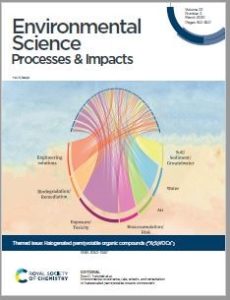
Halogenated (semi)volatile organic compounds – Themed Issue in ESPI

In March 2020 Environmental Science: Processes & Impacts published a special issue on Halogenated (semi)volatile organic compounds (“X(S)VOCs”).

Guest Edited by Elizabeth Edwards (University of Toronto), Lucy Carpenter (University of York), Sarah Blossom (University Arkansas Medical Science) and ESPI Associate Editor Paul Tratnyek (Oregon Health & Science University) this Themed Issue features research and reviews on chlorinated solvents, their metabolites, disinfection byproducts, and their environmental occurrence, fate, effects, and remediation. You can read the Editorial introducing this issue here.


Read the full issue at rsc.li/halocarbons

Below is a small selection of some of the articles featured in this issue:

Retrospective on microbial transformations of halogenated organics
L. McCarty, C. S. Criddle and T. M. Vogel

Placenta as a target of trichloroethylene toxicity
Elana R. Elkin, Sean M. Harris, Anthony L. Su, Lawrence H. Lash and Rita Loch-Caruso

Quantifying the efficiency and selectivity of organohalide dechlorination by zerovalent iron
Feng He, Li Gong, Dimin Fan, Paul G. Tratnyek and Gregory V. Lowry

Natural and anthropogenic sources of bromoform and dibromomethane in the oceanographic and biogeochemical regime of the subtropical North East Atlantic
Melina Mehlmann, Birgit Quack, Elliot Atlas, Helmke Hepach and Susann Tegtmeier

Diverse dechlorinators and dechlorination genes enriched through amendment of chlorinated natural organic matter fractions
Hanna R. Temme and Paige J. Novak

Summation of disinfection by-product CHO cell relative toxicity indices: sampling bias, uncertainty, and a path forward
Elizabeth McKenna, Kyle A. Thompson, Lizbeth Taylor-Edmonds, Daniel L. McCurry and David Hanigan

Comparison of modeled and measured indoor air trichloroethene (TCE) concentrations at a vapor intrusion site: influence of wind, temperature, and building characteristics
Elham Shirazi, Gregory S. Hawk, Chase W. Holton, Arnold J. Stromberg and Kelly G. Pennell

We hope that you enjoy reading the great research featured in this issue.

Digg This
Reddit This
Stumble Now!
Share on Facebook
Bookmark this on Delicious
Share on LinkedIn
Bookmark this on Technorati
Post on Twitter
Google Buzz (aka. Google Reader)

Emerging Investigator Series: Garrett McKay

Dr. Garrett McKay joined the Zachary Department of Civil & Environmental Engineering at Texas A&M University in September 2019 as an assistant professor. Dr. McKay’s research focuses on the fundamental chemistry occurring in natural and engineered systems, including aquatic photochemistry, dissolved organic matter characterization, and treatment of emerging contaminants.  After graduating with his BA and MS in chemistry at California State University Long Beach, Dr. McKay completed a PhD in Environmental Engineering in 2017 at CU Boulder. Dr. McKay is looking forward to contributing to the growing Environmental Engineering program at A&M by sharing his passion for chemistry with undergraduate and graduate students through his teaching and research.

Read Garrett McKay’s Emerging Investigator Series article “Critical review of photophysical models for the optical and photochemical properties of dissolved organic matter” and read more about his in the interview below:

Your recent Emerging Investigator Series paper focuses on a Critical review of photophysical models for the optical and photochemical properties of dissolved organic matter. How has your research evolved from your first article to this most recent article?

During my PhD, my research mostly focused on the formation of reactive oxidants during light absorption by organic matter, which is one way that organic matter dissipates the energy of absorbed photons.  As our studies progressed in this area, they revealed that there was a need to investigate how it is that organic matter absorbs and emits light in the first place. 

What aspect of your work are you most excited about at the moment?

We have just started synthesizing some quinone-hydroquinone complexes to test whether these model systems exhibit optical properties similar to dissolved organic matter.  We are looking forward to getting back in the lab, when it is safe to do so due to SARS-CoV-2, and performing some reactions on these complexes.

In your opinion, what are the most important questions to be asked/answered in this field of research?

The three-dimensional structure of organic matter is really important for a lot of processes, not just light absorption and photochemistry, such as pollutant sorption.  Knowing more specific details about organic matter’s three-dimensional structure (e.g., hydrophobic surface area, whether the structure is static or dynamic) will help address some of the knowledge gaps identified in this review.

What do you find most challenging about your research?

The biggest challenge is the complexity of dissolved organic matter, which really hinders obtaining a molecule-by-molecule understanding of the material.  Fortunately, this complexity is also fascinating to me.

In which upcoming conferences or events may our readers meet you?

The International Humic Substances Society biennial conference is scheduled for August in Estes Park, CO in August, which I am planning to attend.  I am usually at the spring ACS meeting each year to participate in the Aquatic Photochemistry session in the Division of Environmental Chemistry.

How do you spend your spare time?

I enjoy spending time with my wife and playing with our 10 month old son. When I have spare time I try to get out for a run or round of golf.

Which profession would you choose if you were not a scientist?

Potentially an attorney.  I think I would like the analytical nature of their work.

Can you share one piece of career-related advice or wisdom with other early career scientists?

Invest the time to develop a fundamental understanding of what you are studying, whether it is a new experimental or analytical technique, fundamental concept, or data analysis tool.  With the pressure of getting research “done,” it can be tempting to gloss over details.  Taking the time dig deeper is beneficial in the long-run.

Digg This
Reddit This
Stumble Now!
Share on Facebook
Bookmark this on Delicious
Share on LinkedIn
Bookmark this on Technorati
Post on Twitter
Google Buzz (aka. Google Reader)