Archive for August, 2015

Going deep: investigating the physical and chemical properties of humic substances in groundwater

Humic substances play an important role in the speciation of metal ions in the aquatic environment. Understanding these processes is important to ensure the safety of drinking water. In this study, Japanese researchers reveal how physiochemical properties and ion-binding behaviour of HSs can differ between surface water and groundwater environments.

Groundwater constitutes the largest reservoir of freshwater in the world, accounting for over 97% (excluding glaciers and ice caps) of all available freshwater on the planet. It is estimated that about 75% of EU inhabitants depend on groundwater for their water supply. Groundwater also plays an integral role in the hydrological cycle, crucial to the maintenance of wetlands and river flows. Maintaining the quality of groundwater resources is therefore of major environmental, social and economic importance. This requires a good understanding of the physical and chemical processes that may influence groundwater environments.

For future use of deep underground space it is necessary to monitor and protect the quality of deep groundwater. The World Health Organisation (WHO) acknowledges the importance of groundwater resources and the potential risks that poor quality groundwater can cause to human health. Indeed, the WHO has produced a guidance document, “analysing hazards to groundwater quality, assessing the risk they may cause for a specific supply, setting priorities in addressing these, and developing management strategies for their control.”

Humic substances (HSs) are a class of natural organic molecules, ubiquitous in various environments including surface and ground water, oceans, soils, and the atmosphere. HSs are known to play an important role in freshwater systems. For example HSs can effectively capture inorganic and organic contaminants due to the tendency of protons and metal ions to readily bind to the functional groups of HS ligands e.g., carboxylic and phenolic groups and to a lesser extent amine- and sulphur-containing groups. This process can therefore alter the reactivity, bioavailability, and mobility of chemical constituents in fresh water.

The physical and chemical nature of HSs is likely to differ between deep underground and surface aquatic systems, due to slower water movement and more prolonged contact with underlying rocks and dissolved/suspended components, low oxygen, and lack of sunlight. However, while some characteristics of groundwater HSs are understood, their ion binding properties over a wide range of conditions is largely unknown. Given that in many areas, deep underground space may be used in the future for such uses as geological disposal of nuclear wastes, the potential deterioration of groundwater quality, the ion binding properties of deep groundwater HSs need to be studied carefully, and mechanistic models developed to describe these processes.
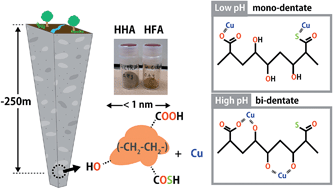
This study by Takumi Saito and co-workers investigates the physicochemical and binding properties of HSs isolated from deep groundwater in a sedimentary rock formation in the Horonobe Underground Research Laboratory of the Japan Atomic Energy Agency (JAEA). Binding isotherms of protons (H+) and copper (Cu2+) were measured over a wide range of conditions by potentiometric titration and were fitted to the NICA-Donnan model and the obtained parameters were compared with average parameters for HSs from surface environments. The oxidation state and local coordination environment of Cu2+ bound to the HA fraction of the HSs were also assessed by X-ray absorption spectroscopy (XAS).

The results clearly indicate distinctive physical and chemical characteristics for the HSs from surface and groundwater environments. It is found that the deep ground HSs were characterised by high aliphaticity and sulphur (S) content and relatively small sizes. Differences in the binding behaviours of H+ and Cu2+ with the HSs in deepwater and surface water were also observed.

The authors discuss the differences in chemical binding behaviour with reference to the unique chemical nature of the functional groups of groundwater HSs compared with those of surface waters and how the binding sites and binding mode can change with changes in conditions (e.g. pH). X-ray absorption spectroscopy also revealed that Cu2+ binds to O/N containing functional groups and to a lesser extent S containing functional groups.

The study therefore demonstrates how HSs could influence freshwater resources differently in deep-ground and surface environments. Although the HSs in this study were derived from a single groundwater source, the authors suggest the outcomes can be applied or be a good starting point to estimate the degree of metal binding to HSs in sedimentary groundwater in general.

The authors also suggest these results should be examined in the future by performing similar investigations for HSs isolated from a range of different groundwater samples and for a wider range of metal ions. This would allow accurate and realistic parameter sets applicable for groundwater HSs to be developed for further modelling for a more extensive range of chemical species.


To read more about this research, download a copy of the manuscript for free* by clicking the link below.

Physicochemical and ion-binding properties of highly aliphatic humic substances extracted from deep sedimentary groundwater
Takumi Saito, Motoki Terashima, Noboru Aoyagi, Seiya Nagao, Nobuhide Fujitake and Toshihiko Ohnuki
Environ. Sci.: Processes Impacts, 2015,17, 1386-1395
DOI: 10.1039/C5EM00176E

—————-

Ian Keyte

About the webwriter

Ian Keyte is a Doctoral Researcher at the University of Birmingham. His research focuses on the sources, behavior and fate of polycyclic aromatic hydrocarbons (PAHs) in the atmosphere.

—————-

* Access is free until 20/09/2015 through a registered RSC account.

Digg This
Reddit This
Stumble Now!
Share on Facebook
Bookmark this on Delicious
Share on LinkedIn
Bookmark this on Technorati
Post on Twitter
Google Buzz (aka. Google Reader)

Assessing the impacts of human activity on plants in one of the world’s most remote regions

These days it seems human activity knows no bounds, reaching as far as the polar regions which have seen an increased flurry of anthropogenic disturbance due to research and tourism. As a result of these activities, fuel spills and their detrimental effects on the local ecosystem are not uncommon in the sub-Antarctic and Antarctic.

It has been estimated that soil in the Antarctic covering an area the size of (10 million cubic meters) is contaminated with hydrocarbons. This environment presents barriers to natural removal of hydrocarbons including low nutrient content and low temperatures that limit microbial activity, as well as low rates of volatilization and evaporation caused by the same reason. Establishing reasonable remediation targets requires a thorough understanding of the biological effects of petroleum hydrocarbons, which can be achieved using biological assays. Though international protocols for such assays have been modified for application to Arctic and cold-climate species, our knowledge of the effects of hydrocarbons on plants in these regions is still lacking.

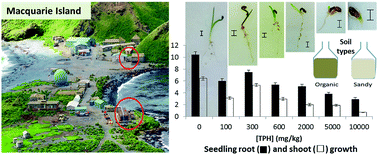
A recent study by Macoustra and co-workers is one of the few to provide such data for the sub-Antarctic region. The researchers first collected seeds from 12 native plants on Macquarie Island, the site of one of Australia’s scientific research stations and multiple diesel fuel spills. They tested the seeds for their suitability for bioassays in the lab, and used the species that successfully germinated in a second bioassay involving exposure to a range of diesel concentrations in soils, at both high and low organic carbon contents. Only four species were able to germinate during the second bioassay, indicating that diesel-contaminated soils reduced germination success.

Using the four species that germinated during the second bioassay, a final bioassay was performed over a 28 day period, again with soils exhibiting a range of diesel contamination and either low or high organic carbon content. The endpoints assessed were germination success, and early-life root and shoot growth. The researchers found that soils with low organic carbon content were generally more toxic to plants than high organic carbon content, and attribute this to the lower bioavailability of organic contaminants associated with higher levels of organic matter, in addition to higher nutrient levels that promote plant growth and higher rates of microbial degradation of petroleum hydrocarbons. Root growth was the most sensitive endpoint, likely due to the high permeability of early-life root tissues.

Though the concentrations of petroleum hydrocarbons necessary to inhibit early growth were similar to those likely to be found very close to a spill site, the unique conditions in the sub-Antarctic that greatly inhibit hydrocarbon loss processes mean that such concentrations can persist in the environment.

Prior to this study by Macoustra and co-workers, there was no such toxicity data for early life stages of native sub-Antarctic plants exposed to petroleum hydrocarbons. This data is extremely useful for models currently being developed to assist in creating remediation targets for the sub-Antarctic, as the models require a certain number of species from a minimum number of taxonomic groups.


To read more about this research, download a copy of the manuscript for free* by clicking the link below.

Impact of hydrocarbons from a diesel fuel on the germination and early growth of subantarctic plants
GK Macoustra, CK King, J Wasley, SA Robinson and DF Jolley
Environ. Sci.: Processes Impacts, 2015, Advance Article
DOI: 10.1039/C4EM00680A

—————-

About the webwriter

Abha Parajulee is a Ph.D. student at the University of Toronto Scarborough. She is interested in water resources and the behavior of organic contaminants in urban environments.

—————-

* Access is free until 06/09/2015 through a registered RSC account.

Digg This
Reddit This
Stumble Now!
Share on Facebook
Bookmark this on Delicious
Share on LinkedIn
Bookmark this on Technorati
Post on Twitter
Google Buzz (aka. Google Reader)

Joint US-UK Workshop on Understanding the Potential Environmental Impacts of Unconventional Hydrocarbons

The UK Natural Environment Research Council (NERC) and the United States National Science Foundation (NSF), along with the Environment Sustainability & Energy Division of the Royal Society of Chemistry, are inviting applications from UK scientists to attend a jointly organised workshop on Improving Understanding of Potential Environmental Impacts Associated with Unconventional Hydrocarbons in Washington DC on 5-6 November 2015.

The deployment of hydraulic fracturing technology to exploit shale oil and gas reservoirs in the USA and now potentially in the UK has raised a number of environmental concerns. This workshop brings together researchers in the USA and the UK to learn from each other to identify the areas of major environmental uncertainty, the focused scientific research questions that need to be addressed, and the opportunities for innovation and translation of existing research within this area.

For further information, please see the Announcement of Opportunity online. The deadline for applications is 16:00 (BST) on Wednesday 9 September 2015.

Digg This
Reddit This
Stumble Now!
Share on Facebook
Bookmark this on Delicious
Share on LinkedIn
Bookmark this on Technorati
Post on Twitter
Google Buzz (aka. Google Reader)