Archive for August, 2012

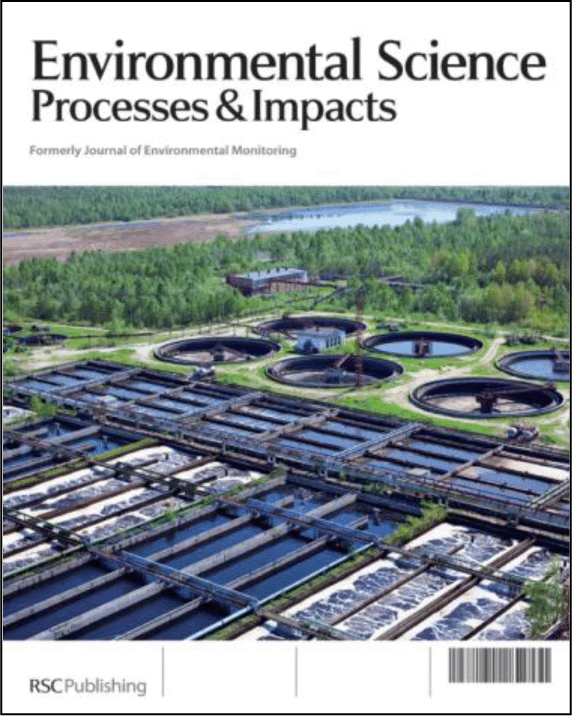
Journal of Environmental Monitoring name change

Important news re: Journal of Environmental Monitoring

The name of a journal should accurately reflect the content that it publishes; in the case of the Journal of Environmental Monitoring it is apparent that the phrase ‘environmental monitoring’ clearly misrepresents the breadth of the journal.

Following consultation and feedback from the environmental science community, Journal of Environmental Monitoring is to be renamed Environmental Science: Processes & Impacts from Issue 1, 2013. This move is wholeheartedly supported by the Editorial Board who are confident that the new name demonstrates that the journal focuses on environmental processes and relevant impacts and not on issues associated with monitoring activities.

As an author or reader, you can be assured of the same rigorous standards that you have come to expect from other high calibre RSC journals.

Importantly, the scope of the journal remains the same.

Subscribers can expect to see Environmental Science: Processes & Impacts on their renewals letters for 2013. There will be new online and print ISSNs, but otherwise the transition will be seamless, as the journal content will be published on the same web page.

If you have any questions, please contact us.

Digg This
Reddit This
Stumble Now!
Share on Facebook
Bookmark this on Delicious
Share on LinkedIn
Bookmark this on Technorati
Post on Twitter
Google Buzz (aka. Google Reader)

Analysing trace elements in baby food for children with celiac disease

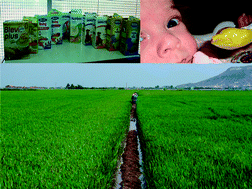
Andrew Meharg, University of Aberdeen, and colleagues from Universidad Miguel Hernández have investigated a number of essential and toxic trace elements present in baby foods, looking particularly at the diet of infants with celiac disease. Although research into trace element availability has been undertaken before, most focus on only a few essential elements such as zinc and iron, and none have specially investigated the foods designed for infants suffering from celiac disease.

Meharg et al. examined gluten-free rice-based baby foods, baby cereals with gluten and puréed baby foods from Spain and compared these with baby foods produced in the US, UK and China for essential (Ca, Na, Fe, Cu, Mn, Zn, Se, Cr, Ni and Co) and non-essential (As, Pb, Cd and Hg) elements.  They found that baby cereals (which contain gluten) were richer in Ca, Fe, Cu, Mn, Zn, Cr and Ni than the gluten-free baby rice options and in line with other recent studies, they found that the content of As in rice-based foods was elevated.  The researchers also discuss the fortification of different baby foods with trace essential elements in line with WHO recommendaitons.

Read the full article here:

Essential and toxic elements in infant foods from Spain, UK, China and USA
Ángel A. Carbonell-Barrachina, Amanda Ramírez-Gandolfo, Xiangchun Wu, Gareth J. Norton, Francisco Burló, Claire Deacon and Andrew A. Meharg
DOI: 10.1039/C2EM30379E

Digg This
Reddit This
Stumble Now!
Share on Facebook
Bookmark this on Delicious
Share on LinkedIn
Bookmark this on Technorati
Post on Twitter
Google Buzz (aka. Google Reader)

JEM author Dr Kevin Ashley presented Moyer D. Thomas Award

Dr Kevin Ashley from the Centers for Disease Control and Prevention, NIOSH, USA, was recently awarded the prestigious Moyer D. Thomas Award for his “outstanding contributions to the standardization of the sampling and analysis of atmospheres” from the ASTM International Committee D22 on Air Quality.

Dr Ashley is a senior research scientist at the U.S. Department of Health and Human Services, Centers for Disease Control and Prevention (CDC), where he has worked since 1991.  His current research is working to evaluate and validate workplace air sampling techniques to improve sample collection and analysis aspects and to harmonize methods for occupational exposure assessment.

A regular author in JEM, some of Dr Ashley’s recent work on environmental atmospheric analysis was published as part of our issue from last year’s AIRMON conference:

Interlaboratory evaluation of trace element determination in workplace air filter samples by inductively coupled plasma mass spectrometry
Kevin Ashley, Stanley A. Shulman, Michael J. Brisson and Alan M. Howe
J. Environ. Monit., 2012,14, 360-367
DOI: 10.1039/C1EM10695C

Preparation, certification and interlaboratory analysis of workplace air filters spiked with high-fired beryllium oxide

Thomas J. Oatts, Cheryl E. Hicks, Amy R. Adams, Michael J. Brisson, Linda D. Youmans-McDonald, Mark D. Hoover and Kevin Ashley
J. Environ. Monit., 2012,14, 391-401
DOI: 10.1039/C1EM10688K

The Moyer D. Thomas award was established in 1975 and is awarded in recognition of outstanding achievement in the standardization of the sampling and analysis of atmospheres. It was last awarded in 2010, to George Luciw, by a task group of the Executive Committee of Committee D22 on Sampling and Analysis of Atmospheres.

Our congratulations to Dr Ashley on receiving this award.

Digg This
Reddit This
Stumble Now!
Share on Facebook
Bookmark this on Delicious
Share on LinkedIn
Bookmark this on Technorati
Post on Twitter
Google Buzz (aka. Google Reader)

HOT article: baseline element compositions of lichens in SW Patagonia, Chile

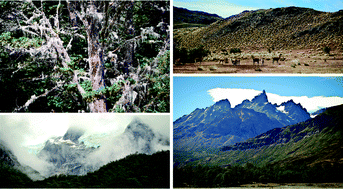
Fabrizio Monaci and co-workers at the University of Siena, Italy, and the University of Concepción, Chile, have measured the baseline element composition of two lichens (Nephroma antarcticum and Usnea sp.) growing in a remote region of SW Chilean Patagonia.

The team recorded the lowest concentrations of major and trace elements from lichens in the rainforest, and say that these concentrations can be used as background levels for the area. The authors believe these levels will be useful for detecting environmental change in the region, which will become more important in the coming months due to the construction of hydropower dams in the area.

Read more about the differences in composition between the different lichens and along the climatic gradient in the full article:

Baseline element composition of foliose and fruticose lichens along the steep climatic gradient of SW Patagonia (Aisén Region, Chile)
Fabrizio Monaci, Federica Fantozzi, Ricardo Figueroa, Oscar Parra and Roberto Bargagli
DOI: 10.1039/C2EM30246B

As with all our HOT articles, this one is free to access for 4 weeks following a simple registration.

Digg This
Reddit This
Stumble Now!
Share on Facebook
Bookmark this on Delicious
Share on LinkedIn
Bookmark this on Technorati
Post on Twitter
Google Buzz (aka. Google Reader)

JEM Issue 8 online now

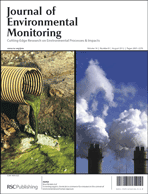
Journal of Environmental Monitoring coverThe latest issue of JEM is now online, featuring two HOT articles on the cover from Knut Breivik and Matthew Nonnenmann et al.

Knut Breivik and colleagues have developed a method to estimate the potential risks of organic chemical emissions emanating from commercial activities. No methods currently exist to quantitatively estimate the risks associated with such emissions and here the authors have sought to address this by developing an approach that looks at the quantities of organic chemicals used, their intended function and physical–chemical properties to estimate emissions to air, soil and water:

Screening organic chemicals in commerce for emissions in the context of environmental and human exposure
Knut Breivik, Jon A. Arnot, Trevor N. Brown, Michael S. McLachlan and Frank Wania
DOI: 10.1039/C2EM30259D

Matthew Nonnenmann et al have sought to overcome some of the limitations associated with culture-based techniques for identifying and quantifying fungi in environmental samples by using pyrosequencing.  Pyrosequencing offers the potential for discovering new fungal species, where are more traditional methods such as PCR and QPCR require known species to develop assays. The paper compares the two approaches in dust samples, where fungi may be associated with lung disease:

Utilizing pyrosequencing and quantitative PCR to characterize fungal populations among house dust samples
Matthew W. Nonnenmann, Gloria Coronado, Beti Thompson, William C. Griffith, John Delton Hanson, Stephen Vesper and Elaine M. Faustman
DOI: 10.1039/C2EM30229B

Also, don’t forget to take a look at the latest environmental digest, which this month discusses noise pollution, the disappointments at Rio+20 and more!

View the issue

Digg This
Reddit This
Stumble Now!
Share on Facebook
Bookmark this on Delicious
Share on LinkedIn
Bookmark this on Technorati
Post on Twitter
Google Buzz (aka. Google Reader)