The most popular Analytical Methods articles in March
Read five of the most-read papers in March 2011 here:
DOI: 10.1039/C0AY00115E
DOI: 10.1039/B9AY00280D
DOI: 10.1039/B9AY00312F
DOI: 10.1039/C0AY00608D
DOI: 10.1039/C0AY00247J
The most popular Analytical Methods articles in March
Read five of the most-read papers in March 2011 here:
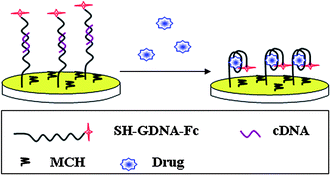
Yan Jin and colleagues from Shaanxi Normal University have designed a G-quadruplex-binding ligand screening strategy that utilises an electrochemical method to select natural G-quadruplex-binding ligands based on structure-switching of telomeric DNA.
Ligands that bind and stabilize G-quadruplex DNA structures are of significant interest because of their potential to inhibit telomerase and halt tumour cell proliferation.
The results demonstrated that daidzein, berberine, emodin, aloe-emodin, rhein and chrysophanol could induce the human telomeric DNA G-quadruplex architecture.
The paper will be free to access to until 3rd May.
Electrochemical selection of G-quadruplex-binding ligands based on structure-switching of telomeric DNA
Xiao-Qin Liu, Yan Jin, Yuexia Wang and Yunxia Qiao
Anal. Methods
DOI: 10.1039/C1AY05046J
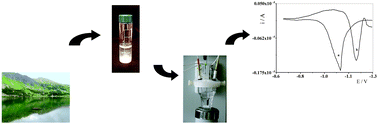
Malgorzata Grabarczyk and Anna Koper from Maria Curie-Sklodowska University, Poland, report a simple and sensitive stripping voltammertric method to determine trace amounts of uranium in natural water samples in this communication. They used an Amberlite XAD-7 or XAD-16 resin to eliminate interference from the surfactants that are often present in environmental samples.

The procedure is based on the adsorptive accumulation of the U(VI)–cupferron complex onto a hanging mercury drop electrode, followed by a reduction of the adsorbed species by a voltammetric scan using differential pulse modulation.
The paper will be free until 13th May.
Adsorptive stripping voltammetry of uranium: elimination of interferences from surface active substances and application to the determination in natural water samples
Malgorzata Grabarczyk and Anna Koper
Anal. Methods
DOI: 10.1039/C1AY05043E
The most popular Analytical Methods articles in February
Read five of the most-read papers in February 2011 here:
What were you reading in our first full year of publication?
2010 was the first full year of publication for Analytical Methods, and we’re delighted with how things went: a huge thank you to all authors and referees in their contribution to a successful 12 months!
But what were people reading the most? Here we give you a selection of some of the most popular Analytical Methods articles from last year. They cover topics such as glucosinolates and pharmaceutical manufacturing equipment, detection of apoptosis and illegal components of herbal products.
They’ll be free to access until the end of April, so have a read and do pass on the information to any colleagues who may be interested.
Why do you think these articles were so popular? We’d appreciate your comments, which can be posted below.
Critical Review: Glucosinolates, structures and analysis in food
Don Brian Clarke
Anal. Methods, 2010, 2, 310-325
DOI: 10.1039/B9AY00280D
Validation of cleaning of pharmaceutical manufacturing equipment, illustrated by determination of cephradine residues
S. Shahnawaz Sajid, M. Saeed Arayne and Najma Sultana
Anal. Methods, 2010, 2, 397-401
DOI: 10.1039/B9AY00278B
HPTLC method development and validation: Quantification of paliperidone in formulations and in vitro release study
Rashmin B. Patel, Mrunali R. Patel, Kashyap K. Bhatt and Bharat G. Patel
Anal. Methods, 2010, 2, 525-531
DOI: 10.1039/B9AY00276F
Communication: Spice up your life: screening the illegal components of ‘Spice’ herbal products
Claire E. J. Emanuel, Bill Ellison and Craig E. Banks
Anal. Methods, 2010, 2, 614-616
DOI: 10.1039/C0AY00200C
Critical Review: Detection of apoptosis: A review of conventional and novel techniques
Michelle M. Martinez, Randall D. Reif and Dimitri Pappas
Anal. Methods, 2010, 2, 996-1004
DOI: 10.1039/C0AY00247J
Including a Critical Review, three Communications and four Technical Notes amongst the usual selection of high quality research papers.
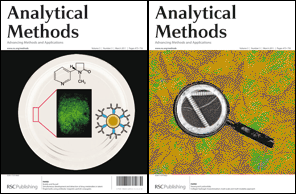
Issue 3 of 2011 is now online, featuring the following cover articles:
Boddis and Russell use antibody-magnetic particle conjugates to simultaneously develop and detect drug metabolites in latent fingermarks.
Simultaneous development and detection of drug metabolites in latent fingermarks using antibody–magnetic particle conjugates
Amanda M. Boddis and David A. Russell
Anal. Methods, 2011, 3, 519-523
DOI: 10.1039/C1AY05009E
Hwang and Lyubovitsky develop a multi-scale and multi-modality approach for characterizing collagen hydrogels
Collagen hydrogel characterization: multi-scale and multi-modality approach
Yu-Jer Hwang and Julia G. Lyubovitsky
Anal. Methods, 2011, 3, 529-536
DOI: 10.1039/C0AY00381F
Both these articles will be free to access for six weeks – happy reading!
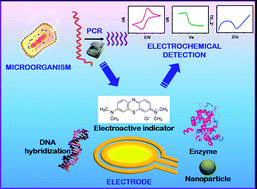
In this Critical Review, José M. Pingarrón, María Pedrero and Susana Campuzano from the University Complutense of Madrid review the use of DNA electrochemical sensors combined with PCR-amplification strategies for the detection of microorganisms. They show that PCR-amplified DNA hybridization electrochemical sensors exhibit a high sensitivity which is attributable not only to PCR-amplification but also to the detection approaches used.
Interested in knowing more? Read the full article here; free until 8th April!
Electrochemical genosensors based on PCR strategies for microorganisms detection and quantification
María Pedrero, Susana Campuzano and José M. Pingarrón
Anal. Methods, 2011, Advance Article
DOI: 10.1039/C0AY00755B
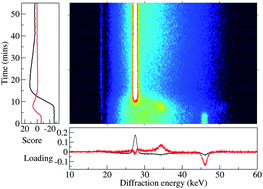
Jonathan C. Burley and co-workers from the UK demonstrate, for the first time, the application of Principal Component Analysis (PCA) to the analysis of time-resolved energy-dispersive X-ray diffraction data. Such a new strategy for the analysis of large sets of diffraction data is needed with the increasing use of in situ diffraction for following a variety of chemical processes. PCA is shown to offer significant advantages over traditional curve-fitting methods in terms of speed and lack of potential user bias.
Interested in knowing more? Read for free until April 4th.
The application of statistical methodology to the analysis of time-resolved X-ray diffraction data
Jonathan C. Burley, Dermot O’Hare and Gareth R. Williams
Anal. Methods, 2011, Advance Article
DOI: 10.1039/C0AY00772B

The authors explain how the challenge test works, its historical context and interpret the results using pharmacopoeia criterion.
The challenge test predicts the antimicrobial abilities of cosmetic preservatives over a prolonger period of time. Salgado and colleagues critique the efficacy of the challenge test for analysisng preservative effectiveness in this critical review.
Read it for free until the 1st April.
The use of the challenge test to analyse preservative efficiency in non-sterile cosmetic and health products: applications and critical points
F. A. M. Fiorentino, M. Chorilli and H. R. N. Salgado
Anal. Methods, 2011
DOI: 10.1039/C0AY00597E
The most popular Analytical Methods articles in January
Read five of the most-read papers in January 2011 here: