Archive for September, 2013

The Top Performer in Pesticide Residue Analysis

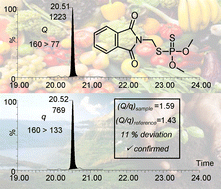
GC-MS/MS in residual pesticide analysis

GC-MS/MS in residual pesticide analysis

The laws surrounding trace amounts of pesticide found in food and the environment are designed to protect consumers and ensure that agricultural practises do not have a detrimental effect on the natural world. Even after being washed and prepared, crops can carry residual pesticides into processed products. These compounds must be both identified and quantified at very low concentration, presenting a particular challenge to analytical chemists.

In this critical review, Felíx Hernández and researchers at the University Jaume I, Spain, examine the use of gas chromatography coupled to tandem mass spectrometry (GC-MS/MS) with a triple quadrupole (QqQ) analyzer for the identification and quantification of pesticide compounds. This technique has emerged as a reliable, highly sensitive and selective tool for pesticide analysis in a complex matrix.

The authors have identified and explored a range of instances where GC-MS/MS has been successfully employed in this way. They make comparisons in a number of areas, including sample preparation, type of analyte, and mode of analysis. The food matrices being tested range from fruit and vegetables to milk, meat, ginseng and olive oil.

To read the full article, please access the link below. This paper will be free to read until October 18th.

The role of GC-MS/MS with triple quadrupole in pesticide residue analysis in food and the environment
F. Hernández, M. I. Cervera, T. Portolés, J. Beltrán and E. Pitarch
Anal. Methods, 2013, Advance Article
DOI: 10.1039/C3AY41104D

Digg This
Reddit This
Stumble Now!
Share on Facebook
Bookmark this on Delicious
Share on LinkedIn
Bookmark this on Technorati
Post on Twitter
Google Buzz (aka. Google Reader)

Web Themed Issue on Food and Packaging: Submissions open!

We are pleased to announce the first web collection of Analytical Methods on Food and Packaging:

This web themed issue covers a range of topics, including a mixture of both fundamental advances and exciting new applications. The issue aims to encourage research on the analytical developments in food analysis combined with biological, nutritional and toxicological evaluations. Analytical research on food components arising from changes during food processing, packaging and storage will also be considered.

Guest Edited by Don Clarke, Food and Environment Research Agency (FERA).

Do you work in the area of food analysis? Contribute to this web theme and submit your work now! New articles will be added to this collection as they are published. Email us at METHODS-RSC@rsc.org for more information.

Here are the first six papers of the Food and Packaging web theme free for you to read for the next four weeks. To read the full articles, please click on the links below:

Highly sensitive determination of Orange II based on the dual amplified electrochemical signal of graphene and mesoporous TiO2
Tian Gan, Junyong Sun,  Zuomin Lin and Yuling Li  
Anal. Methods, 2013,5, 2964-2970
DOI: 10.1039/C3AY40250A

Carotenoids extraction and quantification: a review
Héctor Arvayo-Enríquez, Iram Mondaca-Fernández, Pablo Gortárez-Moroyoqui, Jaime López-Cervantes and Roberto Rodríguez-Ramírez 
Anal. Methods, 2013,5, 2916-2924
DOI: 10.1039/C3AY26295B

Lopez-Gutierrez et al., Anal. Methods, 2013, 5, 3434-3449

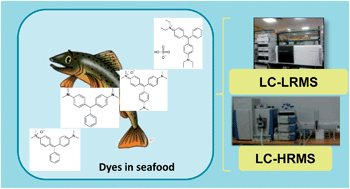
Analysis of triphenylmethane dyes in seafood

Analysis of triphenylmethane dyes in seafood products: a review of extraction methods and determination by liquid chromatography coupled to mass spectrometry
Noelia López-Gutiérrez, Roberto Romero-González, José Luis Martínez Vidal and Antonia Garrido Frenich  
Anal. Methods, 2013,5, 3434-3449
DOI: 10.1039/C3AY40485D

Preparation of Fe3O4@TiO2/graphene oxide magnetic microspheres for microchip-based preconcentration of estrogens in milk and milk powder samples
Miaomiao Tian, Wei Feng, Juanjuan Ye and Qiong Jia  
Anal. Methods, 2013,5, 3984-3991
DOI: 10.1039/C3AY40662H

Determination of bisphenol-A, 2,4-dichlorophenol, bisphenol-AF and tetrabromobisphenol-A in liquid foods and their packaging materials by vortex-assisted supramolecular solvent microextraction/high-performance liquid chromatography
Yingtang Li, Yang Jiao, Yuhong Guo and Yaling Yang  
Anal. Methods, 2013,5, 5037-5043
DOI: 10.1039/C3AY40586A

Proficiency test results for PAH analysis are not method-dependent
Mark Sykes, Martin Rose, Joe Holland, Thomas Wenzl, Janet Kelly and   Dominic Anderson
Anal. Methods, 2013,5, 5345-5350
DOI: 10.1039/C3AY40850G

Digg This
Reddit This
Stumble Now!
Share on Facebook
Bookmark this on Delicious
Share on LinkedIn
Bookmark this on Technorati
Post on Twitter
Google Buzz (aka. Google Reader)

Looking behind Dalí’s paintings

A new technique for assessing the condition of work of arts without taking samples from them has emerged from a research collaboration between conservators, curators and scientists.

Paintings undergo little mechanical stress hanging in a gallery, but are often transported between exhibitions. It is not easy to assess by eye whether they are strong enough to withstand handling and travel, and taking samples from them is not a desirable option.

The risk of paint degradation is increased if the painting’s canvas is in a poor condition, but so far more attention has been given to understanding paint layers than the supports behind them. Reductions in heritage funding make accurate scientific evidence crucial for optimising the environment and handling of paintings.

To read the full article, please visit Chemistry World.

Looking beneath Dalí’s paint: non-destructive canvas analysis
Marta Oriola, Alenka Možir, Paul Garside, Gema Campo, Anna Nualart-Torroja, Irene Civil, Marianne Odlyha, May Cassar and Matija Strlič  
Anal. Methods, 2013, Advance Article
DOI: 10.1039/C3AY41094C

Digg This
Reddit This
Stumble Now!
Share on Facebook
Bookmark this on Delicious
Share on LinkedIn
Bookmark this on Technorati
Post on Twitter
Google Buzz (aka. Google Reader)

Advances in GC IV, Cheshire

Advances in GC IV
30th October 2013 (First Announcement)
LGC Ltd, The Heath Business Park, Runcorn, Cheshire

Joint meeting organised by The Chromatographic Society and the North West Region of the Analytical Division of the Royal Society of Chemistry.

After the success of the 2011 meeting we are pleased to announce another follow up meeting in the series.
GC is still technique of choice for analysing both volatile and semi volatile compounds, but as we move to more difficult matrices, more is being asked of the technique in terms of separation and limits of detection. The meeting sets out to both give an overview of current GC technologies and methodologies, information on newer detection/separation solutions and case studies from all the main user areas.
 
In parallel to the full meeting program will be an Instrument exhibition with representatives from all the major GC Instrument and Consumables Suppliers.
 
For more information please contact Alan Handley.
Tel 01928 513681

Mobile 07917416529
E-mail: alan.handley@lgcgroup.com
 
Advances in GC IV – Topics and Speakers

09:15- 09:50        Registration ,Coffee and Exhibition
 
09:50-10:00         Opening and Welcome
                              Alan Handley (LGC Ltd)
 
10:00-10:40         Sample Preparation solutions for Gas Chromatography
                               Ray Perkins (Anatune)
 
10:40-11:20         Column Selection – there more to life than a boiling point column
                               Jaap de Zeeuw (Restek)
                                               
11:20 –12:00       Demystifying Comprehensive GC
                               Prof Jean-Francois Focant (University of Liege)
 
Exhibition and Lunch
 
14:00 -14:40        A fresh approach to managing GC in your Laboratory
                               Greg Johnson (Thermo Fisher)
 
14:40 – 15:20       Exploring the extra dimension – Getting more out of your GC Analysis
                                Ken Brady (Agilent)
 
15:20 – 15:35       Coffee
 
15:35 – 16:05       What has Deconvolution ever done for us?
                                Neil Owen (Givaudan UK Ltd)
                                                               
16:05 – 16:35       Are GC techniques comparable to the human nose?
                                Lewis Jones (Mars Waltham)
 
16:35                     Close of meeting
 
Registration (Includes all sessions, exhibition and lunch)
 
Members of either The Chromatographic Society, RSC or BMSS                 £60
 
Non Members                                                                                                          £80
 
Students* and Retired                                                                                            £10
*Student bursaries for travel are available please contact Alan Handley

Digg This
Reddit This
Stumble Now!
Share on Facebook
Bookmark this on Delicious
Share on LinkedIn
Bookmark this on Technorati
Post on Twitter
Google Buzz (aka. Google Reader)

Free HOT articles in Analytical Methods

Take a look at the new HOT articles just published in Analytical Methods! These papers will be free for you to read for the next three weeks. Click on the links below:

Bell et al., Anal. Methods, 2013, 5, 4591-4601

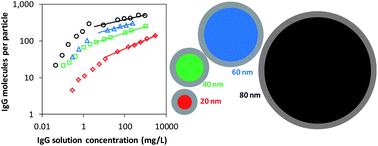
Quantitation of IgG protein adsorption to gold nanoparticles using particle size measurement
Nia C. Bell, Caterina Minelli and   Alexander G. Shard
Anal. Methods, 2013,5, 4591-4601
DOI: 10.1039/C3AY40771C

Label-free fluorometric assay for acetylcholinesterase and inhibitor screening based on supramolecular assemblies
Lan Jia, Jun Pan and   Jingxin Zhu
Anal. Methods, 2013, Advance Article
DOI: 10.1039/C3AY41007B

Evaluation of the multimetal deposition process for fingermark enhancement in simulated operational environments
Deborah T. Charlton, Stephen M. Bleay and   Vaughn G. Sears
Anal. Methods, 2013, Advance Article
DOI: 10.1039/C3AY40533H

Imidazolium-modified sulfonated polyetheretherketone for selective isolation of hemoglobin
Gang Zhao, Shuai Chen, Jie Yue and   Rong-huan He
Anal. Methods, 2013, Advance Article
DOI: 10.1039/C3AY40845K

Digg This
Reddit This
Stumble Now!
Share on Facebook
Bookmark this on Delicious
Share on LinkedIn
Bookmark this on Technorati
Post on Twitter
Google Buzz (aka. Google Reader)