Mimicking nature’s leaving group

by Russell Johnson 

A synthetic leaving group to be used in DNA synthesis could lead to new antiviral drugs or an artificial rival to DNA, say European scientists. 

DNA can be synthesised using enzymes to catalyse the polymerisation of nucleoside triphosphate building blocks. Nucleoside monophosphates are incorporated in a growing nucleic acid chain, while pyrophosphates are released as leaving groups. Replacing the pyrophosphate leaving groups with synthetic alternatives could open up a range of biotech opportunities. 

Now, Piet Herdewijn from the Catholic University of Leuven, Belgium, and colleagues have designed a series of leaving groups that are compatible with HIV-1 reverse transcriptase (an enzyme that synthesises DNA from RNA). They found that the most efficient pyrophosphate mimic was 3-phosphono-L-alanine. Herdewijn explains that they have managed to improve the kinetics of incorporating the nucleotide into the chain compared to previous leaving groups. However, 3-phosphono-L-alanine has a lower efficiency than pyrophosphate, which can cause DNA synthesis to stall. But the team says that they hope to use the stalling effect to create new antiviral drugs that selectively stall the synthesis of viral DNA, preventing virus replication. 

Structures of 2'-deoxyadenosine nucleotide and 3-phosphono-L-alanine

The implications of this research aren’t limited to new drugs, says Herdewijn, and designing a replacement for the pyrophosphate group could be a step towards creating an artificial rival to DNA. ‘The long term goal is to look at nucleic acid synthesis using alternative biochemistry and eventually make xeno-nucleic acids [artificial nucleic acids] as an alternative to natural nucleic acids in vivo,’ explains Herdewijn. 

David Jakeman, an expert in biosynthetic mechanisms at Dalhousie University, Canada, says that this could be an interesting avenue of research in the future. ‘The study of non-canonical mimics of pyrophosphate provides insight into the role of the leaving group in DNA synthesis, by HIV-1 reverse transcriptase. These advances may provide new directions for biotechnological applications of in vitro, and ultimately in vivo, DNA synthesis and replication.’ 

Read the full article here and the full story in Highlights in Chemical Biology

Digg This
Reddit This
Stumble Now!
Share on Facebook
Bookmark this on Delicious
Share on LinkedIn
Bookmark this on Technorati
Post on Twitter
Google Buzz (aka. Google Reader)

Meet the OBC team

The OBC team will be attending a number of conferences in 2011 and we would be delighted to meet you.


Here’s where you can meet us in the coming months:

Please let us know if you are planning on attending any of these meetings as it would be lovely to meet you there.

Digg This
Reddit This
Stumble Now!
Share on Facebook
Bookmark this on Delicious
Share on LinkedIn
Bookmark this on Technorati
Post on Twitter
Google Buzz (aka. Google Reader)

Submit abstracts for ISACS now

Online abstract submission for the International Symposia on Advancing the Chemical Sciences (ISACS) is now open. Abstracts are invited by the dates below:

ISACS5: Challenges in Chemical Biology:
Oral Presentations: 21 January 2011, Posters: 27th May 2011
ISACS6: Challenges in Organic Materials & Supramolecular Chemistry:
Oral Presentations: 18 March 2011, Posters: 8th July 2011

You can find out more about the exceptional speaker line-up at each event, sign up for news updates and submit abstracts and oral presentations at www.rsc.org/isacs.

3. ISACS5 – Challenges in Chemical Biology

ISACS5 – Challenges in Chemical Biology: 26-29 July 2011, Manchester, UK

Online abstract submission is now open for ISACS5, the fifth in the International Symposia on Advancing the Chemical Sciences (ISACS) conference series from the RSC. Contributions for posters are invited by 27th May 2011 to supplement the exceptional plenary programme. Also, new for 2011, we are delighted to have oral presentation slots available – submission deadline 21 January 2011. You can find out more about the outstanding speaker line-up, sign up for news updates and submit abstracts at www.rsc.org/isacs5

4. ISACS6 – Challenges in Organic Materials & Supramolecular Chemistry

ISACS6 – Challenges in Organic Materials & Supramolecular Chemistry: 2-5 September 2011, Beijing, China

Online abstract submission is now open for ISACS6, the sixth in the International Symposia on Advancing the Chemical Sciences (ISACS) conference series from the RSC. Contributions for posters are invited by 8th July 2011 to supplement the exceptional plenary programme. Also, new for 2011 we are delighted to have oral presentation slots available – submission deadline 18 March 2011. You can find out more about the outstanding speaker line-up, sign up for news updates and submit abstracts at www.rsc.org/isacs6

Digg This
Reddit This
Stumble Now!
Share on Facebook
Bookmark this on Delicious
Share on LinkedIn
Bookmark this on Technorati
Post on Twitter
Google Buzz (aka. Google Reader)

HOT: Nucleotidylation of unsaturated carbasugar in validamycin biosynthesis

Taifo Mahmud and colleagues at Oregon State and Shanghai Jiao Tong Universities present their results on the role of ValB in validamycin biosynthesis and facilitate the development of new tools for the production of carbohydrate mimetics in this HOT and very significant (as rated by the referees) paper.

You can now read this HOT paper which is free to access until the 14th of December and leave your comments on our blog.

Nucleotidylation of unsaturated carbasugar in validamycin biosynthesis
Jongtae Yang, Hui Xu, Yirong Zhang, Linquan Bai, Zixin Deng and Taifo Mahmud
Org. Biomol. Chem., 2011, Advance Article
DOI: 10.1039/C0OB00475H

Digg This
Reddit This
Stumble Now!
Share on Facebook
Bookmark this on Delicious
Share on LinkedIn
Bookmark this on Technorati
Post on Twitter
Google Buzz (aka. Google Reader)

HOT: Rapid and clean methods of DNA ligation

Tom Brown, El-Sagheer and Cheong describe in this HOT article how oligonucleotides can be ligated into larger strands by a template-directed Diels-Alder reaction.
Maleimide and furan moieties are terminally attached to synthetic DNA oligonucleotides by Diels Alder reactions.
It is also likely that the same chemistry can be applied to biologically important RNA analogues.

Find out more in this HOT article with important applications in biology and nanotechnology which is free to access until the 14th December.

Rapid chemical ligation of oligonucleotides by the Diels–Alder reaction
Afaf H. El-Sagheer, Vee Vee Cheong and Tom Brown
Org. Biomol. Chem., 2011, Advance Article
DOI: 10.1039/C0OB00451K
Digg This
Reddit This
Stumble Now!
Share on Facebook
Bookmark this on Delicious
Share on LinkedIn
Bookmark this on Technorati
Post on Twitter
Google Buzz (aka. Google Reader)

HOT: Rate of radical clocks by Martin Newcomb

Martin Newcomb and co-workers at University of Illinois in Chicago talk about absolute kinetic studies of cyclizations of two α-hydroxy substituted radicals that can serve as radical clocks.

Read more about this  ‘excellent piece of work’ as highlighted by the referees in this HOT article that will be free to access until the 14th December.

This paper is part of a collection of papers on radical chemistry that will be published shortly in OBC. Watch out for this web themed issue coming soon.

Rate constants for cyclizations of α-hydroxy radical clocks
Christopher B. DeZutter, John H. Horner and Martin Newcomb
Org. Biomol. Chem., 2011, Advance Article
DOI: 10.1039/C0OB00588F

Digg This
Reddit This
Stumble Now!
Share on Facebook
Bookmark this on Delicious
Share on LinkedIn
Bookmark this on Technorati
Post on Twitter
Google Buzz (aka. Google Reader)

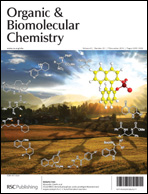
Chiral BINOL as powerful Bronsted acid catalyst-Cover of OBC Issue 23

Svetlana B Tsogoeva and colleagues at University of Erlagen-Nuremberg review the recent advances on the most successful C-C formation reactions using chiral BINOL phosphates as Bronsted acid catalysts.

Read this review, which is free to access until the end of the year, to find out more about these very popular Bronsted acid catalysts.

Chiral BINOL-derived phosphoric acids: privileged Brønsted acid organocatalysts for C–C bond formation reactions
Alexandru Zamfir, Sebastian Schenker, Matthias Freund and Svetlana B. Tsogoeva
Org. Biomol. Chem., 2010, 8, 5262-5276
DOI: 10.1039/C0OB00209G , Perspective
Digg This
Reddit This
Stumble Now!
Share on Facebook
Bookmark this on Delicious
Share on LinkedIn
Bookmark this on Technorati
Post on Twitter
Google Buzz (aka. Google Reader)

RSC journal lecture awards

While you are thinking about your nominee for the OBC Lecture Award, why not consider making nominations for other journal awards?

ChemComm Emerging Investigator Lectureship

ChemComm is delighted to invite nominations for the very first ChemComm Emerging Investigator Lectureship. The lectureship, which will be awarded annually, will recognise an emerging scientist in the early stages of their independent academic career. Deadline for nominations: 28th February 2011. Visit the ChemComm blog for more information.

Natural Product Reports Award Lecture

The NPR Lecture Award is an annual event which is held at an international meeting of the recipient’s choosing. The recipient will be someone who has made significant research contribution to natural products chemistry in its broadest sense.

Anyone can make a nomination for the award. Simply send the name of the person you would like to nominate, along with a brief justification, to the Editor, Dr Richard Kelly. All nominations should be received by Monday 6th December. Visit to NPR blog for more details.

Chem Soc Rev Emerging Investigators award

Don’t forget to nominate your colleagues for the Chem Soc Rev 2011 Emerging Investigator Award before the end of January. This annual award is given to recognise an emerging scientist who has made a significant contribution to their research field. Those wishing to make a nomination should send details of the nominee, including a brief C.V. together with a letter supporting the nomination, to the Chem Soc Rev  Editorial Office by 31st January 2011. Please note that self nomination is not permissible. More details on the CSR blog.

Digg This
Reddit This
Stumble Now!
Share on Facebook
Bookmark this on Delicious
Share on LinkedIn
Bookmark this on Technorati
Post on Twitter
Google Buzz (aka. Google Reader)

Top ten most accessed articles in September

This month sees the following articles in OBC that are in the top ten most accessed:-

Chiral BINOL-derived phosphoric acids: privileged Bronsted acid organocatalysts for C-C bond formation reactions 
Alexandru Zamfir, Sebastian Schenker, Matthias Freund and Svetlana B. Tsogoeva 
Org. Biomol. Chem., 2010, Advance Article, DOI: 10.1039/C0OB00209G , Perspective 

In water, on water, and by water: mimicking nature’s aldolases with organocatalysis and water 
Nobuyuki Mase and Carlos F. Barbas, III 
Org. Biomol. Chem., 2010, 8, 4043-4050, DOI: 10.1039/C004970K , Perspective 

Strain-promoted double-click reaction for chemical modification of azido-biomolecules 
Isao Kii, Akira Shiraishi, Toshiyuki Hiramatsu, Takeshi Matsushita, Hidehiro Uekusa, Suguru Yoshida, Makoto Yamamoto, Akira Kudo, Masatoshi Hagiwara and Takamitsu Hosoya 
Org. Biomol. Chem., 2010, 8, 4051-4055, DOI: 10.1039/C0OB00003E , Communication 

Multicolor fluorescent switches in gel systems controlled by alkoxyl chain and solvent 
Yue Xu, Pengchong Xue, Defang Xu, Xiaofei Zhang, Xingliang Liu, Huipeng Zhou, Junhui Jia, Xinchun Yang, Fengyong Wang and Ran Lu 
Org. Biomol. Chem., 2010, 8, 4289-4296, DOI: 10.1039/C0OB00091D , Paper 

High-throughput synthesis of azide libraries suitable for direct “click” chemistry and in situ screening 
Rajavel Srinivasan, Lay Pheng Tan, Hao Wu, Peng-Yu Yang, Karunakaran A. Kalesh and Shao Q. Yao 
Org. Biomol. Chem., 2009, 7, 1821-1828, DOI: 10.1039/B902338K , Paper 

Stereoselective synthesis of the bicyclic guanidine alkaloid (+)-monanchorin 
Ahmed M. Zaed and Andrew Sutherland 
Org. Biomol. Chem., 2010, 8, 4394-4399, DOI: 10.1039/C0OB00219D , Paper 

Selectivity enhancement in functionalization of C-H bonds: A review 
Georgiy B. Shul’pin 
Org. Biomol. Chem., 2010, 8, 4217-4228, DOI: 10.1039/C004223D , Perspective 

Picolylamine as an organocatalyst template for highly diastereo- and enantioselective aqueous aldol reactions 
Thomas C. Nugent, M. Naveed Umar and Ahtaram Bibi 
Org. Biomol. Chem., 2010, 8, 4085-4089, DOI: 10.1039/C0OB00049C , Paper 

Four-fold click reactions: Generation of tetrahedral methane- and adamantane-based building blocks for higher-order molecular assemblies 
Oliver Plietzsch, Christine Inge Schilling, Mariyan Tolev, Martin Nieger, Clemens Richert, Thierry Muller and Stefan Bräse 
Org. Biomol. Chem., 2009, 7, 4734-4743, DOI: 10.1039/B912189G , Paper 

Recent advances in transition metal-catalyzed N-atom transfer reactions of azides 
Tom G. Driver 
Org. Biomol. Chem., 2010, 8, 3831-3846, DOI: 10.1039/C005219C , Perspective 

Why not take a look at the articles today and blog your thoughts and comments below.

Fancy submitting an article to OBC? Then why not submit to us today or alternatively email us your suggestions.
  

Digg This
Reddit This
Stumble Now!
Share on Facebook
Bookmark this on Delicious
Share on LinkedIn
Bookmark this on Technorati
Post on Twitter
Google Buzz (aka. Google Reader)

HOT: How reliable are DFT transition structures?

Luis Simón and Jonathan Goodman calculate the geometries of covalent-bond forming transition states by using computational methods.

The manuscript reports an analysis of the performance of different density functionals in computational organic chemistry. The paper is based on a very large number of calculations and provides significant conclusions that have immediate application. The referees said that the manuscript stands out and that is why it is a HOT article.

Find out more on the original paper which is free to access until 25th November.

How reliable are DFT transition structures? Comparison of GGA, hybrid-meta-GGA and meta-GGA functionals
Luis Simón and Jonathan M. Goodman
Org. Biomol. Chem., 2011, Advance Article
DOI: 10.1039/C0OB00477D, Paper

Digg This
Reddit This
Stumble Now!
Share on Facebook
Bookmark this on Delicious
Share on LinkedIn
Bookmark this on Technorati
Post on Twitter
Google Buzz (aka. Google Reader)