
Top ten most accessed articles in April

This month sees the following articles in OBC that are in the top ten most accessed:-

Carbohydrate chemistry in drug discovery 
M. Carmen Galan, David Benito-Alifonso and Gregory M. Watt 
Org. Biomol. Chem., 2011, 9, 3598-3610 DOI: 10.1039/C0OB01017K  

Gold-catalysed synthesis of amino acid-derived 2,5-disubstituted oxazoles 
Christopher L. Paradise, Pooja R. Sarkar, Mina Razzak and Jef K. De Brabander 
Org. Biomol. Chem., 2011, 9, 4017-4020 DOI: 10.1039/C1OB05390F 

Mannich-Michael versus formal aza-Diels-Alder approaches to piperidine derivatives 
P. Ricardo Girling, Takao Kiyoi and Andrew Whiting 
Org. Biomol. Chem., 2011, 9, 3105-3121 DOI: 10.1039/C0OB00996B, Perspective 

The stimulating adventure of KRN 7000 
Aline Banchet-Cadeddu, Eric Hénon, Manuel Dauchez, Jean-Hugues Renault, Fanny Monneaux and Arnaud Haudrechy 
Org. Biomol. Chem., 2011, 9, 3080-3104 DOI: 10.1039/C0OB00975J  

Highly selective fluorescent OFF-ON thiol probes based on dyads of BODIPY and potent intramolecular electron sink 2,4-dinitrobenzenesulfonyl subunits 
Huimin Guo, Yingying Jing, Xiaolin Yuan, Shaomin Ji, Jianzhang Zhao, Xiaohuan Li and Yanyan Kan 
Org. Biomol. Chem., 2011, 9, 3844-3853 DOI: 10.1039/C0OB00910E 

Mild preparation of functionalized [2.2]paracyclophanes via the Pummerer rearrangement 
Matteo Montanari, Alberto Bugana, Arvind K. Sharma and Dario Pasini 
Org. Biomol. Chem., 2011, Advance Article DOI: 10.1039/C1OB05319A  

Rhodamine-based highly sensitive colorimetric off-on fluorescent chemosensor for Hg2+ in aqueous solution and for live cell imaging 
Hengguo Wang, Yapeng Li, Shufei Xu, Yanchun Li, Chen Zhou, Xiaoliang Fei, Lei Sun, Chaoqun Zhang, Yaoxian Li, Qingbiao Yang and Xiaoyi Xu 
Org. Biomol. Chem., 2011, 9, 2850-2855 DOI: 10.1039/C0OB01032D, Paper 

Energy transfer cassettes in silica nanoparticles target intracellular organelles 
Jiney Jose, Aurore Loudet, Yuichiro Ueno, Liangxing Wu, Hsiang-Yun Chen, Dong Hee Son, Rola Barhoumi, Robert Burghardt and Kevin Burgess 
Org. Biomol. Chem., 2011, 9, 3871-3877 DOI: 10.1039/C0OB00967A  

A ratiometric near-infrared pH-responsive fluorescent dye based on distyryl BODIPY 
Hui He and Dennis K. P. Ng 
Org. Biomol. Chem., 2011, 9, 2610-2613 DOI: 10.1039/C0OB01252A, Communication 

A specific chemodosimeter for fluoride ion based on a pyrene derivative with trimethylsilylethynyl groups 
Hua Lu, Qiuhong Wang, Zhifang Li, Guoqiao Lai, Jianxiong Jiang and Zhen Shen 
Org. Biomol. Chem., 2011, Advance Article DOI: 10.1039/C1OB05164D  

Why not take a look at the articles today and blog your thoughts and comments below.

Fancy submitting an article to OBC? Then why not submit to us today or alternatively email us your suggestions.
   

Digg This
Reddit This
Stumble Now!
Share on Facebook
Bookmark this on Delicious
Share on LinkedIn
Bookmark this on Technorati
Post on Twitter
Google Buzz (aka. Google Reader)

OBC themed issue on foldamer chemistry – Call for papers

OBC is delighted to announce a high-profile web theme focussing on foldamer chemistry. Submissions are now open.

This online theme issue will be published at the end of 2011. Submissions of communications and full papers can be made at any time but must be received by the editorial office by 15 August 2011 for peer review.

Submission and tracking of manuscripts can be done directly online at http://mc.manuscriptcentral.com/ob. Submissions should indicate in the “comments to the editor” section that they are for the foldamers web theme.

You can view other, recently published OBC web themes at http://pubs.rsc.org/en/journals/journalissues/ob#!themedissues

Digg This
Reddit This
Stumble Now!
Share on Facebook
Bookmark this on Delicious
Share on LinkedIn
Bookmark this on Technorati
Post on Twitter
Google Buzz (aka. Google Reader)

OBC Issue 11 published!

Check out the cover articles in Organic & Biomolecular Chemistry Issue 11.

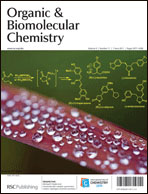
The outside cover features work by Michael Doyle and colleagues  at University of Maryland. They talk about catalytic C-H insertion processes in comparison with other approaches for the synthesis of selected synthetic targets, lactones and lactams, which have been of biological or medicinal interest. It is a very interesting and original review article. Read more at
Intramolecular catalytic asymmetric carbon–hydrogen insertion reactions. Synthetic advantages in total synthesis in comparison with alternative approaches
Michael P. Doyle, Maxim Ratnikov and Yu Liu
Org. Biomol. Chem., 2011, 9, 4007-4016
DOI: 10.1039/C0OB00698J

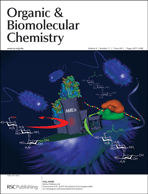
The inside cover represents how Aminoglycoside acetyltransferase AAC(6’) belonging to the aminoglycoside-modifying enzymes (AMEs) does not deactivate the 6’-N-glycinyl tobramycin which attacks the bacterial ribosome (green arrow). In contrast, the parent aminoglycoside tobramycin cannot pass through bacterial resistance mechanism (red arrow).
You can read more about this article by Micha Fridman, Sylvie Garneau-Tsodikova and co-workers at Michigan and Tel Aviv at

Assessment of 6′- and 6′′′-N-acylation of aminoglycosides as a strategy to overcome bacterial resistance
Pazit Shaul, Keith D. Green, Roi Rutenberg, Maria Kramer, Yifat Berkov-Zrihen, Elinor Breiner-Goldstein, Sylvie Garneau-Tsodikova and Micha Fridman
Org. Biomol. Chem., 2011, 9, 4057-4063
DOI: 10.1039/C0OB01133A

Both articles are FREE to download until the end of June.

Digg This
Reddit This
Stumble Now!
Share on Facebook
Bookmark this on Delicious
Share on LinkedIn
Bookmark this on Technorati
Post on Twitter
Google Buzz (aka. Google Reader)

Cascade reactions and multiple rings – OBC emerging area

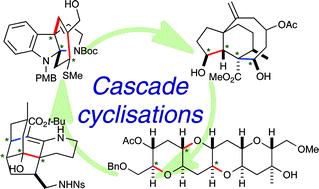
Cascade or domino processes have become one of the Holy Grails in organic synthesis. They allow the sequential formation of multiple new bonds and therefore, the one-pot synthesis of new and complex organic molecules. 

The formation of new cyclic frameworks in a controlled-one synthetic operation is almost a dream come true for synthetic chemists due to the complexity and challenging structure of these heterocycles.

In this review article, Edward Anderson, at Oxford University, gives us a selective overview of cascade reactions as applied to natural product synthesis. We invite you to download it and read this excellent accounting of recent cascade-based polycyclic reactions towards the synthesis of natural products.

Cascade polycyclisations in natural product synthesis
Edward A. Anderson
Org. Biomol. Chem., 2011, Advance Article
DOI: 10.1039/C1OB05212H, Emerging Area

Digg This
Reddit This
Stumble Now!
Share on Facebook
Bookmark this on Delicious
Share on LinkedIn
Bookmark this on Technorati
Post on Twitter
Google Buzz (aka. Google Reader)

Catalytic asymmetric C-H insertions-OBC perspective

Asymmetric catalytic intramolecular carbon-hydrogen insertion reactions are pivotal reactions in the world of organic chemistry and there is a considerable amount of literature on this topic.

Michael Doyle and his colleagues at University of Maryland, have now written a very original and different review on the catalytic C-H insertion process in comparison with other approaches for the synthesis of selected synthetic targets, lactones and lactams, which have been of biological or medicinal interest. They discuss these well-defined targeted molecules for which there have been multiple examples of their synthesis. They conclude by saying that the catalytic route through chiral dirhodium(II) carboxamidates is the most appropriate method for the stereoselective carbon–hydrogen insertion reactions that produce biologically relevant lactones and lactams.

If you want to find out more about the different synthetic approaches and the advantges of using one over the other, download this very interesting review.

Intramolecular catalytic asymmetric carbon–hydrogen insertion reactions. Synthetic advantages in total synthesis in comparison with alternative approaches
Michael P. Doyle, Maxim Ratnikov and Yu Liu
Org. Biomol. Chem., 2011, Advance Article
DOI: 10.1039/C0OB00698J, Perspective

Digg This
Reddit This
Stumble Now!
Share on Facebook
Bookmark this on Delicious
Share on LinkedIn
Bookmark this on Technorati
Post on Twitter
Google Buzz (aka. Google Reader)

HOT: Monitoring intracellular copper levels in living cells

Copper is an essential trace element in the physiology of living organisms as many critical proteins and enzymes contain copper in their active sites or/and require copper for their activities.
Disruption of copper levels in cells can cause diseases such as Menkes syndrome, Wilson’s disease, amyotrophic lateral sclerosis and Alzheimer’s. Therefore, the quantitative detection of intracellular copper could help with the understanding of its complex physiological and pathological roles.

Unlike other trace metals such as zinc, iron, chromium and mercury, which can be successfully detected with rhodamine-based fluorescence probes, the detection of copper has proven to be more challenging and the development of satisfactory fluorescent probes needs addressing.

Bao-Xiang Zhao, Jun-Ying Miao and colleagues at Shandong University in China have now developed a rhodamine chromene-based fluorescence probe to monitor the intracellular levels of copper in living cells. The probe switches to a highly fluorescent complex upon coordination with copper under physiological conditions in a very sensitive and selective manner and facilitates the naked-eye detection of the metal.

If you want to learn more about this satisfactory fluorescent probe I invite you to download this paper that is free to access until 15th June.

Synthesis, crystal structure and living cell imaging of a Cu2+-specific molecular probe
Wei-Yong Liu, Hai-Ying Li, Bao-Xiang Zhao and Jun-Ying Miao
Org. Biomol. Chem., 2011, Advance Article
DOI: 10.1039/C1OB05358B

Digg This
Reddit This
Stumble Now!
Share on Facebook
Bookmark this on Delicious
Share on LinkedIn
Bookmark this on Technorati
Post on Twitter
Google Buzz (aka. Google Reader)

HOT: One electron oxidation of substituted ferrocenes

How can the structure of short-lived N-oxyl radicals influence its electron transfer (ET) properties?

Osvaldo Lanzalunga and his team at Sapienza Universita di Roma and Istituto CNR di Metodologie Chimiche (IMC-CNR) provide some answers to this question in this OBC HOT paper.

They study the kinetics of the one electron oxidation of substituted ferrocenes by a series of N-oxyl radicals in acetonitrile and determine self-exchange reorganization energy values.
They conclude by saying that ‘even small modifications of the structure of the N-oxyl radicals lead to signifiant variation of the self-exchange reorganization energy values.’

If you want to read more about these results, you can download the paper for free until 8th June.

This paper is part of the Free Radical collection of papers in memory of Athel Beckwith, which will be published at the end of May. Watch this space.

One-electron oxidation of ferrocenes by short-lived N-oxyl radicals. The role of structural effects on the intrinsic electron transfer reactivities
Enrico Baciocchi, Massimo Bietti, Claudio D’Alfonso, Osvaldo Lanzalunga, Andrea Lapi and Michela Salamone
Org. Biomol. Chem., 2011, Advance Article
DOI: 10.1039/C0OB01257B

Digg This
Reddit This
Stumble Now!
Share on Facebook
Bookmark this on Delicious
Share on LinkedIn
Bookmark this on Technorati
Post on Twitter
Google Buzz (aka. Google Reader)

Most cited OBC Emerging Areas free to download!

The OBC editorial team has collected the most cited Emerging Areas published in our journal in the last 5 years. You can now download them for free!

Emerging Areas are short, forward-looking feature articles on particularly topical subjects. These articles are generally submitted following invitation; however the editorial team are happy to consider suggestions for review articles. If you have an idea for a review topic please contact the Editor.

Find below the top 5 most cited emerging areas in the last 5 years. Congratulations to the authors and thanks!

Asymmetric organocatalysis
Jayasree Seayad and Benjamin List
Org. Biomol. Chem., 2005, 3, 719-724
DOI: 10.1039/B415217B

The golden gate to catalysis
Anja Hoffmann-Röder and Norbert Krause
Org. Biomol. Chem., 2005, 3, 387-391
DOI: 10.1039/B416516K

σ-Chelation-directed C–H functionalizations using Pd(II) and Cu(II) catalysts: regioselectivity, stereoselectivity and catalytic turnover
Jin-Quan Yu, Ramesh Giri and Xiao Chen
Org. Biomol. Chem., 2006, 4, 4041-4047
DOI: 10.1039/B611094K

A hitchhiker’s guide to G-quadruplex ligands
David Monchaud and Marie-Paule Teulade-Fichou
Org. Biomol. Chem., 2008, 6, 627-636
DOI: 10.1039/B714772B

“Frustrated Lewis pairs”: a concept for new reactivity and catalysis
Douglas W. Stephan
Org. Biomol. Chem., 2008, 6, 1535-1539
DOI: 10.1039/B802575B

Digg This
Reddit This
Stumble Now!
Share on Facebook
Bookmark this on Delicious
Share on LinkedIn
Bookmark this on Technorati
Post on Twitter
Google Buzz (aka. Google Reader)

Good TEMPO-H for OBC! Highlighted in C&EN

Congratulations to Jason Clyburne and colleagues at Saint Mary’s University in Canada are in order!

Their recent Organic & Biomolecular Chemistry HOT article on ‘Anhydrous TEMPO-H: reactions of a good hydrogen atom donor with low-valent carbon centres’ has been highlighted in C&EN this month (May).

If you want to read the story just click below:
Going Anhydrous modifies TEMPO-H

We are delighted to see such a great coverage and promotion of this very interesting article. You can now download it for free until 14th May here!

Thanks to our colleagues in C&EN for a nice story on the article.

Digg This
Reddit This
Stumble Now!
Share on Facebook
Bookmark this on Delicious
Share on LinkedIn
Bookmark this on Technorati
Post on Twitter
Google Buzz (aka. Google Reader)

Top ten most accessed articles in March

This month sees the following articles in OBC that are in the top ten most accessed:-

A facile method for the synthesis of oxindole based quaternary a-aminonitriles via the Strecker reaction 
Yun-Lin Liu, Feng Zhou, Jun-Jie Cao, Cong-Bin Ji, Miao Ding and Jian Zhou 
Org. Biomol. Chem., 2010, 8, 3847-3850 DOI: 10.1039/C0OB00174K, Communication 

Sequential one-pot combination of multi-component and multi-catalysis cascade reactions: an emerging technology in organic synthesis 
Dhevalapally B. Ramachary and Sangeeta Jain 
Org. Biomol. Chem., 2011, 9, 1277-1300 DOI: 10.1039/C0OB00611D, Emerging Area 

Carbohydrate chemistry in drug discovery 
M. Carmen Galan, David Benito-Alifonso and Gregory M. Watt 
Org. Biomol. Chem., 2011, 9, 3598-3610 DOI: 10.1039/C0OB01017K, Perspective 

Mannich-Michael versus formal aza-Diels-Alder approaches to piperidine derivatives 
P. Ricardo Girling, Takao Kiyoi and Andrew Whiting 
Org. Biomol. Chem., 2011, 9, 3105-3121 DOI: 10.1039/C0OB00996B, Perspective 

A general approach to high-yielding asymmetric synthesis of chiral 3-alkyl-4-nitromethylchromans via cascade Barbas-Michael and acetalization reactions 
Dhevalapally B. Ramachary, M. Shiva Prasad and R. Madhavachary 
Org. Biomol. Chem., 2011, 9, 2715-2721 DOI: 10.1039/C0OB00861C, Paper 

A ratiometric near-infrared pH-responsive fluorescent dye based on distyryl BODIPY 
Hui He and Dennis K. P. Ng 
Org. Biomol. Chem., 2011, 9, 2610-2613 DOI: 10.1039/C0OB01252A, Communication 

Cycloaddition of homochiral dihydroimidazoles: A 1,3-dipolar cycloaddition route to optically active pyrrolo[1,2-a]imidazoles 
Raymond C. F. Jones, Kevin J. Howard, John S. Snaith, Alexander J. Blake, Wang-Shei Li and Peter J. Steel 
Org. Biomol. Chem., 2011, 9, 297-306 DOI: 10.1039/C0OB00529K, Paper 

Rhodamine-based highly sensitive colorimetric off-on fluorescent chemosensor for Hg2+ in aqueous solution and for live cell imaging 
Hengguo Wang, Yapeng Li, Shufei Xu, Yanchun Li, Chen Zhou, Xiaoliang Fei, Lei Sun, Chaoqun Zhang, Yaoxian Li, Qingbiao Yang and Xiaoyi Xu 
Org. Biomol. Chem., 2011, 9, 2850-2855 DOI: 10.1039/C0OB01032D, Paper 

Chiral BINOL-derived phosphoric acids: privileged Brønsted acid organocatalysts for C-C bond formation reactions 
Alexandru Zamfir, Sebastian Schenker, Matthias Freund and Svetlana B. Tsogoeva 
Org. Biomol. Chem., 2010, 8, 5262-5276 DOI: 10.1039/C0OB00209G, Perspective 

Second-order NMR spectra at high field of common organic functional groups 
Paul J. Stevenson 
Org. Biomol. Chem., 2011, 9, 2078-2084 DOI: 10.1039/C0OB00705F, Comment 

Why not take a look at the articles today and blog your thoughts and comments below.

Fancy submitting an article to OBC? Then why not submit to us today or alternatively email us your suggestions.

Digg This
Reddit This
Stumble Now!
Share on Facebook
Bookmark this on Delicious
Share on LinkedIn
Bookmark this on Technorati
Post on Twitter
Google Buzz (aka. Google Reader)