HOT: new N-spiro quaternary ammonium salt phase-transfer catalysts from tartaric acid

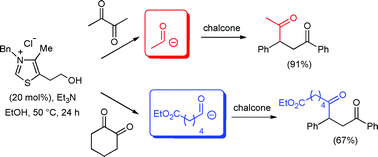
Mario Waser et al. have designed new N-spiro quaternary ammonium salt-based catalysts from tartaric acid-derived TADDOLs.  The new catalysts catalyse the asymmetric α-alkylation of glycine Schiff bases in good yields and up to 93% ee.

Design, synthesis, and application of tartaric acid derived N-spiro quaternary ammonium salts as chiral phase-transfer catalysts
Mario Waser, Katharina Gratzer, Richard Herchl and Norbert Müller
DOI: 10.1039/C1OB06573D

This article is part of a joint ChemComm & OBC web theme issue on Organocatalysis.

Keep checking this page as further articles are added to the web theme issue.

Digg This
Reddit This
Stumble Now!
Share on Facebook
Bookmark this on Delicious
Share on LinkedIn
Bookmark this on Technorati
Post on Twitter
Google Buzz (aka. Google Reader)

HOT: Organocatalytic approach to the enantioselective synthesis of alpha-arylcyclohexenones and derivatives


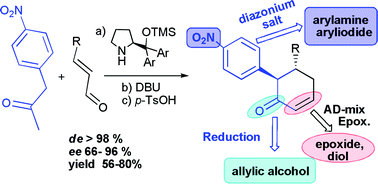
M. Belén Cid et al. at the Universidad Autonoma de Madrid, Spain, have devised a simple and efficient organocatalytic approach for the synthesis of alpha-aryl cyclohexenones and cyclohexanones, leading to ee up to 96% and complete diastereoselectivity, via a Michael addition and aldol reaction as key steps.

Highly rated by the reviewers and editorial office alike, this Hot Article will be FREE to access for the next 4 weeks.

This article is also part of a joint ChemComm & OBC web theme issue on Organocatalysis.

Keep checking this page as further articles are added to the web theme issue.

An organocatalytic approach to enantiomerically enriched α-arylcyclohexenones and cyclohexanones
Sara Duce, María Jorge, Inés Alonso, José Luis García Ruano and M. Belén Cid
Org. Biomol. Chem., 2011, Advance Article
DOI: 10.1039/C1OB06356A, Paper
From collection Organocatalysis

Digg This
Reddit This
Stumble Now!
Share on Facebook
Bookmark this on Delicious
Share on LinkedIn
Bookmark this on Technorati
Post on Twitter
Google Buzz (aka. Google Reader)

Perspective: Development and utilization of non-coding RNA–small molecule interactions

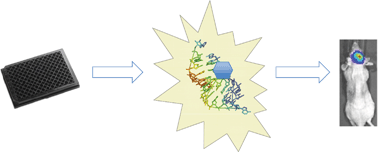
Wesleigh Georgianna and Douglas Young review the possibilities for small molecule regulation of non-coding RNA covering:

  • miRNA
  • siRNA
  • RNA aptamers
  • riboswitches
  • ribozymes

Download the article to find out more about regulating this novel target:

Development and utilization of non-coding RNA–small molecule interactions
Wesleigh E. Georgianna and Douglas D. Young
Org. Biomol. Chem., 2011, Advance Article
DOI: 10.1039/C1OB06324C

Digg This
Reddit This
Stumble Now!
Share on Facebook
Bookmark this on Delicious
Share on LinkedIn
Bookmark this on Technorati
Post on Twitter
Google Buzz (aka. Google Reader)

HOT: Increased affinity of LewisX mimics for DC-SIGN

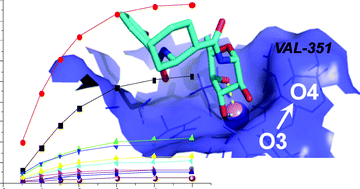
The binding of two α-fucosylamide-based mimics of LewisX to DC-SIGN ECD (Dendritic Cell-Specific ICAM-3 Grabbing Nonintegrin extracellular domain) using STD NMR and docking studies has been investigated by Pedro M. Nieto and coworkers.  The mimics are shown to bind in a similar way to LewisX, through the fructose moiety and in a multi-modal fashion, but with increased affinity due to the aromatic moiety.

Insights into molecular recognition of LewisX mimics by DC-SIGN using NMR and molecular modelling
Cinzia Guzzi, Jesús Angulo, Fabio Doro, José J. Reina, Michel Thépaut, Franck Fieschi, Anna Bernardi, Javier Rojo and Pedro M. Nieto
Org. Biomol. Chem., 2011, 9, 7705-7712
DOI: 10.1039/C1OB05938F

Digg This
Reddit This
Stumble Now!
Share on Facebook
Bookmark this on Delicious
Share on LinkedIn
Bookmark this on Technorati
Post on Twitter
Google Buzz (aka. Google Reader)

HOT: Biologically active molecules – the effect of cyclization on self-diffusion rates

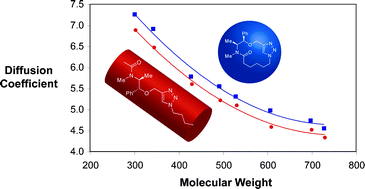
Using DOSY NMR spectroscopy, collaborators from the Scripps Research Institute in La Jolla (USA) and Pfizer Worldwide Research have systemically measured the self-diffusion rates of linear vs. macrocyclic drug-like structures.

Check out this seminal work: selected as a HOT Article, it will free to access for the next 4 weeks*

Comparison of diffusion coefficients for matched pairs of macrocyclic and linear molecules over a drug-like molecular weight range
Andrew R. Bogdan, Nichola L. Davies and Keith James
Org. Biomol. Chem., 2011, 9, 7727-7733
DOI: 10.1039/C1OB05996C

* upon a simple registration process for individual access

Digg This
Reddit This
Stumble Now!
Share on Facebook
Bookmark this on Delicious
Share on LinkedIn
Bookmark this on Technorati
Post on Twitter
Google Buzz (aka. Google Reader)

HOT Perspective: Effective synthetic routes to the lantibiotics peptides

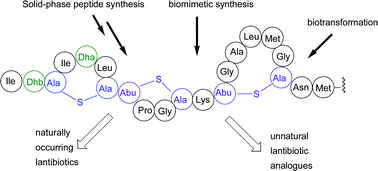
In this ‘Hot’ OBC Perspective, Alethea Tabor (University College London, UK) provides an excellent overview of the recent advances in the chemical synthesis of lantibiotics, a field which has considerably moved on since the last review in the area in 2005 by W. A. van der Donk.

The approaches covered include:

  • solution-phase  and solid-phase synthesis
  •  biomimetic approaches
  •  biotransformation strategies

Keep up-to date with the synthesis of these structurally complex peptides possessing unique antibacterial properties and read this review article, FREE to access for the next 4 weeks*


The challenge of the lantibiotics: synthetic approaches to thioether-bridged peptides
Alethea B. Tabor
Org. Biomol. Chem., 2011, 9, 7606-7628
DOI: 10.1039/C1OB05946G

* upon a simple registration process for individual access

Digg This
Reddit This
Stumble Now!
Share on Facebook
Bookmark this on Delicious
Share on LinkedIn
Bookmark this on Technorati
Post on Twitter
Google Buzz (aka. Google Reader)

On the cover: a fluorescent probe for cyclin A and C-nitrosation of minoxidil

On the outside front cover of this issue we have a hot communication from José L. Mascareñas and M. Eugenio Vázquez on the design of a peptide fluorescent sensor for cyclin A, a key protein in cycle cycle regulation.

Rational design of a cyclin A fluorescent peptide sensor
Elena Pazos, Miguel Pérez, Hugo Gutiérrez-de-Terán, Mar Orzáez, Tatiana Guevara, José L. Mascareñas and M. Eugenio Vázquez
Org. Biomol. Chem., 2011, Advance Article
DOI: 10.1039/C1OB06009K

The image on the inside front cover depicts work from Julio Casado et al. on minoxidil – a treatment for hair loss and high blood pressure.  They have investigated C-nitrosation at the C-5 position of the pyrimidine ring, which is 7 times more likely to occur than in phenol, and conclude that the resultant N-nitrosominoxidil could be harmful to minoxidil users.

Aromatic C-nitrosation of a bioactive molecule. Nitrosation of minoxidil
Mario González-Jiménez, Jorge Arenas-Valgañón, Emilio Calle and Julio Casado
Org. Biomol. Chem., 2011, Advance Article
DOI: 10.1039/C1OB05686G

View the rest of the issue, including reviews on the photo-dehydro-Diels–Alder reaction and synthetic approaches to lantibiotics

Digg This
Reddit This
Stumble Now!
Share on Facebook
Bookmark this on Delicious
Share on LinkedIn
Bookmark this on Technorati
Post on Twitter
Google Buzz (aka. Google Reader)

Top ten most accessed articles in September

This month sees the following articles in Organic & Biomolecular Chemistry that are in the top ten most accessed:

Recent advances in indole syntheses: New routes for a classic target
Rubén Vicente
Org. Biomol. Chem., 2011, 9, 6469-6480
DOI: 10.1039/C1OB05750B

Brønsted acid assisted activation of imide carbonyl group: regioselective synthesis of isoindoloisoquinolinone alkaloid (±)-nuevamine
Jayaraman Selvakumar and Chinnasamy Ramaraj Ramanathan
Org. Biomol. Chem., 2011, 9, 7643-7646
DOI: 10.1039/C1OB06349A

Palladium-catalyzed desulfitative C–H arylation of azoles with sodium sulfinates
Ru Chen, Saiwen Liu, Xinhua Liu, Luo Yang and Guo-Jun Deng
Org. Biomol. Chem., 2011, 9, 7675-7679
DOI: 10.1039/C1OB06387A

Tandem reactions initiated by copper-catalyzed cross-coupling: A new strategy towards heterocycle synthesis
Yunyun Liu and Jie-Ping Wan
Org. Biomol. Chem., 2011, 9, 6873-6894
DOI: 10.1039/C1OB05769C

Chromo-fluorogenic detection of aldehydes with a rhodamine based sensor featuring an intramolecular deoxylactam
Zhu Li, Zhongwei Xue, Zhisheng Wu, Jiahuai Han and Shoufa Han
Org. Biomol. Chem., 2011, 9, 7652-7654
DOI: 10.1039/C1OB06448G

Pd-Catalyzed cyclization reaction: a convenient domino process for synthesis of α-carbonyl furan derivatives
Hua Cao, Huan-Feng Jiang, Hua-Wen Huang and Jin-Wu Zhao
Org. Biomol. Chem., 2011, 9, 7313-7317
DOI: 10.1039/C1OB06105D

N-Heterocyclic carbene-catalyzed 1,3-dipolar cycloaddition reactions: a facile synthesis of 3,5-di- and 3,4,5-trisubstituted isoxazoles
Shravankumar Kankala, Ravinder Vadde and Chandra Sekhar Vasam
Org. Biomol. Chem., 2011, 9, 7869-7876
DOI: 10.1039/C1OB06072D

Highly effective copper-catalyzed decarboxylative coupling of aryl halides with alkynyl carboxylic acids
Xiaoming Qu, Tingyi Li, Peng Sun, Yan Zhu, Hailong Yang and Jincheng Mao
Org. Biomol. Chem., 2011, 9, 6938-6942
DOI: 10.1039/C1OB05969F

Synthesis and thermal decomposition of N,N-dialkoxyamides
Katherine M. Digianantonio, Stephen A. Glover, Jennifer P. Johns and Adam A. Rosser
Org. Biomol. Chem., 2011, 9, 4116-4126
DOI: 10.1039/C1OB00008J

Facile carbohydrate-based stereocontrolled divergent synthesis of (+)-pericosines A and B
Subhankar Tripathi, Ajam Chand Shaikh and Chinpiao Chen
Org. Biomol. Chem., 2011, 9, 7306-7308
DOI: 10.1039/C1OB06383A

Why not take a look at the articles today and blog your thoughts and comments below.

Fancy submitting an article to Organic & Biomolecular Chemistry? Then why not submit to us today or alternatively email us your suggestions.

Digg This
Reddit This
Stumble Now!
Share on Facebook
Bookmark this on Delicious
Share on LinkedIn
Bookmark this on Technorati
Post on Twitter
Google Buzz (aka. Google Reader)

Hot: From D- to L-sugars, a green and efficient synthetic protocol for rare sugars

While L-sugars are promising candidates in medicinal chemistry, such as L-ribose-containing nucleosides, only their D-forms naturally occur, thus prompting the need for an efficient synthetic methodology.

In this aim, Gaik-Khuan Chuah et al. at the National University of Singapore have devised a novel route to access rare L-lyxose and L-ribose in a simple 5-step procedure, leading to significantly increased yields and greener conditions as compared to previous reports.

To overcome the critical step for the oxidation of D-sugar to the corresponding D-lactone, the authors have used a heterogeneous catalyst – palladium-bismuth supported on carbon – and molecular oxygen, thus eliminating the need for bromine often used for this oxidation. The catalyst can easily be separated from the reaction mixture and reused, which enhances even further the relevance of this novel protocol.

Interested? Why not read this Hot Article now, it will be free to access for the next 4 weeks upon a simple registration process.

Reference
A heterogeneous Pd–Bi/C catalyst in the synthesis of L-lyxose and L-ribose from naturally occurring D-sugars
Ao Fan, Stephan Jaenicke and Gaik-Khuan Chuah
Org. Biomol. Chem., 2011, Advance Article
DOI: 10.1039/C1OB06116J, Paper

Digg This
Reddit This
Stumble Now!
Share on Facebook
Bookmark this on Delicious
Share on LinkedIn
Bookmark this on Technorati
Post on Twitter
Google Buzz (aka. Google Reader)

Hot: General methods for targeting proteins

In this Hot article, Adam T. Slósarczyk and Lars Baltzer from Uppsala University, Sweden, report on the conjugation of designed polypeptides to a small organic molecule as a strategy for the recognition and binding of phosphorylated proteins.

Conjugating a polypeptide to the zinc chelating ligand led to a dramatic increase in affinity and selectivity towards phosphoproteins, here caseins, however this concept for binder development is thought to be widely applicable and ‘high-affinity binders can conveniently be developed for a variety of proteins including those with posttranslational modifications for which small molecule recognition elements are available.’, report the authors.

Curious to learn more? Read the full article now, FREE to access for the next 4 weeks.

Reference
The molecular recognition of phosphorylated proteins by designed polypeptides conjugated to a small molecule that binds phosphate
Adam T. Ślósarczyk and Lars Baltzer
Org. Biomol. Chem., 2011, Advance Article
DOI: 10.1039/C1OB06154B, Paper

Digg This
Reddit This
Stumble Now!
Share on Facebook
Bookmark this on Delicious
Share on LinkedIn
Bookmark this on Technorati
Post on Twitter
Google Buzz (aka. Google Reader)