OBC issue 35 online now, read it today!

Issue 35 of Organic & Biomolecular Chemistry is now available online for you to access today!

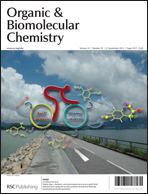
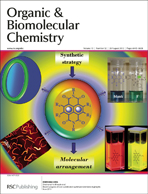
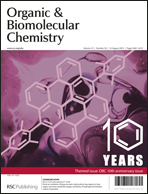
On the front cover this weeks is the work of Chi-Ming Che and colleagues from The University of Hong Kong, who present a gold(I)/chiral Brønsted acid cooperative catalytic system for the efficient one-pot asymmetric synthesis of tetrahydroquinolines, with one or two chiral centres at different positions as well as highly divergent functional groups, from reaction of 2-aminobenzaldehydes or 2-aminophenones with alkynes.

Highly regio-, diastereo- and enantioselective one-pot gold/chiral Brønsted acid-catalysed cascade synthesis of bioactive diversely substituted tetrahydroquinolines
Xin-Yuan Liu, Ya-Ping Xiao, Fung-Ming Siu, Li-Chen Ni, Yong Chen, Lin Wang and Chi-Ming Che
DOI: 10.1039/C2OB25753J

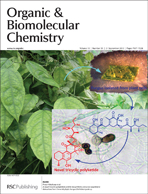
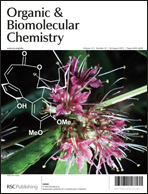
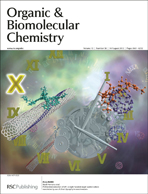
The inside cover highlights the work of Prasat Kittakoop et al. on the isolation, characterization, and biological activities of a novel tricyclic polyketide, 2 of its biosynthetic congeners as well as austdiol, a known azaphilone, from the endophytic fungus Dothideomycete sp., which was isolated from the Thai medicinal plant, Tiliacora triandra.

A novel tricyclic polyketide and its biosynthetic precursor azaphilone derivatives from the endophytic fungus Dothideomycete sp
Sarath P. D. Senadeera, Suthep Wiyakrutta, Chulabhorn Mahidol, Somsak Ruchirawat and Prasat Kittakoop
DOI: 10.1039/C2OB25959A

Read this issue, and previous issues, today!

Do you have an image you think would look good on a cover? Why not let us know when you submit your work to us.

Digg This
Reddit This
Stumble Now!
Share on Facebook
Bookmark this on Delicious
Share on LinkedIn
Bookmark this on Technorati
Post on Twitter
Google Buzz (aka. Google Reader)

OBC issue 34 now online

Forget the pot of gold at the end of the rainbow, this week it’s all about getting you hands on issue 34 of Organic & Biomolecular Chemistry and its technicoloured covers.

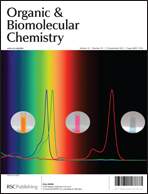
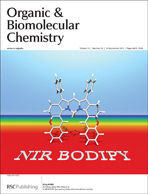
On the front cover Hidemitsu Uno, Ehime University, and colleagues have prepared potential selective near-infrared (NIR) dyes by the fusion of boron-dipyrromethene (BODIPY) chromophores. Uno et al. designed these π-fused bis-BODIPY chromophores to show intensive absorption and strong fluorescence in the near-infrared region and not to have any strong absorption in the visible region.

π-Fused bis-BODIPY as a candidate for NIR dyes
Mitsunori Nakamura, Hiroyuki Tahara, Kohtaro Takahashi, Toshi Nagata, Hiroki Uoyama, Daiki Kuzuhara, Shigeki Mori, Tetsuo Okujima, Hiroko Yamada and Hidemitsu Uno

The inside cover from Xin-Dong Jiang, Henan University, and co-workers demonstrates the synthesis of a novel BODIPY from a 3,4,4a-trihydroxanthene-fused pyrrole, that is non-cytotoxic and so is suited to the labeling of living cells in the NIR region.

A NIR BODIPY dye bearing 3,4,4a-trihydroxanthene moieties
Xin-Dong Jiang, Ruina Gao, Yi Yue, Guo-Tao Sun and Weili Zhao

Also in this issue is a review by Liqun Jin and Aiwen Lei which presents insights into the elementary steps in Negishi coupling through kinetic investigations.

Read the complete issue here…. and as always the cover articles will be free to access for the next 6 weeks!

Digg This
Reddit This
Stumble Now!
Share on Facebook
Bookmark this on Delicious
Share on LinkedIn
Bookmark this on Technorati
Post on Twitter
Google Buzz (aka. Google Reader)

OBC issue 33 now online: a tool for RNA conjugation and iodine cyclisations on the covers

Crack open this week’s issue over your coffee break and have a read…

On the front cover:

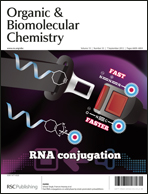
Strap yourself in with this week’s front cover highlighting the work of Ishwar Singh and co-workers who have developed a fast, strain promoted cycloaddition as a tool for RNA conjugation on the solid phase exploiting the cycloaddition of a series of RNA-cyclooctynes with both azide (strain-promoted azide–alkyne cycloaddition) and nitrile oxide dipoles (strain-promoted nitrile oxide–alkyne cycloaddition). Singh et al. say that the reaction is compatible with 2’-OMe blocking as well as with 2’-O-TBDMS protection on the ribose moieties of the sugar.

Fast RNA conjugations on solid phase by strain-promoted cycloadditions
Ishwar Singh, Colin Freeman, Annemieke Madder, Joseph S. Vyle and Frances Heaney
DOI: 10.1039/C2OB25628B

On the inside front cover:

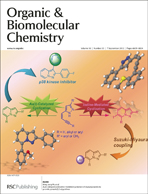
Ming-Jung Wu and colleagues, National Sun Yat-sen University, have developed an efficient synthetic method to convert enynylpyrazoles to pyrazolo[1,5-a]pyridines and 6-iodopyrazolo[1,5-a]pyridines by gold-catalyzed cyclisation and iodinemediated cyclisation reactions, respectively. Wu et al. go on to demonstrate the synthetic utility of this by preparing a p38 kinase inhibitor.

Au(I)-catalyzed and iodine-mediated cyclization of enynylpyrazoles to provide pyrazolo[1,5-a]pyridines
Hung-Chou Wu, Chia-Wen Yang, Long-Chih Hwang and Ming-Jung Wu
DOI: 10.1039/C2OB25973G

Read both these articles for free for 6 weeks!

Digg This
Reddit This
Stumble Now!
Share on Facebook
Bookmark this on Delicious
Share on LinkedIn
Bookmark this on Technorati
Post on Twitter
Google Buzz (aka. Google Reader)

Issue 32 now published: Lythracea alkaloids and core-substituted naphthalenediimides on the covers

Issue 32 is now published, read it here today!

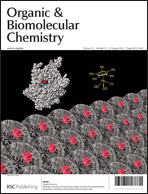
The front cover of this issue (right) highlights the work of E. Peter Kündig et al. who present the total syntheses of the Lythracea alkaloids (+)-vertine and (+)-lythrine, which is the first reported total synthesis of (+)-lythrine.

Asymmetric synthesis of (+)-vertine and (+)-lythrine
Laëtitia Chausset-Boissarie, Roman Àrvai, Graham R. Cumming, Laure Guénée and E. Peter Kündig
DOI: 10.1039/C2OB25880C

The inside cover (left) is courtesy of Sheshanath V. Bhosale et al. whose Emerging area review provides an update on the progress in the field of core-substituted naphthalenediimides from 2010, covering supramolecular chemistry, sensors, photo-induced electron transport in artificial photosystems, and solar cell applications.

Recent progress of core-substituted naphthalenediimides: highlights from 2010
Sheshanath V. Bhosale,  Sidhanath V. Bhosale and Suresh K. Bhargava
DOI: 10.1039/C2OB25798J

Both of these articles will free to access for the next 6 weeks so take a look and let us know your thoughts by commenting below.

Missed our 10th anniversary themed issue for OBC? Well after reading this week’s issue have a look at the 68 articles that made up our 10th birthday issue here….
Digg This
Reddit This
Stumble Now!
Share on Facebook
Bookmark this on Delicious
Share on LinkedIn
Bookmark this on Technorati
Post on Twitter
Google Buzz (aka. Google Reader)

Top ten most accessed articles in June

This month sees the following articles in Organic & Biomolecular Chemistry that are in the top ten most accessed:

Efficient iodine catalyzed three components domino reaction for the synthesis of 1-((phenylthio)(phenyl)methyl)pyrrolidin-2-one derivatives possessing anticancer activities
Gunasekar Ramachandran, Natesan S. Karthikeyan, Periyasamy Giridharan and Kulathu I. Sathiyanarayanan
Org. Biomol. Chem., 2012, 10, 5343-5346
DOI: 10.1039/C2OB25530H

A BODIPY-based colorimetric and fluorometric chemosensor for Hg(II) ions and its application to living cell imaging
Mani Vedamalai and Shu-Pao Wu
Org. Biomol. Chem., 2012, 10, 5410-5416
DOI: 10.1039/C2OB25589H

Copper-catalyzed domino coupling reaction: an efficient method to synthesize oxindoles
Jen-Chieh Hsieh, An-Yi Cheng, Jun-Hao Fu and Ting-Wei Kang
Org. Biomol. Chem., 2012, 10, 6404-6409
DOI: 10.1039/C2OB26110C

Asymmetric formal synthesis of schulzeines A and C
Jaebong Jang, Jong-Wha Jung, Jaeseung Ahn, Jaehoon Sim, Dong-Jo Chang, Dae-Duk Kim and Young-Ger Suh
Org. Biomol. Chem., 2012, 10, 5202-5204
DOI: 10.1039/C2OB25772F

Chiral quaternary phosphonium salts: a new class of organocatalysts
Dieter Enders and Thanh Vinh Nguyen
Org. Biomol. Chem., 2012, 10, 5327-5331
DOI: 10.1039/C2OB25823D

Total synthesis of indole-3-acetonitrile-4-methoxy-2-C-β-D-glucopyranoside. Proposal for structural revision of the natural product
Akop Yepremyan and Thomas G. Minehan
Org. Biomol. Chem., 2012, 10, 5194-5196
DOI: 10.1039/C2OB25821H

Enantioselective synthesis of 3,3′-dihydropyrryl-spirooxindoles via an organocatalytic three-component reaction
Wen-Tao Wei, Chun-Xia Chen, Rui-Jiong Lu, Jin-Jia Wang, Xue-Jing Zhang and Ming Yan
Org. Biomol. Chem., 2012, 10, 5245-5252
DOI: 10.1039/C2OB25629K

A convergent stereocontrolled total synthesis of (–)-terpestacin
Yehua Jin and Fayang G. Qiu
Org. Biomol. Chem., 2012, 10, 5452-5455
DOI: 10.1039/C2OB25940K

A cyanine based fluorophore emitting both single photon near-infrared fluorescence and two-photon deep red fluorescence in aqueous solution
Lu Wang, Jiefu Jin, Xishan Chen, Hai-Hua Fan, Billy King Fai Li, Kok-Wai Cheah, Ning Ding, Shenghong Ju, Wing-Tak Wong and Cong Li
Org. Biomol. Chem., 2012, 10, 5366-5370
DOI: 10.1039/C2OB25619C

Transition metal-catalyzed fluorination of multi carbon–carbon bonds: new strategies for fluorinated heterocycles
Guosheng Liu
Org. Biomol. Chem., 2012, 10, 6243-6248
DOI: 10.1039/C2OB25702E

Why not take a look at the articles today and blog your thoughts and comments below.

Fancy submitting an article to Organic & Biomolecular Chemistry? Then why not submit to us today or alternatively email us your suggestions.

Digg This
Reddit This
Stumble Now!
Share on Facebook
Bookmark this on Delicious
Share on LinkedIn
Bookmark this on Technorati
Post on Twitter
Google Buzz (aka. Google Reader)

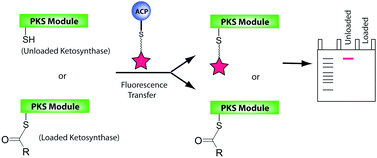
Organic: A mechanism-based fluorescence transfer assay for examining ketosynthase selectivity

US scientists have developed a cheap and simple way to examine the selectivity of the ketosynthase domain found in polyketide synthases.

Polyketide synthases are multicomponent enzyme systems that make polyketide natural products. They have received attention from researchers hoping to harness their potential as a platform for generating new and improved therapeutics. But the field of polyketide engineering has faced a constant struggle to overcome often strict substrate selectivities of the critical biosynthetic enzymes.

The new fluorescence-based method is much simpler and cheaper than previously used radiolabelling techniques and should enable improved understanding of how these biosynthetic machines function.

A Mechanism-Based Fluorescence Transfer Assay for Examining Ketosynthase Selectivity
Gitanjeli Prasad, Lawrence S. Borketey, Tsung-Yi Lin and Nathan A. Schanrr
Org. Biomol. Chem.
, 2012, Accepted Manuscript
DOI:
10.1039/C2OB26008E

Digg This
Reddit This
Stumble Now!
Share on Facebook
Bookmark this on Delicious
Share on LinkedIn
Bookmark this on Technorati
Post on Twitter
Google Buzz (aka. Google Reader)

Issue 31 online now, complete with mutant lipases & cyclic di-oxoguanidines

Organic & Biomolecular Chemistry issue 31, it’s here and waiting to be read!

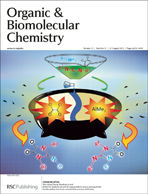
Secondary alcohols having bulky substituents on both sides of the hydroxy group are inherently poor substrates for most lipases. In a paper by Tadashi Ema et al., highlighted on this week’s front cover of OBC (right), the detailed rational design and creation of mutant lipases that display remarkably enhanced catalytic activity and enantioselectivity for poor substrates bearing bulky substituents on both sides of the hydroxy group is presented.

Redesign of enzyme for improving catalytic activity and enantioselectivity toward poor substrates: manipulation of the transition state
Tadashi Ema, Yasuko Nakano, Daiki Yoshida, Shusuke Kamata and Takashi Sakai
DOI: 10.1039/C2OB25614B

The inside front cover (left) highlights the Communication of Wen-Xiong Zhang and Zhenfeng Xi et al., presenting the first metal-free one-pot sequential coupling of various amines, carbodiimides and acyl dichlorides, providing a simple and straightforward path to cyclic di-oxoguanidines via an unexpected 2,2-dichloroimidazolidindione intermediate.

Metal-free synthesis of cyclic di-oxoguanidines via one-pot sequential transformation of amines, carbodiimides and acyl dichlorides
Fei Zhao, Yang Wang, Wen-Xiong Zhang and Zhenfeng Xi
DOI: 10.1039/C2OB25799H

Both of these featured articles are FREE to access for the next 6 weeks, why not have a read and let us know your thoughts by commenting below.


Also in this issue:

Emerging Area
Transition metal-catalyzed fluorination of multi carbon–carbon bonds: new strategies for fluorinated heterocycles
Guosheng Liu
DOI: 10.1039/C2OB25702E

Perspective
Discovery, application and protein engineering of Baeyer–Villiger monooxygenases for organic synthesis
Kathleen Balke, Maria Kadow, Hendrik Mallin, Stefan Saß and Uwe T. Bornscheuer
DOI: 10.1039/C2OB25704A

View the complete issue online now……

Digg This
Reddit This
Stumble Now!
Share on Facebook
Bookmark this on Delicious
Share on LinkedIn
Bookmark this on Technorati
Post on Twitter
Google Buzz (aka. Google Reader)

OBC 10th anniversary art gallery

A selection of images suggested for the cover of OBC’s 10th anniversary themed issue

With the 10th anniversary themed issue of OBC now online we thought we would share with you a couple of the other cover suggestions that were put forward by authors for this issue.

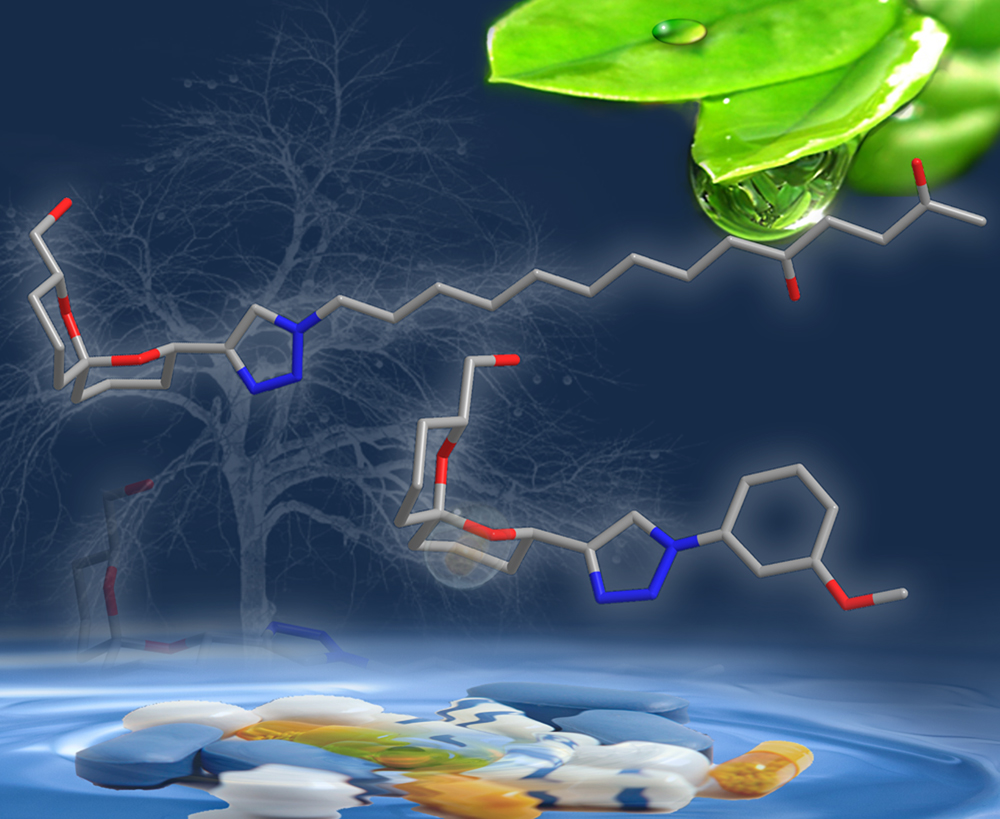
Below is the rather striking suggestion from Brimble et al. The tree and leaves represent nature, and its dew, superimposed with their spiroacetal-triazoles, drops into a pool of tablets representing the development of new therapeutic agents.


Enantioselective synthesis of C-linked spiroacetal-triazoles as privileged natural product-like scaffolds
Jui Thiang Brian Kueh, Ka Wai Choi and Margaret A. Brimble
DOI: 10.1039/C2OB06802H

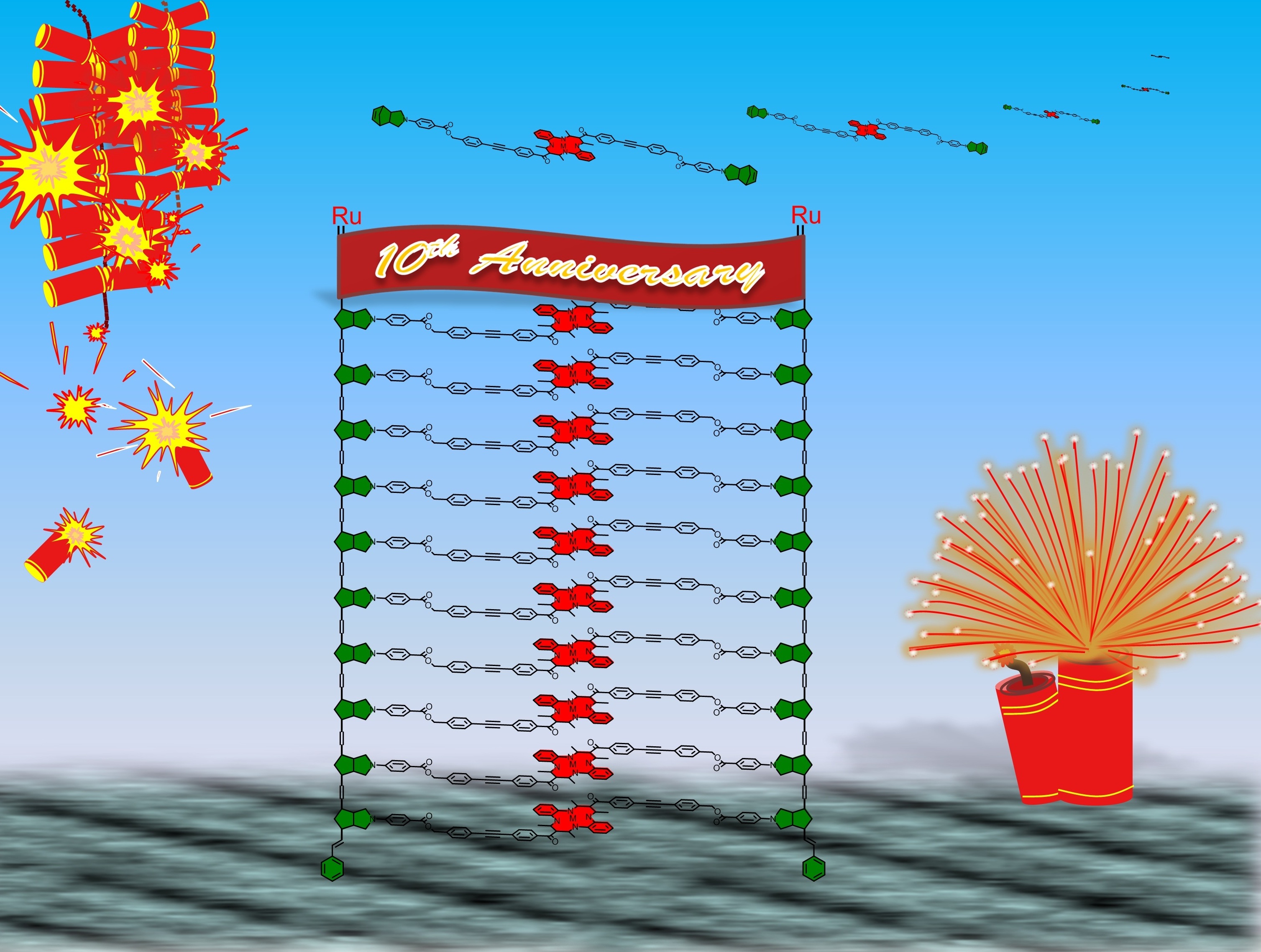
This second suggestion comes from Luh et al., featuring a decameric ladderphane in recognition of the 10 years that OBC has been published.

Double stranded polymeric ladderphanes with 16-π-electron antiaromatic metallocycle linkers
Hsin-Hua Huang , Chih-Gang Chao, Shern-Long Lee, Hung-Jen Wu, Chun-hsien Chen and Tien-Yau Luh
DOI: 10.1039/C2OB25114K

Now you’ve seen the art, why not see the science? View the entire issue, featuring 68 articles from the breadth of OBC‘s scope by leaders in the field!

Digg This
Reddit This
Stumble Now!
Share on Facebook
Bookmark this on Delicious
Share on LinkedIn
Bookmark this on Technorati
Post on Twitter
Google Buzz (aka. Google Reader)

Organic & Biomolecular Chemistry 10th anniversary themed issue now online: 68 great articles!

The 10th anniversary issue of OBC has arrived! This celebratory issue contains a massive 68 articles of great science from investigators at the forefront of current research. View the entire issue here….

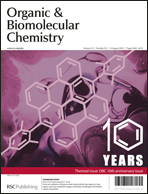
This nice front cover is courtesy of Eric H. Fort and Lawrence T. Scott who report the high reactivity of dimesitylbisanthene toward bay region air oxidation, leading to a bay region quinine. Fort and Scott say that “this finding signals a warning about the potential oxygen-sensitivity of hydrogenterminated carbon nanotubes; a single oxidation of this sort on the cylindrical rim of a growing carbon nanotube would preclude further elongation of the tube by the Diels–Alder cycloaddition/rearomatization protocol and would thereby terminate the growth.”

Facile air-oxidation of large aromatic hydrocarbon bay regions to bay region quinones: predicted oxygen-sensitivity of hydrogen-terminated carbon nanotubes
Eric H. Fort and Lawrence T. Scott

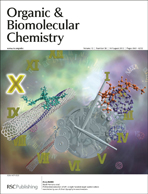
Also geared towards celebrating our 10th anniversary is this inside cover from Naoki Komatsu et al., which highlights their paper reporting on the optical enrichment of single-walled carbon nanotubes (SWNTs) with (n,m) other than those so far reported, together with their simultaneous separation according to their diameters by preferential extraction of commercial SWNTs with 2,6-pyridylene-bridged chiral diporphyrin nanotweezers.

Preferential extraction of left- or right-handed single-walled carbon nanotubes by use of chiral diporphyrin nanotweezers
Gang Liu, Tatsuki Yasumitsu, Li Zhao, Xiaobin Peng, Feng Wang, Ajoy K. Bauri, Shuji Aonuma, Takahide Kimura and Naoki Komatsu

In an issue packed with work from some of the best researches around there was always going to be a lot of HOT articles included, too many to list here. So, for the complete list of the HOT articles from this issue please have a look at our recent blog highlighting them.

Finally, the entire Organic & Biomolecular Chemistry team we would like to thank all of our Associate Editors, Editorial and Advisory Board members, authors and referees, without whom none of this past decade would have been possible, and we hope to work with you all to make the next 10 years even more successful.

Digg This
Reddit This
Stumble Now!
Share on Facebook
Bookmark this on Delicious
Share on LinkedIn
Bookmark this on Technorati
Post on Twitter
Google Buzz (aka. Google Reader)

HOT articles from 10th anniversary themed issue of Organic & Biomolecular Chemistry

A collection of the HOT articles in OBC’s upcoming 10th anniversary themed issue

After much anticipation the themed issue marking the 10th anniversary of Organic & Biomolecular Chemistry will be published this week, and it’s a bumper issue full of work from many at the forefront of current research who have continued contribute to the success of OBC over the past decade.

Ahead of the issue’s publication we have prepared a FREE collection of all the HOT articles that can be found within its covers, and considering all the talent that has contributed it is quite a big collection. These will all be free to access until the end of July.

Click here for the full list

Digg This
Reddit This
Stumble Now!
Share on Facebook
Bookmark this on Delicious
Share on LinkedIn
Bookmark this on Technorati
Post on Twitter
Google Buzz (aka. Google Reader)