An alternative one-pot gold-catalyzed approach to the assembly of 11H-indolo[3,2-c]quinolines

This article is HOT as recommended by the referees.

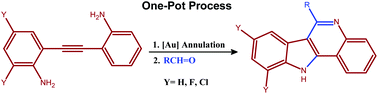
In this HOT paper Antonio Arcadi, Università degli Studi di L’Aquila, and colleagues present a newly developed one-pot gold-catalysed approach to the assembly of 11H-indolo[3,2-c]quinolines from readily available unprotected 2-[2-(2-aminophenyl)ethynyl]anilines and aldehydes.

Arcadi et al. use the clever idea of first using a fast regio-selective intramolecular reaction, followed by a slower intermolecular condensation and subsequent cyclisation and final hydrogen transfer nicely provides a fast, synthetically efficient and elegant access to indolo[3,2-c]quinolines. With its broad scope, mild conditions and high regioselectivity this could be a valuable alternative to protocols previously described in the literature.

Find out more by downloading this paper today. It’s free to access for 4 weeks so grab it whilst you can.

An alternative one-pot gold-catalyzed approach to the assembly of 11H-indolo[3,2-c]quinolines
Giorgio Abbiati, Antonio Arcadi, Marco Chiarini, Fabio Marinelli, Emanuela Pietropaolo and Elisabetta Rossi
DOI: 10.1039/C2OB26380G

Digg This
Reddit This
Stumble Now!
Share on Facebook
Bookmark this on Delicious
Share on LinkedIn
Bookmark this on Technorati
Post on Twitter
Google Buzz (aka. Google Reader)

Steric effects on the catalytic activities of zinc(II) complexes in the cleavage of the RNA and DNA model phosphates

This article is HOT as recommended by the referees.

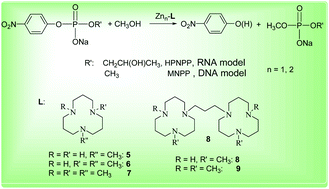
This manuscript from Zhong-Lin Lu and co-workers presents the preparation of a series of mononuclear and dinuclear zinc(II) complexes with ligands bearing different numbers of N-methyl groups, and includes a thorough kinetic study towards the hydrolytic cleavage of RNA and DNA model substrates.

The study focuses on the influence of steric effects on the catalytic efficiency and for the first time probes the effect of N-methylation of triazacyclododecane ligands. The N-methylation substantially reduces the co-operative behaviour between mononuclear zinc complexes and for the dinuclear complexes the activities are also substantially reduced but are still faster than the background reaction without the metal-complex.

Find out more by clicking below… download it now, it’s free for 4 weeks!

Steric effects on the catalytic activities of zinc(II) complexes containing [12]aneN3 ligating units in the cleavage of the RNA and DNA model phosphates
Yang Song, Ju Zan, Hao Yan, Zhong-Lin Lu and Ruibing Wang
DOI: 10.1039/C2OB25624J

Digg This
Reddit This
Stumble Now!
Share on Facebook
Bookmark this on Delicious
Share on LinkedIn
Bookmark this on Technorati
Post on Twitter
Google Buzz (aka. Google Reader)

Chemical biology and medicinal: Potential agents to treat Alzheimer’s disease

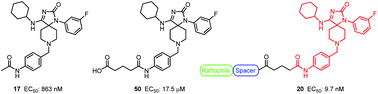
Scientists in Germany have worked on optimising compounds that reduce the formation of amyloid β-peptides, which play a crucial role in the development and progression of Alzheimer’s disease. The team varied the membrane anchor, spacer and pharmacophore building blocks on BACE1 inhibitors to make tripartite structures (assembled by covalent coupling of BACE1 inhibitors with membrane anchors via suitable spacers).

Several BACE1 inhibitors have already been reported, but here, the team has shown that the cellular activity of small-molecule BACE1 inhibitors can be significantly increased by membrane targeting via a spacer with a raftophilic membrane anchor.

Optimisation of BACE1 Inhibition of Tripartite Structures by Modification of Membrane Anchor, Spacer and Pharmacophore – Development of Potential Agents for the Treatment of Alzheimer’s Disease
Hans-Joachim Knölker
DOI: 10.1039/C2OB26103K

Digg This
Reddit This
Stumble Now!
Share on Facebook
Bookmark this on Delicious
Share on LinkedIn
Bookmark this on Technorati
Post on Twitter
Google Buzz (aka. Google Reader)

Physical organic chemistry: An article collection

A free collection of high impact articles on physical organic chemistry from the RSC’s ChemComm, Chemical Science and Organic & Biomolecular Chemistry (OBC).

Physical organic chemistry, the study of the underlying principles and rationale of organic reactions which looks at the interrelationships between the structure and reactivity of organic molecules, now encompasses a wider range of contexts than ever before.

Making use of tools such as chemical kinetics, quantum chemistry, thermochemistry, chemical equilibrium and computational chemistry, to name but a few, researchers are investigating topics such as:

•    Supramolecular interactions, aggregation and reactivity
•    The computation of transition states and mechanisms
•    Molecular recognition, reactions and catalysis in biology
•    Materials where molecular structure controls function
•    Structure activity correlations
•    Mechanisms in synthesis and catalysis

To highlight some of the cutting edge research that ChemComm, Chemical Science and Organic & Biomolecular Chemistry receive we have collected a selection of articles for you to enjoy. These will be free to access until 25th September!

Click here for the full list of free articles

Digg This
Reddit This
Stumble Now!
Share on Facebook
Bookmark this on Delicious
Share on LinkedIn
Bookmark this on Technorati
Post on Twitter
Google Buzz (aka. Google Reader)

Using Chemistry to improve Agricultural Productivity

Chemistry for Tomorrow’s World 2012: Using Chemistry to Improve Agricultural Productivity

6 pm, 26 September 2012
Chemistry Centre, Burlington House, London

Join us at the RSC’s Chemistry Centre in London to hear about how synthetic organic chemistry can help to feed the world.

Azoxystrobin is the world’s leading agricultural fungicide. It is a fully synthetic compound, whose invention was inspired by the structure and activity of the naturally-occurring fungicide strobilurin A. Today it is used worldwide to control fungi growing on over 120 types of crop, improving plant health, raising quality and increasing yield. The success of the project highlights the crucial importance of chemistry in meeting grand challenges such as global food security and the broader applicability of skills such as natural product synthesis. Our keynote speaker Dr John Clough led the team of chemists at Syngenta that invented azoxystrobin. He will discuss the key role that synthetic organic chemistry played in creating an effective and safe fungicide.

This event will be held in the Chemistry Centre on 26 September at the RSC’s recently refurbished building in Burlington House, London. Doors will open at 17:30 for refreshments. The event will begin at 18:00 and will finish with a wine reception. Please follow the link here for information and to register for the event.

Digg This
Reddit This
Stumble Now!
Share on Facebook
Bookmark this on Delicious
Share on LinkedIn
Bookmark this on Technorati
Post on Twitter
Google Buzz (aka. Google Reader)

Stimulate your senses with OBC issue 37

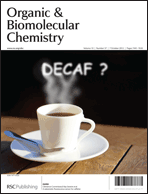
OBC issue 37 has arrived, hot off the press, so why not put your feet up and have a cup of coffee as you browse through its contents. Prefer decaf? Well the work on this week’s front cover might be able to help you find out if that coffee you have really is decaffeinated…

…. Kay Severin and colleagues from École Polytechnique Fédérale de Lausanne (EPFL) have synthesised a dye (3,4:3’,4’-bibenzo[b]thiophene-2,2’-disulfonate) that can be used as a sensitive and selective molecular probe for the fluorimetric detection of caffeine in water with a better sensitivity and selectivity than previously reported caffeine sensors.

A ratiometric fluorescence sensor for caffeine
Nicolas Luisier, Albert Ruggi, Stephan N. Steinmann, Laurane Favre, Nicolas Gaeng, Clémence Corminboeuf and Kay Severin

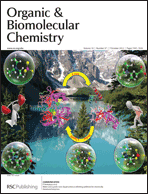
On the inside cover is a communication from P. Venkatesu et al. demonstrating the ability of water and a protic ionic liquid, triethyl ammonium phosphate (TEAP) to act as refolding additives for the urea-induced chemical denaturated state of the two enzymes, α-chymotrypsin and succinylated Con A. Water and TEAP are shown to efficient and effective additives, with the enzymatic activity of the enzymes’ being regained and in some cases even enhanced.

Water and a protic ionic liquid acted as refolding additives for chemically denatured enzymes
Pankaj Attri, P. Venkatesu and Anil Kumar

Both articles can be downloaded free for the next 6 weeks, and they are just a click away….

Go to the issue….

Digg This
Reddit This
Stumble Now!
Share on Facebook
Bookmark this on Delicious
Share on LinkedIn
Bookmark this on Technorati
Post on Twitter
Google Buzz (aka. Google Reader)

Organometallics in catalysis: an article collection

A collection of high impact articles focusing on organometallic complexes in catalysis, from the RSC’s Catalysis Science & Technology, ChemComm, Chemical Science, Dalton Transactions, Organic & Biomolecular Chemistry (OBC) and RSC Advances

Perhaps the most well-known applications of organometallics in catalysis are the Ziegler–Natta catalysts which are used to generate polymers, the catalysts are made up of mixtures of transition metal halides and organo-aluminium complexes. Karl Ziegler and Giulio Natta were awarded the 1963 Nobel Prize in Chemistry for their discovery and development of the catalysts, which today are the most commonly used for the manufacture of polythene.

The esteemed history of organometallics are not to be under-estimated and include Grignard’s reagents, the Heck reaction, Schrock catalysts, Grubbs’ catalysts and the Suzuki Coupling to name just a few. Organometallic compounds have revolutionised science and industry and to keep you up to date with the latest break-through research being made across all areas of organometallics in catalysis, we have made this cross-journal article collection free until the 26th September.

Click here for the full list of free articles

Digg This
Reddit This
Stumble Now!
Share on Facebook
Bookmark this on Delicious
Share on LinkedIn
Bookmark this on Technorati
Post on Twitter
Google Buzz (aka. Google Reader)

OBC issue 36 online now!

Taking a sneak peek at some of the content in this week’s issue

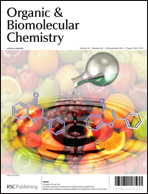
It’s all getting a bit fruity on the cover of this week’s issue of OBC thanks to the work of Sungwoo Hong and co-workers from Korea Advanced Institute of Science and Technology. Hong et al. present the impressive catalytic effects of Fe(OTf)3 in the Pd(II)-catalyzed conjugate addition of arylboronic acids to chromones to give a variety of flavanones, which exclusively yield flavone analogs when of catalytic amounts of DDQ and KNO2 are added.

Synthetic approach to flavanones and flavones via ligand-free palladium(II)-catalyzed conjugate addition of arylboronic acids to chromones
Donghee Kim, Kyungrok Ham and Sungwoo Hong

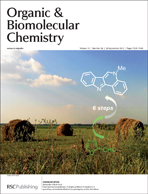
The inside cover highlights the work of Alexander V. Butin and colleagues, who have developed a simple method for the transformation of furfural, a large-scale product from the processing of agricultural and forestry wastes, into the  potent pharmacologically active compounds indolo[3,2-c]quinolines and isocryptolepines.

From biomass to medicines. A simple synthesis of indolo[3,2-c]quinolines, antimalarial alkaloid isocryptolepine, and its derivatives
Maxim G. Uchuskin, Arkady S. Pilipenko, Olga V. Serdyuk, Igor V. Trushkov and Alexander V. Butin

Both of these cover articles will be free to access for the next 6 weeks.

Also of interest in this issue is the review:

Organic fluorine as a polypeptide building element: in vivo expression of fluorinated peptides, proteins and proteomes

from L. Merkel and N. Budisa who present the most recent advances in the field of protein biosynthesis using fluorinated amino acids.

Read the entire issue HERE today!

Digg This
Reddit This
Stumble Now!
Share on Facebook
Bookmark this on Delicious
Share on LinkedIn
Bookmark this on Technorati
Post on Twitter
Google Buzz (aka. Google Reader)

Trojan horse tuberculosis treatment
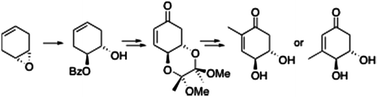
A Chemistry World story on the OBC paper ‘Syntheses of mycobactin analogs as potent and selective inhibitors of Mycobacterium tuberculosis’

During the Trojan war, Greeks built a huge wooden horse, hid men inside it and left it outside the city of Troy. The Trojans, claiming it as a victory trophy, brought it into their city. That night, the Greek force crept out of the horse, opened the gates for the rest of the Greek army and they destroyed the city of Troy

The emergence of drug resistant bacterial strains has led to an urgent need for new antibiotic agents. Scientists in the US are utilising the iron uptake pathway of Mycobacterium tuberculosis as a ‘Trojan horse’ approach to tuberculosis treatment.

Marvin Miller at the University of Notre Dame and colleagues have synthesised analogues of iron scavenging compounds that contain a maleimide functional group for future drug conjugation. Miller explains that these compounds will be actively assimilated by the M. tuberculosis pathogen by the active iron transport system, but can also carry a lethal agent into the pathogen.

One of the challenges of synthesising drug conjugates is finding a suitable functional group to attach the drug to the conjugate. The maleimide functionalised mycobactin analogue synthesised by the team simplifies the synthetic route by reducing the need for protecting groups. Thiol-maleimide chemistry can then be used to attach the drug.

Derek Tan, an expert in rational drug design at the Memorial Sloan–Kettering Cancer Center, US, is enthusiastic about the work. He believes that the advantage of the maleimide functional group is that it can react with nucleophiles, which may already be present in a potential conjugate drug, as opposed to electrophiles, which generally need to be synthetically introduced into the conjugate drug. This maleimide–mycobactin analogue ‘will enable the future synthesis of a wider array of potential Trojan horse antibiotics’, says Tan.

Miller and co-workers found that the maleimide–mycobactin analogue displayed antibiotic activity against Mycobacterium tuberculosis, but it was inactive against a broad panel of Gram-positive and Gram-negative bacteria. ‘The use of siderophores [iron chelating compounds] to deliver antibiotics exclusively into a single type of bacteria (e.g., Mtb, P. aeruginosa, E. coli), could reduce the administration of broad-spectrum antibiotics, minimising exposure and therefore the development of drug resistance’ says Miller.

In the future, the team intends to use a rational approach for selecting drugs to attach to the maleimide–mycobactin analogue, starting with drugs that inhibit essential survival processes.

References
1. R E Juárez-Hernández, S G Franzblau and M J Miller, Org. Biomol. Chem., 2012, DOI: 10.1039/c2ob26077h

2. Chemistry World story by Alisa Becker

Digg This
Reddit This
Stumble Now!
Share on Facebook
Bookmark this on Delicious
Share on LinkedIn
Bookmark this on Technorati
Post on Twitter
Google Buzz (aka. Google Reader)

Caffeine test to tell if decaf coffee really is decaffeinated

Graphical abstractScientists in Switzerland have synthesised a dye (3,4:3’,4’-bibenzo[b]thiophene-2,2’-disulfonate) that can be used as a sensitive and selective molecular probe for the fluorimetric detection of caffeine in water.

The system’s sensitivity and selectivity are higher than those of current synthetic caffeine sensors, so much so that caffeine can be detected in the sub-millimolar concentration range, the researchers claim. The team prepared sensor test strips on which a change in emission colour on addition of caffeine was easy to detect by the naked eye.

A ratiometric fluorescence sensor for caffeine
Nicolas Luisier, Albert Ruggi, Stephan N. Steinmann, Laurane Favre, Nicolas Gaeng, Clémence Corminboeuf and Kay Severin
DOI: 10.1039/C2OB26117K

Digg This
Reddit This
Stumble Now!
Share on Facebook
Bookmark this on Delicious
Share on LinkedIn
Bookmark this on Technorati
Post on Twitter
Google Buzz (aka. Google Reader)