Introducing two new article types for Organic & Biomolecular Chemistry

OBC is introducing two new review article types: Reviews and Perspectives. These replace previous review article types and offer our authors and readers an even broader range of reviews, opinions and commentaries on the latest developments in organic chemistry and chemical biology.

Reviews
OBC Reviews are short, easy-to-read review articles covering current areas of interest to the OBC audience. Flexible in style, they give a concise and critical appraisal of recent advances in an established field or a new area of research.

Authors are encouraged to include their own views on developments, trends and future directions, with speculation about the future potential of the field particularly encouraged. Reviews are typically 6-12 pages in length. 

Reviews replace the previous Perspective and Emerging Area article types. While there is a change in name, the flexibility and breadth of style and content remain very much the same. Authors can write on established topics of current interest or emerging topics that are in the early stages of development. All of these styles will be consolidated under the Review name.*

Perspectives
OBC Perspectives are changing. These are now a new article style which will highlight pieces of exciting, recently-published research. Written by the authors of the original research, Perspectives will give a personal viewpoint on the topic, discussing their research in the wider context of the field and the future potential for the area.

Perspectives are designed to be short (2-4 printed pages) articles, briefly covering:

  • The background to the research area; its importance and previous developments
  • A summary of the key aspects of the research paper(s) recently published by the author
  • An outlook on future progression of the field, including how the author’s research could impact that

 Each Perspective will focus on just one or two recently-published research papers by the author. They will not cover large aspects of an author’s previous research.

 For guidelines on the new article types please click on the following links: Reviews | Perspectives.

*As a result of these changes the Emerging Area article type has been discontinued. Any emerging area style article should now be submitted under the Review article type.

Digg This
Reddit This
Stumble Now!
Share on Facebook
Bookmark this on Delicious
Share on LinkedIn
Bookmark this on Technorati
Post on Twitter
Google Buzz (aka. Google Reader)

Monitoring ATP cleavage by fluorescence

This paper is HOT as recommended by the referees, and is free to access for 4 weeks.
Published on behalf of Steve Moore, Organic & Biomolecular Chemistry web science writer.

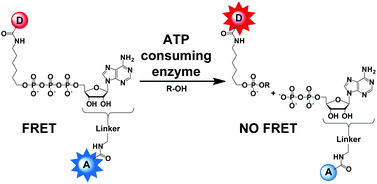
Exploring enzymatic systems that use adenosine triphosphate (ATP) can improve our understanding of various biological pathways. The production of ATP cleavage products can be monitored in vitro using radioactive ATP analogues or by the colorimetric detection of released phosphate or pyrophosphate. These methods do not allow the continuous detection of ATP turnover. Enzyme-coupled assays offer an alternative means to explore these systems, but require consideration of the effects of additional enzymes. Thus, there is a need for probes that enable the continuous study of enzymatic ATP consumption.

This HOT article describes the synthesis of ATP analogues labelled with a fluorescence donor and a fluorescence acceptor, suitable for Förster Resonance Energy Transfer. Excitation promotes energy transfer from the fluorescence donor to the fluorescence acceptor on the same molecule. Cleavage of the ATP analogue prevents energy transfer via an intramolecular pathway, resulting in a large change in fluorescence. Synthetic routes to seven new doubly labelled ATP analogues are reported and the fluorescence properties of these molecules are described using snake venom phosphodiesterase as a model enzyme.

Synthesis and fluorescence characteristics of ATP-based FRET probes
Norman Hardt, Stephan M. Hacker and Andreas Marx
Org. Biomol. Chem., 2013, DOI: 10.1039/C3OB41751D

Digg This
Reddit This
Stumble Now!
Share on Facebook
Bookmark this on Delicious
Share on LinkedIn
Bookmark this on Technorati
Post on Twitter
Google Buzz (aka. Google Reader)

Professor Ramachary joins the Advisory Board

We are pleased to announce that Professor Dhevalapally B. Ramachary, University of Hyderabad, has recently joined the Organic & Biomolecular Chemistry Advisory Board.

The main focus of his research group is to engineer  novel and green asymmetric cascade and multi-component reactions (MCRs) to generate biologically important molecules and natural products in a single step via emerging chiral amines or amino acid-catalysis.

His research group is actively engaged in the design and synthesis of novel enzyme mimetic small organic amines and amino acids to catalyze the fundamental organic reactions in an enantioselective manner.

Direct organocatalytic stereoselective transfer hydrogenation of conjugated olefins of steroids
RSC Adv., 2013,3, 13497-13506 DOI: 10.1039/C3RA41519H, Paper

Direct catalytic asymmetric synthesis of highly functionalized (2-ethynylphenyl)alcohols via Barbas–List aldol reaction: scope and synthetic applications
Org. Biomol. Chem., 2012, 10, 5094-5101 DOI: 10.1039/C2OB25563D, Paper

Observation of neighboring ortho-hydroxyl group participation in organocatalytic asymmetric sequential Michael-lactonization reactions: synthesis of highly substituted chiral spirodihydrocoumarins
Org. Biomol. Chem., 2012, 10, 5825-5829 DOI: 10.1039/C2OB07122C, Communication

Discovery of 2-aminobuta-1,3-enynes in asymmetric organocascade catalysis: construction of drug-like spirocyclic cyclohexanes having five to six contiguous stereocenters
Chem. Commun., 2012,48, 2252-2254 DOI: 10.1039/C2CC17219D, Communication

Digg This
Reddit This
Stumble Now!
Share on Facebook
Bookmark this on Delicious
Share on LinkedIn
Bookmark this on Technorati
Post on Twitter
Google Buzz (aka. Google Reader)

Oliver Kappe: Freedom to explore

An interview with Professor C. Oliver Kappe, University of Graz, published in Chemistry World.

Oliver Kappe is professor of chemistry at the University of Graz in Austria. Research in the Kappe group focuses on enabling technologies for synthesis, including microwave and continuous flow methods.

Read some of his recent work in OBC and Green Chemistry:

A three step continuous flow synthesis of the biaryl unit of the HIV protease inhibitor Atazanavir

Design and evaluation of improved magnetic stir bars for single-mode microwave reactors

On the mechanism of the Dakin–West reaction

Nanocatalysis in continuous flow: supported iron oxide nanoparticles for the heterogeneous aerobic oxidation of benzyl alcohol

Direct aerobic oxidation of 2-benzylpyridines in a gas–liquid continuous-flow regime using propylene carbonate as a solvent

Can you tell us what inspired you to become a scientist?

In my case it was pretty straightforward since my father was also a professor of organic chemistry at the University of Graz. It’s a family affair!

What led you towards microwave chemistry in particular?

At a conference in 1998 in Hungary I heard a lecture by Professor Rajender Varma, now at the US EPA, highlighting the benefits of doing organic chemistry under microwave conditions. At that time it was all kitchen microwaves, there was almost nothing else available. That same year we started our collaboration and the following year published our first joint paper together.

I liked it so much that we continued in many different areas. We studied fundamental issues, such as the occurrence of special microwave effects, as well as the application of microwave chemistry in organic synthesis and fields like peptide chemistry, nanomaterials, polymer synthesis. And of course, finally, we looked at how to scale-up microwave chemistry.

Expand to read more of this interview…

Digg This
Reddit This
Stumble Now!
Share on Facebook
Bookmark this on Delicious
Share on LinkedIn
Bookmark this on Technorati
Post on Twitter
Google Buzz (aka. Google Reader)

HOT Organic & Biomolecular Chemistry articles for October

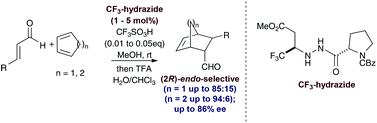
The development of highly active acyclic chiral hydrazides for asymmetric iminium ion organocatalysis
Eoin Gould, Tomas Lebl, Alexandra M. Z. Slawin, Mark Reid, Tony Davies and Andrew D. Smith
Org. Biomol. Chem., 2013, DOI: 10.1039/C3OB41719K, Paper

Free to access until 2nd December


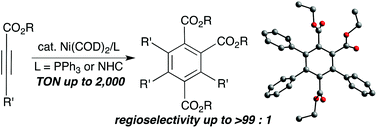
Efficient and regioselective nickel-catalyzed [2 + 2 + 2] cyclotrimerization of ynoates and related alkynes
Sanjeewa K. Rodrigo, Israel V. Powell, Michael G. Coleman, Jeanette A. Krause and Hairong Guan
Org. Biomol. Chem., 2013, DOI: 10.1039/C3OB41872C, Communication

Free to access until 25th November


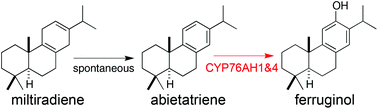
Characterization of CYP76AH4 clarifies phenolic diterpenoid biosynthesis in the Lamiaceae
Jiachen Zi and Reuben J. Peters
Org. Biomol. Chem., 2013, DOI: 10.1039/C3OB41885E, Communication

Free to access until 25th November


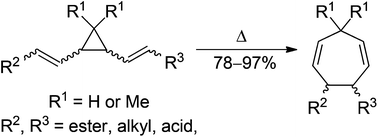
The Cope rearrangement of gem-dimethyl substituted divinylcyclopropanes
Jonathan D. Osler, William P. Unsworth and Richard J. K. Taylor
Org. Biomol. Chem., 2013, DOI: 10.1039/C3OB41617H, Paper

Free to access until 18th November

Expand this blog to see more Hot articles

Digg This
Reddit This
Stumble Now!
Share on Facebook
Bookmark this on Delicious
Share on LinkedIn
Bookmark this on Technorati
Post on Twitter
Google Buzz (aka. Google Reader)

Novel synthetic anion transporters

Annabella Newton is an organic chemist and trainee patent attorney with Phillips Ormonde Fitzpatrick based in Melbourne, Australia.

Acylthioureas as anion transporters: the effect of intramolecular hydrogen bonding

Acylthioureas that can act as ion transporters across cell membranes may lead to novel treatments for cystic fibrosis and associated conditions.

Inorganic anions such as chloride play a crucial role in biological systems, and the mechanisms behind their transport and regulation are still to be fully understood. Proteins embedded in the lipid bilayer regulate these transport processes and carry anions across cell membranes. When these processes are defective, then channelopathic diseases such as cystic fibrosis can develop.

Synthetic anion transporters based on small molecules may serve as replacements for faulty transport proteins, and may therefore find use in the treatment of such diseases.

Professor Philip Gale and his research group at the University of Southampton have been looking into synthetic membrane transporters for anions based on thiourea scaffolds.

In this HOT Article, Prof. Gale and co-workers discuss the synthesis of a series of acylthioureas and their potential as anion transporters in POPC lipid bilayers. They have discovered that these molecules function effectively as anion antiporters, but that the incorporation of lipophilic moieties leads to a reduction in their efficiency. This is due to an intramolecular hydrogen bond that forms and shields the binding site from interactions with water.

It is clear from these results that striking a balance between hydro- and lipo-philicity of the anion transporter is of crucial consideration in their efficiency. Furthermore, the intramolecular hydrogen bonding behaviour of these molecules may be of use in enabling more hydrophilic moieties to be incorporated in future transporter design. It is hoped that this information will eventually lead to the development of new transporters for medicinal applications.

Acylthioureas as anion transporters: the effect of intramolecular hydrogen bonding
Cally J. E. Haynes, Nathalie Busschaert, Isabelle L. Kirby, Julie Herniman, Mark E. Light, Neil J. Wells, Igor Marques, Vítor Félix and Philip A. Gale
Org. Biomol. Chem., 2013, DOI: 10.1039/C3OB41522H

Digg This
Reddit This
Stumble Now!
Share on Facebook
Bookmark this on Delicious
Share on LinkedIn
Bookmark this on Technorati
Post on Twitter
Google Buzz (aka. Google Reader)

Q3 Top Ten most accessed Organic & Biomolecular Chemistry articles

During July, August and September, the following articles were the Top Ten most accessed:

Synthesis of azetidines and pyrrolidines via iodocyclisation of homoallyl amines and exploration of activity in a zebrafish embryo assay
Antonio Feula, Sundeep S. Dhillon, Rama Byravan, Mandeep Sangha, Ronald Ebanks, Mariwan A. Hama Salih, Neil Spencer, Louise Male, Istvan Magyary, Wei-Ping Deng, Ferenc Müller and John S. Fossey
Org. Biomol. Chem., 2013, 11, 5083-5093
DOI: 10.1039/c3ob41007b

Electrophilicity: the “dark-side” of indole chemistry
Marco Bandini
Org. Biomol. Chem., 2013, 11, 5206-5212
DOI: 10.1039/c3ob40735g

Transition-metal-catalyzed additions of C–H bonds to C–X (X = N, O) multiple bonds via C–H bond activation
Guobing Yan, Xiangmei Wu and Minghua Yang
Org. Biomol. Chem., 2013, 11, 5558-5578
DOI: 10.1039/c3ob40652k

Synthetic applications of photoredox catalysis with visible light
Yumeng Xi, Hong Yi and Aiwen Lei  
Org. Biomol. Chem., 2013,11, 2387-2403
DOI: 10.1039/C3OB40137E

Bioorthogonal labelling of biomolecules: new functional handles and ligation methods
Marjoke F. Debets, Jan C. M. van Hest and Floris P. J. T. Rutjes  
Org. Biomol. Chem., 2013,11, 6439-6455
DOI: 10.1039/C3OB41329B

DABCO-promoted synthesis of pyrazoles from tosylhydrazones and nitroalkenes
Meng Tang, Wen Zhang and Yuanfang Kong  
Org. Biomol. Chem., 2013,11, 6250-6254
DOI: 10.1039/C3OB41435C

Organocatalytic asymmetric synthesis of ß3-amino acid derivatives
Sun Min Kim and Jung Woon Yang
Org. Biomol. Chem., 2013, 11, 4737-4749
DOI: 10.1039/c3ob40917a

The first asymmetric total synthesis of (+)-coriandrone A and B
Wenjing Wang, Jijun Xue, Tian Tian, Yingdong Jiao and Ying Li  
Org. Biomol. Chem., 2013,11, 6686-6690
DOI: 10.1039/C3OB41497C

Design and biological characterization of hybrid compounds of curcumin and thalidomide for multiple myeloma
Kai Liu, Datong Zhang, Jeremy Chojnacki, Yuhong Du, Haian Fu, Steven Grant and Shijun Zhang  
Org. Biomol. Chem., 2013,11, 4757-4763
DOI: 10.1039/C3OB40595H

Pd(0)-catalyzed benzylic arylation–oxidation of 4-methylquinazolines via sp3 C–H activation under air conditions
Dan Zhao, Min-Xue Zhu, Yue Wang, Qi Shen and Jian-Xin Li  
Org. Biomol. Chem., 2013,11, 6246-6249
DOI: 10.1039/C3OB41488D

If you have any thoughts or comments on any of these articles, please post these below.

Fancy submitting an article to Organic & Biomolecular Chemistry? Why not submit to us today!

Digg This
Reddit This
Stumble Now!
Share on Facebook
Bookmark this on Delicious
Share on LinkedIn
Bookmark this on Technorati
Post on Twitter
Google Buzz (aka. Google Reader)

Gold nanoparticles detect avian influenza

This paper is HOT as recommended by the referees, and is free to access for 4 weeks.
Published on behalf of Steve Moore, Organic & Biomolecular Chemistry web science writer.

The influenza virus is capable of crossing from animals to humans. The health threat posed by influenza jumping the species barrier has been highlighted by recent outbreaks: N5N1 ‘bird flu’ in 2003/2004, H1N1 ‘swine flu’ in 2009 and avian H7N9 earlier this year. Current methods used for the detection of influenza are time consuming and may require trained analysts and specialised equipment. There is a need for a rapid diagnostic test to discriminate between human influenza and emerging animal strains.

This HOT article describes a gold nanoparticle-based colorimetric assay for the detection of influenza. Specificity was achieved by targeting the haemagglutanin (HA) surface glycoprotein.  Human influenza binds preferentially to sialic acid α2,6 galactose sequences and avian influenza preferentially binds to sialic acid α2,3 galactose sequences. Gold nanoparticles were functionalised with trivalent α2,6-thio-linked sialic acid ligands and polyethylene glycol ligands. A solution of gold nanoparticles was used to detect HA virus surface glycoproteins and in the presence of human influenza virus a colour change was observed. The colour change was caused by the aggregation of the glycopeptide with the influenza virus and was detectable with the naked eye. Owing to the careful choice of ligands, this assay was able to discriminate between human and avian H5N1 influenza.

Glyconanoparticles for the plasmonic detection and discrimination between human and avian influenza virus
María J. Marín, Abdul Rashid, Martin Rejzek, Shirley A. Fairhurst, Stephen A. Wharton, Stephen R. Martin, John W. McCauley, Thomas Wileman, Robert A. Field and David A. Russell
Org. Biomol. Chem., 2013,11, 7101-7107
DOI: 10.1039/C3OB41703D

Digg This
Reddit This
Stumble Now!
Share on Facebook
Bookmark this on Delicious
Share on LinkedIn
Bookmark this on Technorati
Post on Twitter
Google Buzz (aka. Google Reader)

Mutant enzymes help break cocaine habit

An enzyme modified to hydrolyse cocaine 1000 faster than it did before could form the basis of the first medicinal treatment for cocaine addiction. Not only can the enzyme swiftly chop cocaine into inactive metabolites but modification of the enzyme has not affected its selectivity towards other natural substrates.

A treatment for cocaine abuse could be on the horizon © Shutterstock

A treatment for cocaine abuse could be on the horizon © Shutterstock

Cocaine is one the most widely used illegal drugs in the world. Unlike many other commonly abused substances, there are no proven medications available to treat cocaine addition. The health consequences of cocaine abuse are severe and addicts can cause significant societal problems. Finding an addiction treatment is therefore of the utmost importance.

Substrate selectivity of high-activity mutants of human butyrylcholinesterase
Chang-Guo Zhan et al.
Org. Biomol. Chem., 2013, Advance Article
DOI: 10.1039/C3OB41713A

Digg This
Reddit This
Stumble Now!
Share on Facebook
Bookmark this on Delicious
Share on LinkedIn
Bookmark this on Technorati
Post on Twitter
Google Buzz (aka. Google Reader)

OMCOS 17 poster prizes

Congratulations to Carla Obradors and Keisuke Nakamura who received poster prizes from OBC and Chemical Science at OMCOS 17 (17th IUPAC International Symposium on Organometallic Chemistry Directed Towards Organic Synthesis).

Carla Obradors, from the group of Professor Antonio Echavarren at Institute of Chemical Research of Catalonia (ICIQ) won for a poster entitled “Role of the Counterion in Intermolecular Gold(I)-Catalyzed Cycloadditions“, while Keisuke Nakamura from the group of Professor Naoto Chatani at Osaka University presented a poster entitled “Nickel-Catalyzed Transformations Involving the Cleavage of a Carbon-Nitrogen Bond in Aniline Derivative“.

Both winners received a copy of Organometallic Chemistry, edited by Ian J S Fairlamb, Jason M Lynam. Their awards were presented by Chemical Science Associate Editor Matt Gaunt.

Digg This
Reddit This
Stumble Now!
Share on Facebook
Bookmark this on Delicious
Share on LinkedIn
Bookmark this on Technorati
Post on Twitter
Google Buzz (aka. Google Reader)