NJC: important information for our authors about new submission requirements

Written by Denise Parent

Dear NJC Authors,

Today many editors and reviewers evaluate manuscripts “on-screen” (whether this be a computer, a tablet or even a smartphone). It is quite difficult to read manuscripts in which the tables and figures are collected at the end, because the reader then has to scroll back-and-forth between two or even three different pages while reading the text. To facilitate the work of the reviewers as well as the editors, the New Journal of Chemistry Editorial Board has recently adopted a new requirement for submissions to NJC.

This new requirement is described below, along with some additional important information that we ask you to read.

The editors and reviewers thank you for your attention to this new submission requirement. If you have any questions please contact the Montpellier editorial office and we will be happy to help you.

New Submission Requirement
All submissions to NJC must include a file of the “integrated manuscript”: this is a file with all of the tables and artwork integrated into the text at the point close to where the table/figure/scheme, etc., is first mentioned.
– Tables should be complete with the table number and title above the table and footnotes below. Please place the table in the text at a point where the entire table can fit on a single page (unless the table is longer than a single page).
– Figures/schemes/charts should have the number and caption below the artwork. Avoid splitting the graphic over two pages (when possible) by placing it appropriately in the text.

Please see the figure below showing proper presentation of a table and a figure within the text.

Submissions to NJC that do not include this “integrated manuscript” file will be un-submitted, and the author will be requested to upload the “integrated manuscript” file to complete the submission.
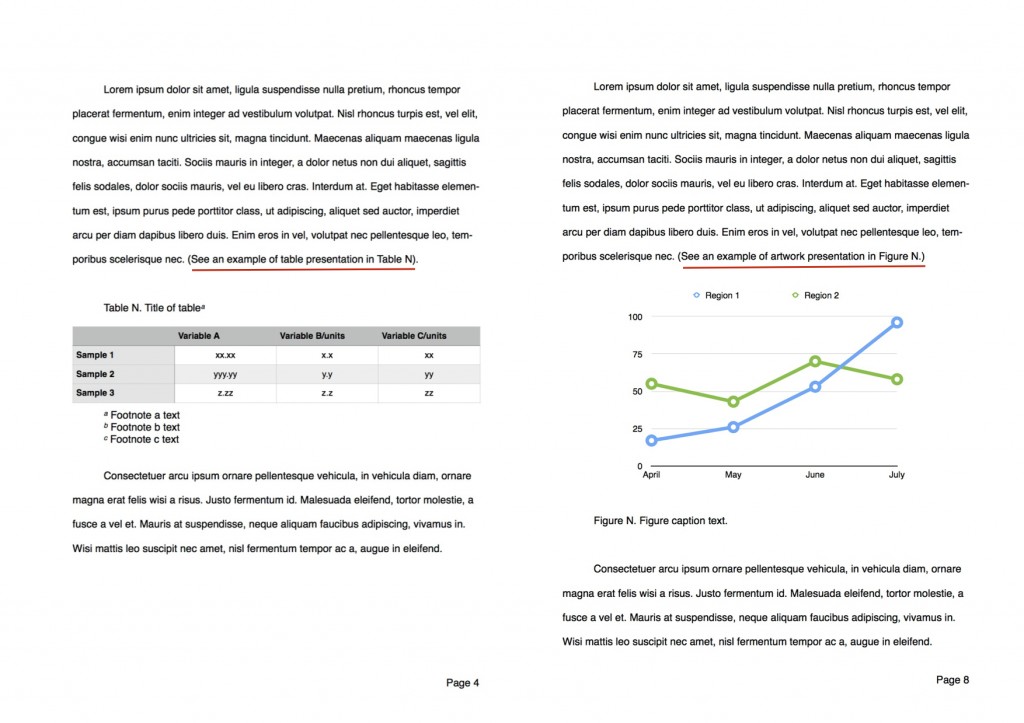
Integrated Manuscript - NJC

Figure showing pages of an "integrated manuscript" with table and figure incorporated in the text

Please note that this new policy does not require authors to use the journal template for NJC article types that do not have a limit on their length (regular Papers and Perspective reviews). However, the latest journal template should be used for Letters and Focus reviews, which are limited to 4 and 6 pages, respectively. Please read more about article types below.

Recommendations
To avoid the shifting of inserted graphics/tables during the generation of the pdf file that is read by the editors and reviewers, we suggest to the author to upload a pdf version of their “integrated manuscript” in addition to the native file. The “file designation” to choose when uploading the “integrated manuscript” file(s) is “article”.

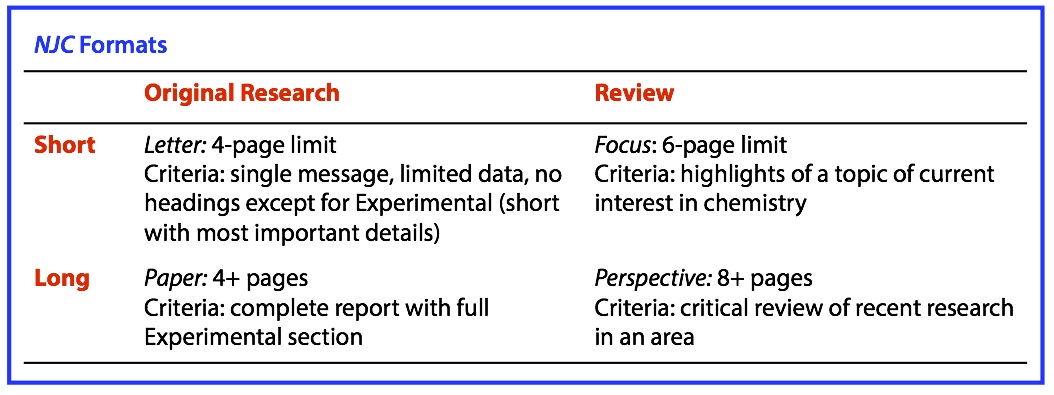
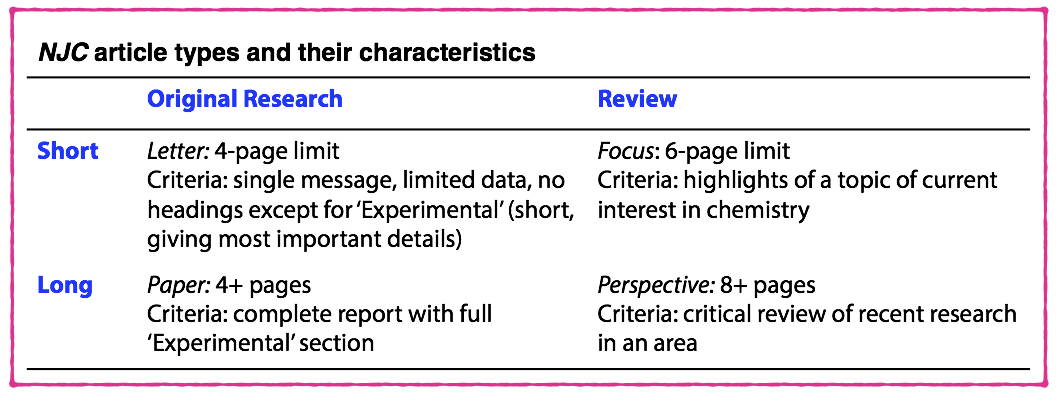
When submitting your manuscript, please be sure to select the appropriate “article type” (see the chart below) from the list given during the online manuscript submission process. (A fifth format is also published—Comments—which are meant for scientific comments on a paper previously published in NJC.)
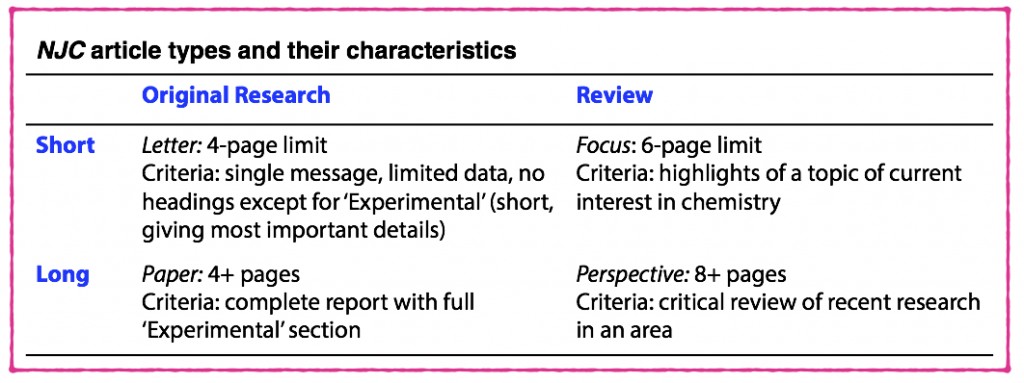
NJC article types

Chart showing the 4 NJC types of original research and review articles and their characteristics

Digg This
Reddit This
Stumble Now!
Share on Facebook
Bookmark this on Delicious
Share on LinkedIn
Bookmark this on Technorati
Post on Twitter
Google Buzz (aka. Google Reader)

NJC issue 10 out now

Discover the articles that comprise the October issue…

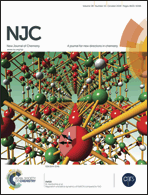
NJC Oct outside cover 2014 - HerlitschkeThe October outside cover, designed by Marcus Herlitschke (Jülich Centre for Neutron Science, Germany) et al., presents their paper in which the first experimental results concerning unusual magnetic properties of FeNCN are reported.
This study reveals the unconventional behaviour of the magnetic parameters below the Néel temperature of 350 K. The comparison of the obtained data with literature data of iron monoxide reveals very similar iron phonon modes with a small softening and a slightly reduced sound velocity. The authors showed that iron monoxide and iron carbodiimide exhibit a similar local iron environment with a mean nearest neighbour distance of about 2.2 Å in an octahedral coordination by oxygen or nitrogen, respectively.

The authors also presented measurements of FeNCN, featuring similarities and differences to the related iron monoxide. In summary, the iron carbodiimide is a particularly attractive target for magnetic investigations using Mössbauer spectroscopy and magnetometry.

Magnetism and lattice dynamics of FeNCN compared to FeO
M. Herlitschke, A. L. Tchougréeff, A. V. Soudackov, B. Klobes, L. Stork, R. Dronskowski and R. P. Hermann.
New J. Chem.
, 2014, 38, 4670-4677. DOI: 10.1039/C4NJ00097H.

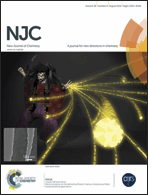
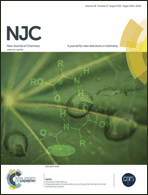
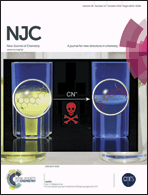
NJC Oct inside cover - WallaceThe inside cover illustrates a paper written by Karl Wallace (University of Southern Mississippi, USA) and his colleagues who are interested in the design of new molecular probes.
The authors have synthesized two coumarin-enamine chemodosimeters which can selectively detect the cyanide ion and investigated the spectroscopic properties in various organic solvents.

An activated coumarin-enamine Michael acceptor for CN−
Aaron B. Davis, Rachel E. Lambert, Frank R. Fronczek, Peter J. Cragg and Karl J. Wallace.
New J. Chem., 2014, 38, 4678-4683. DOI: 10.1039/C4NJ00862F.

Access the entire issue here

Digg This
Reddit This
Stumble Now!
Share on Facebook
Bookmark this on Delicious
Share on LinkedIn
Bookmark this on Technorati
Post on Twitter
Google Buzz (aka. Google Reader)

NJC Editor-in-Chief recipient of award in macrocyclic chemistry

Professor Mir Wais Hosseini was awarded the 2014 Izatt Christensen Award at the ISMSC-9 conference in June.

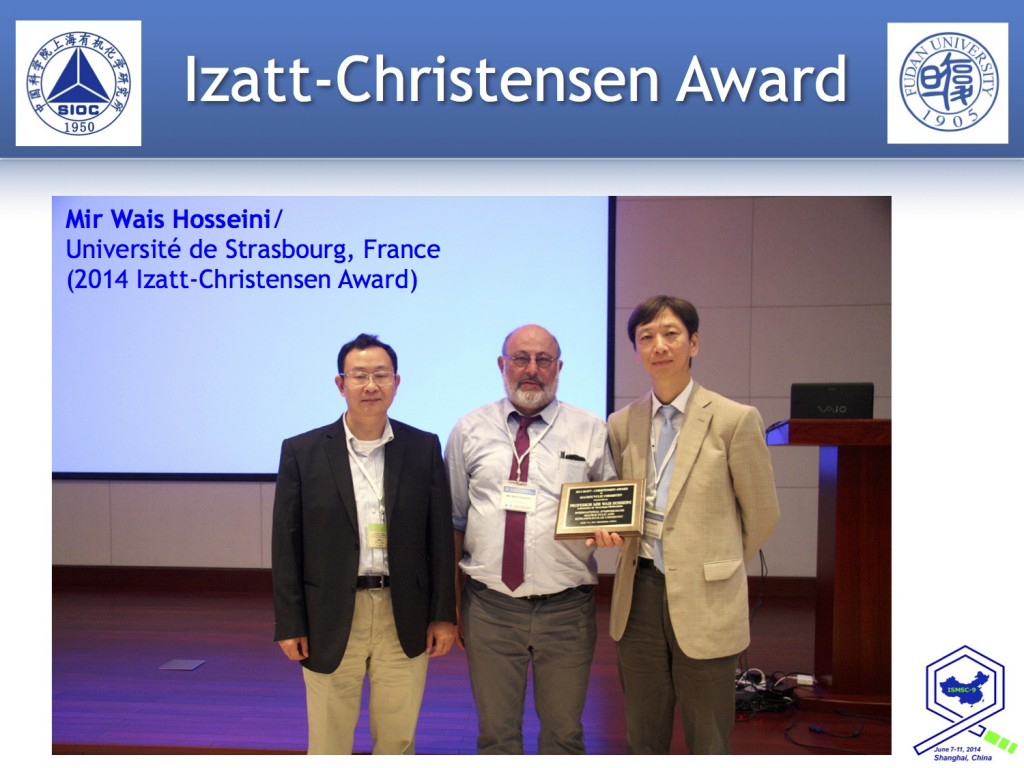
Mir Wais Hosseini, Professor at the Faculty of Chemistry of the University of Strasbourg and at the Institut Universitaire de France (IUF) has been honoured with the 2014 Izatt Christensen Award for Macrocyclic Chemistry. Professor Hosseini was presented with the award at the 9th International Symposium on Macrocyclic and Supramolecular Chemistry, held in Shanghai in June 2014.

Presentation of the Izatt-Christensen award at the 2014 ISMSC meeting.

Presentation of the 2014 Izatt-Christensen Award to Mir Wais Hosseini (middle), flanked by ISMSC-9 Chair Zhanting Li (Fudan University) and former recipient Makoto Fujita (The University of Tokyo).

This award, given to the top macrocyclic chemist in the world as selected by his/(her) peers, is sponsored by IBC Advanced Technologies, Inc. and is awarded yearly. Professor Hosseini received the award for his work in molecular tectonics and molecular machines. He joins a prestigous group of chemists working in the broad area of macrocyclic chemistry, including his Strasbourg colleague Jean-Pierre Sauvage, who received the first Izatt Christensen Award in 1991.

An overview (in French) of the research topics studied in Professor Hosseini’s group can be found on his laboratory website.

Digg This
Reddit This
Stumble Now!
Share on Facebook
Bookmark this on Delicious
Share on LinkedIn
Bookmark this on Technorati
Post on Twitter
Google Buzz (aka. Google Reader)

NJC issue 9 out now

Read the September 2014 issue online!

Sept OFC by Prof. R. KeeneThis month’s outside cover illustrates an article by Prof. Richard Keene (James Cook University, Australia) and co-workers in which they report important observations in the development of multinuclear ruthenium complexes as a new class of anticancer agents.

There has been little success in developing drugs that are active in cancer cell lines resistant to cisplatin. Consequently, there was a need in developing “non-classical” platinum complexes – complexes that can bind DNA differently than cisplatin and its analogues. Thus, multinuclear platinum complexes, where two or more platinum coordination units are linked by a variety of organic ligand bridges, represent a genuinely new class of anticancer drug.

This study shows that it should be possible to optimize cellular uptake and the kinetics of DNA binding, and thereby produce dinuclear ruthenium(II) complexes with significant clinical potential.

Multinuclear ruthenium(II) complexes as anticancer agents
Anil K. Gorle, Alaina J. Ammit, Lynne Wallace, F. Richard Keene and J. Grant Collins.
New J. Chem., 2014, 38, 4049-4059. DOI: 10.1039/C4NJ00545G.
________________________

Also discover the four Letters comprising this issue:

Nan Cao, Teng Liu, Jun Su, Xiaojun Wu, Wei Luo and Gongzhen Cheng.
New J. Chem., 2014, 38, 4032-4035. DOI: 10.1039/C4NJ00739E.

Jinwei Yin, Huimin Shi, Ping Wu, Qingyun Zhu, Hui Wang, Yawen Tang, Yiming Zhou and Tianhong Lu.
New J. Chem., 2014, 38, 4036-4040. DOI: 10.1039/C4NJ00767K.

Hongyu Zhen and Kan Li.
New J. Chem., 2014, 38, 4041-4044. DOI: 10.1039/C4NJ00768A.

Yang Liu, Jianan Zhang, Shoupei Wang, Kaixi Wang, Zhimin Chen and Qun Xu.
New J. Chem., 2014, 38, 4045-4048. DOI: 10.1039/C4NJ00816B.

Access the full issue here.

Digg This
Reddit This
Stumble Now!
Share on Facebook
Bookmark this on Delicious
Share on LinkedIn
Bookmark this on Technorati
Post on Twitter
Google Buzz (aka. Google Reader)

NJC call-for-papers: ‘Frontiers of Organo-f-element Chemistry’ themed issue

New Journal of Chemistry invites contributions to a themed issue on the organometallic chemistry of lanthanide and actinide elements.

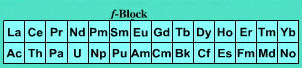
As part of the Pacifichem 2015 conference in Honolulu, Hawaii, USA (December 15–20, 2015), there will be a symposium devoted to the topic ‘Frontiers of Organo-f-element Chemistry‘. This symposium will focus on recent advances and future directions in the organometallic chemistry of lanthanide and actinide elements. It is intended to cover all fundamental and technological aspects of organo-f-element chemistry.

Organo-f-element chemistry continues to be one of the most attractive fields for potential applications in homogeneous catalysis and organic synthesis. The main goal of this symposium is to bring together the world’s leading experts in the field to discuss and elucidate current trends in fundamental and applied organo-f-element chemistry and to identify the most promising future developments for the next decade.

Scope
New Journal of Chemistry (NJC), an CNRS journal published by the RSC, will publish a thematic issue on organo-f-element chemistry in October 2015, shortly before the symposium. The symposium invited speakers have agreed to contribute to this thematic issue. We cordially invite you to join them with your contribution in the broad area of organo-f-element chemistry.

All aspects of organo-f-element chemistry (lanthanides and actinides, theoretical and synthetic studies, catalysis and materials science) are welcome. Full Papers, Letters (communications with limited data and a single message; 4-page limit), Perspective  reviews (with no length limitations) and Focus reviews on a topic of current interest (6-page limit) will be accepted.
 

Guest Editors
Professor Dr. Frank T. Edelmann (Madgeburg, Germany)
Professor Peter Junk (James Cook University, Australia)

How to submit and deadline
Please use the manuscript templates for your contributions and submit using the NJC manuscript submission website. Please clearly indicate in the ‘Comments to the Editor’ section that the contribution is intended for the Organo-f Element themed issue.

Please select the correct format for your contribution. These are clearly defined in the table below.

All contributions will undergo the usual evaluation process (see the January 2014 editorial for further details).


The deadline to submit is March 1, 2015.
 Contributions received after this date will be considered but inclusion in the themed issue, if accepted, is not guaranteed.


Specifications for NJC manuscript formats

For further information:
Read NJC
More news
Submit to NJC
Contact us: NJC “at” univ-montp2.fr

Digg This
Reddit This
Stumble Now!
Share on Facebook
Bookmark this on Delicious
Share on LinkedIn
Bookmark this on Technorati
Post on Twitter
Google Buzz (aka. Google Reader)

NJC issue 8 out now

Read the articles published in the last summer issue of NJC

Aug OFC by Prof. YamauchiOur outside cover, designed by Prof. Yamauchi (National Institute for Materials Science, Japan) and his colleagues, presents a Focus article dedicated to mesoporous fibers.

The authors review several works on non-siliceous mesoporous fibers synthesized with both soft- and hard-templates. They also discuss the orientation control of the mesochannels inside the fibers, which is important for considering the adsorption and diffusion of molecules, and they introduce their recent works on the novel synthesis of mesoporous fibers.

Recent progress on the tailored synthesis of various mesoporous fibers toward practical applications
Norihiro Suzuki, Jian Liu and Yusuke Yamauchi.
New J. Chem., 2014, 38, 3330-3335. DOI: 10.1039/C4NJ00016A.

Aug IFC by Dr ChahmaThe inside cover illustrates a paper by Dr Chahma (Laurentian University, Canada) and his co-workers in which they  describe the characterization of interactions between a free amino acid and chiral conducting surfaces using cyclic voltammetry and FTIR spectroscopy.

They report that being able to control the functionalities on conducting surfaces can help tune the chemical and electrochemical properties of the modified surfaces, thereby affecting the detectability of immobilized molecules on them.

Characterization of phenomena occurring at the interface of chiral conducting surfaces
M’hamed Chahma, Christopher D. McTiernan and Sara A. Abbas.
New J. Chem., 2014, 38, 3379-3385. DOI: 10.1039/C4NJ00489B.

_______________________________________________________________________________

The second Focus article is written by Dr Nicolas Giuseppone (University of Strasbourg) and co-workers in which they present how chromatographic, spectroscopic, and microscopic techniques, as well as theoretical modelling and statistical data treatment, are instrumental in the new research area of dynamic combinatorial systems, a significant area at the interface of molecular biology and materials science. The authors illustrate the advantages of a number of experimental and theoretical methods by a non-exhaustive review of examples from the recent literature.

Experimental and theoretical methods for the analyses of dynamic combinatorial libraries
Maria Cristina Misuraca, Emilie Moulin, Yves Ruffa and Nicolas Giuseppone.
New J. Chem., 2014, 38, 3336-3349. DOI: 10.1039/C4NJ00304G.

To find out more, access the full issue

Digg This
Reddit This
Stumble Now!
Share on Facebook
Bookmark this on Delicious
Share on LinkedIn
Bookmark this on Technorati
Post on Twitter
Google Buzz (aka. Google Reader)

Congratulations to the NJC Poster Prize winner at ISXB-1

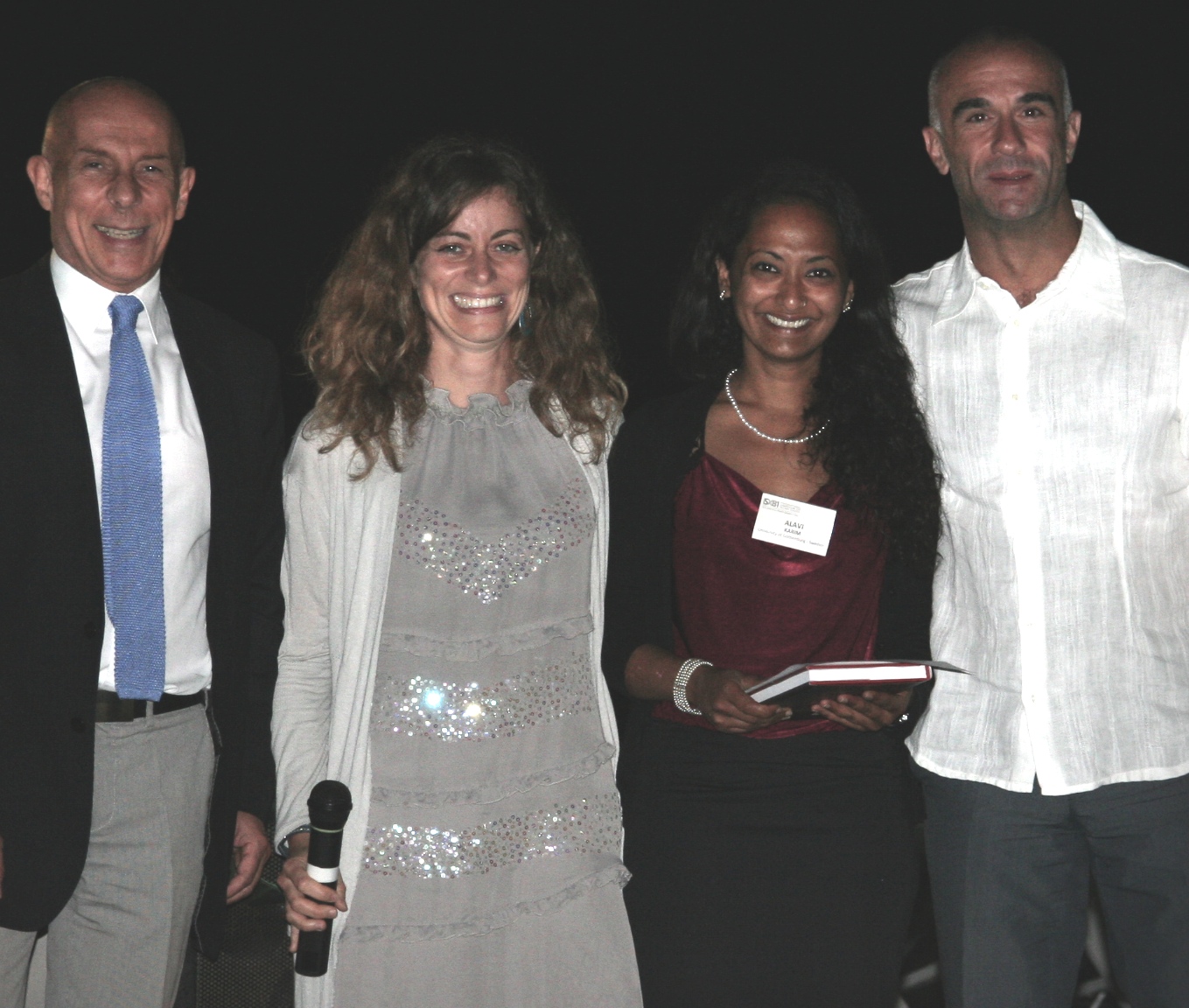
Graduate student Alavi Karim from the group of Prof Mate Erdelyi at the University of Gothenburg, Sweden, has been recognized for her work on halogen bonding.

NJC was pleased to honour Alavi Karim from the University of Gothenburg (Sweden) for her outstanding poster presentation at the 1st International Symposium on Halogen Bonding (ISXB-1) that was held in Porto Cesareo (Italy) on June 18–22.

Alavi Karim is a graduate student in the Department of Chemistry and Molecular Biology where she works under the supervision of Dr. Mate Erdelyi. Her project currently focuses on Understanding Halogen Bonding in Solution.

In her award-winning poster titled “The Nature of [N–Cl–N]+ and [N–F–N]+ Halogen Bonds in Solution” she presented solution-phase NMR spectroscopy data and theoretical studies investigating the geometries and stabilities of the highly reactive, lighter haloniums in comparison to their well-studied iodonium and bromonium centered analogues. Alavi said: “We have characterized three-centre-four-electron halogen bonds, [N–X–N]+, in solution and demonstrated the iodine-, bromine- and chlorine-centred halogen bonds to be static symmetric. In line with fluorine, the [N+–F···N] system shows different behaviour in comparison to the heavier halogens. The complex is asymmetric and thus encompasses one conventional-covalent and one conventional-weak halogen bond. The fluorine- and chlorine-centred systems are highly reactive and could therefore only be stabilized in solution at low temperature. The conclusions drawn from NMR studies were supported by DFT calculations.”

The poster prize committee and winner (from left to right): Giuseppe Resnati, Francesca Baldelli-Bombelli, Alavi Karim and Pierangelo Metrangolo.

Many congratulations to Alavi on receiving her NJC poster prize. She also received a book from the Royal Society of Chemistry and a 1-year electronic subscription to New Journal of Chemistry.

You can read more about the ISXB-1 by visiting their website.

To keep up-to-date with all the latest research, sign up for the journal’s e-alerts.

Digg This
Reddit This
Stumble Now!
Share on Facebook
Bookmark this on Delicious
Share on LinkedIn
Bookmark this on Technorati
Post on Twitter
Google Buzz (aka. Google Reader)

NJC issue 7 out now

Discover the second summer issue of NJC now!

This month’s issue begins with a Focus article by Dr Fuwei Li (Lanzhou Institute of Chemical Physics, Chinese Academy of Sciences) and co-workers in which the authors review reactions that introduce carbonyl groups into unactivated heterocycles. They highlight that various heterocycles could be utilized as simple starting materials to generate carbonyl group containing target molecules.

Carbonylative diversification of unactivated heteroaromatic compounds
Rui Lang, Chungu Xia and Fuwei Li.
New J. Chem., 2014, 38, 2732-2738. DOI: 10.1039/C4NJ00099D.

This month’s front cover illustrates the Letter by Dr Soumen Basak (Saha Institute of Nuclear July OFC - Dr BasakPhysics, India) and co-workers who report an elegant, facile and green protocol for designing dendrimer-like assemblies of multicolor fluorophore-labeled peptides grafted on gold nanoparticles.

According to the authors, multicolour fluorescent labeling of both intra- and extracellular structures is a powerful technique for simultaneous monitoring of multiple complex biochemical processes. These multi-functional nanoparticles have shown great promise as new probes for biomedical imaging and carriers in drug delivery.

A multicolor fluorescent peptide–nanoparticle scaffold: real time uptake and distribution in neuronal cells
Kallol Bera, Shounak Baksi, Moupriya Nag, Subhas Chandra Bera, Debashis Mukhopadhyay and Soumen Basak.
New J. Chem., 2014, 38, 2739-2743. DOI: 10.1039/C4NJ00265B.July IFC - Dr Loots

The inside cover was designed by Dr Leigh Loots (University of Stellenbosch, South Africa).

Dr Loots and her colleagues demonstrated that the synthesis of novel pyridinium zwitterionic compounds show a great potential as a new class of supramolecular building blocks for the formation of ionic as well as metal-organic frameworks.

Synthesis and solid-state supramolecular chemistry of a series of pyridinium-derived zwitterions
Leigh Loots, Delia A. Haynes and Tanya le Roex.
New J. Chem., 2014, 38, 2778-2786. DOI: 10.1039/C4NJ00281D.

Read the full issue here

Digg This
Reddit This
Stumble Now!
Share on Facebook
Bookmark this on Delicious
Share on LinkedIn
Bookmark this on Technorati
Post on Twitter
Google Buzz (aka. Google Reader)

Hot Article: Dye Hard

covalent modification

Industrial printing and fabric-dying processes generate vast amounts of wastewater. The removal of these industrial dyes, many of which are harmful to both aquatic and human health, is mandatory.

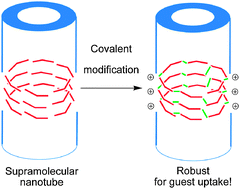
In this NJC paper, Jianyong Zhang, Cheng-Yong Su and co-workers (Sun Yat-Sen University, Guangzhou, China) report a method for generating robust and mechanically stable nanotubes by modification of a supramolecular gel via a covalent capture reaction.

The surface of the resulting structure is cationic, allowing for the effective and selective adsorption of anionic dyes over cationic or neutral species. The authors also report that the materials can be reused for dye capture without losses in their capture ability.

 To find out more, read the full article, which is free to access for of 4 weeks:

Surface modification of supramolecular nanotubes and selective guest capture
Minjuan Lin, Haoliang Liu, Philip W. Miller, Jianyong Zhang and Cheng-Yong Su
New J. Chem., 2014, DOI: 10.1039/C4NJ00445K

Digg This
Reddit This
Stumble Now!
Share on Facebook
Bookmark this on Delicious
Share on LinkedIn
Bookmark this on Technorati
Post on Twitter
Google Buzz (aka. Google Reader)

Hot Article: The Shining Film

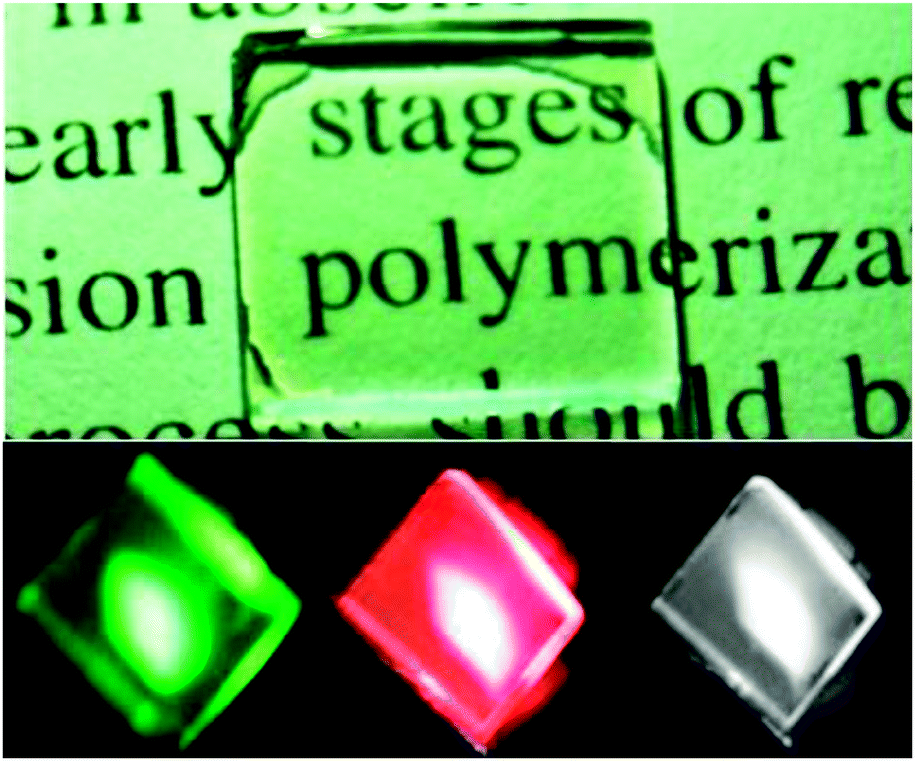
Photoluminescent, lanthanide-containing, organic-inorganic hybrid materials find applications in various fields, such as: fluorescent biology, fluoroimmunoassays, NIR-emitting probes and amplifiers for optical communications.

Transparent thin films


In this NJC article, Ji-Na Hao and Bing Yan (Tongji University, Shanghai) report the preparation of new polymer thin films co-doped with lanthanide complexes and zeolite A. The lanthanide complexes are embedded into the cages of the zeolite, leading to host–guest materials with markedly enhanced thermal- and photo-stabilities.

All the materials are transparent and maintain the luminescent properties that are characteristic of lanthanide materials, emitting light with tuneable colours depending on the lanthanide used.


To find out more, read the full paper, which is free to access for a period of 4 weeks:

Ji-Na Hao and  Bing Yan
New J. Chem., 2014,  DOI: 10.1039/C4NJ00466C
Digg This
Reddit This
Stumble Now!
Share on Facebook
Bookmark this on Delicious
Share on LinkedIn
Bookmark this on Technorati
Post on Twitter
Google Buzz (aka. Google Reader)