Archive for the ‘Hot Article’ Category

Promising multifunctional two-photon chromophores for photodynamic therapy

Scientists from the Universities of Rennes and Nancy in France have developed dual-role biphotonic chromophores for photodynamic therapy (PDT) applications that retain fluorescence properties, thus enabling their 3-D localization and the selective irradiation of cancer cells when combined with targeting.

In their paper selected as ‘Hot Article’, the collaboration led by Mireille Blanchard-Desce presents the synthesis and photophysical study of “banana-shaped” chromophores where the nature of the conjugated backbone is modified by playing with the aromatic units (a complementary approach to that based on the incorporation of heavy atom substituents).

By optimizing the chromophore structure of a series of fluorene derivatives, the researchers were able to design photosensitizers exhibiting large two-photon adsorption (TPA) cross section in the biologically useful spectral region combined with singlet oxygen production.

‘This route allows to combine in a single biphotonic chromophore several features highly desirable for two-photon PDT: fluorescence (for localisation and subsequent localized irradiation), large and broad TPA responses in the spectral range of interest for bio-oriented applications (700-1000 nm), as well reasonable singlet oxygen sensitization ability’, says Mireille Blanchard-Desce.

The team is now working on developing nano-objects with very high TPA, that incorporate the biphotonic sensitizers.

Banana-shaped biphotonic quadrupolar chromophores: from fluorophores to biphotonic photosensitizers
Cédric Rouxel, Marina Charlot, Youssef Mir, Céline Frochot, Olivier Mongin and Mireille Blanchard-Desce
New J. Chem., 2011, Advance Article
DOI: 10.1039/C1NJ20073A, Paper

Mild methodologies: electrochemical hydrogenolysis in ionic liquids

In this NJC Hot Article, Richard Compton and co-workers at the University of Oxford highlight novel electro-synthetic applications of ionic liquids.

The team has decorated carbon nanotubes with Palladium nanoparticles and used the composite material for the efficient electrochemical deprotection of common functional groups in ionic liquids (IL), thus demonstrating that Pd nanoparticles can be used for clean, efficient, safe electro- chemical hydrogenolysis in IL media.

This NJC article will be of interest to synthetic organic and inorganic chemists, electrochemists, material chemists, pharmaceutical chemists and process chemists alike.


Palladium nanoparticle-modified carbon nanotubes for electrochemical hydrogenolysis in ionic liquids
Yao Meng, Leigh Aldous, Ben S. Pilgrim, Timothy J. Donohoe and Richard G. Compton
New J. Chem., 2011, Advance Article
DOI: 10.1039/C1NJ20070D, Paper

Digg This
Reddit This
Stumble Now!
Share on Facebook
Bookmark this on Delicious
Share on LinkedIn
Bookmark this on Technorati
Post on Twitter
Google Buzz (aka. Google Reader)

Hot Article: A persistant (amino)(ferrocenyl) carbene

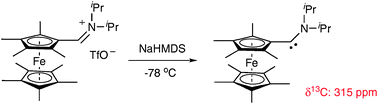
Ferrocene units confer a set of interesting properties to ligands for transition metal complexes, such as reversible redox- properties, planar chirality, or strong electron donating ability. While there are numerous examples of ferrocenylphosphines in which the ferrocene unit is directly bonded to the active coordination center – therefore maximizing its impact – attempts at stabilizing a carbene center using one or two ferrocenyl substituents had yet to prove successful.

Now, Guy Bertrand and colleagues at the University of California, Riverside, have successfully prepared the first stable carbene featuring a ferrocenyl unit directly bonded to the electron-deficient center, by using a pi-electron-donating substituent in the form of an amino group. The team was able to spectroscopically characterize and chemically trap the novel (amino)(ferrocenyl)carbene compound.

Such work is envisioned to open perspectives for the synthesis of new types of carbene ligands, and will be of high relevance to researchers in fundamental chemistry, organometallics, supramolecular chemistry, catalysis and beyond. Challenges ahead now include the further stabilization of such carbenes, via the preparation of cyclic ferrocenylaldiminium systems.

A persistent (amino)(ferrocenyl)carbene
Alan DeHope, Daniel Mendoza-Espinosa, Bruno Donnadieu and Guy Bertrand
New J. Chem., 2011, Advance Article
DOI: 10.1039/C1NJ20170K, Paper

Interested? Why not read this NJC Article selected as Hot, FREE to access until 6th of June 2011.
Let us know what you think and leave us a comment below!

This article will be part of the themed issue of NJC honouring the life and work of Prof. Didier Astruc, on the occasion of his 65th birthday – Coming soon.

Digg This
Reddit This
Stumble Now!
Share on Facebook
Bookmark this on Delicious
Share on LinkedIn
Bookmark this on Technorati
Post on Twitter
Google Buzz (aka. Google Reader)

News in Phosphole Chemistry – changing the course of intramolecular dimerisation

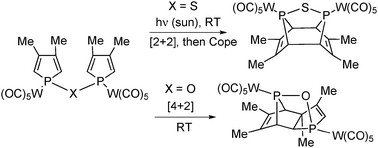
A new facet of Phosphole chemistry is being uncovered it this NJC Letter by François Mathey et al. at the Nanyang Technological University, Singapore. Phosphole rings have been known for a long time to dimerize via [4+2] cycloaddition whenever the phosphorus lone pair is oxidized or complexed. The [2+2] dimerization, on the contrary, is almost unknown.

Now, the authors show that a minor change in the structure of the bisphospholes derivative – i.e. P-O-P vs. P-S-P – completely suppresses the familiar (4+2)-cycloaddition in favour of the thermally forbidden (2+2) -cycloaddition despite considerable steric constraint.

Under solar light at room temperature, the tungsten pentacarbonyl complex of the P–S–P-linked biphosphole undergoes a [2+2] intramolecular cycloaddition. Then, this [2+2] dimer gives the original [4+4] dimer via a Cope rearrangement. This sequence stands in sharp contrast with the behavior of the corresponding P–O–P-linked biphosphole which undergoes a classical [4+2] cycloaddition.

This NJC Letter has been rated as Hot, and will be FREE to access for 4 weeks. Read it now and let us know what you think!

Intramolecular [4+2] versus [2+2] cycloadditions in P–X–P-linked biphospholes (X = O, S)
Matthew P. Duffy, Yuhan Lin, Liow Yu Ting and François Mathey
New J. Chem., 2011, Advance Article
DOI: 10.1039/C1NJ20087A, Letter

This article will be part of the themed issue of NJC honouring the life and work of Prof. Didier Astruc, on the occasion of his 65th birthday – Coming soon.

Digg This
Reddit This
Stumble Now!
Share on Facebook
Bookmark this on Delicious
Share on LinkedIn
Bookmark this on Technorati
Post on Twitter
Google Buzz (aka. Google Reader)

NJC Hot Articles: our latest selection

Here are the latest Hot Articles published in NJC, selected by the journal editorial team and highly commended by the reviewers. All are FREE to access for 6 weeks, so why not take your pick and have a read now?

These four hot articles have been made freely available until April 28th, so why not download the ones that interest you today and let us know what you think in our blog below.

If you have some of your own exciting, high impact research to publish then consider submitting your manuscript to NJCvia our online submission system.

Digg This
Reddit This
Stumble Now!
Share on Facebook
Bookmark this on Delicious
Share on LinkedIn
Bookmark this on Technorati
Post on Twitter
Google Buzz (aka. Google Reader)

Mimicking bone growth for the conservation of historic stones

Since the 1950’s, synthetic organic polymers have been widely used as consolidants for the preservation of historic stones, altered by the weather conditions. Although still in use, their conservation efficiency has been drastically reconsidered due to their fugitiveness, thermo- and photo-degradation, limited removability, and incompatibility with the stone matrix. Synthetic organic polymers are thus believed to be harmful in the long term and unsuitable materials for the consolidation of historic stone.

Inorganic materials such as alkaline earth hydroxides are better suited for the task due to their higher physicochemical compatibility with the rocks, but mostly exist as isolated particles acting as fillers only, rather than offering a continuous medium that would ensure an optimal adhesion between the newly produced carbonate and the weathered stone.

Now, Bingjian Zhang and his team at the University of Zhejiang and Tianshui (China) have solved the adhesion issue and developed for the first time a biomimetic approach for the reinforcement of weathered stones. Their strategy was to mimic the growth of bones, by introducing calcium and phosphore sources in the pores of the damaged stone, and then let them mineralize in the presence of collagen at ambient temperature. This biomimetic mineralization process allows a porous and interlinked reinforcing phase of apatite to be formed, which can bind the grains of loose weathered calcareous stone together and provide substantial reinforcement. The team also showed that the breathing function of the stones was retained, due to the porous nature of bone-like apatite. With the highly positive results achieved, this method is promising for the conservation of historic stones, say the researchers, while further challenges lie towards a reinforcement method aimed at non-calcareous rocks.

Biomimic conservation of weathered calcareous stones by apatite
Fuwei Yang, Bingjian Zhang, Yan Liu, Guofeng Wei, Hui Zhang, Weixiang Chen and Zhude Xu
New J. Chem., 2011, Advance Article
DOI: 10.1039/C0NJ00783H, Paper

  • Interested? Then why not download and read the article today! Let us know what you think by leaving a comment below.
  • Digg This
    Reddit This
    Stumble Now!
    Share on Facebook
    Bookmark this on Delicious
    Share on LinkedIn
    Bookmark this on Technorati
    Post on Twitter
    Google Buzz (aka. Google Reader)

    Noteworthy Chemistry: wastewater purification

    Zhaoyang Liu, Hongwei Bai and Darren Delai Sun’s recent NJC article is highlighted in this week’s ACS Noteworthy Chemistry, along with 6 other recent publications from leading journals.

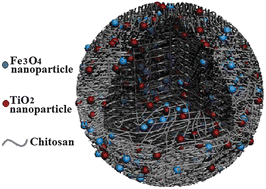
    In this selected paper, the team of scientists from Nanyang Technological University in Singapore report on their design of multi-functional microspheres bearing highly adsorptive, photocatalytic and magnetic properties. These microspheres composed of chitosan, TiO2, and Fe3O4 are then used for water treatments, in which the chitosan matrix provides superhigh adsorption capacity; TiO2 nanoparticles act as nano reactors for the in situ removal of contaminants adsorbed by chitosan under UV irradiation, which is an environment-friendly and safe regeneration. Finally, the magnetic property of Fe3O4 nanoparticles enables effective recovery of the microspheres, using a magnetic field, from treated water for reuse.


    Facile Fabrication of Porous Chitosan/Fe3O4/TiO2 Microspheres with Multifunction for Water Purifications
    Zhaoyang Liu, Hongwei Bai and Darren Delai Sun
    New J. Chem., 2011, 35, 137-140
    DOI: 10.1039/C0NJ00593B

    Interested? Then why not read all about it now.

    This article will be free to access for a period of 6 weeks, until April 14th, upon a simple registration process.

    Do let us know what you think by leaving a comment below!

    Digg This
    Reddit This
    Stumble Now!
    Share on Facebook
    Bookmark this on Delicious
    Share on LinkedIn
    Bookmark this on Technorati
    Post on Twitter
    Google Buzz (aka. Google Reader)

    Hot Article: native enzymes in hybrid materials for efficient catalysis

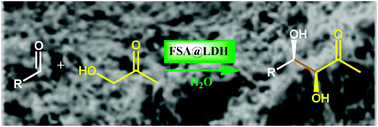
    A native enzyme, which catalyzes stereoselective aldol reactions, was successfully encapsulated in an inorganic support by Forano, Lemaire, and co-workers. This biocatalyst maintains 100% of enzyme activity through a series of different condensation reactions. In addition, the immobilized enzyme is stable under storage and can be reused several times without a notable loss of activity, highlighting its suitability for organic synthesis.

    Efficient immobilization of fructose-6-phosphate aldolase in layered double hydroxide: improved stereoselective synthesis of sugar analogues
    Christine Guérard-Hélaine, Bertrand Légeret, Carlos Fernandes, Vanessa Prévot, Claude Forano and Marielle Lemaire
    New J. Chem., 2011, Advance Article
    DOI: 10.1039/C0NJ00956C, Letter

    Curious? Why not read all about it here. This NJC paper has been rated as ‘hot’ and is FREE to access to all for a period of four weeks, after a simple registration process at: http://pubs.rsc.org/en/account/register. Let us know your thoughts and comments below!

    Digg This
    Reddit This
    Stumble Now!
    Share on Facebook
    Bookmark this on Delicious
    Share on LinkedIn
    Bookmark this on Technorati
    Post on Twitter
    Google Buzz (aka. Google Reader)

    Hot Article : A 3D metal organic framework exhibiting four different magnetic states.

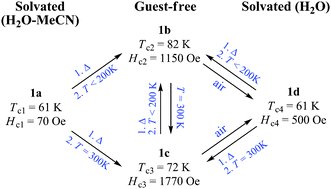
    Sutter and co-workers (Laboratoire de Chimie de Coordination, France) report the synthesis of the 3D metal organic framework of formula [K2(H2O)4Mn5(H2O)8(MeCN){Mo(CN)7}3].2H2O. This new coordination polymer exhibits four different ferromagnetic states showing different magnetic properties depending on the structure and on the presence of H2O molecules and thermal history. Thus, the results described in this paper demonstrate that a porous framework can be achieved with the small cyanide ligand that also ensures good magnetic performances.


    [K2Mn5{Mo(CN)7}3]: an open framework magnet with four Tc conversions orchestrated by guests and thermal history
    Julie Milon, Philippe Guionneau, Carine Duhayon and Jean-Pascal Sutter
    New J. Chem., 2011, Advance Article
    DOI: 10.1039/C0NJ00860E, Paper
    This article was selected as “hot” and will be free to access for a period of four weeks.

    The article will also be part of the forthcoming NJC thematic issue on Molecular Materials, to be published in the summer. To stay up-to-date with the latest NJC developments, sign up to its free table-of-contents email alert at www.rsc.org/alerts

    Digg This
    Reddit This
    Stumble Now!
    Share on Facebook
    Bookmark this on Delicious
    Share on LinkedIn
    Bookmark this on Technorati
    Post on Twitter
    Google Buzz (aka. Google Reader)

    Hot Article : Prussian blue-type thin films and their magnetic anisotropy

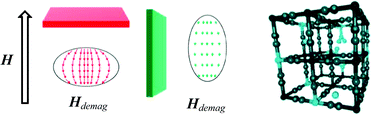
    Meisel and co-workers (University of Florida, USA) report on the elaboration of thin films of a series of Prussian Blue analogs, together with their magnetic behaviour. These films were shown to exhibit magnetic anisotropy by investigating the magnetic susceptibility, and specifically the difference between parallel and perpendicular orientations of the films with respect to the applied magnetic field. The degree of anisotropy is largely explained by demagnetizing effects, and a simple model is discussed. This paper represents a first step towards the understanding of the anisotropy of thin films of coordination polymer systems, of importance if films are to be used in device applications. Furthermore, this manuscript casts light on the origin of the anisotropy of photomagnetic systems.

    Anisotropic magnetism in Prussian blue analogue films
    Daniel M. Pajerowski, Justin E. Gardner, Daniel R. Talham and Mark W. Meisel
    New J. Chem., 2011, Advance Article
    DOI: 10.1039/C0NJ00841A, Paper

  • This article was selected as ‘Hot’ and will be FREE to access for a period of four weeks. Why not read it now and let us know your thoughts by leaving a comment below!
  •  

  • The article will also be part of the forthcoming NJC thematic issue on Molecular Materials, to be published in the summer. To stay up-to-date with the latest NJC developments, sign up to its free table-of-contents email alert at www.rsc.org/alerts
  • Digg This
    Reddit This
    Stumble Now!
    Share on Facebook
    Bookmark this on Delicious
    Share on LinkedIn
    Bookmark this on Technorati
    Post on Twitter
    Google Buzz (aka. Google Reader)