Sandy nanoparticles for safer-by-design sunscreens

Nanoparticles coated with an inert layer of silica could be used in sunscreens and cosmetics to reduce the potential hazards of these increasingly indispensable materials, new research shows.

The particles still block UV rays, but DNA damage is reduced

In recent years, zinc oxide nanoparticles have been used in sunscreen because of their ability to block ultraviolet radiation and produce less opaque products that are attractive to consumers. This isn’t the only application where nanoparticles are making an impact, being found in everything from cancer drugs to batteries.

To read the full article please visit Chemistry World.

Engineering safer-by-design, transparent, silica-coated ZnO nanorods with reduced DNA damage potential
George Sotiriou, Christa Watson, Kimberly Murdaugh, Thomas H. Darrah, Georgios Pyrgriotakis, Alison Elder, Joseph Brain and Philip Demokritou  
Environ. Sci.: Nano, 2014, Accepted Manuscript
DOI: 10.1039/C3EN00062A, Paper

Digg This
Reddit This
Stumble Now!
Share on Facebook
Bookmark this on Delicious
Share on LinkedIn
Bookmark this on Technorati
Post on Twitter
Google Buzz (aka. Google Reader)

Sustainable solution for aqueous purification systems

Having recently read several papers regarding the toxicity of nanoparticles to the aquatic environment, I was starting to view nanoparticles as an environmental bad guy. However, this study conducted by Anthony B. Dichiara and colleagues from Rochester Institute of Technology has stopped me in my tracks. It appears that nanoparticles could provide a sustainable solution for future aqueous purification systems – in the form of carbon nanocomposite papers – and we like sustainable solutions!

Activated carbon is currently the most commonly used material for water purification, but carbon nanotubes have higher adsorption capacities. For an adsorption material to be used for large-scale removal of pollutants from water, the regeneration property and reusability must also be taken into consideration.

In this study, the recycling efficiency of Graphene nanoplatelet-single-walled nanontube hybrid papers (graphene cylinders) when saturated with 2,4-dichlorophenoxyacetic acid was investigated.  Figure 1 shows that every time the papers were recycled the uptake of 2,4-dichlorophenoxyacetic acid always exceeded that of the original adsorbents.

Figure 1

Carbon nanocomposite papers are therefore potential adsorbents for future aqueous purification systems due to their larger adsorption capacity and enhanced recovery ability. So perhaps nanoparticles are not too bad after all!

To read the full article, download a copy for free* by clicking the link below:

Enhanced adsorption of carbon nanocomposites exhausted with 2,4-dichlorophenoxyacetic acid after regeneration by thermal oxidation and microwave irradiation, Antony Dichiara, Jordan Benton-Smith and Reginald Rogers

DOI: 10.1039/C3EN00093A

*Access is free through a registered RSC account – click here to register

Digg This
Reddit This
Stumble Now!
Share on Facebook
Bookmark this on Delicious
Share on LinkedIn
Bookmark this on Technorati
Post on Twitter
Google Buzz (aka. Google Reader)

Cellulose nanocrystals: paving the way to greener production of precious metal catalysts

By Ian Keyte, Doctoral Researcher at University of Birmingham and web writer for the Royal Society of Chemistry Environmental Team

Cellulose-derived structural supports can improve the performance and the environmental credentials of gold nanoparticle catalysts. This study from the Polymer Research Institute of Sichuan University in China demonstrates the potential of this approach.
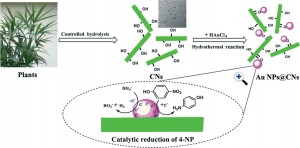

Achieving the optimum performance and stability of catalysts is of paramount importance to the development of a wide range of industrial processes and the manufacture of new products and devices. Gold nanoparticles (Au NPs) are widely used as catalysts in many chemical processes. However, these often suffer from instability owing to their large active surface area which can lead to self-aggregation. They therefore require a supporting matrix, commonly using polymeric encapsulation or support on graphene oxide or silica surfaces.

However, greener, more sustainable approaches are now being sought to improve the environmental credentials of these processes. Cellulose is the most common and abundant natural polymer.  Cellulose nanocrystals (CNs) can therefore provide a possible solution as these posses the desired properties (mechanical strength, self-assembly, high specific surface area, nanometirc dispersity and high stability) to allow them to act as an effective catalyst carrier.

However the use of these have previously involved use of toxic reducing agents such as sodium borohydride or hydrazine hydride. A cleaner synthesis is required. In this study Xiaodong Wu and co workers report the first instance of a one-step, environmentally-friendly synthesis of gold NPs (Au NPs) deposited on cellulose nanocrystals and demonstrate the technical and environmental advantages of this approach.

CNs were derived from bulk cellulose using controlled acid hydrolysis of waste cotton fabric. The Au NPs were synthesised and deposited on to CNs by hydrothermal reduction of HAuCl4. Both Au NP-CN hybrids and unsupported Au NPs were prepared and their performance in the reduction of 4-nitrophenol was compared using UV-Vis spectroscopic analysis. The structure and properties of the resulting particles were characterized using transmission electron microscopy (TEM), X-Ray Diffraction (XRD) and X-Ray photoelectron spectrometric (XPS) techniques.

It was shown that the electron-rich –OH groups, abundant on their surface allow the CNs to provide the dual role of reductant and stabilizer in this process. The larger specific surface area and better dispersity of Au NPs supported on CNs meant these nano-hybrid catalysts displayed enhanced stability and superior catalytic activity than an unsupported Au NP catalyst for the reduction of 4-NP.

This approach offers a number of important advantages over previous traditional techniques. It has a lower overall cost and avoids the use of toxic or dangerous reducing, capping or dispersing agents. Furthermore this process utilises a renewable and biodegradable natural resource since the CNs can be obtained from various plant materials.

This investigation could therefore potentially pave the way to green production of bio-supported organic/inorganic nano-hybrid catalysts with possible further applications in the production of sensors, antibacterial materials and electronic devices.

To access the full article, download your free* copy by clicking the link below:

Green synthesis and formation mechanism of cellulose nanocrystal-supported gold nanoparticles with enhanced catalytic performance

Xiaodong Wu, Canhui Lu, Zehang Zhou, Guiping Yuan, Rui Xiong and Xinxing Zhang Environ. Sci.: Nano, 2014, 1, 71-79 DOI: 10.1039/C3EN00066D

*Access is free through a registered RSC account – click here to register

Digg This
Reddit This
Stumble Now!
Share on Facebook
Bookmark this on Delicious
Share on LinkedIn
Bookmark this on Technorati
Post on Twitter
Google Buzz (aka. Google Reader)

Electrostatic forces – not the only interactions governing nanoparticle deposition.

Virtually all environmental surfaces have microbial biofilms, which are an essential component of natural systems.  Nanoparticles are abundant in nature, but how much do we know about nanoparticle-biofilm interactions?

Kaoru Ikuma and colleagues from the University of Massachusetts Amherst have completed a study highlighting the importance of assessing small-scale biofilm surface characteristics in future nanoparticle-biofilm interaction studies. They hypothesized that the contribution of electrostatic forces in relation to other forces would be dominant in governing the deposition of bare nanoparticles onto polysaccharide-coated surfaces. The also expected biofilm surface charge to impact nanoparticle deposition.

Polysaccharides are a major extracellular component of biofilms. They are ubiquitous in the environment and occur in pure forms as well as in complexes. As polysaccharides are extracellular they are an initial point of contact for nanoparticles and play an important role in early nanoparticle-biofilm interactions. Typical characterization of biofilms often treat all polysaccharides as one entity.  This study suggests that the small-scale chemical and electrochemical identities of the polysaccharides present in the biofilms may play an important role in the initial surface attachment of nanoparticles; therefore effecting their deposition.

The significance of polysaccharide coatings on the deposition of nanoparticles was examined using in-depth characterization of surface properties. It would appear that surface charge density and distribution of the biofilms both contribute to different nanoparticle deposition behaviours.

Kelvin probe force microscopy was used as a probe for spatial variations of surface potential across two different polysaccharides (alginate and dextran sulphate). Patches of lower surface potential are observed as the areas of darker colour on the images below.

alginate (a) and dextran sulfate (b)

The results showed that even though the interactions between nanoparticles and surfaces coated with pure polysaccharides may be governed by electrostatic forces, these interactions can be altered by microscale and nanoscale differences in surface charge. Therefore, instead of treating polysaccharides as one entity, spatial characterization of biofilm surface properties is necessary to improve our understanding of nanoparticle-biofilm interactions.

To find out more, download your free* copy by following the link below.

Deposition of nanoparticles onto polysaccharide-coated surfaces: Implications for nanoparticle-biofilm interactions. Kaoru Ikuma, Andrew Madden, Alan Decho and Boris L. T. Lau 10.1039/C3EN00075C

*Access is free through a registered RSC account – click here to register

Digg This
Reddit This
Stumble Now!
Share on Facebook
Bookmark this on Delicious
Share on LinkedIn
Bookmark this on Technorati
Post on Twitter
Google Buzz (aka. Google Reader)

Could the interactions between seaweed and suncream be posing a threat to aquatic systems?

One of our recent Environmental Science: Nano papers looks into the effect of natural organic matter on the disagglomeration of manufactured TiO2 nanoparticles.

This research, conducted by Frédéric Loosli and colleagues from the University of Geneva, studied the stability of TiO2 nanoparticles at various pH values.

TiO2 nanoparticles (the most produced nanoparticles to date) are used in consumer goods such as cosmetics, paints and as a UV protection agent. These consumer goods are then released into our environment, but there is a lack of data on nanomaterial transformations under relevant environmental conditions.

It is generally assumed that agglomerated nanoparticles are less toxic to aquatic organisms than single nanoparticles. As a given amount of nanoparticles will enter aquatic environments in an agglomerated, potentially less toxic form, the potential risk comes from natural processes which may considerably alter the stability of such agglomerated nanoparticles. Such processes have the possibility to disperse them, increasing diffusion and potential toxicity of the nanoparticles.

This study looked at the effects of two types of natural organic matter, at typical environmental concentrations, to determine if their presence induced significant disagglomeration of large submicron nanoparticle agglomerates. The natural organic matter used for this research were: Suwannee River humic acid, which can act as a pH regulator, and Alginate, which is found in the cell walls of seaweed and is commonly used in the food industry as a stabilizer and a thickening agent.

Figure 1

It was shown that the addition of natural organic material significantly modifies the stability of TiO2 nanoparticles by inducing disagglomeration. Figure 1, taken from the paper, demonstrates how alginate and Suwannee River humic acid effect the disagglomeration of agglomerated nanoparticles differently.

To find out more about this research, download your free* copy by following the link below:

Effect of natural organic matter on the disagglomeration of manufactured TiO2 nanoparticles by Frédéric Loosli, Philippe Le Coustumer and Serge Stoll DOI: 10.1039/C3EN00061C

*Access is free through a registered RSC account – click here to register

Digg This
Reddit This
Stumble Now!
Share on Facebook
Bookmark this on Delicious
Share on LinkedIn
Bookmark this on Technorati
Post on Twitter
Google Buzz (aka. Google Reader)

Summertime DNA damage: Is it the sun or the suncream?

It’s becoming apparent to me that there are nanoparticles all over the place. My vision hasn’t increased outstandingly, but papers like this one in Environmental Science: Nano, which address materials that are used in consumer products, can bring home the relevance of this fast-paced scientific field to everyday life. Read on to find out how, if manufacturers aren’t careful, it might be possible that the suncream you use to protect your skin from UV radiation damage is introducing DNA mutations of its own.

Zinc oxide (ZnO) absorbs UVA and UVB wavelengths; exactly the ones we want to block out when we spend too long in the sun. ZnO is therefore the perfect suncream ingredient. However, micron-sized ZnO particles are bright white in visible light, and no one wants that streaky beach look. Nano-sized ZnO particles, however, are transparent to visible light and are therefore ideal for use in suncream and cosmetics that aim to protect us from UV radiation.

But there is a problem with using ZnO nanoparticles in cosmetics. They have a tendency to induce significant DNA damage and cytotoxicity.

With an increase in recent years in the use of ZnO nano structures in suncreams, efforts must be made to develop safer ZnO particles which maintain their optical properties whilst displaying reduced toxicity.

In this Environmental Science: Nano paper by Philip Demokritou and colleagues from Harvard University, ZnO nanorods were trapped in a biologically inert nanothin amorphous SiO2 coating during the gas phase of synthesis. The team then demonstrated, using human lymphoblastoid cells, that whilst encapsulation did not alter optical properties, the SiO2-coated ZnO produced significantly lower DNA damage than uncoated ZnO nanorods.

TEM images of the uncoated (a,b) and SiO2-coated (c,d) ZnO nanoparticles

Demokritou’s method, or an extension of it, could allow manufacturers to tick all the boxes: use colourless (aesthetically pleasing) ZnO nano structures to absorb the harmful UV rays your product protects against, whilst ensuring that the wearer isn’t slapping a cytotoxin all over their skin.


Download your free* copy of this paper by following the link below:

Engineered safer-by-design, transparent, silica-coated ZnO nanorods with reduced DNA damage potential, by Philip Demokritou and colleagues, DOI: 10.1039/C3EN00062A

*Access is free through a registered RSC account – click here to register

Digg This
Reddit This
Stumble Now!
Share on Facebook
Bookmark this on Delicious
Share on LinkedIn
Bookmark this on Technorati
Post on Twitter
Google Buzz (aka. Google Reader)

Step away from the hairspray. Nanoparticle inhalation possible.

Fig 2. TEM micrographs of regular silver spray (a,b), regular disinfectant spray (c,d), regular hairspray (e,f), regular skin hydrating mist (g,h) and regular facial spray (i,j)

One of our latest Environmental Science: Nano papers focuses on quantification of inhalation exposure relating to aerosols.

The research, conducted by Gediminas Mainelis and colleagues from Rutgers University, USA, measured inhalation exposure and dose deposition of spray particles, as well as using electron microscopy to visually identify nano-objects. The team tested five ‘regular’ sprays and five nanotechnology-based sprays, with some interesting conclusions.

Electron microscopy showed that some regular sprays contained nanoparticles, whilst some nanoparticle sprays did not. Nanoparticles manufactured in small to moderate quantities, or those without novel molecular identities, may not be subject to regulation, meaning that it might be possible for them to appear in ‘regular’ sprays without the nanotechnology label.

Mainelis et al found no correlation between the presence and abundance of nano-objects and the determined inhalation exposures and in 7/10 sprays, the highest inhalation range was in the coarse particle (2.5-10um) range. Does this suggest that nanoparticles are less easily inhaled? In addition, 8/10 sprays produced high deposited doses, with deposition mostly in the head airways versus the alveolar region. This is an interesting insight, which lends itself to further toxicological study of inhalation exposure; is it better or worse for these particles to deposit mostly in our head airways rather than our lungs, and what are the effects of deposition?

As nanoparticle use continues to increase, it might be expected that regulation will increase with it. Mainelis’ study and quantitative results provide valuable data on the potential exposure associated with these sprays, and will aid both manufacturers and regulators in the development and safe use of these products. I don’t know about you, but I’d rather not have hair spray particles floating around my airways.

To download your free copy* of Mainelis’ full paper, follow the link below:

Quantitative assessment of inhalation exposure and deposited dose of aerosol from nanotechnology-based consumer sprays, by G Mainelis, P Lioy and Y Nazrenko. DOI: 10.1039/C3EN00053B

*Access is free through a registered RSC account – click here to register

Digg This
Reddit This
Stumble Now!
Share on Facebook
Bookmark this on Delicious
Share on LinkedIn
Bookmark this on Technorati
Post on Twitter
Google Buzz (aka. Google Reader)

Most accessed Environmental Science: Nano articles in Q4 2013

Most accessed articles from October – December 2013

Natural water chemistry (dissolved organic carbon, pH, and hardness) modulates colloidal stability, dissolution, and antimicrobial activity of citrate functionalized silver nanoparticles
Lok R. Pokhrel, Brajesh Dubey and Phillip R. Scheuerman
Environ. Sci.: Nano, 2014,1, 45-54
DOI: 10.1039/C3EN00017F

A chemical free, nanotechnology-based method for airborne bacterial inactivation using engineered water nanostructures
Georgios Pyrgiotakis, James McDevitt, Andre Bordini, Edgar Diaz, Ramon Molina, Christa Watson, Glen Deloid, Steve Lenard, Natalie Fix, Yosuke Mizuyama, Toshiyuki Yamauchi, Joseph Brain and Philip Demokritou
Environ. Sci.: Nano, 2014,1, 15-26
DOI: 10.1039/C3EN00007A

A minor lipid component of soy lecithin causes growth of triangular prismatic gold nanoparticles
Benjamin R. Ayres and Scott M. Reed
Environ. Sci.: Nano, 2014,1, 37-44
DOI: 10.1039/C3EN00015J

Alterations of intestinal serotonin following nanoparticle exposure in embryonic zebrafish
Rıfat Emrah Özel, Kenneth N. Wallace and Silvana Andreescu
Environ. Sci.: Nano, 2014,1, 27-36
DOI: 10.1039/C3EN00001J

Interactions between polybrominated diphenyl ethers and graphene surface: a DFT and MD investigation
Ning Ding, Xiangfeng Chen and Chi-Man Lawrence Wu
Environ. Sci.: Nano, 2014,1, 55-63
DOI: 10.1039/C3EN00037K

Quantification of carbon nanomaterials in vivo: direct stable isotope labeling on the skeleton of fullerene C60
Xue-Ling Chang, Longfei Ruan, Sheng-Tao Yang, Baoyun Sun, Cuibin Guo, Liangjun Zhou, Jinquan Dong, Hui Yuan, Gengmei Xing, Yuliang Zhao and Min Yang
Environ. Sci.: Nano, 2014,1, 64-70
DOI: 10.1039/C3EN00046J

Why not take a look at the articles today and blog your thoughts and comments below.

Fancy submitting an article to Environmental Science: Nano? Then why not submit to us today or alternatively email us your suggestions.

Digg This
Reddit This
Stumble Now!
Share on Facebook
Bookmark this on Delicious
Share on LinkedIn
Bookmark this on Technorati
Post on Twitter
Google Buzz (aka. Google Reader)

Nanomaterials: Bin and burn?

It is inevitable that nanomaterials will enter the waste stream and be incinerated © Shutterstock

Scientists in the US have begun addressing the question of whether the disposal of nanomaterials could damage the environment, by investigating the fate of nanomaterials in incinerators.

Over the past few decades, nanomaterials have proven to be extremely useful, and as our understanding of their unique properties has increased, so has the variety of applications for which they have been used. For example, nanomaterials make excellent catalysts due to their very large surface area to volume ratios, and they are very popular in the medical industry as vehicles for the delivery of drugs into the body. But it’s not only in industry that nanomaterials have been making their mark, they are slowly but surely making their way into a myriad of consumer products as well. Nanomaterials are already being used as UV filters in sun cream and in cosmetics as colourants, and nanosilver is becoming popular as an antibacterial agent in fabrics and cleaning products.

Read the full article for free!

Characterization of particle emissions and fate of nanomaterials during incineration
Eric P. Vejerano, Elena C. Leon, Amara L. Holder and Linsey C. Marr
Environ. Sci.: Nano, 2014, Advance Article
DOI: 10.1039/C3EN00080J, Paper
Digg This
Reddit This
Stumble Now!
Share on Facebook
Bookmark this on Delicious
Share on LinkedIn
Bookmark this on Technorati
Post on Twitter
Google Buzz (aka. Google Reader)

We celebrate inaugural Issue launch…with cake!

The Royal Society of Chemistry is very good at chemical science. Publishing it, promoting it, encouraging it, supporting it. We are constantly aiming to advance excellence in the chemical sciences.

…but there is also another thing we’re very good at, which is lesser known.


Cake.

We do cake really well.


And so, Environmental Science: Nano demonstrated the RSC love for cake with a celebration of our inaugural issue – in sponge form. Managing Editor Harp Minhas cuts the Environmental Science: Nano cake, featuring our Philip Demokritou front cover, in the picture below.

A huge congratulations to the whole team, and to our excellent authors, for producing such a successful first Issue. We may have had our fill of cake for now, but we certainly haven’t had our fill of nanoscience…


Digg This
Reddit This
Stumble Now!
Share on Facebook
Bookmark this on Delicious
Share on LinkedIn
Bookmark this on Technorati
Post on Twitter
Google Buzz (aka. Google Reader)