Analytical Research Forum 2010

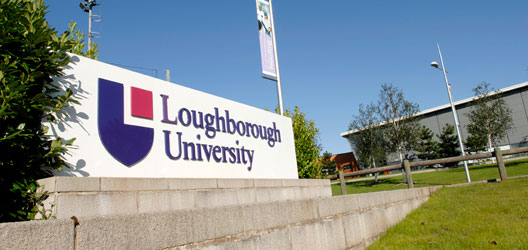
The Analytical Research Forum was held at Loughborough University this year. We were in excellent company, as we were sharing the campus with many young teams from numerous sports on training camps, and in particular the World Rope-Skipping Championships!
The keynote speakers included Gary Eiceman from New Mexico State University, US who gave a fascinating talk on the possibilites of ion-mobilty mass spectrometry, and some thoughts on what the future holds for this technique. Read one of recent articles in Analyst.

Ion mobility mass spectrometry (IM-MS) became a bit of theme with further discussion from Perdita Barran on the use of nano-electrospray ionisation mass spectrometry and IM-MS for examining biological systems in the gas phase.
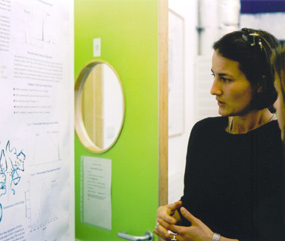
Perdita was also presented with the 2009 Joseph Black award for her developments in the field of mass spectrometry, especially ion-mobility techniques, and the application of these techniques to biological macromolecules and their gas phase interactions.

Look out for the Emerging Investigators Issue in Analyst early next year, which Perdita is co-Guest Editing with Christy Haynes.

Fingerprinting and forensics was another popular theme of the conference, with a very impressive keynote from David Russell from the University of East Anglia. He updated delegates on the methods his group have developed to detect drugs and metabolites on fingerprints. The  method of combining magnetic microparticles or gold nanoparticles with antibodies is so powerful, you can expect to see this approach in use in the near future – drug-drivers beware! Read his article on these methods in Analyst.
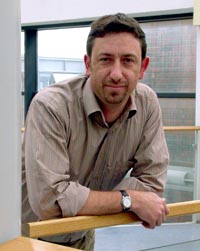
Brett Paull, Analytical Methods Editor-in-ChiefAnalytical Methods Editor-in-Chief, Brett Paull gave the final keynote talk on the Wednesday morning, on the topic of monolithic materials for separation science. 

Other talks which were also impressive included “Ion mobility-mass spectrometry of 3-D supramolecular architectures” by Martin De Cecco from the University of Edinburgh and “Spatially standardized cell biology” by Jonathan West from ISAS, Dortmund, Germany.

The social and networking side of ARF is however just as important as the science, and there were plenty of opportunities for this too. The quiz held in the bar on the Monday night required a combination of largely musical knowledge with a small amount of chemistry! This was most abely won by Perdita Barran’s group from the University of Edinburgh. The conference dinner was also traditionally held on the Tuesday evening.

Digg This
Reddit This
Stumble Now!
Share on Facebook
Bookmark this on Delicious
Share on LinkedIn
Bookmark this on Technorati
Post on Twitter
Google Buzz (aka. Google Reader)

Analytical Methods now in Scopus!

From this week, I am delighted to say that you will now be able to find Analytical Methods articles in Scopus!

Scopus is the largest abstract and citation database of peer-reviewed literature and quality web sources with smart tools to track, analyze and visualize research.

Analytical Methods publishes the latest in new and improved methods for the practical application of analytical science. Read the latest issue now!

Digg This
Reddit This
Stumble Now!
Share on Facebook
Bookmark this on Delicious
Share on LinkedIn
Bookmark this on Technorati
Post on Twitter
Google Buzz (aka. Google Reader)

Microfluidic on-chip testing

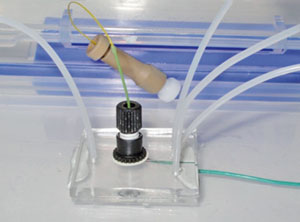
Continuous flowing inlets deliver essential nutrients to the tissue in the microfluidic device

A microfluidic device for tissue biopsy culture and interrogation
Abigail Webster, Charlotte E. Dyer, Stephen J. Haswell and John Greenman, Anal. Methods, 2010
DOI: 10.1039/c0ay00293c

Charlotte Dyer and colleagues at the University of Hull have designed a microfluidic device that can maintain tissue cultures for at least three days – much longer than previous designs, and long enough to perform drug testing.  This has the potential to reduce the need for animal testing and improve personalised medicine.

“The tissue is maintained in the device with continuous flow systems delivering essential nutrients and removing waste products in a highly controllable manner and with highly sensitive monitoring,” explains Dyer.

Her team tested the system using both normal and cancerous colon tissue, showing for the first time that a tumour biopsy sample can be maintained and responds to external stimuli, such as drugs.  They now intend to test other tissue types, and use the device to test the response of individual patient biopsy tissue samples to chemotherapeutic drugs.

To read Harriet Brewerton’s full news article, go to Highlights in Chemical Biology.

Digg This
Reddit This
Stumble Now!
Share on Facebook
Bookmark this on Delicious
Share on LinkedIn
Bookmark this on Technorati
Post on Twitter
Google Buzz (aka. Google Reader)

GRC Bioanalytical Sensors 2010

The 2010 GRC on Bioanalytical Sensors took place 20-25 June in the green setting of Colby-Sawyer College, New Hampshire, USA.  Talks by leading researchers, including Analytical Methods US Associate Editor, Prof. Sue Lunte, set the tone for five days of high-quality, cutting edge and interdisciplinary science presented in a format that drove discussion in a hugely positive way.

Antje Bauemner and Weihong Tan

Co-Chairs Anjte Baeumner of Cornell University and Weihong Tan of the University of Florida had put together a packed programme which covered topics such as nanotechnology, point-of-care applications, commercialisation and microfluidics.  The unique structure of GRC meetings gives research communities the chance to engage in person, and this opportunity was exploited to the full here.  Debate was free-flowing between the internationally diverse delegates, with conversations often continuing into break and meal times.

It wasn’t all intense work, though.  Vice-Chair of the meeting was Analyst US Associate Editor, Steve Soper, who arranged a social programme that was almost as busy as the scientific one.  From golf to hiking, volleyball to historical visits,there was plenty to do in the free afternoons.  And with Analytical Methods sponsoring the evening refreshments, there was no excuse for an early night!

I was very impressed by my first experience of a Gordon Research Conference.  The talks and posters presented showcased some of the most exciting developments in the broad field of bioanalytical sensing, but more importantly there was a sense of community amongst those attending.  This atmosphere nurtured the sort of personal interaction that can only lead to more exciting science in the future.


– Vibhuti Patel, Deputy Editor

Digg This
Reddit This
Stumble Now!
Share on Facebook
Bookmark this on Delicious
Share on LinkedIn
Bookmark this on Technorati
Post on Twitter
Google Buzz (aka. Google Reader)

Gordon F. Kirkbright Bursary Award 2011

Applications are invited for the 2011 Gordon Kirkbright Bursary.

The Gordon F. Kirkbright Bursary Award is a prestigious annual award that enables a promising student/non-tenured young scientist of any nation to attend a recognised scientific meeting or visit a place of learning.

The fund for this bursary was established in 1985 as a memorial to Professor Gordon Kirkbright in recognition of his contributions to analytical spectroscopy and to science in general. Although the fund is administered by the Association of British Spectroscopists (ABS) Trust, the award is not restricted to spectroscopists.

For further information contact John Chalmers at vibspecconsult@aol.com.

The closing date for entries is 31st December 2010.

Digg This
Reddit This
Stumble Now!
Share on Facebook
Bookmark this on Delicious
Share on LinkedIn
Bookmark this on Technorati
Post on Twitter
Google Buzz (aka. Google Reader)