Top ten most accessed articles in January

This month sees the following articles in Analytical Methods that are in the top ten most accessed:-

Rhodamine and BODIPY chemodosimeters and chemosensors for the detection of Hg2+, based on fluorescence enhancement effects 
M. J. Culzoni ,  A. Muñoz de la Peña ,  A. Machuca ,  H. C. Goicoechea and R. Babiano  
Anal. Methods, 2013,5, 30-49 DOI: 10.1039/C2AY25769F  

Paper-based electroanalytical sensing platforms 
Jonathan P. Metters ,  Said M. Houssein ,  Dimitrious K. Kampouris and Craig E. Banks  
Anal. Methods, 2013,5, 103-110 DOI: 10.1039/C2AY26396C  

Progress on the analytical methodology for biological volatile organic compounds 
Zhuomin Zhang ,  Yunjian Ma and Gongke Li  
Anal. Methods, 2013,5, 20-29 DOI: 10.1039/C2AY26082D  

Electrochemical impedance spectroscopy: an overview of bioanalytical applications 
Edward P. Randviir and Craig E. Banks  
Anal. Methods, 2013,5, 1098-1115 DOI: 10.1039/C3AY26476A  

Detection of concanavalin A based on attenuated fluorescence resonance energy transfer between quantum dots and mannose-stabilized gold nanoparticles 
Kyung Rae Lim ,  Kwang-Soo Ahn and Won-Yong Lee  
Anal. Methods, 2013,5, 64-67 DOI: 10.1039/C2AY26128F  

Sensitive detection of prion protein through long range resonance energy transfer between graphene oxide and molecular aptamer beacon 
Hong Lin Zhuang ,  Shu Jun Zhen ,  Jian Wang and Cheng Zhi Huang 
Anal. Methods, 2013,5, 208-212 DOI: 10.1039/C2AY26156A  

Fragrances: from essential oils to the human body and atmospheric aerosols 
Lai-Hao Wang  
Anal. Methods, 2013,5, 316-322 DOI: 10.1039/C2AY25980J  

Extractive electrospray ionization mass spectrometry for direct characterization of cosmetic products 
Xinglei Zhang ,  Nannan Wang ,  Yafei Zhou ,  Yan Liu ,  Jinghua Zhang and Huanwen Chen  
Anal. Methods, 2013,5, 311-315 DOI: 10.1039/C2AY25876E  

Current trends in liquid–liquid and solid–liquid extraction for cosmetic analysis: a review 
N. Cabaleiro ,  I. de la Calle ,  C. Bendicho and I. Lavilla  
Anal. Methods, 2013,5, 323-340 DOI: 10.1039/C2AY25830G  

Facile and sensitive paper-based chemiluminescence DNA biosensor using carbon dots dotted nanoporous gold signal amplification label 
Yanhu Wang ,  Shoumei Wang ,  Shenguang Ge ,  Shaowei Wang ,  Mei Yan ,  Dejin Zang and Jinghua Yu
Anal. Methods, 2013,5, 1328-1336 DOI: 10.1039/C2AY26485D  

Why not take a look at the articles today and blog your thoughts and comments below.

Fancy submitting an article to Analytical Methods? Then why not submit to us today or alternatively email us your suggestions.

Digg This
Reddit This
Stumble Now!
Share on Facebook
Bookmark this on Delicious
Share on LinkedIn
Bookmark this on Technorati
Post on Twitter
Google Buzz (aka. Google Reader)

Finding absestos in soil

Nowadays we all know the health risks posed by asbestos, and the great lengths taken to detect it and eliminate it from our environment. At one point, however, asbestos was used in everything from insulation material and flooring material to the brake linings used in cars, meaning there is plenty of it still out there.

Current methods of asbestos analysis are geared towards looking at building materials, but are not sensitive enough to detect the substance in soil. But recent work by a team of US scientists could solve this problem, boosting the sensitivity of the technique 100-fold.

To read the full article please visit Chemistry World.

Evaluation of a fluidized bed asbestos segregator preparation method for the analysis of low-levels of asbestos in soil and other solid media
J. Januch, W. Brattin, L. Woodbury and D. Berry
Anal. Methods, 2013, Advance Article
DOI: 10.1039/C3AY26254E

Digg This
Reddit This
Stumble Now!
Share on Facebook
Bookmark this on Delicious
Share on LinkedIn
Bookmark this on Technorati
Post on Twitter
Google Buzz (aka. Google Reader)

Analytical Methods Issue 6 now online!

Analytical Methods Issue 6 is now available online!

Take a look at our great new cover showing an interesting study coming directly from Brazil.

Marcos Eberlin and his team at the University of Campinas established two simple, fast and accurate techniques to optimise and standardise the quality control of the Andiroba oil, a famous Amazonian oil used as insecticide and analgesic. The team compared two mass spectrometry techniques, direct electrospray ionization mass spectrometry (ESI-MS) and easy ambient sonic-spray ionization (EASI-MS). Both techniques in the positive ion mode could detect adulteration of the Andiroba oil with soybean oil at low levels. According to the study, this method represents a fast and reproducible approach for typification and quality control of this important Amazonian oil.

Typification and quality control of the Andiroba (Carapa guianensis) oil via mass spectrometry fingerprinting
Elaine C. Cabral ,  Georgiana F. da Cruz ,  Rosineide C. Simas ,  Gustavo B. Sanvido ,  Lenise de V. Gonçalves ,  Rodrigo V. P. Leal ,  Regina C. F. da Silva ,  Julio C. T. da Silva ,  Lauro E. S. Barata ,  Valnei S. da Cunha ,  Luiz F. de França ,  Romeu J. Daroda ,  Gilberto F. de Sá and Marcos N. Eberlin
Anal. Methods, 2013, 5, 1385-1391
DOI: 10.1039/C3AY25743F

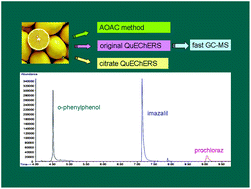
Comparative study of three QuEChERS methods to determine endocrine disrupting pesticides in lemons

In addition, check out this informative article on detection of endocrine discruptive pesticides in lemons. Mária Andraščíková and Svetlana Hrouzková from the Slovak University of Technology in Bratislava present a comparative study of three different versions of the quick, easy, cheap, effective, rugged and safe (QuEChERS) method to analyse endocrine disrupting compounds in acidic matrices. They showed that in difficult matrices such as lemons, the choice of modifications is analyte/matrix dependent.

A comparative study of three modifications of the QuEChERS method for determination of endocrine disrupting pesticide residues in lemon matrices by fast GC-MS
Mária Andraščíková and Svetlana Hrouzková
Anal. Methods, 2013, 1374-1384
DOI: 10.1039/C3AY26434C

Finally, remember to take a look at the selected HOT article of this issue! Please access the link below:

A spectrophotometric lipase assay based on substrate–nanoparticle assembly degradation
Margarita Stoytcheva ,  Roumen Zlatev ,  Samuel Behar and Jean-Jacques Bois
Anal. Methods, 2013, 1370-1373
DOI: 10.1039/C3AY00044C

Digg This
Reddit This
Stumble Now!
Share on Facebook
Bookmark this on Delicious
Share on LinkedIn
Bookmark this on Technorati
Post on Twitter
Google Buzz (aka. Google Reader)

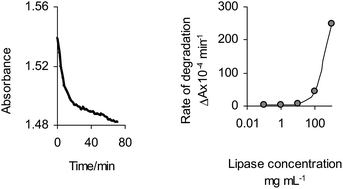
A new spectrophotometric method to measure lipase activity

Olive oil/nanoparticle degradation by lipase activity

Researchers in Mexico present a new rapid and cost effective spectrophotometric method to determine lipase activity in olive oil.

Lipases are a group of enzymes which catalyse reaction of hydrolysis of triacylglycerols to give free fatty acids, monoacylglycerol and glycerol. Measuring their activity is important in medicine and diagnostics as well as in pharmaceutical, cosmetic and paper industry. Unfortunately, the conventional assays currently available still rely on time-consuming procedures and employ radioactive materials and expensive reagents. In this work, the researchers used a layer of triglyceride coated with  Fe2O nanoparticles which are released when the substrate is degraded. A consequent change in light absorbance is observed following substrate degradation.
The new spectrophotometric method introduced by Margarita Stoytcheva and her group represents a promising analytical approach to reduce cost and increase effciency.

To read the full article, please access the link below. The paper will be free to read until March 18th.

A spectrophotometric lipase assay based on substrate–nanoparticle assembly degradation
Margarita Stoytcheva ,  Roumen Zlatev ,  Samuel Behar and Jean-Jacques Bois
Anal. Methods, 2013, Advance Article
DOI: 10.1039/C3AY00044C

Digg This
Reddit This
Stumble Now!
Share on Facebook
Bookmark this on Delicious
Share on LinkedIn
Bookmark this on Technorati
Post on Twitter
Google Buzz (aka. Google Reader)

Electronic tongue develops a taste for brandy

When it comes to brandy, analysis is an important part of the production process. It’s usually carried out by a panel sense experts, but now a team of Spanish scientists is set to replace the human palette with an electronic tongue that classifies brandy according to taste, and can even discriminate between aging methods.

An electronic tongue is an analytical system that mimics the sense of taste using an array of sensors and advanced signal-processing methods. Where classical analytical chemistry involves the identification of individual chemical species, an electronic tongue creates a fingerprint using multiple signals from its sensor array. This is useful for looking at alcoholic beverages, in which the species responsible for specific tastes are often unknown.


To read the full article please visit Chemistry World.

Application of an electronic tongue towards the analysis of brandies
Xavier Cetó ,  Matias Llobet ,  Joan Marco and Manel del Valle
Anal. Methods, 2013,5, 1120-1129
DOI: 10.1039/C2AY26066B

Digg This
Reddit This
Stumble Now!
Share on Facebook
Bookmark this on Delicious
Share on LinkedIn
Bookmark this on Technorati
Post on Twitter
Google Buzz (aka. Google Reader)

Evaluating Procedures for Lead Detection

Laura Ruvuna is guest web writer for Analytical Methods. She is currently a PhD student at Northwestern University, Evanston, Illinois, USA.

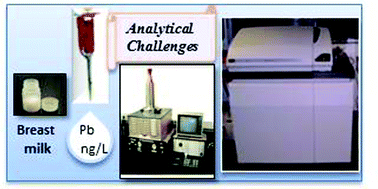
Trace lead analysis performed using ID-CP-MS

A toxin or heavy metal in a mother’s body can transfer to her baby, and even though lead is primarily stored in bones, trace amounts have the potential to enter breast milk and create a dangerous health risk.

Although multiple testing procedures are available, they have demonstrated a wide range of sensitivities arising from sample contamination and preparation issues. Adrienne Ettinger and researchers at Harvard School of Public Health, USA,  evaluated three digestion procedures for lead analysis using isotope dilution inductively coupled mass spectrometry (ID-ICP-MS).  The primary goal was to see if they could achieve 100% efficiency in any of the digestion processes in the complex media of breast milk, which contains high levels of contaminants such as fat and calcium, and trace levels of lead. Of these, the high pressure asher demonstrated complete sample digestion and had the most consistent lead concentration measurement. By removing analyte contaminants and maximizing the preparation efficiency, they detected trace levels of lead down to 0.2 ng mL-1.

To read more about this research, please access the link below. This paper will be free to read until March 8th.

Comparison of digestion procedures and methods for quantification of trace lead in breast milk by isotope dilution inductively coupled plasma mass spectrometry
Chitra J. Amarasiriwardena ,  Innocent Jayawardene ,  Nicola Lupoli ,  Ramon M. Barnes ,  Mauricio Hernandez-Avila ,  Howard Hu and Adrienne S. Ettinger
Anal. Methods, 2013, Advance Article
DOI: 10.1039/C3AY26321E

Digg This
Reddit This
Stumble Now!
Share on Facebook
Bookmark this on Delicious
Share on LinkedIn
Bookmark this on Technorati
Post on Twitter
Google Buzz (aka. Google Reader)

Analysing the Products of Carbon Dioxide Reduction

Polly-Anna Ashford is a guest web writer for Analytical Methods. She is currently a PhD student at the University of East Anglia, UK.

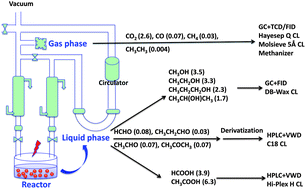
Analysis of gas and liquid phase photoreduction products

Analysis of gas and liquid phase photoreduction products

Carbon dioxide produced by combustion of fossil fuels can potentially be removed from the atmosphere using an abundant carbon-neutral form of energy: sunlight. Photocatalytic reduction is a promising strategy for CO2 conversion, but controlling the reaction pathways can be difficult. Identification and isolation of the range of reduction products provides a way of evaluating the efficiency of different photocatalysts.

In this minireview, Rong Xu and researchers at the Nanyang Technological University examine different analytical methods for these conversion products.  They compare a range of GC, HPLC and other chromatographic systems for separation of compounds including alcohols, aldehydes, carboxylic acids and small hydrocarbons. Moreover, they apply their findings to a new set of techniques for accurate detection of CO2 reduction products with low detection limits, employing a combination of GC and HPLC.

In a useful addition to the study, the authors also investigated the effects of organic additives such as solvents and photosensitisers on these analytical methods.

Photocatalytic reduction of CO2: a brief review on product analysis and systematic methods
Jindui Hong, Wei Zhang, Jia Ren and Rong Xu
Anal. Methods, 2013,5, 1086-1097
DOI: 10.1039/C2AY26270C

Digg This
Reddit This
Stumble Now!
Share on Facebook
Bookmark this on Delicious
Share on LinkedIn
Bookmark this on Technorati
Post on Twitter
Google Buzz (aka. Google Reader)

A cheap microfluidic-device for rapid analyses

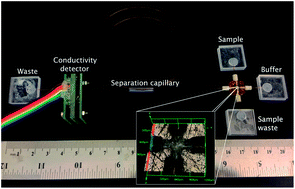
Picture of 5 interconnecting microfluidic components

A new and fast microchip-inspired analytical device based on standard Plexiglas tubes has been developed by researchers in Brazil.
The team, led by Carlos Garcia from the University of Sao Paulo, propose a device based on 5 plastic microfluidic components that serve as both the injector and the reservoir. The plastic components are connected with standard capillary tubes that easily enable the in-channel detection of analytes by a variety of techniques including electrophoresis. To demonstrate the applicability of this design, the researchers performed efficient analysis of inorganic cations by capillary electrophoresis on soil samples.
The microchip-capillary electrophoresis devices commercially available at the moment are still expensive and do not always offer the best analytical performances. This new microfluidic device developed using cheap and simple fabrication materials is an attractive approach for portable and rapid analytical instrumentation.

To read the full article, free to read until March 6th, please access the link below:

Microfab-less microfluidic capillary electrophoresis devices
Thiago P. Segato ,  Samir A. Bhakta ,  Matthew T. Gordon ,  Emanuel Carrilho ,  Peter A. Willis ,  Hong Jiao and Carlos D. Garcia
Anal. Methods, 2013, Advance Article
DOI: 10.1039/C3AY26392D

Digg This
Reddit This
Stumble Now!
Share on Facebook
Bookmark this on Delicious
Share on LinkedIn
Bookmark this on Technorati
Post on Twitter
Google Buzz (aka. Google Reader)

Analytical Methods Issue 5 now online!

The latest issue of Analytical Methods is now available online. Take a look at our woderful covers and discover all about the new research behind them.

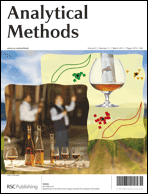
On the outside front cover is an original image from Manel del Valle from the Autonomous University of Barcelona, Spain. The researchers report the analysis of different types of brandy using a voltammetric Electronic Tongue (ET), a promising method previously used for analysis of liquid samples. To date, classification of brandy is performed by a skilled sensory panel. In this study, brandies are classified with high accuracy and efficiency with the voltammetric ET, indicating that this automated method could be an helpful tool to assess quality control standards and identify contaminations.

Application of an electronic tongue towards the analysis of brandies
Xavier Cetó ,  Matias Llobet ,  Joan Marco and Manel del Valle
Anal. Methods, 2013, 5, 1120-1129
DOI: 10.1039/C2AY26066B

On the inside front cover is an interesting picture showing the work of Rong Xu and colleagues from the Nanyang Technological University, China. The authors present a review on photocatalytic reduction of CO2, a chemical process of particular importance when considering energy and environmental issues. Photocatalytic reduction of CO2 has in fact low efficiency, and the resulting products are still unknown. In this review, current methods to analyse reduction products as well as new proposed analytical techniques are outlined.

Photocatalytic reduction of CO2: a brief review on product analysis and systematic methods
Jindui Hong ,  Wei Zhang ,  Jia Ren and Rong Xu
Anal. Methods, 2013, 5, 1086-1097
DOI: 10.1039/C2AY26270C

In addition to our new covers, here is a selection of HOT articles for you to enjoy. They will be free to read until March 6th. Have a read now!

Notes on the use of Mandel’s test to check for nonlinearity in laboratory calibrations
J. M. Andrade and M. P. Gómez-Carracedo
Anal. Methods, 2013,5, 1145-1149
DOI: 10.1039/C2AY26400E

On-site solid phase extraction and HPLC determination of chloramphenicol in surface water and sewage
Sheng Liu ,  Xian-Zheng Wu ,  Zi-Hui Gao and Fang Jiao
Anal. Methods, 2013,5, 1150-1154
DOI: 10.1039/C2AY26162F

Novel separation for the determination of cadmium by isotope dilution ICP-MS in samples containing high concentrations of molybdenum and tin
Robert Q. Thompson and Steven J. Christopher
Anal. Methods, 2013,5, 1346-1351
DOI: 10.1039/C2AY26212F

Using electrochemistry for metabolite simulation and synthesis in preventive doping research: application to the Rycal S107 and the PPARδ-agonist GW1516
Sandra Jahn ,  Simon Beuck ,  Ines Möller ,  Mario Thevis and Uwe Karst
Anal. Methods, 2013,5, 1214-1224
DOI: 10.1039/C2AY00030J

Digg This
Reddit This
Stumble Now!
Share on Facebook
Bookmark this on Delicious
Share on LinkedIn
Bookmark this on Technorati
Post on Twitter
Google Buzz (aka. Google Reader)

A Portable HPLC for On Site Water Testing

Laura Ruvuna is guest web writer for Analytical Methods. She is currently a PhD student at Northwestern University, Evanston, Illinois, USA.

Antibiotics provide vital treatment in fighting bacterial infection, but over time some have become phased out or even toxic to humans.

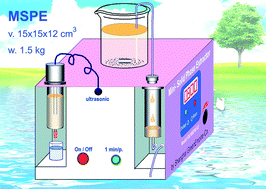
Miniaturized device for detection of chloramphenicol in water

One of these is chloramphenicol. Although banned in the European Union, chloramphenicol continues to be used as a cheap remedy in veterinary medicine and can lead to contaminated water and food for our consumption. One technique to test for this contaminant, solid phase extraction (SPE), purifies samples effectively, but requires a pump and a laboratory setting.

Alternatively, Sheng Liu, from the Chinese Academy of Sciences, and colleagues developed a simple yet portable miniaturized SPE (MSPE) device capable of detecting chloramphenicol in water, which has been difficult to test using other methods. A macroporous resin captures and concentrates the chloramphenicol before it passes through an HPLC, all within a 1.5 kg mass instrument. This new technique directly detects low concentrations of chloramphenicol in water, and demonstrates the capacity to function at contaminated locations.

To know more about the study, please click on the link below. This paper will be free to read for the next two weeks.

On-site solid phase extraction and HPLC determination of chloramphenicol in surface water and sewage
Sheng Liu ,  Xian-Zheng Wu ,  Zi-Hui Gao and Fang Jiao
Anal. Methods, 2013, Advance Article
DOI: 10.1039/C2AY26162F

Digg This
Reddit This
Stumble Now!
Share on Facebook
Bookmark this on Delicious
Share on LinkedIn
Bookmark this on Technorati
Post on Twitter
Google Buzz (aka. Google Reader)