HOT: One step closer to the synthesis of an unstable antibiotic

Nature has been giving organic chemists inferiority complexes for many, many years, so it is always good to see a neat piece of synthesis for a tricky natural product.

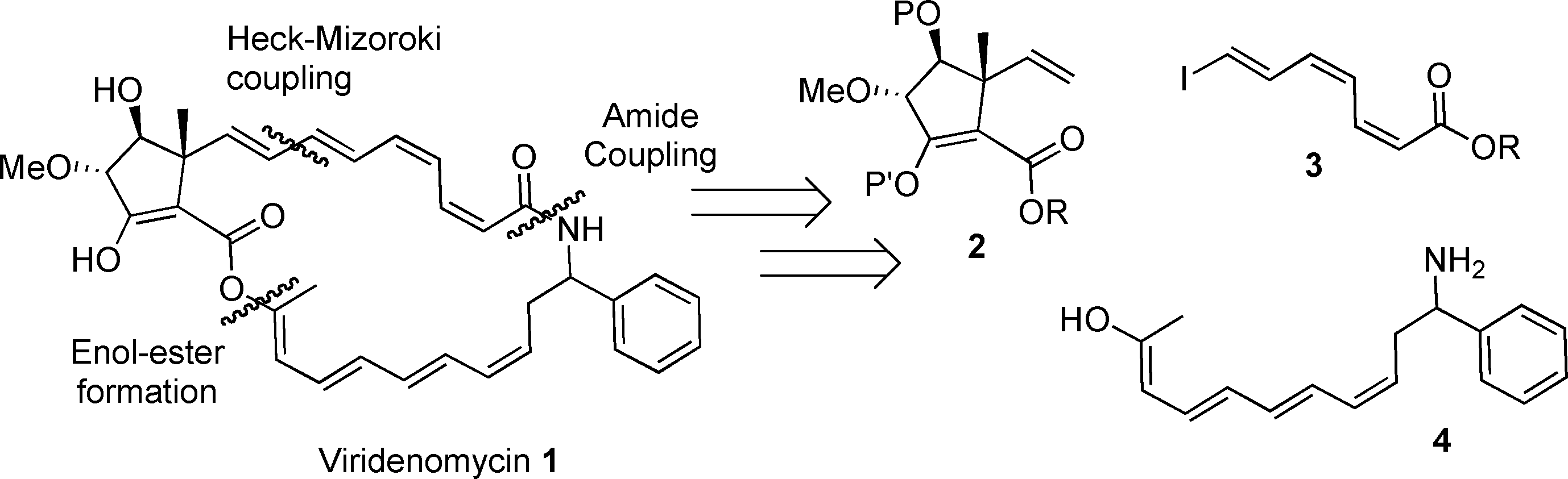
The structure of viridenomycin – an antibiotic with anti-tumor activity – has been known for 20 years, but attempts to synthesise it thus far have failed due to its complex structure and inherent instability. Now, Andy Whiting and colleagues from Durham University have synthesised fragments suitable for constructing a particularly unstable part of viridenomycin via a series of cross-coupling reactions.

They focused on the northern polyene fragment, synthesising several analogues with better isometric ratios and increased stability towards photoisomerisation than the original tetraene fragment.  The authors hope that their method may help to achieve the total synthesis of this valuable complex molecule.

Read how they did it online – the article is free to access for 4 weeks!

Studies towards the synthesis of the northern polyene of viridenomycin and synthesis of Z-double bond analogues
Jonathan P. Knowles, Victoria E. O′Connor and Andrew Whiting
Org. Biomol. Chem., 2011, Advance Article
DOI: 10.1039/C0OB00977F


Digg This
Reddit This
Stumble Now!
Share on Facebook
Bookmark this on Delicious
Share on LinkedIn
Bookmark this on Technorati
Post on Twitter
Google Buzz (aka. Google Reader)

HOT: Aryl azides go with the flow

Organic azides are considered to be amongst the most hazardous chemicals and therefore not amongst the most popular within  synthetic chemistry communities. In organic chemistry they are commonly used as a way to introduce an amine group, which makes them key compounds for synthetic chemists.

Steven Ley, Ian Baxendale and their group at University of Cambridge, describe in these back to back papers the development of a flow process for the synthesis of alkyl and aryl azides in high conversions. One of the key features of this flow procedure is the introduction of a new monolithic triphenylphosphine reagent that allows the use of triphenylphosphine in flow to provide high purity products without the need of further purification steps.

They also describe a general protocol for the in-line purification of the intermediates. They incorporate the azide synthesis and purification process into a multistep flow sequence to generate a collection of aminocyanotriazoles in a fully automated fashion.

Now you can read these very interesting and HOT papers which are free to access until the 8th March.

Download both papers here.

Flow synthesis of organic azides and the multistep synthesis of imines and amines using a new monolithic triphenylphosphine reagent
Catherine J. Smith, Christopher D. Smith, Nikzad Nikbin, Steven V. Ley and Ian R. Baxendale
Org. Biomol. Chem., 2011
DOI: 10.1039/C0OB00813C

A fully automated, multistep flow synthesis of 5-amino-4-cyano-1,2,3-triazoles
Catherine J. Smith, Nikzad Nikbin, Steven V. Ley, Heiko Lange and Ian R. Baxendale
Org. Biomol. Chem., 2011
DOI: 10.1039/C0OB00815J

Digg This
Reddit This
Stumble Now!
Share on Facebook
Bookmark this on Delicious
Share on LinkedIn
Bookmark this on Technorati
Post on Twitter
Google Buzz (aka. Google Reader)

Perspective: Multivalent inhibitors of lectins

Sebastien G. Gouin and his team at University of Nantes, France, review some of the important structural features in the synthesis of multivalent glycoconjugates for a tight binding with specific lectins.

Read this review on multivalent inhibitors of lectins from a different and very interesting point of view: how the scaffold influences potency.

Insights in the rational design of synthetic multivalent glycoconjugates as lectin ligands
David Deniaud, Karine Julienne and Sébastien G. Gouin
Org. Biomol. Chem., 2011, 9, 966-979
DOI: 10.1039/C0OB00389A, Perspective

Digg This
Reddit This
Stumble Now!
Share on Facebook
Bookmark this on Delicious
Share on LinkedIn
Bookmark this on Technorati
Post on Twitter
Google Buzz (aka. Google Reader)

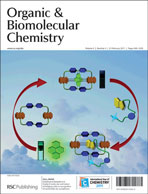
Size is important – OBC Cover Issue 4

Cyclophanes have been used as molecular systems in host-guest complexations due to their ability to encapsulate other molecules through various non-covalent interactions.
Cyclophanes  can be rationally designed by choosing the right components, similar to  Lego® bricks. However, the features of these ‘lego bricks’ required to build the desired cyclophanes with the requisite biomolecular recognition properties have not been widely explored.

Now, Danaboyina Ramaiah and colleagues at NIIST in India have revealed some of the features to bear in mind when designing cyclophanes. They concluded by saying that  that the cavity size and its rigidity, the aromatic surface and nature of bridging units dictate the stability of the supramolecular complex and thereby govern the biomolecular recognition properties of cyclophanes.

You can now download this article, which is free to access until mid-March.

Study of cavity size and nature of bridging units on recognition of nucleotides by cyclophanes
Prakash P. Neelakandan, Paramjyothi C. Nandajan, Baby Subymol and Danaboyina Ramaiah
Org. Biomol. Chem., 2011, 9, 1021-1029
DOI: 10.1039/C0OB00673D, Paper

Digg This
Reddit This
Stumble Now!
Share on Facebook
Bookmark this on Delicious
Share on LinkedIn
Bookmark this on Technorati
Post on Twitter
Google Buzz (aka. Google Reader)

HOT: The workings of T. cruzi trans-sialidase

T. cruzi, the causative agent of Chagas disease, relies on its enzyme trans-sialidase for part of its infectivity. Robert Field et al., from several collaborating institutions worldwide, have studied this enzyme, highlighting the wide range of structures and functionalities that it can accommodate. This study has demonstrated important features for potential inhibitor design (a therapeutic target for Chagas’ disease) and also opens up possibilities for using the versatility of this enzyme more generally as a catalyst for α-(2→3)-sialylglycoconjugate synthesis.

This HOT article is now free to access until 22nd February.

Probing the acceptor substrate binding site of Trypanosoma cruzi trans-sialidase with systematically modified substrates and glycoside libraries
Jennifer A. Harrison, K. P. Ravindranathan Kartha, Eric J. L. Fournier, Todd L. Lowary, Carles Malet, Ulf J. Nilsson, Ole Hindsgaul, Sergio Schenkman, James H. Naismith and Robert A. Field
Org. Biomol. Chem., 2011, Advance Article
DOI: 10.1039/C0OB00826E, Paper

Digg This
Reddit This
Stumble Now!
Share on Facebook
Bookmark this on Delicious
Share on LinkedIn
Bookmark this on Technorati
Post on Twitter
Google Buzz (aka. Google Reader)

HOT: PBD-DNA adduct formation is reversible. Evidence by Thurston

PBDs (pyrrolo[2,1-c][1,4]benzodiazepines) and their interaction with DNA is an area of active research.

PBDs belong to a family of biologically active an DNA-interactive antibiotics having unique mechanism of action compared with other DNA-binding agents. Up until now, there have been several reports in literature suggesting that PBD-DNA adduct formation might be reversible; however, no evidence of this reversibility had been reported.

For the first time, in this paper, David Thurston and colleagues at the School of Pharmacy at University of London, investigate the adduct formation of PBDs with DNA and its reversibility using HPLC/MS methodology and polarised light spectroscopy.

Read about some of their findings in this OBC HOT paper which is free to access until the 22nd February.

Observation of the reversibility of a covalent pyrrolobenzodiazepine (PBD) DNA adduct by HPLC/MS and CD spectroscopy
Khondaker M. Rahman, Colin H. James and David E. Thurston
Org. Biomol. Chem., 2011, Advance Article
DOI: 10.1039/C0OB00762E, Paper

Digg This
Reddit This
Stumble Now!
Share on Facebook
Bookmark this on Delicious
Share on LinkedIn
Bookmark this on Technorati
Post on Twitter
Google Buzz (aka. Google Reader)

HOT: Investigating a new therapeutic target for leishmaniases

Leishmania is a terrible disease transmitted by the bite of a sandfly.  Tackling it has been given priority by the WHO, especially as co-infection with HIV has been identified.  Many current treatments are costly, have serious side effects and more worryingly drug resistance has been reported even in the most recent drugs.  Therefore identifying new therapeutic targets to combat this disease is imperative.

Patrick Steel and a team from Durham University have targeted the membrane bound enzyme inositol phosphorylceramide synthase (IPCS)  – which is essential for the survival of Leishmania species.  They synthesised a series of ceramide analogues, changing the sphingosine tail, N-acyl unit and the degree of hydroxylation to explore the enzyme active site.  The analogues were assayed against Leishmania major IPCS to determine the degree of inhibition and a mechanism of action was subsequently proposed.

Read about their findings here – the article is free to access for 4 weeks:

Exploring Leishmania major Inositol Phosphorylceramide Synthase (LmjIPCS): Insights into the ceramide binding domain
John G. Mina, Jackie A. Mosely, Hayder Z. Ali, Paul W. Denny and Patrick G. Steel
Org. Biomol. Chem., 2011, Advance Article
DOI: 10.1039/C0OB00871K

Digg This
Reddit This
Stumble Now!
Share on Facebook
Bookmark this on Delicious
Share on LinkedIn
Bookmark this on Technorati
Post on Twitter
Google Buzz (aka. Google Reader)

Top ten most accessed articles in December

This month sees the following articles in OBC that are in the top ten most accessed:-

A facile method for the synthesis of oxindole based quaternary a-aminonitriles via the Strecker reaction 
Yun-Lin Liu, Feng Zhou, Jun-Jie Cao, Cong-Bin Ji, Miao Ding and Jian Zhou 
Org. Biomol. Chem., 2010, 8, 3847-3850, DOI: 10.1039/C0OB00174K, Communication 

Chiral Separation by Enantioselective Liquid-Liquid Extraction
Boelo Schuur, Bastiaan J. V. Verkuijl, Adriaan J. Minnaard, Johannes G. de Vries, Hero J. Heeres and Ben L. Feringa 
Org. Biomol. Chem., 2011, 9, 36-51, DOI: 10.1039/C0OB00610F, Perspective 

Sequential one-pot combination of multi-component and multi-catalysis cascade reactions: an emerging technology in organic synthesis 
Dhevalapally B. Ramachary and Sangeeta Jain 
Org. Biomol. Chem., 2011, Advance Article, DOI: 10.1039/C0OB00611D, Emerging Area 

Asymmetric organocatalytic Michael–α-amination sequence for the construction of a quaternary stereocenter  
Alaric Desmarchelier, Jérôme Marrot, Xavier Moreau and Christine Greck 
Org. Biomol. Chem., 2011, Advance Article, DOI: 10.1039/C0OB00751J, Communication 

Oxidative amide synthesis directly from alcohols with amines 
Cheng Chen and Soon Hyeok Hong 
Org. Biomol. Chem., 2011, 9, 20-26, DOI: 10.1039/C0OB00342E, Emerging Area 

Copper catalysis in the construction of indole and benzo[b]furan rings 
Sandro Cacchi, Giancarlo Fabrizi and Antonella Goggiamani 
Org. Biomol. Chem., 2011, 9, 641-652, DOI: 10.1039/C0OB00501K, Perspective 

Efficient total synthesis of (-)-stemoamide 
Toshio Honda, Tomoha Matsukawa and Kazunori Takahashi 
Org. Biomol. Chem., 2011, 9, 673-675, DOI: 10.1039/C0OB00850H, Communication 

Synthesis of difluoroaryldioxoles using BrF3 
Youlia Hagooly, Michael J. Welch and Shlomo Rozen
Org. Biomol. Chem., 2011, 9, 902-905, DOI: 10.1039/C0OB00571A, Paper 

Transition metal mediated construction of pyrrole ring on 2,3-dihydroquinolin-4(1H)-one: synthesis and pharmacological evaluation of novel tricyclic heteroarenes 
Mohosin Layek, Appi Reddy M., A. V. Dhanunjaya Rao, Mallika Alvala, M. K. Arunasree, Aminul Islam, K. Mukkanti, Javed Iqbal and Manojit Pal 
Org. Biomol. Chem., 2011, Advance Article, DOI: 10.1039/C0OB00771D, Communication 

Practical access to highly enantioenriched quaternary carbon Michael adducts using simple organocatalysts 
Thomas C. Nugent, Mohammad Shoaib and Amna Shoaib 
Org. Biomol. Chem., 2011, 9, 52-56, DOI: 10.1039/C0OB00822B, Communication 

Why not take a look at the articles today and blog your thoughts and comments below.

Fancy submitting an article to OBC? Then why not submit to us today or alternatively email us your suggestions.

Digg This
Reddit This
Stumble Now!
Share on Facebook
Bookmark this on Delicious
Share on LinkedIn
Bookmark this on Technorati
Post on Twitter
Google Buzz (aka. Google Reader)

HOT: Tetra-substituted furans in one pot? No problem!

When a referee calls a paper outstanding you know you are onto a good thing!
Pirali et al. from Università degli Studi del Piemonte Orientale “A. Avogadro” have documented a straightforward synthesis of dialkyl 2-acyl-5-aminofuran-3,4-dicarboxylates, displaying four points of diversity and an unprecedented substitution pattern. The products are easily isolated and the functional groups are ripe for further derivatisation, making this a reaction which is both mechanistically interesting and also has practical value for synthetic and medicinal chemists.

Both reviewers thought this HOT article would be of wide interest in the organic community and it is now free to access until 18th February.

Read it today in OBC.

A novel α-isocyanoacetamide-based three-component reaction for the synthesis of dialkyl 2-acyl-5-aminofuran-3,4-dicarboxylates
Riccardo Mossetti, Diego Caprioglio, Giampiero Colombano, Gian Cesare Tron and Tracey Pirali
Org. Biomol. Chem., 2011, Advance Article
DOI: 10.1039/C0OB00979B

Digg This
Reddit This
Stumble Now!
Share on Facebook
Bookmark this on Delicious
Share on LinkedIn
Bookmark this on Technorati
Post on Twitter
Google Buzz (aka. Google Reader)

HOT: Two-faced nucleosides combat RNA viruses

Ribavirin is a nucleoside drug used to treat RNA viral infections such as Hepaptitis C, which interferes with RNA metabolism required for viral replication. But its efficiency is relatively low, so in a HOT article just published, Yang He and colleagues at Sichuan University report the synthesis of two new nucleosides and their improved anti-viral activity.

He’s nucelosides contain structural features of two naturally occurring components of RNA (guanine and cytosine). This unique feature allows it to interfere with the RNA virus via hydrogen bond pairing with either guanine or cytosine, as well as allowing it to be recognised by viral enzymes more efficiently than ribavirin.   

 If you want to find out more about these interesting bio-active nucleosides download the article now! It’s free to access until the 18th February.

Synthesis of Janus type nucleoside analogues and their preliminary bioactivity 
Hao-Zhe Yang, Mei-Ying Pan, Da-Wei Jiang and Yang He
Org. Biomol. Chem., 2011, DOI: 10.1039/C0OB00495B

Digg This
Reddit This
Stumble Now!
Share on Facebook
Bookmark this on Delicious
Share on LinkedIn
Bookmark this on Technorati
Post on Twitter
Google Buzz (aka. Google Reader)