HOT: Thiophosphonoacetate-modified oligoribonucleotides with RNA therapeutics in sight

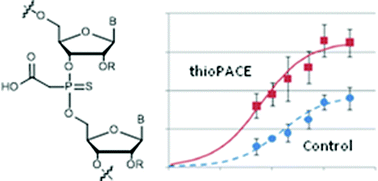
The groups of Marvin Caruthers (University of Colorado at Boulder, USA) and Michael Gait (Medical Research Council Centre, Cambridge, UK) describe a new chemical synthesis and biological properties of 2’-O-methyl oligoribonucleotides (ORNs) containing internucleotide linkages modified with phosphonoacetate (PACE) and thiophosphonoacetate (thioPACE) groups.

ThioPACE modifications were found to greatly improve the efficiency of cell uptake and the potency of a 2′-O-Me-ORN miRNA122 inhibitor, showing that this class of modifications has great potential for applications in RNA therapeutics research.

As with all our HOT Articles, this OBC article is FREE for you to access, for a period of 4 weeks.


Synthesis and biological activity of phosphonoacetate- and thiophosphonoacetate-modified 2′-O-methyl oligoribonucleotides
Richard N. Threlfall, Adrian G. Torres, Angelika Krivenko, Michael J. Gait and Marvin H. Caruthers
Org. Biomol. Chem., 2012, Advance Article
DOI: 10.1039/C1OB06614E

Digg This
Reddit This
Stumble Now!
Share on Facebook
Bookmark this on Delicious
Share on LinkedIn
Bookmark this on Technorati
Post on Twitter
Google Buzz (aka. Google Reader)

On the cover of Issue 3: high yield domino reactions for nitro alkenes

Welcome to Issue 3!  On the front cover we have work from Lucio Pellacani and colleagues on their one-pot method to α-substituted nitro alkenes. They devised a domino condensation-dehydration process to give α-nitro acrylates or cinnamates, α-nitro α,β-unsaturated ketones and aromatic and heteroaromatic (E)-2-nitro allylic alcohols, compounds with anticancer activity, in high yields and high diastereomeric purity which has not previously been achieved.

Domino reactions for the synthesis of various α-substituted nitro alkenes
Stefania Fioravanti, Lucio Pellacani and Maria Cecilia Vergari
DOI: 10.1039/C1OB06260C

As with all our cover articles, this one is free to access for 6 weeks – so why not take a look?

Digg This
Reddit This
Stumble Now!
Share on Facebook
Bookmark this on Delicious
Share on LinkedIn
Bookmark this on Technorati
Post on Twitter
Google Buzz (aka. Google Reader)

Hot emerging area: Transition metal-catalysed (4 + 3) cycloaddition reactions involving allyl cations

Israel Fernández and José Luis Mascareñas review novel intramolecular (4 +3)-cycloaddition reactions of allenedienes in this Emerging Area article, focussing on recent examples where the allene acts as an allylic-cation surrogate.  These methodologies overcome problems with previous strategies involving unstable allyl cation precursors or the need for stoichiometric activators and conformationally restricted dienes.

Areas covered include:

  • (4 + 3)-Cycloaddition reactions mediated by platinum(II) and gold(I) complexes
  • Aromaticity in the (4 + 3)-cycloaddition
  • Concerted vs. stepwise reaction mechanisms

As with all our hot research, this article will be free to access for 4 weeks – so take a look today:

Transition metal-catalysed (4 + 3) cycloaddition reactions involving allyl cations
Israel Fernández and José Luis Mascareñas
DOI: 10.1039/C1OB06604H

Digg This
Reddit This
Stumble Now!
Share on Facebook
Bookmark this on Delicious
Share on LinkedIn
Bookmark this on Technorati
Post on Twitter
Google Buzz (aka. Google Reader)

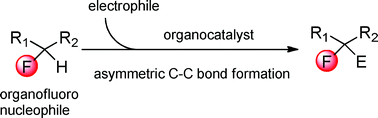
Perspective: Organofluoro nucleophiles for enantioselective organocatalytic fluorination


‘While methods of electrophilic fluorination have been extensively developed to stereoselectively install fluorine atoms onto molecules, nucleophilic fluorination is a much less explored approach’, explains Associate Professor Choon-Hong Tan, from National University of Singapore.

In this concise review article, Choon-Hong and coll. highlight an emerging methodology of enatioselective C-C coupling via fluorocarbanion additions, which significantly expands the scope of enantio-enriched fluorine-containing compounds that can be synthesised. The recent advances in the application of organofluoro nucleophiles in organocatalysis are described.

Enantioselective organocatalytic fluorination using organofluoro nucleophiles
Yujun Zhao, Yuanhang Pan, Sui-Boon Derek Sim and Choon-Hong Tan
Org. Biomol. Chem., 2012, Advance Article
DOI: 10.1039/C1OB05840A, Perspective

Digg This
Reddit This
Stumble Now!
Share on Facebook
Bookmark this on Delicious
Share on LinkedIn
Bookmark this on Technorati
Post on Twitter
Google Buzz (aka. Google Reader)

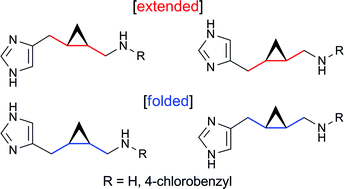
HOT: Stereochemical diversity-oriented strategy for histamine receptor ligands synthesis

In their quest to develop specific ligands for drug target proteins, Professor Satoshi Shuto and coll. have used a stereochemical diversity-oriented conformational restriction strategy to synthesize potent histamine H3 and/or H4 receptor ligands. Some of these cyclopropane-based analogs of histamine with a chiral cis- or trans-2,3-methanobutane backbone show remarkable antagonistic activity towards H3 and H4.


Interested in Medicinal Chemistry and curious about what conformational restriction strategies can do for you?

Then why not read this article, FREE to access for a period of four weeks


Cyclopropane-based stereochemical diversity-oriented conformational restriction strategy: Histamine H3 and/or H4 receptor ligands with the 2,3-methanobutane backbone
Mizuki Watanabe, Takaaki Kobayashi, Takatsugu Hirokawa, Akira Yoshida, Yoshihiko Ito, Shizuo Yamada, Naoki Orimoto, Yasundo Yamasaki, Mitsuhiro Arisawa and Satoshi Shuto
Org. Biomol. Chem., 2012, Advance Article
DOI: 10.1039/C1OB06496G, Paper

Digg This
Reddit This
Stumble Now!
Share on Facebook
Bookmark this on Delicious
Share on LinkedIn
Bookmark this on Technorati
Post on Twitter
Google Buzz (aka. Google Reader)

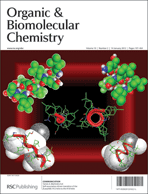
Tunable H12 helix → H18 helix transition on the cover of OBC Issue 2

Welcome to OBC Issue 2, 2012

On the cover this week is the work of Tamas Martinek et al. at the University of Szeged (Hungary), reporting a tunable H12 helix –> H18 helix transition not previously observed for foldamers.

Combining traditional methods for peptide folding (ECD, DOSY-NMR) and molecular modeling to investigate the folding and self-assembly of peptide mimics, the authors show that foldamer sequences constructed using trans-ABHC and β3-hSer residues produce β-H18 helix in a solvent- and concentration-dependent way.

‘These observations strongly support the view that foldameric helix refolding is promoted by higher-order packing of the helices in protic solvent’, say the authors.


This OBC Communication will be FREE to access for the next 6 weeks:
 

Self-association-driven transition of the β-peptidic H12 helix to the H18 helix
Éva Szolnoki, Anasztázia Hetényi, Tamás A. Martinek, Zsolt Szakonyi and Ferenc Fülöp
Org. Biomol. Chem., 2012, 10, 255-259
DOI: 10.1039/C1OB06627G
 

View the rest of Issue 2 here

Digg This
Reddit This
Stumble Now!
Share on Facebook
Bookmark this on Delicious
Share on LinkedIn
Bookmark this on Technorati
Post on Twitter
Google Buzz (aka. Google Reader)

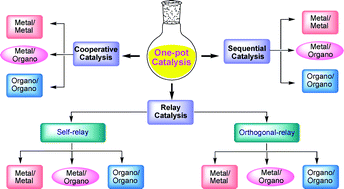
Emerging area: classifying one-pot catalysis

Take a look at this Emerging Area article from Nitin Patil et al. who propose a classification system to update the definition of one-pot catalysis.   They give readers recent examples of metal-metal, metal-organo and organo-organo catalytic systems that fall into the three categories of cooperative, relay and sequential one-pot catalysis.

The article will be free to access for the next four weeks:

A one-pot catalysis: the strategic classification with some recent examples
Nitin T. Patil, Valmik S. Shinde and Balakrishna Gajula
DOI: 10.1039/C1OB06432K

Digg This
Reddit This
Stumble Now!
Share on Facebook
Bookmark this on Delicious
Share on LinkedIn
Bookmark this on Technorati
Post on Twitter
Google Buzz (aka. Google Reader)

Nominations for the 2012 RSC Prizes and Awards now open

Nominations for the 2012 RSC Prizes and Awards close on the 15 January 2012

Our Prizes and Awards represent the dedication and outstanding achievements and are a platform to showcase inspiring science to gain the recognition deserved. Don’t forget to nominate colleagues who have made a significant contribution to advancing the chemical sciences.

View our full list of Prizes and Awards and use the online system to nominate a colleague.

Digg This
Reddit This
Stumble Now!
Share on Facebook
Bookmark this on Delicious
Share on LinkedIn
Bookmark this on Technorati
Post on Twitter
Google Buzz (aka. Google Reader)

OBC Issue 1 now published!

Welcome to Issue 1 of OBC, 2012!

On the front cover we have an article from Brian Stolz and team on the synthesis of enantioenriched γ-quaternary cycloheptenones, with potential for the preparation of non-natural analogs of cycloheptanoid natural products.

Synthesis of enantioenriched γ-quaternary cycloheptenones using a combined allylic alkylation/Stork–Danheiser approach: preparation of mono-, bi-, and tricyclic systems
Nathan B. Bennett, Allen Y. Hong, Andrew M. Harned and Brian M. Stoltz
DOI: 10.1039/C1OB06189E

On the inside front cover is an article from Robert Stockman and coworkers.  They report the synthesis of an advanced intermediate, an azaspirocyclic aldehyde, in the route to halichlorine developed by Clive and coworkers, shortening the synthetic route by 15 steps.

Combining two-directional synthesis and tandem reactions: a short formal synthesis of halichlorine
Camille Gignoux, Annabella F. Newton, Alexandre Barthelme, William Lewis, Marie-Lyne Alcaraz and Robert A. Stockman
DOI: 10.1039/C1OB06380D

Incredibly 2012 will be our 10th year of publication and we would like to thank all our authors, referees, readers and Board members for their support over the last decade. Read the Editorial introduction to the next volume from Chair Jeffrey Bode and Editor Richard Kelly for the changes we’ve seen and what we have to look forward to in the coming year.

Digg This
Reddit This
Stumble Now!
Share on Facebook
Bookmark this on Delicious
Share on LinkedIn
Bookmark this on Technorati
Post on Twitter
Google Buzz (aka. Google Reader)

Organic & Biomolecular Chemistry goes weekly!

The publication this week of OBC’s first issue of 2012 sees the journal doubling its frequency to 48 issues per year.

Since 2003 OBC has built on its core values of high impact research, good author service and rigorous, fair and timely peer review to grow into one of the leading journals in the field. It’s no surprise therefore that in the last four years the number of authors choosing to publish their articles with OBC each year has more than doubled. To accommodate this increased content we will now be publishing issues weekly.

To receive weekly updates on the latest research published in OBC, sign-up for our contents alerts.

Digg This
Reddit This
Stumble Now!
Share on Facebook
Bookmark this on Delicious
Share on LinkedIn
Bookmark this on Technorati
Post on Twitter
Google Buzz (aka. Google Reader)