HOT: Synthesis of symmetric anhydrides using visible light-mediated photoredox catalysis

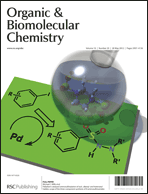
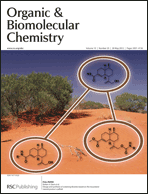
In this HOT communication Corey R. J. Stephenson and colleagues at Boston University demonstrate the application of visible light-mediated photoredox catalysis for the synthesis of symmetric anhydrides. This new approach to anhydride formation proceeds via the activation of C–O bonds by the Vilsmeier–Haack reagent formed by Ru(bpy)3Cl2 and CBr4 in DMF.

Stephenson et al. demonstrate the reaction with various aryl and alkyl carboxylic acids being converted to the corresponding anhydrides in excellent yields and they go on to show the efficacy of the method by performing scale-up reactions.

For the full reaction conditions have a look at this Communication today. As always, this HOT article will be free to access for the next 4 weeks!

Synthesis of symmetric anhydrides using visible light-mediated photoredox catalysis
Marlena D. Konieczynska ,  Chunhui Dai and Corey R. J. Stephenson
DOI: 10.1039/C2OB25463H

Digg This
Reddit This
Stumble Now!
Share on Facebook
Bookmark this on Delicious
Share on LinkedIn
Bookmark this on Technorati
Post on Twitter
Google Buzz (aka. Google Reader)

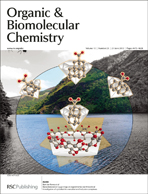
OBC issue 22: artificial O2 and CO receptors and oxidative Umpolung on the covers

Welcome to OBC issue 22!

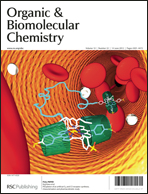
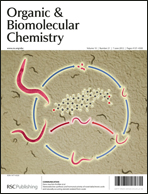
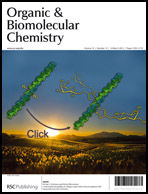
This colourful front cover is courtesy of Koji Kano and colleagues from Doshisha University. This HOT paper from Kano et al. discusses a study on how to control the circulation time of a synthetic oxygen and carbon monoxide receptor by attaching poly(ethylene glycol) chains to the periphery of an iron porphyrin. By attaching chains of varying molecular weight Kano et al. are successfully able to modify the length of time the receptor remains in the blood stream.

PEGylation of an artificial O2 and CO receptor: synthesis, characterisation and pharmacokinetic study
Takunori Ueda, Hiroaki Kitagishi and Koji Kano
Org. Biomol. Chem., 2012, 10, 4337-4347
DOI: 10.1039/C2OB07044H

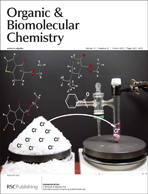
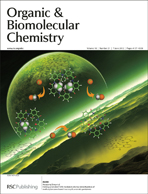
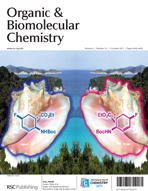
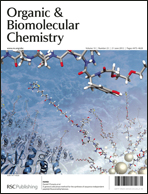
The inside cover highlights the work of Nuno Maulide and co-workers, who present a new protocol for the direct 2-electron oxidative Umpolung of halide salts with commercially available sulfoxide. This means that electrophilic halogenations (including halolactonisations) can proceed directly from the corresponding sodium salts.

Sulfoxide-mediated Umpolung of alkali halide salts
Sebastian Klimczyk, Xueliang Huang, Christophe Farès and Nuno Maulide
Org. Biomol. Chem., 2012, 10, 4327-4329
DOI: 10.1039/C2OB25459J

Both of these articles are free to access for 6 weeks, so it’s easy to have a read.

You might also be interested in this perspective by Oskari K. Karjalainen and Ari M. P. Koskinen on the diastereoselective synthesis of vicinal amino alcohols.

View the complete issue here

Digg This
Reddit This
Stumble Now!
Share on Facebook
Bookmark this on Delicious
Share on LinkedIn
Bookmark this on Technorati
Post on Twitter
Google Buzz (aka. Google Reader)

Review: Modulation of the antioxidant activity of phenols by non-covalent interactions

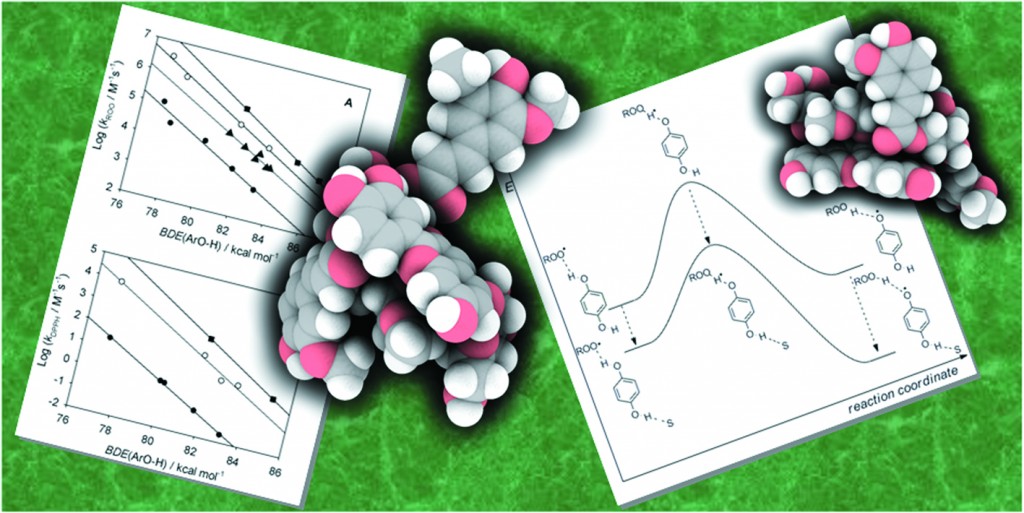
This review by Riccardo Amorati and Luca Valgimigli, University of Bologna, is featured in issue 21 of OBC, which can now be found online.

In this Perspective Amorati and Valgimigli summarize some recent results obtained with simplified models, which can aid in understanding the effects of non-covalent interactions, i.e.  intra- and inter-molecular H-bonds, on the radical chemistry of natural phenolic and polyphenolic antioxidants.

Areas of discussion include:

Intramolecular hydrogen bonds:

Reactive OH groups as H-bond donors

Reactive OH groups as H-bond acceptor

Remote H-bond effect

Intermolecular hydrogen bonds

Reactive OH groups as H-bond donors: the “classical” kinetic solvent effect (KSE)

The remote kinetic solvent effect (RKSE)

Other solvent effects

Read this well received review today!

Modulation of the antioxidant activity of phenols by non-covalent interactions
Riccardo Amorati and Luca Valgimigli
Org. Biomol. Chem., 2012, 10, 4147-4158
DOI: 10.1039/C2OB25174D

Digg This
Reddit This
Stumble Now!
Share on Facebook
Bookmark this on Delicious
Share on LinkedIn
Bookmark this on Technorati
Post on Twitter
Google Buzz (aka. Google Reader)

OBC issue 21: Novel dafachronic acids and macrocyclic aromatic pentamers on the covers

OBC issue 21 has now landed, and you can find it here….

Hans-Joachim Knölker and co-workers present the stereoselective synthesis of several (25S)-dafachronic acids using an orthogonally diprotected diol as a relay compound. In addition Knölker et al. discuss the hormonal activity of the novel (25S)-dafachronic acids.

Stereoselective synthesis and hormonal activity of novel dafachronic acids and naturally occurring steroids isolated from corals
Ratni Saini, Sebastian Boland, Olga Kataeva, Arndt W. Schmidt, Teymuras V. Kurzchalia and Hans-Joachim Knölker
Org. Biomol. Chem., 2012, 10, 4159-4163
DOI: 10.1039/C2OB25394A


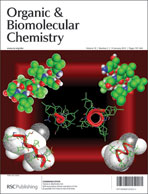
This impressive inside front cover highlights the work of Huaqiang Zeng et al. describing the ability of tetrabutylammonium salts to mediate an efficient mono-/di-demethylation in H-bonded macrocyclic aromatic pentamers, which occur in a chemo- and regionselective fashion.

Folding-promoted TBAX-mediated selective demethylation of methoxybenzene-based macrocyclic aromatic pentamers
Zhiyun Du, Bo Qin , Chang Sun, Ying Liu, Xi Zheng, Kun Zhang, Allan H. Conney and Huaqiang Zeng
Org. Biomol. Chem., 2012, 10, 4164-4171
DOI: 10.1039/C2OB25160D

Take a closer look at both of these articles; they’re free to access for the next 6 weeks!

Digg This
Reddit This
Stumble Now!
Share on Facebook
Bookmark this on Delicious
Share on LinkedIn
Bookmark this on Technorati
Post on Twitter
Google Buzz (aka. Google Reader)

RSC US Roadshow 2012 – Week 4: North East

Organic & Biomolecular Chemistry Editor Richard Kelly will be visiting several North East universities next week as part of the RSC US Roadshows 2012.

Week 4 sees the Royal Society of Chemistry visiting four universities in Pennsylvania and New York:

May 7th – University of Pittsburgh
May 8th – Pennsylvania State University
May 10th – University of Pennsylvania
May 11th – Columbia University

Read more about the US roadshows 2012:

Starting in mid April 2012, RSC Publishing has been touring the United States of America to share more than 170 years experience of publishing in the chemical sciences. Sixteen universities across the country are hosting these one-day events, which are open to all members of the hosting institute.

Attendees have the opportunity to explore RSC’s apps on mobile devices and meet informally with RSC editors. Lunchtime discussion groups explore reading habits and opportunities in the 21st century and an afternoon seminar give an insight into the world of scholarly publishing, with tips on how to get published in high impact journals. A demonstration of ChemSpider, and a guest lecture from an RSC associate editor or board member are available at many of the roadshows.

Follow the RSC Roadshows on Twitter – just look for #RSC2012.

Digg This
Reddit This
Stumble Now!
Share on Facebook
Bookmark this on Delicious
Share on LinkedIn
Bookmark this on Technorati
Post on Twitter
Google Buzz (aka. Google Reader)

Palladium-catalysed aminosulfonylation and the design and synthesis of screening libraries on the cover of issue 20

The covers of this week’s OBC issue are brought to you by Michael C. Willis et al. and Rohan A. Davis et al.

The front cover highlights the work of Michael C. Willis et al. who demonstrate that it is possible to construct C–SO2–N linkages using palladium-catalysed aminosulfonylation processes.

Palladium-catalysed aminosulfonylation of aryl-, alkenyl- and heteroaryl halides: scope of the three-component synthesis of N-aminosulfonamides
Edward J. Emmett, Charlotte S. Richards-Taylor, Bao Nguyen, Alfonso Garcia-Rubia, Barry R. Hayter and Michael C. Willis
DOI: 10.1039/C2OB07034K

The inside front cover shows work from Rohan A. Davis et al. who present the design and synthesis of two screening libraries utilising the muurolane natural product scaffold from the plant E. mitchellii.

Design and synthesis of screening libraries based on the muurolane natural product scaffold
Emma C. Barnes, Vanida Choomuenwai, Katherine T. Andrews, Ronald J. Quinn and Rohan A. Davis
DOI: 10.1039/C2OB00029F

Don’t forget, access to these cover articles is FREE for the next 6 weeks.

Also in this issue is the HOT article ‘Synthetic UDP-galactofuranose analogs reveal critical enzyme–substrate interactions in GlfT2-catalyzed mycobacterial galactan assembly‘ which was highlighted in the C&EN news story ‘Determining Sugar Sequence Fidelity‘.

Find all of issue 20 here

Digg This
Reddit This
Stumble Now!
Share on Facebook
Bookmark this on Delicious
Share on LinkedIn
Bookmark this on Technorati
Post on Twitter
Google Buzz (aka. Google Reader)

Check out our Foldamer Chemistry web themed issue

The Organic & Biomolecular Chemistry web theme issue focussing on the exciting area of foldamer chemistry is now available for you to access, with 21 articles for you to read, 4 of which have so far appeared on the covers of issues.

Here are some of the popular articles that others have been reading:

Regio- and diastereoselective fluorination of alicyclic β-amino acids
Loránd Kiss, Enikő Forró, Santos Fustero and Ferenc Fülöp
Org. Biomol. Chem., 2011, 9, 6528-6534
DOI: 10.1039/C1OB05648D

Conformational stability of collagen triple helices functionalized in the Yaa position by click chemistry
Roman S. Erdmann and Helma Wennemers
Org. Biomol. Chem., 2012, 10, 1982-1986
DOI: 10.1039/C2OB06720J

Stereoselective preparation of β,γ-methano-GABA derivatives
David J. Aitken, Ludovic Drouin, Sarah Goretta, Régis Guillot, Jean Ollivier and Marco Spiga
Org. Biomol. Chem., 2011, 9, 7517-7524
DOI: 10.1039/C1OB06095C

Design and synthesis of trans-3-aminopyran-2-carboxylic acid (APyC) and α/β-peptides with 9/11-helix
Gangavaram V. M. Sharma, Kodeti Srinivas Reddy, Shaik Jeelani Basha, Kondreddi Ravinder Reddy and Akella V. S. Sarma
Org. Biomol. Chem., 2011, 9, 8102-8111
DOI: 10.1039/C1OB06279D

To read the rest of this great web themed issue… CLICK HERE

                             What do you think if this area of chemistry? Do you have a favourite article from the collection?
Let us know your thoughts by leaving a comment below.

Digg This
Reddit This
Stumble Now!
Share on Facebook
Bookmark this on Delicious
Share on LinkedIn
Bookmark this on Technorati
Post on Twitter
Google Buzz (aka. Google Reader)

HOT: Critical enzyme–substrate interactions in GlfT2-catalyzed mycobacterial galactan assembly

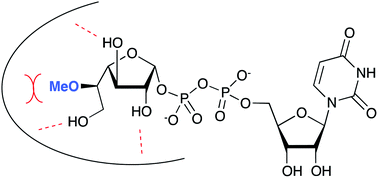
Todd L. Lowary and colleagues at the University of Alberta, Canada, have synthesised a series of UDP-galactofuranose analogs and used these analogs to examine enzyme–substrate binding interactions for the galactofuranosyltransferase enzyme GlfT2, a glycosyltransferase responsible for the formation of the galactan complex in M. tuberculosis and a potential drug target.

Critical hydrogen bonding interactions within the active site of the mycobacterial galactofuranosyltransferase GlfT2 are revealed and it is hoped the knowledge of these specific protein-carbohydrate interactions may be explored for the development of novel inhibitors.

Selected as ‘Hot’, this article will be FREE to access for the next 4 weeks.
Why not read it now and let us know what you think by leaving a comments below!

Synthetic UDP-galactofuranose analogs reveal critical enzyme–substrate interactions in GlfT2-catalyzed mycobacterial galactan assembly
Myles B. Poulin, Ruokun Zhou and Todd L. Lowary
Org. Biomol. Chem., 2012, Advance Article
DOI: 10.1039/C2OB25159K, Paper


Todd L. Lowary’s OBC work is also highlighted in this C&EN news story ‘Determining Sugar Sequence Fidelity’

Digg This
Reddit This
Stumble Now!
Share on Facebook
Bookmark this on Delicious
Share on LinkedIn
Bookmark this on Technorati
Post on Twitter
Google Buzz (aka. Google Reader)

OBC symposium concludes in Beijing

The final day of the OBC symposium saw us arrive at Peking University.

Professor Lei Liu presenting at Peking University

The day opened with PKU head of organic chemistry Professor Zhenfeng Xi welcoming us to the institute, and this was followed by Andrei Yudin’s final presentation and then Professor Guanxin Liang from Nankai University showing a variety of natural product syntheses from his lab. The morning was rounded off by Dirk Trauner.

The first afternoon session showcased the work of Professors from two institutes in Beijing. Professor Lei Liu from Tsinghua University presented on protein synthesis while Professor Sanzhong Luo from the Institute of Chemistry, Chinese Academy of Sciences showed his latest research on asymmetric binary-acid catalysis.

The second afternoon session saw OBC Chair Jeffrey Bode giving another demonstration of his research into amide-forming reactions, and then Professor Zhi-Xiang Yu from Peking University gave an interesting overview of the potential power of computational chemistry in natural products synthesis.

Our visit to Beijing was a great way to finish this first OBC symposium and we’re very grateful to local organiser Professor Jianbo Wang and all of the speakers.

Digg This
Reddit This
Stumble Now!
Share on Facebook
Bookmark this on Delicious
Share on LinkedIn
Bookmark this on Technorati
Post on Twitter
Google Buzz (aka. Google Reader)

OBC Symposium moves to Lanzhou University

Following a successful first day in Shanghai, the OBC Symposium travelled to Lanzhou. On arrival we were greeted by a huge banner opposite the entrance. No one visiting the University would be in any doubt that OBC were in town!

The OBC symposium banner at the entrance to Lanzhou University

The day started with a welcome by Director of the State Key Laboratory of Applied Organic Chemistry at Lanzhou Professor Yongqiang Tu, which was followed by Dirk Trauner’s presentation on natural product synthesis. The morning was rounded-off by Professor Xiaoming Feng from Sichuan University, who guided us through his research on asymmetric catalysis using chiral N,N’-Dioxide ligands.

Professor Andrei Yudin at Lanzhou University

Following lunch Professor Hongbin Zhang from Yunnan University presented the syntheses of some bioactive alkaloids. Professor Tu then returned to the stage to continue the natural products synthesis theme by giving an overview of his work on syntheses which employ 1,2-migration reactions. Andre Yudin gave another overview of his work using amphoteric molecules and the final talk of the day was given by Professor Hanmin Huang from Lanzhou Institute of Chemical Physics, on C-C and C-N bond formation via C-H activation.

All in all it was a very enjoyable visit to Lanzhou. Our thanks go to Professor Tu for hosting us, Professor Wei Wang and his colleagues for local organisation and to all the speakers.

Digg This
Reddit This
Stumble Now!
Share on Facebook
Bookmark this on Delicious
Share on LinkedIn
Bookmark this on Technorati
Post on Twitter
Google Buzz (aka. Google Reader)