HOT article: Inter- and intramolecular reactions of 1-deoxy-1-thio-1,6-anhydrosugars with α-diazoesters: synthesis of the tagetitoxin core by photochemical ylide rearrangement

This paper is HOT as recommended by the referees, and is free to access for 4 weeks.

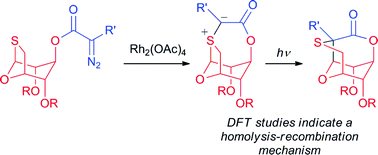
In this HOT paper Michael J. Porter and colleagues at University College London report the synthesis of the core structure of tagetitoxin using a novel photochemical 1,2-Stevens rearrangement. The method presented by Porter et al. uses the carbene-mediated ring expansion of a bicyclic monothioacetal, through the intermediacy of a sulfonium ylide.

To see all the experimental and mechanistic details download the paper today. It will be free to access for 4 weeks!

Inter- and intramolecular reactions of 1-deoxy-1-thio-1,6-anhydrosugars with α-diazoesters: synthesis of the tagetitoxin core by photochemical ylide rearrangement
Anne J. Price Mortimer, Julien R. H. Plet, Oluwafunsho A. Obasanjo, Nikolas Kaltsoyannis and Michael J. Porter
DOI: 10.1039/C2OB26308D

Digg This
Reddit This
Stumble Now!
Share on Facebook
Bookmark this on Delicious
Share on LinkedIn
Bookmark this on Technorati
Post on Twitter
Google Buzz (aka. Google Reader)

Novel 3-C-alkylated-Neu5Ac2en derivatives as probes of influenza virus sialidase 150-loop flexibility

This paper is HOT as recommended by the referees, and is free to access for 4 weeks.

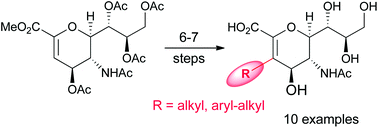
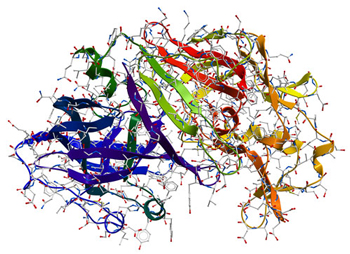
Mark von Itzstein and co-workers have synthesised a series of novel C3 C-alkylated Neu5Ac2en derivatives, which by virtue of the substituent extending from C3 are probes of 150-loop flexibility in influenza virus sialidases.

Currently there is speculation as to what factors determine or affect loop flexibility in influenza A virus sialidases. The compounds described by Mark von Itzstein et al. in this HOT paper provide a way to probe sialidases for this flexibility and should help to elucidate the generality of 150-loop flexibility across all influenza virus sialidases, the factors that affect loop flexibility, and potentially the functional roles this flexibility may play.

This article is free to download for 4 weeks so find out more by reading the paper now.

Synthesis and evaluation of novel 3-C-alkylated-Neu5Ac2en derivatives as probes of influenza virus sialidase 150-loop flexibility
Santosh Rudrawar, Philip S. Kerry, Marie-Anne Rameix-Welti, Andrea Maggioni, Jeffrey C. Dyason, Faith J. Rose, Sylvie van der Werf, Robin J. Thomson, Nadia Naffakh, Rupert J. M. Russell and Mark von Itzstein
DOI: 10.1039/C2OB25627D

Digg This
Reddit This
Stumble Now!
Share on Facebook
Bookmark this on Delicious
Share on LinkedIn
Bookmark this on Technorati
Post on Twitter
Google Buzz (aka. Google Reader)

Synthesis and hybridization properties of modified oligonucleotides – a HOT Communication from Patrick J. Hrdlicka

This Communication is HOT as recommended by the referees, and is free to access for 4 weeks.

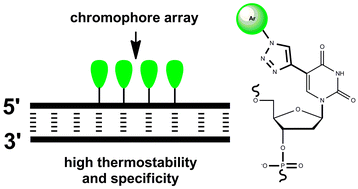
In this HOT Communication Patrick J. Hrdlicka and colleagues at University of Idaho study the hybridization properties of oligonucleotides, which are modified with 5-(1-aryl-1,2,3-triazol-4-yl)-2′-deoxyuridine monomers featuring three differentially sized aromatic moieties at the 1-position of the triazole ring.

These modified oligonucleotides modified with consecutive show a strong thermal affinity and binding specificity toward RNA targets, due to the formation of stabilizing chromophore arrays in the major groove.

This Communication can be downloaded for free for 4 weeks.

This work is also part of the OBC collection on ‘Nucleic acids: new life, new materials‘, so for related articles have a browse through the collection.

Synthesis and hybridization properties of oligonucleotides modified with 5-(1-aryl-1,2,3-triazol-4-yl)-2′-deoxyuridines
Mamta Kaura, Pawan Kumar and Patrick J. Hrdlicka
DOI: 10.1039/C2OB26717A

Digg This
Reddit This
Stumble Now!
Share on Facebook
Bookmark this on Delicious
Share on LinkedIn
Bookmark this on Technorati
Post on Twitter
Google Buzz (aka. Google Reader)

HOT Communication – A cucurbit[8]uril sponge

This Communication is HOT as recommended by the referees, and is free to access for 4 weeks.

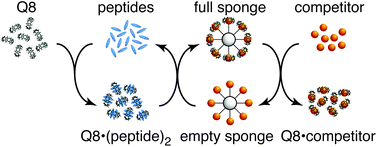
In this HOT Communication Adam R. Urbach and colleagues, Trinity University, present a convenient approach for the quantitative removal of the synthetic host cucurbit[8]uril from aqueous mixtures using a sepharose resin coated in memantine groups to selectively isolate cucurbit[8]uril in the presence of competing hosts and guests. The “cucurbit[8]uril sponge” can separate cucurbit[8]uril from cucurbit[6]uril and reverse the cucurbit[8]uril-mediated dimerization of peptides.

This communication is free to access for the next 4 weeks!

A cucurbit[8]uril sponge
Vijayakumar Ramalingam, Sharon K. Kwee, Lisa M. Ryno and Adam R. Urbach
DOI: 10.1039/C2OB26774H

Digg This
Reddit This
Stumble Now!
Share on Facebook
Bookmark this on Delicious
Share on LinkedIn
Bookmark this on Technorati
Post on Twitter
Google Buzz (aka. Google Reader)

RSC poster prizes awarded at Carbohydrate COST Meeting 2012

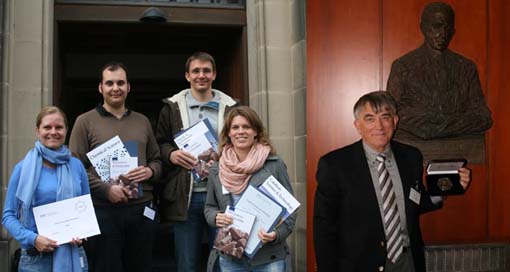
Congratulations to Dirk Heyl (Organic & Biomolecular Chemistry), Richard Blackburn (Chemical Science) and Hilde van Hattum (Catalysis Science & Technology) who were the winners of the RSC poster prizes at the RSC Carbohydrate COST Meeting held at University of Birmingham on September 27th-28th:

Congratulations also go to Myriam Bergmann for winning the Buchanan Memorial Prize for best student talk, and to Professor David Bundle for being awarded the Haworth Medal.

Thank you to Professor Nigel Simpkins & Professor Rob Field for presenting the prizes, and to all those who participated for making this a success.

View more photos of the winners here

Digg This
Reddit This
Stumble Now!
Share on Facebook
Bookmark this on Delicious
Share on LinkedIn
Bookmark this on Technorati
Post on Twitter
Google Buzz (aka. Google Reader)

Taking a look at this week’s issue of Organic & Biomolecular Chemistry

An overview of this week’s issue of Organic & Biomolecular Chemistry

Organic & Biomolecular Chemistry issue 42

On the front cover:

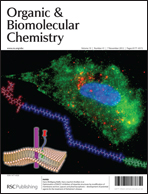
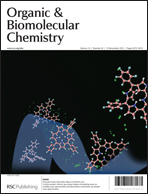
We have this HOT article from Marcos N. Eberlin and colleagues studying corrole isomers using traveling wave ion mobility mass spectrometry and collision induced dissociation experiments. The isomers had subtle structural changes, promoted by exchange of nitrogen and carbon atoms in the corrole ring, and significant differences in the shapes and charge distributions of the protonated molecules were found to lead to contrasting gas phase mobilities.

Corrole isomers: intrinsic gas-phase shapes via traveling wave ion mobility mass spectrometry and dissociation chemistries via tandem mass spectrometry
Maíra Fasciotti, Alexandre F. Gomes, Fabio C. Gozzo, Bernardo A. Iglesias, Gilberto F. de Sá, Romeu J. Daroda, Motoki Toganoh, Hiroyuki Furuta, Koiti Araki and Marcos N. Eberlin
DOI: 10.1039/C2OB26209F
On the inside cover:

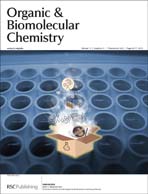
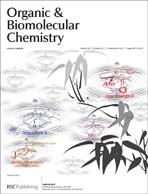
A Perspective by Xuefeng Jiang, Jason S. Chen and colleagues, on the thermodynamic driving force of many synthetic transformations – gas extrusion. The review focuses on gas expulsion in key reactions within natural products total syntheses, selected from the past two decades. Included are transformations that generate sulfur dioxide, carbon dioxide, carbonyl sulfide, or nitrogen through polar, radical, pericyclic, photochemical, or organometallic mechanisms.

Gas extrusion in natural products total synthesis
Xuefeng Jiang, Lei Shi, Hui Liu, Akbar H. Khan and Jason S. Chen
DOI: 10.1039/C2OB26152A

There is also:

Another HOT article on the efficient synthesis of N-(buta-2,3-dienyl) amides from terminal N-propargyl amides and their synthetic potential towards oxazoline derivatives by Shengming Ma et al., 1 Communication and 16 more Papers… read them all in OBC issue 42 – it’s online now.

And don’t forget, the cover articles will be free to access for the next 6 weeks!

Digg This
Reddit This
Stumble Now!
Share on Facebook
Bookmark this on Delicious
Share on LinkedIn
Bookmark this on Technorati
Post on Twitter
Google Buzz (aka. Google Reader)

N-(buta-2,3-dienyl) amide synthesis, combined with palladium catalysis leads to oxazolines

This paper is HOT as recommended by the referees, and is free to access for 4 weeks.

In this OBC HOT article Shengming Ma and co-workers report the efficient synthesis of N-(buta-2,3-dienyl) amides and their application towards the efficient synthesis of oxazolines under palladium catalysis.


Read the article to find out more about the reaction conditions and yields involved in this synthesis…. FREE to access for 4 weeks!


Efficient synthesis of N-(buta-2,3-dienyl) amides from terminal N-propargyl amides and their synthetic potential towards oxazoline derivatives
Bo Chen, Nan Wang, Wu Fan and Shengming Ma
DOI: 10.1039/C2OB26291F

Digg This
Reddit This
Stumble Now!
Share on Facebook
Bookmark this on Delicious
Share on LinkedIn
Bookmark this on Technorati
Post on Twitter
Google Buzz (aka. Google Reader)

Inside Organic & Biomolecular Chemistry issue 41 – online now

An overview of this week’s issue of Organic & Biomolecular Chemistry

OBC issue 41 is now online, and ready for you to browse to your heart’s content. So what have we got for you this week? Well…

On the front cover:
A HOT paper by Hans-Wolfgang Klafki, Hans-Joachim Knölker and co-workers, who describe the synthesis of novel tripartite structures and extensive studies on their structure-activity relations in cell-based assays. They report, in detail, the effect of different lipophilic membrane anchors and spacers on the activity of tripartite structures carrying the prototype peptidic pharmacophore GL189.

Optimisation of BACE1 inhibition of tripartite structures by modification of membrane anchors, spacers and pharmacophores – development of potential agents for the treatment of Alzheimer’s disease
Philipp Linning, Ute Haussmann, Isaak Beyer, Sebastian Weidlich, Heinke Schieb, Jens Wiltfang, Hans-Wolfgang Klafki and Hans-Joachim Knölker

On the inside cover:
In this HOT perspective Helen E. Blackwell and colleagues at University of Wisconsin-Madison provide an overview of the use of chemical probes and techniques in quorum sensing research, highlighting throughout how the diversity of chemical techniques can complement biological approaches and ultimately lead to an improved understanding of bacterial quorum sensing.

Chemical methods to interrogate bacterial quorum sensing pathways
Thanit Praneenararat, Andrew G. Palmer and Helen E. Blackwell

As always both cover articles are free to access for the next 6 weeks.


Also in this issue of OBC is a HOT article that featured in Chemistry World recently:

Triterpenoids functionalized at C-2 as diagenetic transformation products of 2,3-dioxygenated triterpenoids from higher plants in buried wood
Gilles Schnell, Philippe Schaeffer, Estelle Motsch and Pierre Adam

For all this and much more, have a look at OBC issue 41 today.

Digg This
Reddit This
Stumble Now!
Share on Facebook
Bookmark this on Delicious
Share on LinkedIn
Bookmark this on Technorati
Post on Twitter
Google Buzz (aka. Google Reader)

Biocatalysis: an article collection

A collection of high impact articles focusing on biocatalysis, from the RSC’s Catalysis Science & Technology, Green Chemistry, RSC Advances, Organic & Biomolecular Chemistry (OBC) and ChemComm

Beers, wines and cheeses are enjoyed around the world today and have been for millennia. In fact the practices of brewing and cheese-making pre-date recorded history so it is difficult to accurately determine when we first started using naturally occurring enzymes and microorganisms to create valuable (and in this case, tastier!) products.

Biocatalysts are of course used in far more diverse applications than the creation of food-stuffs, including in many organic syntheses and in the generation of fine chemicals. Due to their natural design, they can offer superior selectivity for particular products and have a far lower environmental impact than many traditional catalysts. Our knowledge and understanding of biocatalysts has increased dramatically in the last few decades, which has allowed us to develop biologically modified and biomimetic catalysts for a range of applications.

To keep you up to date with the latest advances in this rapidly expanding field we have collected together these high impact articles and made them free to access until the 31st October!

Click here for the full list of free articles

Digg This
Reddit This
Stumble Now!
Share on Facebook
Bookmark this on Delicious
Share on LinkedIn
Bookmark this on Technorati
Post on Twitter
Google Buzz (aka. Google Reader)

OBC poster prize awarded at ICPOC-21

Congratulations to Michael J. Rawling, from the University of Strathclyde in Glasgow, who won the Organic & Biomolecular Chemistry poster prize at the 21st IUPAC  International Conference on Physical Organic Chemistry (ICPOC21 ) in Durham on 9th-13th September 2012.

His winning poster was entitled ‘Metal-Free Dihydroxylation of Alkenes’, presenting his work carried out in Prof. Nicholas Tomkinson‘s group.

Prof. Ian Williams presents Michael Rawling with his certificate. (Photo taken by Anne Horan)

Michael receives a one-year personal subscription to Organic & Biomolecular Chemistry, and a book of his choice from the RSC books catalogue. Thank you to Ian Williams, Professor of Theoretical Organic Chemistry at the University of Bath, for awarding the prize certificate.

Digg This
Reddit This
Stumble Now!
Share on Facebook
Bookmark this on Delicious
Share on LinkedIn
Bookmark this on Technorati
Post on Twitter
Google Buzz (aka. Google Reader)