Hot article: Highway to Gel

In this NJC letter, Christine Gérardin-Charbonnier and co-workers (Université de Lorraine, Vandoeuvre-Les-Nancy, France) report a supramolecular hydrogel resulting from the mixture of a cationic pseudopeptide (beta-AlaHisC8) and lauric acid in water at pH 8.5. The subsequent thermo-responsive aggregate displays a lamellar structure, which is stabilized by strong intermolecular hydrogen bonds and hydrophobic interactions.

This hydrogel could be a promising candidate for original biocompatible formulations in cosmetics or pharmaceuticals.

“A supramolecular hydrogel based on an original pseudopeptidic catanionic surfactant”

Firmin Obounou Akong,  Andreea Pasc,  Mélanie Emo and Christine Gérardin-Charbonnier

New J. Chem., 2013, Advance Article, DOI: 10.1039/C2NJ40960G.

Interested in reading further? These “Hot articles” will be FREE to access for a period of 4 weeks.

To stay up-to-date with the latest NJC developments, sign up to its table-of-contents email alert.

Digg This
Reddit This
Stumble Now!
Share on Facebook
Bookmark this on Delicious
Share on LinkedIn
Bookmark this on Technorati
Post on Twitter
Google Buzz (aka. Google Reader)

NJC at the first ERC Grantees Conference

Frontier Research in Chemistry was the theme of this first conference gathering winners of ERC grants from the first 5 years of the program. A young researcher from the ENS in Paris working on proteo-liposomes won the NJC Poster Prize.

I attended the first ERC Grantees Conference at the Council of Europe in Strasbourg last month, to hear about the research of recent winners of ERC starting and advanced grants in chemistry. The conference was proposed and organized by two chemists at the Institut Charles Sadron of Strasbourg: Nicolas Giuseppone and Jean-François Lutz.


The first two days began with plenary lectures by Jean-Marie Lehn and Ben Feringa, sponsored by Angewandte Chemie (Wiley) and NJC (RSC), respectively. The presentations by 24 grantees of the 2007–2011 grant period were strongly oriented towards complex systems, both chemical and biological.


European Research Council officials were also on hand to present the grants program and give an update on what to expect in the coming proposal period.


Sightseeing boat in front of the European Parlement.

Conference participants board the sightseeing boat in front of the European Parlement that will take them to the conference dinner.

On Friday evening, a boat ride on the Ill river flowing through the center of Strasbourg took participants to the conference dinner held at the historic Maison Kammerzell, next to the cathedral.


The next morning, the younger participants eagerly awaited the announcement of the four poster prizes, provided by three scientific publishers (Nature, Wiley and the RSC for NJC). Dr Yan-Jun Liu, a postdoctoral fellow in the group of Damien Baigl (Ecole Normale Supérieure, Paris) won the NJC prize. Her poster was entitled “High-yield preparation of proteo-liposomes: a synthetic biology approach”.

Read more »

Digg This
Reddit This
Stumble Now!
Share on Facebook
Bookmark this on Delicious
Share on LinkedIn
Bookmark this on Technorati
Post on Twitter
Google Buzz (aka. Google Reader)

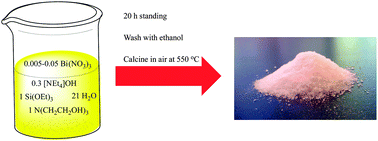
Blue-shift in Bi-impregnated mesoporous silicas

In this NJC Hot Article, Thomas Maschmeyer and his colleagues (University of Sydney and University of New South Wales, Australia) report on the incorporation of bismuth in TUD-1-type mesoporous silicas. These materials were prepared with different Bi loadings and the silicas were fully characterized. The most interesting finding is the unprecedented blue shift observed in the diffuse reflectance that is attributed to different species of Bi.

Interested in reading further?  Why not read by accessing the full article now…

Unprecedented blue-shift in bismuth oxide supported on mesoporous silica by Antony J. Ward, Anne M. Rich, Anthony F. Masters and Thomas Maschmeyer; New J. Chem., 2013, Advance Article, DOI: 10.1039/C2NJ40847C, Paper

This “Hot article” will be free to access for a period of 4 weeks.

Digg This
Reddit This
Stumble Now!
Share on Facebook
Bookmark this on Delicious
Share on LinkedIn
Bookmark this on Technorati
Post on Twitter
Google Buzz (aka. Google Reader)

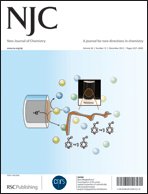
Visit the December issue of NJC

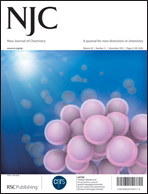
An article by B. Mizaikoff and co-workers (Georgia Institute of Technology, Atlanta, USA & University of Ulm, Ulm, Germany) features on this month’s front cover. In this article, the cathodic electropolymerization conditions for poly(4-vinylpyridine) and the uptake characteristics of anions were evaluated with respect to their application for electrochemical sensing.

Investigation of the anion uptake properties of cathodically electropolymerized poly(4-vinylpyridine) membranes, N. Menegazzo, Ch. Kranz and B. Mizaikoff, New J. Chem., 2012, 36, 2460-2466, DOI: 10.1039/c2nj40156h (Article)

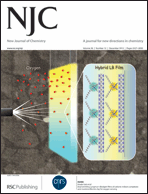
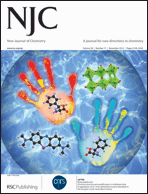
The inside cover was produced by H. Sato and co-workers (Ehime University, Matsuyama & National Institute for Materials Science, Tsukuba, Japan), presenting preparation of Langmuir-Blodgett films by hybridizing a floating monolayer of an amphiphilic cationic iridium(III) complex with clay particles in a subphase.

Dual emitting Langmuir–Blodgett films of cationic iridium complexes and montmorillonite clay for oxygen sensing, K. Morimoto, T. Nakae, K. Ohara, K. Tamura, S.-I. Nagaoka and H. Sato, New J. Chem., 2012, 36, 2467-2471, DOI: 10.1039/c2nj40351j (Article)

You can access and read the whole of issue 12 here.

Digg This
Reddit This
Stumble Now!
Share on Facebook
Bookmark this on Delicious
Share on LinkedIn
Bookmark this on Technorati
Post on Twitter
Google Buzz (aka. Google Reader)

Hot Article: One-pot pyrolytic synthesis of C-N codoped titania

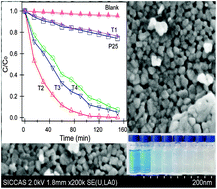
In this NJC paper, Liang Li (School of Materials Science and Engineering, East China University of Science and Technology, Shanghai, China) and Jianlin Shi (Shanghai Institute of Ceramics, Chinese Academy of Sciences, Shanghai, China) et al. report a simple but efficient, controlled thermal decomposition approach to fabricate polycrystalline mesoporous C-N-codoped anatase TiO2.

The prepared material possesses a high surface area and extraordinary high photocatalytic degradation properties under visible irradiation.

One-pot pyrolytic synthesis of C–N-codoped mesoporous anatase TiO2 and its highly efficient photo-degradation properties by Liang Li, Jingjing Shi, Gengnan Li, Yinyin Yuan, Yongsheng Li, Wenru Zhao and Jianlin Shi New J. Chem., 2012, Advance Article DOI: 10.1039/C2NJ40901A

Interested in reading further? Why not download the full article now, FREE to access for a period of 4 weeks!

Digg This
Reddit This
Stumble Now!
Share on Facebook
Bookmark this on Delicious
Share on LinkedIn
Bookmark this on Technorati
Post on Twitter
Google Buzz (aka. Google Reader)

Hot wheels: strapped porphyrin-based rotaxanes

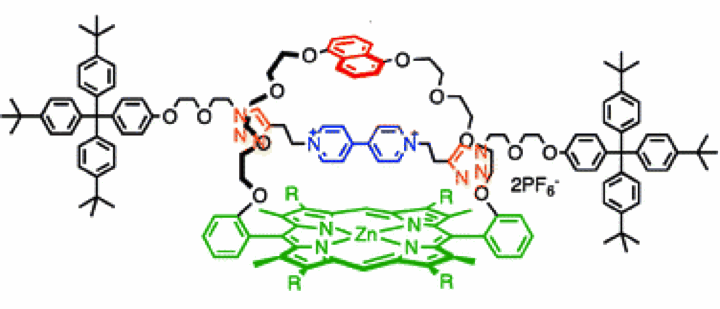
Mechanically interlocked architectures such as rotaxanes and catenanes are prime candidates for the construction of molecular machines and the fabrication of molecular electronic devices. 

In this NJC paper, Kathleen Mullen and co-workers (Queensland University of Technology, Brisbane, Australia) report a “click” methodology towards bipyridinium porphyrin [2]rotaxanes. An X-ray study of the strapped zinc metalloporphyrin revealed that the wheel adopts a 1-dimensional coordination polymer arrangement in the solid state, in which an oxygen atom in the strap of one macrocycle is coordinated to the zinc metal center in an adjacent porphyrin ring. 

Future work will investigate the photo- and electro-chemical properties of these interlocked architectures.

“New approaches to the synthesis of strapped porphyrin containing bipyridinium [2]rotaxanes”
Victoria Raymont, Hannah Wilson, Michael Pfrunder, John C. McMurtrie and Kathleen M. Mullen
New J. Chem., 2013, Advance Article, DOI:10.1039/c2nj40762k.

Interested in reading further?  Why not read by accessing the full article now!  These “Hot articles” will be FREE to access for a period of 4 weeks. 

To stay up-to-date with the latest NJC developments, sign up to its table-of-contents email alert

Digg This
Reddit This
Stumble Now!
Share on Facebook
Bookmark this on Delicious
Share on LinkedIn
Bookmark this on Technorati
Post on Twitter
Google Buzz (aka. Google Reader)

NJC Hot Articles: our latest selection


Check out NJC’s latest Hot Articles now available as Advance Articles on the web:

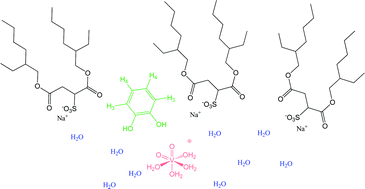
Stabilization of a vanadium(V)–catechol complex by compartmentalization and reduced solvation inside reverse micelles by Debbie C. Crans and Michael D. Johnson, New J. Chem., 2013, Advance Article, DOI: 10.1039/C2NJ40524E, Paper

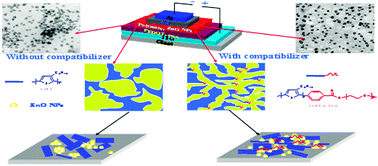
Controlling morphology and improving the photovoltaic performances of P3HT/ZnO hybrid solar cells via P3HT-b-PEO as an interfacial compatibilizer by Yueqin Shi, Fan Li and Yiwang Chen, New J. Chem., 2012, Advance Article, DOI: 10.1039/C2NJ40779E, Paper


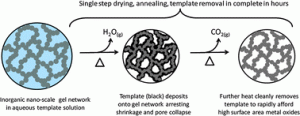
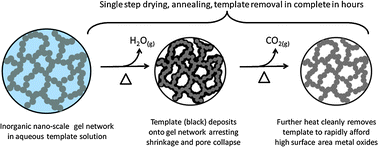
Rapid preparation of high surface area iron oxide and alumina nanoclusters through a soft templating approach of sol–gel precursors by Louisa J. Hope-Weeks, New J. Chem., 2012, Advance Article, DOI: 10.1039/C2NJ40781G, Paper

Interested in reading further?  Why not read by accessing the full article now!  These “Hot articles” will be free to access for a period of 4 weeks.

If you have some of your own exciting, high impact research to publish and are considering submitting your manuscript to NJC, then why not submit to us today or alternatively email us your suggestions.


Digg This
Reddit This
Stumble Now!
Share on Facebook
Bookmark this on Delicious
Share on LinkedIn
Bookmark this on Technorati
Post on Twitter
Google Buzz (aka. Google Reader)

Meet Our Authors – November 2012

This month again, we are delighted to introduce you to authors from NJC’s latest issue. Many thanks to them for sharing with us.

Our first author is Dr Kenta Adachi, who is Assistant Professor in the Department of Environmental Science & Engineering at Yamaguchi University, Japan. His current research interests focus on the optical and spectroscopic properties of organic/inorganic hybrid nanoparticles and clusters, along with the design, assembly, and use of nanoparticle-tagged biomolecules as analytical tools for sensing, imaging, and diagnosis. In his NJC letter, an approach is presented for the first time to induce chirality in aggregates of achiral organic dyes by chiral amino acid molecules pre-adsorbed on the metal oxide colloid surface. The authors believe that these findings, together with the possibility of fine-tuning both amino acids and organic dyes on the metal oxide colloid surface, open new promising ways towards the design of efficient chiral supramolecular sensors and devices.

“NJC covers various areas of chemistry, and is a high quality multidisciplinary journal for all chemists. This study is focused on the interfacial phenomena of organic/inorganic hybrid materials, that is, is of broad interest to all organic, inorganic, and physical chemists”, commented Dr Adachi on choosing the NJC journal.

Besides his research activity, Kenta greatly enjoys travelling around the world with his wife, especially visiting world heritage sites. Together, they have already been to Machu Picchu, Nazca Lines (Peru), Chichen Itza, Calakmul, Palenque (Mexico), Hawaii Volcanoes, Statue of Liberty (USA), Uluru (Australia), Giza Pyramids (Egypt), Angkor (Cambodia), Sigiriya (Sri Lanka), Changdeokgung (South Korea), Suzhou (China), Himeji Castle (Japan), and Sri Lanka.  His most favorite world heritage site is Machu Picchu (see photo), and he is now planning to go to Indonesia to visit Borobudur Temple.

When asked for an alternative career path, Kenta replied: “In my childhood, I really wanted to become archaeologist. I’m still hanging in there. My dream will definitely come true if I don’t give up”.
“Chirality induction and amplification in methylene blue H-aggregates via D- and L-phenylalanine pre-adsorbed on the tungsten oxide nanocolloid surface” Kenta Adachi, Shohei Tanaka, Suzuko Yamazaki, Hideaki Takechi, Satoshi Tsukahara and Hitoshi Watarai, New J. Chem.2012, 36, 2167-2170. DOI: 10.1039/C2NJ40415J.

Dr Cyrille Monnereau is Assistant Professor at the Ecole Normale Supérieure de Lyon (France). Dr Monnereau is interested in molecular engineering of chromophores and fluorophores, especially for biophotonics applications. In recent years, the authors have been trying to develop two-photon absorbing chromophores for fluorescence bio-imaging and photodynamic therapy, which could be easily and efficiently delivered into cells or target organs. The simple and adaptable ATRP methodology used in their NJC paper allowed the authors to progress significantly towards this aim, with minimal synthetic effort.

The ambitious and open-minded editorial line of NJC that promotes interdisciplinary and innovative works from all disciplines across chemistry, made NJC a logical choice in the authors’ eyes. In addition, they appreciate “The RSC not-for-profit motto, which ensures that science is the only criterion for papers’ acceptance or rejection”.

Outside of the lab, Cyrille’s favorite activity is listening to music and desperately trying to introduce his 4 and 2 years old kids to more or less obscure and experimental rock and jazz acts from the past 50 years. If he could not be a scientist, Cyrille would be a professional musician, although he admitted: “I have honestly never seriously thought about it”.

“Water-soluble chromophores with star-shaped oligomeric arms: synthesis, spectroscopic studies and first results in bio-imaging and cell death induction” Cyrille Monnereau, Sophie Marotte, Pierre-Henri Lanoë, Olivier Maury, Patrice L. Baldeck, David Kreher, Arnaud Favier, Marie-Thérèse Charreyre, Jacqueline Marvel, Yann Leverrier and Chantal Andraud, New J. Chem., 2012, 36, 2328-2333. DOI: 10.1039/C2NJ40407A.

Our last chemist for this month is Dr Marina Lezhnina, who is Research Fellow in the Institute for Optical Technologies at Münster University of Applied Sciences, Germany. Her research activity focuses on the synthesis of luminescent species in non-classical matrices, with applications in lighting technologies and analytics. Her NJC paper contributes to the search for efficient luminescing rare earth complexes with versatile potential for linkage to secondary substrates. The authors demonstrated that tris-ß-diketonate-Europium complexes could readily be co-ligated with epoxyphenanthroline, yet widely retaining the advantageous optical properties of higly efficient phenanthroline or bipyridyl analogues, while the epoxy group provides a fascinating prospect for coupling to polymer backbones, activated surfaces, and last but not least to biologically relevant substrates like proteins and peptides (see the glutathione model in the present publication).

Dr Lezhnina’s opinion of NJC is that:”The journal has published numerous articles on novel compounds with intriguing luminescent properties in the past. While claiming “a new direction in chemistry” based on our complexes would sound overstated, we yet believe that our work has some noteworthy implications, which may be acknowledged by the readership of the journal”.

In the non-lab world, Marina is fascinated by the true naturalness of Nature. At home, she likes to relax with Delta blues, to take an interest in social criticism and politics, and to see through crime stories. When asked for an alternative career path, Marina answered: “I would be getting on other people’s nerves with never-ending and obtrusive questioning”.

“Luminescence of a novel Eu(diketonato)–epoxiphenanthroline complex and covalent coupling to peptides via the epoxigroup” Marina M. Lezhnina, Diana Hofmann, Beatrix Santiago-Schübel, Peter Klauth and Ulrich H. Kynast, New J. Chem.2012, 36, 2322-2327. DOI: 10.1039/C2NJ40505A.

Check back next month for more profiles of NJC authors!

Digg This
Reddit This
Stumble Now!
Share on Facebook
Bookmark this on Delicious
Share on LinkedIn
Bookmark this on Technorati
Post on Twitter
Google Buzz (aka. Google Reader)

NJC Issue 11 now online

NJC is delighted to present this month’s issue. Whether you are a materials scientist, biologist, physicist or medicinal chemist, you are guaranteed to find articles of relevance to your specialist interests.

The outside front cover highlights our latest article by Yukikazu Takeoka and co-workers. In their Letter article, the authors describe the preparation of an amorphous array composed of thermo-responsive fine core–shell particles in which the core is a monodisperse silica particle and the shell is a high-density polymer brush of uniform thickness made from thermally responsive poly(N-isopropylacrylamide) (PNIPA).  After observing the optical behaviours of the amorphous array, it was found that the position and the strength of the angle-independent PBG from the array can reversibly change depending on the environmental temperature. This system has promising application in light switching, sensors, and displays.

An amorphous array of poly(N-isopropylacrylamide) brush-coated silica particles for thermally tunable angle-independent photonic band gap materials by Yoshie Gotoh, Hiromasa Suzuki, Naomi Kumano, Takahiro Seki, Kiyofumi Katagiri and Yukikazu Takeoka, New J. Chem., 2012,36, 2171-2175, DOI: 10.1039/C2NJ40368D

The inside front cover was produced by Kenta Adachi and co-workers, and highlights a new approach to induce chirality in H-aggregates of achiral methylene blue (MB) dyes by chiral phenylalanine (Phe) molecules. The results demonstrate a chirality transfer and amplification from only the pre-adsorbed Phe molecules to MB aggregates formed on the WO3 colloid surface via non-covalent interactions. These findnings open new promising ways towards the design of efficient chiral supramolecular sensors and devices.

Chirality induction and amplification in methylene blue H-aggregates viaD– and L-phenylalanine pre-adsorbed on the tungsten oxide nanocolloid surface by Kenta Adachi, Shohei Tanaka, Suzuko Yamazaki, Hideaki Takechi, Satoshi Tsukahara and Hitoshi Watarai, New J. Chem., 2012, 36, 2167-2170, DOI: 10.1039/C2NJ40415J

You can access and read the whole issue 11 of NJC here.

We hope you enjoy this issue!

If you fancy submitting an article to New Journal of Chemistry, then why not submit to us today or alternatively email us your suggestions.

To be alerted to each new issue of the NJC journal, sign-up for FREE Contents list email alert.

Digg This
Reddit This
Stumble Now!
Share on Facebook
Bookmark this on Delicious
Share on LinkedIn
Bookmark this on Technorati
Post on Twitter
Google Buzz (aka. Google Reader)

NJC Poster Prize awarded at Chirality conference

A post-doctoral fellow in the Moltech lab (University of Angers, France) has won the NJC Poster Prize at JACC 2012.


Dr Flavia Pop (University Angers)

Dr Flavia Pop

At the recent Journées André Collet de la Chiralité conference, the jury selected Dr Flavia Pop for her poster entitled “Hierarchical Self-Assembly of Chiral C3-Symmetrical Tetrathiafulvalenes”. Flavia, who is now a teaching/research assistant at the University of Angers, carried out this work in the group of Narcis Avarvari in the Moltech Laboratory, in collaboration with the group of David Amabilino in Barcelona and with the contribution of Mathieu Linares at the Royal Institute of Technology in Stockholm.

Her winning poster presents compounds of C3 symmetry based on electroactive TTF grafted onto a 1,3,5-tris(amido-2,2’-bipyridine-amido)benzene core. Stereogenic centres attached to the TTF units provide self-assembled homochiral architectures (see Figure 1), like helical aggregates of preferential helicity twist. Different chiral alkyl branches were used (isopentyl, citronellyl and dihydrocitronellyl), leading to the formation of fibres or croissants whose helicity was connected with the nature of the alkyl chain, its stereochemistry and the employed conditions.


Self assembly of a TTF-grafted C3 core

Figure 1. Self assembly of a TTF-grafted C3 core

Flavia obtained her Ph.D. degree in 2009 from the Universities of Babes-Bolyai, Cluj-Napoca (Romania) and Angers (France) under the joint supervision of Prof. Ion Grosu and Dr. Jean Roncali. She has continued her research since then at the University of Angers in the field of molecular materials based on electroactive  tetrathiafulvalene as the donor in radical cation salts, covalent donor-acceptor systems and chiral disk-shape molecules.

Congratulations to Flavia for her NJC Poster Prize from the NJC team!


Digg This
Reddit This
Stumble Now!
Share on Facebook
Bookmark this on Delicious
Share on LinkedIn
Bookmark this on Technorati
Post on Twitter
Google Buzz (aka. Google Reader)