Author Archive

NIR-triggered multifunctional CuS-embedded nanogels for advanced chronic wounds therapy

Chronic wounds are considered a major healthcare problem all over the world. Long-term infections and/or suppressed immune responses may cause chronic wounds with slower healing, resulting in increased mortality. Although antibiotics, skin disinfectants, and hydrogels are currently being used to combat microbial pathogenesis, they still have some significant limitations when used in clinical wound healing. Therefore, researchers have been exploring alternative approaches, such as combining antimicrobial, antioxidant, and anti-inflammatory agents for advanced chronic wound therapy.

Recently, nanomaterial-based antimicrobials have gained popularity thanks to catalytic and near-infrared (NIR) irradiation treatments, which induce controlled oxidative stress (photodynamic and catalytic therapies) and hyperthermia (photothermal therapies) to eradicate bacteria. However, little research into nanomaterial-based antimicrobial activity against biofilms and chronic wound healing in vivo has previously been reported.
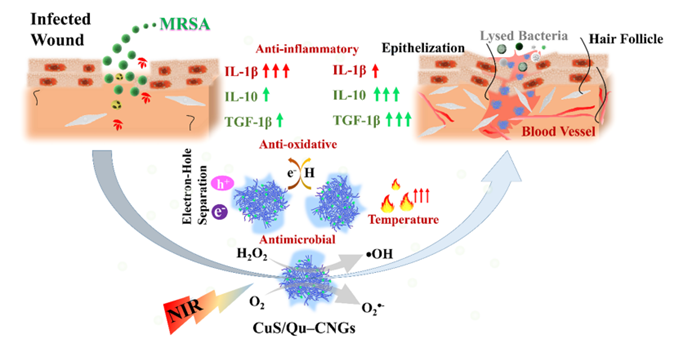
Fig. 1 An overview of the properties of CuS/Qu–CNGs and their role in wound healing. Reproduced from DOI: 10.1039/D3NH00275F with permission from the Royal Society of Chemistry.

In this regard, an NIR-triggered multifunctional quercetin carbonized nanogel embedded with copper sulfide nanoclusters (CuS/Qu-CNG) was reported by Nain et al. for advanced therapy of chronic wounds. Polymerization and mild carbonation procedures were used to prepare quercetin carbonized nanogels (Qu-CNGs), which were subsequently used as templates to grow CuS in situ forming CuS/Qu-CNGs. The resulting CuS/Qu–CNGs are photoreactive and contain antioxidant and catalytic properties (oxidase- and peroxidase-like activities). As a result of their photo-responsive properties, CuS/Qu-CNGs significantly amplified their antimicrobial activity when exposed to NIR-II light. A CuS/Qu–CNGs MIC90 value of 6–9 mg mL-1 is ~125-fold lower than Qu or Qu–CNGs under NIR-II irradiation and was further improved by ~30-fold (ca. 0.2 mg mL-1) in the presence of H2O2. Besides, CuS/Qu-CNGs demonstrated exceptional penetration ability, eliminating MRSA biofilms caused by diabetic wounds in diabetic mice. By suppressing pro-inflammatory cytokines (IL-1β) and boosting anti-inflammatory cytokines (IL-10 and TGF-β1), CuS/Qu-CNGs significantly accelerated wound healing by promoting angiogenesis, epithelialization and collagen synthesis. Finally, CuS/Qu–CNGs showed superior in vivo efficacy in treating bacterial infections and enhancing wound healing in diabetic mice.

In summary, a “Three in One” multifunctional CuS/Qu-CNGs with excellent antimicrobial/antioxidative/anti-inflammatory properties demonstrate great potential in treating bacterial infections and promoting chronic wound healing. This work is expected to provide new solutions for wound treatment complicated by microbial pathogenesis.


To find out more, please read:

NIR-activated quercetin-based nanogels embedded with CuS nanoclusters for the treatment of drug-resistant biofilms and accelerated chronic wound healing
Amit Nain, Yu-Ting Tseng, Akash Gupta, Yu-Feng Lin, Sangili Arumugam, Yu-Fen Huang, Chih-Ching Huang and Huan-Tsung Chang
Nanoscale Horiz., 2023, 8, 1652-1664


About the blogger



Jiangjiexing Wu is an Associate Professor at Tianjin University and a member of the Nanoscale Horizons Community Board. Dr Wu’s research focuses on the rational design and synthesis of functional nanomaterials (such as nanozymes) for analytical, biomedical, and environmental applications.

Digg This
Reddit This
Stumble Now!
Share on Facebook
Bookmark this on Delicious
Share on LinkedIn
Bookmark this on Technorati
Post on Twitter
Google Buzz (aka. Google Reader)

Defect engineering enhances CO2 reducing photocatalysts

Recycling CO2 molecules through photocatalysis represents an innovative technology to mitigate the emission of CO2 gas. The deliberate introduction of defects into a photocatalyst plays a crucial role in optimizing photocatalytic performance, since the defects regulate the electronic structure, fine-tune selectivity by enhancing catalytic activity, and reduce the activation barrier of the catalyst.

A team of researchers based in Australia have recently developed a photocatalytic system for CO production by CO2 reduction. In this study, defect-rich g-C3N4 serves as a semiconducting substrate, and it was further loaded with Ag nanoparticles (NPs) to act as a plasmonic source, resulting in the creation of the g-C3N4-Ag photocatalyst. The defects within the g-C3N4 were known as the active sites that enhance the efficiency of photocatalytic CO2 conversion. In addition, these defects are strategically positioned alongside the loaded Ag NPs, which improves the effectiveness of injected hot electrons from the Ag NPs, thereby synergistically enhancing the activity of photocatalytic CO2 reduction.

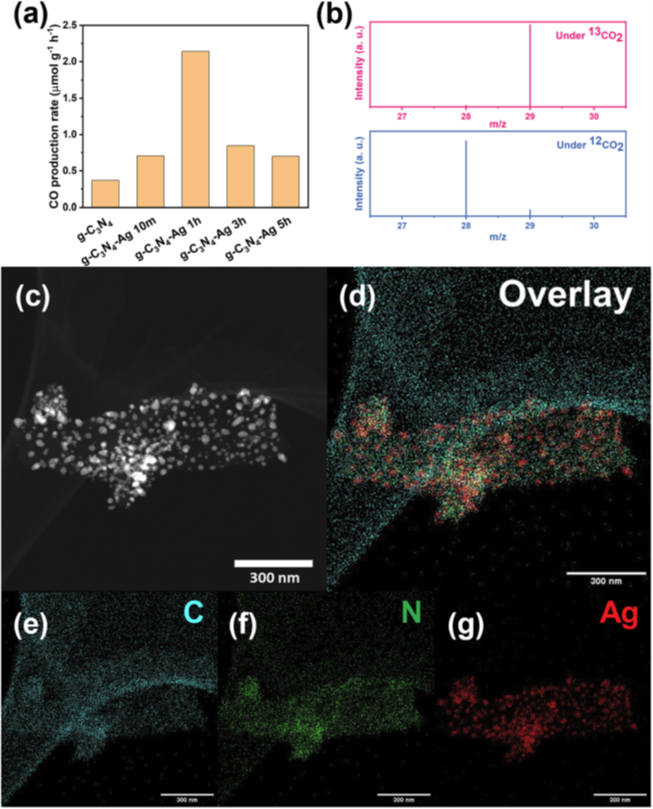
In the experiments involving defect-rich g-C3N4, different photodeposition times, including 10 minutes, 1 hour, 3 hours, and 5 hours, were performed to load Ag particles, denoted the as-preared photocatalyst as g-C3N4-Ag 10m, 1h, 3h, and 5h, respectively. These variants were evaluated for their photocatalytic performance in CO production via CO2 reduction (Fig. 1a). The optimal performance was achieved with g-C3N4-Ag 1h, and the production of CO was confirmed through isotopic experiments (Fig. 1b). The g-C3N4-Ag photocatalysts were characterized using scanning transmission electron microscopy, as typical image is presented in Fig. 1c and the corresponding elemental mapping were presented in Fig. 1d to 1g.

Fig 1. (a) CO production rate based on various g-C3N4 based photocatalysts. (b) Isotope labelling experiments tested under 13CO2 and 12CO2, and the mass spectrometry signals at m/z = 28 and m/z = 29 are 13CO and 12CO, respectively. (c) STEM dark field image and (d)–(g) elemental mapping of g-C3N4-Ag 1h catalyst. Scale bar: 300 nm. Reproduced from DOI: 10.1039/D3NH00348E with permission from the Royal Society of Chemistry.

To elucidate the mechanism behind the defect engineering scenario, Ag NPs were initially loaded onto g-C3N4 via photodeposition. Due to the electron-rich environment of the point defects on g-C3N4, Ag+ ions selectively grow on these defect sites. The resulting g-C3N4-Ag composite was subsequently annealed. During this process, the new defects formed on the g-C3N4 substrate owing to the strain induced by the differing thermal expansion rates between the Ag and g-C3N4. These new defects were found to be located around the Ag NPs, representing a significant change in the pristine g-C3N4 following the introduction of Ag.

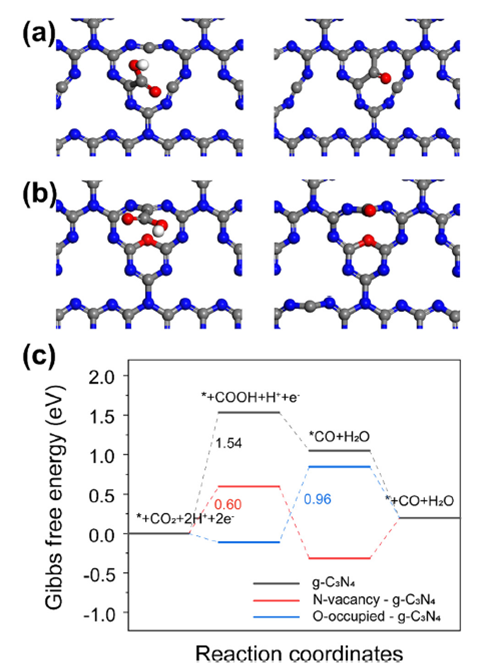
Furthermore, density functional theory (DFT) calculations were conducted to gain a deeper understanding of how the defects in g-C3N4 improve performance. Three models of photocatalysts were considered, including pristine g-C3N4, g-C3N4 with N vacancies, and N vacancies in g-C3N4 with O sites on the surface. In the models of pristine g-C3N4 and g-C3N4 with N vacancies, the formation of *COOH intermediates was identified as the rate-limiting step (RDS), and moreover, N vacancies in g-C3N4 were found to enhance the activity in this conversion (Fig 2a). For N vacancies in g-C3N4 with additional surface O sites (Fig. 2b), the initial reaction step favored the formation of *COOH intermediates from a thermodynamic perspective. Subsequently, the reduction of *COOH intermediates to *CO species occurred by reacting with protons, releasing H2O molecules. In the case of O-enriched g-C3N4, this conversion became the RDS. DFT calculations indicated that the ΔG values for *COOH and *H to form *CO and H2O at the C defect active sites were 0.96 eV, which determined the reaction rate (Fig. 2c). These results provide insight into the reasons behind the improved performance in CO production through CO2 reduction.

Fig 2. Optimized configurations of reaction intermediates *COOH and *CO on the C atom and N vacancy active sites of (a) g-C3N4 with N vacancy and (b) N vacancies in g-C3N4 with O sites on the surface. (Red ball is oxygen atom, white ball is hydrogen atom, gray is carbon atom, and blue is nitrogen atom) (c) Gibbs free energy diagrams for photocatalytic CO2 reduction to CO on g-C3N4, g-C3N4 with N vacancy and O-occupied g-C3N4. Reproduced from DOI: 10.1039/D3NH00348E with permission from the Royal Society of Chemistry.

In summary, the deliberate introduction of active defects into g-C3N4 photocatalysts, strategically positioned near the plasmon centers of Ag NPs, optimizes the utilization efficiency of plasmonic hot electrons, resulting in an enhanced efficiency for CO2 photoreduction. Importantly, this strategy has the potential for extension to various systems based on polymers, hard materials, and hybrid materials, offering promising applications that harness the functionalities of defects in a wide range of fields.


To find out more, please read the full article:

Defect engineering enhances plasmonic-hot electrons exploitation for CO2 reduction over polymeric catalysts
Hang Yin, Zhehao Sun, Kaili Liu, Ary Anggara Wibowo, Julien Langley, Chao Zhang, Sandra E. Saji, Felipe Kremer, Dmitri Golberg, Hieu T. Nguyen, Nicholas Cox and Zongyou Yin
Nanoscale Horiz., 2023, Advance Article


About the blogger


Photo of Yuanxing Fang.


Yuanxing Fang is a Professor at Fuzhou University, and a member of the Nanoscale Horizons Community Board. Prof. Fang’s research lab focuses on the synthesis of metal-free semiconductors for photoelectrochemical systems for energy and environmental applications, including water splitting, hydrogen peroxide synthesis, organic transformations and others.

Digg This
Reddit This
Stumble Now!
Share on Facebook
Bookmark this on Delicious
Share on LinkedIn
Bookmark this on Technorati
Post on Twitter
Google Buzz (aka. Google Reader)